Items Similar to Antique early 20th Chinese Exceptional Solid Silver Teapot, Wu Hua物華, Tianjin
Video Loading
Want more images or videos?
Request additional images or videos from the seller
1 of 9
Antique early 20th Chinese Exceptional Solid Silver Teapot, Wu Hua物華, Tianjin
$22,000
£16,714.57
€19,208.55
CA$30,901.70
A$33,635.72
CHF 17,822.36
MX$404,520.43
NOK 226,606.82
SEK 207,660.07
DKK 143,486.70
About the Item
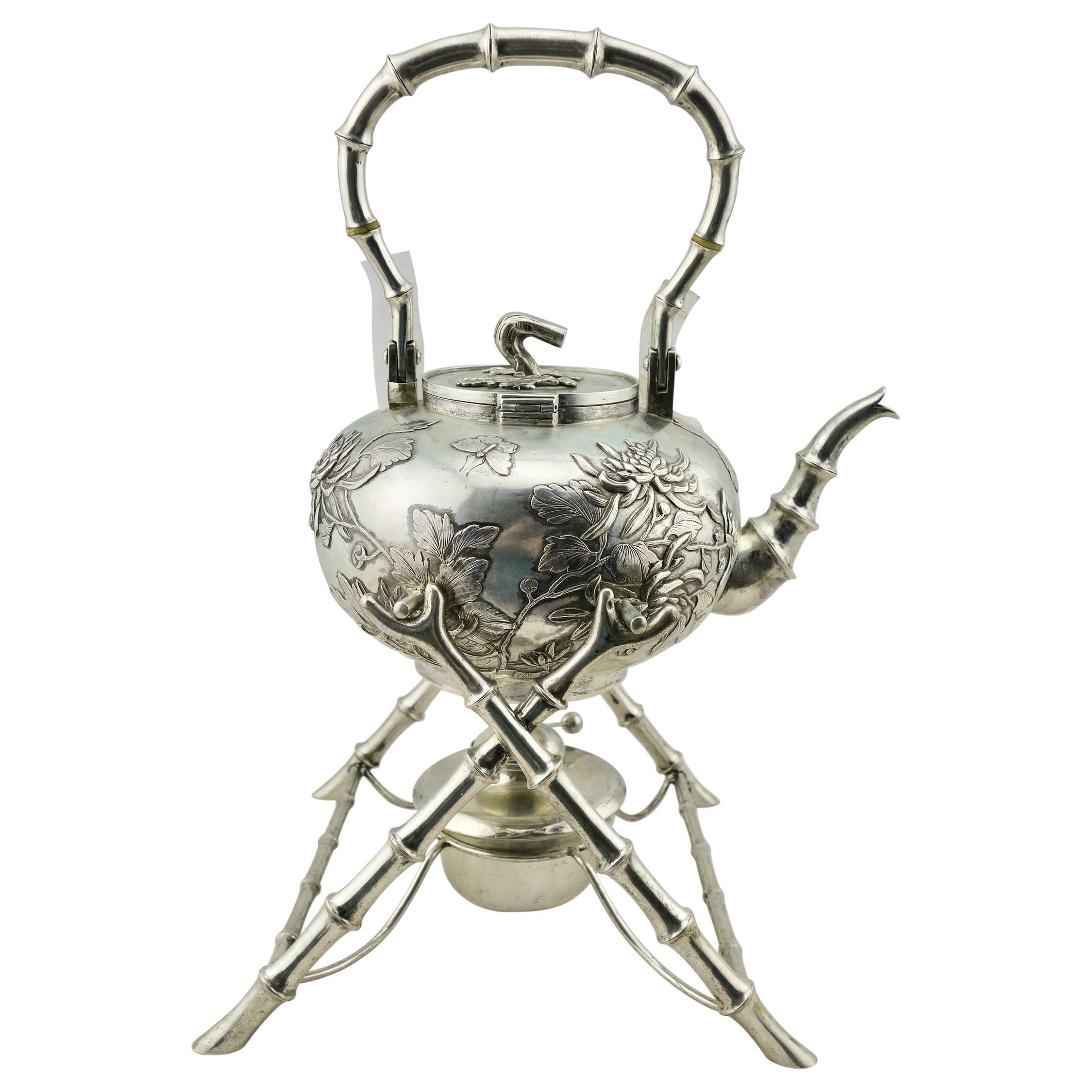
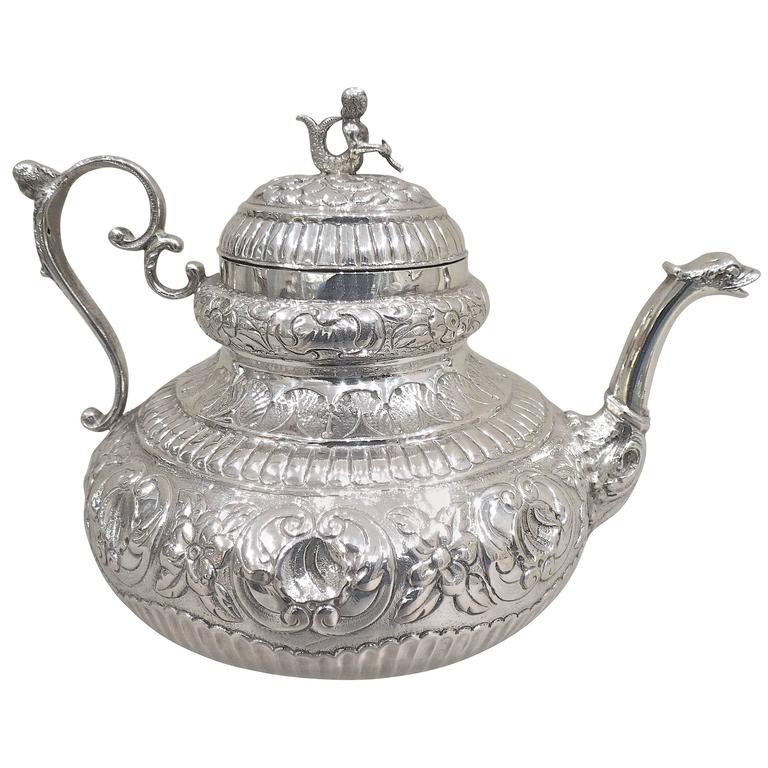
Antique early 20th Century exceptionally rare Chinese solid silver teapot, of traditional round form, the body finely engraved in traditional Chinese style, suggesting this teapot was made for the Chinese market. The body engraved with bamboo and butterflies , the unusual handle imitating bamboo, the removable lid set with a peach finial (Peaches are the symbol of longevity). According to Daoist lore, the peaches of immortality grew in the garden of the Queen Mother of the West - Xi Wangmu.
the spout with a hedged cover in the shape of a lingzhi mushroom and a FU symbol of good furtune.
the top frieze is decorated with 8 Chinese symbols: a scroll, a Ruyi scepter, a qin, The Endless Knot, a pendant, an old book, a wrist rest, and two overlapping squares.
The teapot is very unusual, fine and exceptionally crisp. it is made of heavy Gauge silver and the attention to detail and design is simply outstanding.
"WU HUA 物華 TIANJIN 天津 opened shortly after 1901 [after the Boxer rebellion],
The artisan marks are SHEN 慎 and XIE 爕,b both closely connected with other known Wu Hua items. If an artisan was considered important enough to have a mark, they were already a “master” with of silver-making or a speciality technique connected with silver-making
The over-ridding allegorical message conveyed by the decorative motifs collectively is “longevity”; the ruyi 如意 and meander borders convey this, as does the bamboo foliate
butterfly motif [the butterfly hudie 蝴蝶 is a symbol of long life]- the very name “ruyi” also means “as you wish”
Bamboo zhu 竹 is a complex decorative motif. Firstly, it symbolises the ideals of a Confucian scholar, since both are perceived as being upright, strong and resilient as well as being gentle, graceful and refined. The name zhu 竹 is homophonous with the word zhu 祝, which means “to congratulate.
The top border of the “eight precious things” babao 八宝 are collectively considered symbols of good fortune. Red ribbons makes each a charm. There is a difference between the Taoist and Buddhist interpretations and degree of importance of these symbols:
The sequential order for Chinese Buddhism was defined in the Qing Dynasty as:
Wheel of Dharma
Conch shell
Victory Banner
Parasol
Lotus flower
Treasure Vase
Golden Fish pair
Endless knot
Wu Hua silver had a definitive style and is always of a very high standard, Invariably conservatively traditional Chinese as much as the bounds of doing so Within a contrived Western form allows.
From a silversmith who understood Western classical design so well, it is obvious There was an equally high degree of understanding of Chinese classicism.
This teapot is an excellent edition to any important collection of Chinese antiques and Chinese silver.
- Dimensions:Height: 4.73 in (12 cm)Width: 4.34 in (11 cm)Depth: 6.7 in (17 cm)
- Style:Chinese Export (Of the Period)
- Materials and Techniques:
- Place of Origin:
- Period:
- Date of Manufacture:1901
- Condition:Wear consistent with age and use. Some minor scratches and small minimal dents, this item was used and was never restored in any way, great condition for age, best quality and no missing parts.
- Seller Location:Tel Aviv - Jaffa, IL
- Reference Number:1stDibs: LU8130232628262
About the Seller
No Reviews Yet
Vetted Professional Seller
Every seller passes strict standards for authenticity and reliability
1stDibs seller since 2023
- ShippingRetrieving quote...Shipping from: Tel Aviv - Jaffa, Israel
- Return Policy
More From This Seller
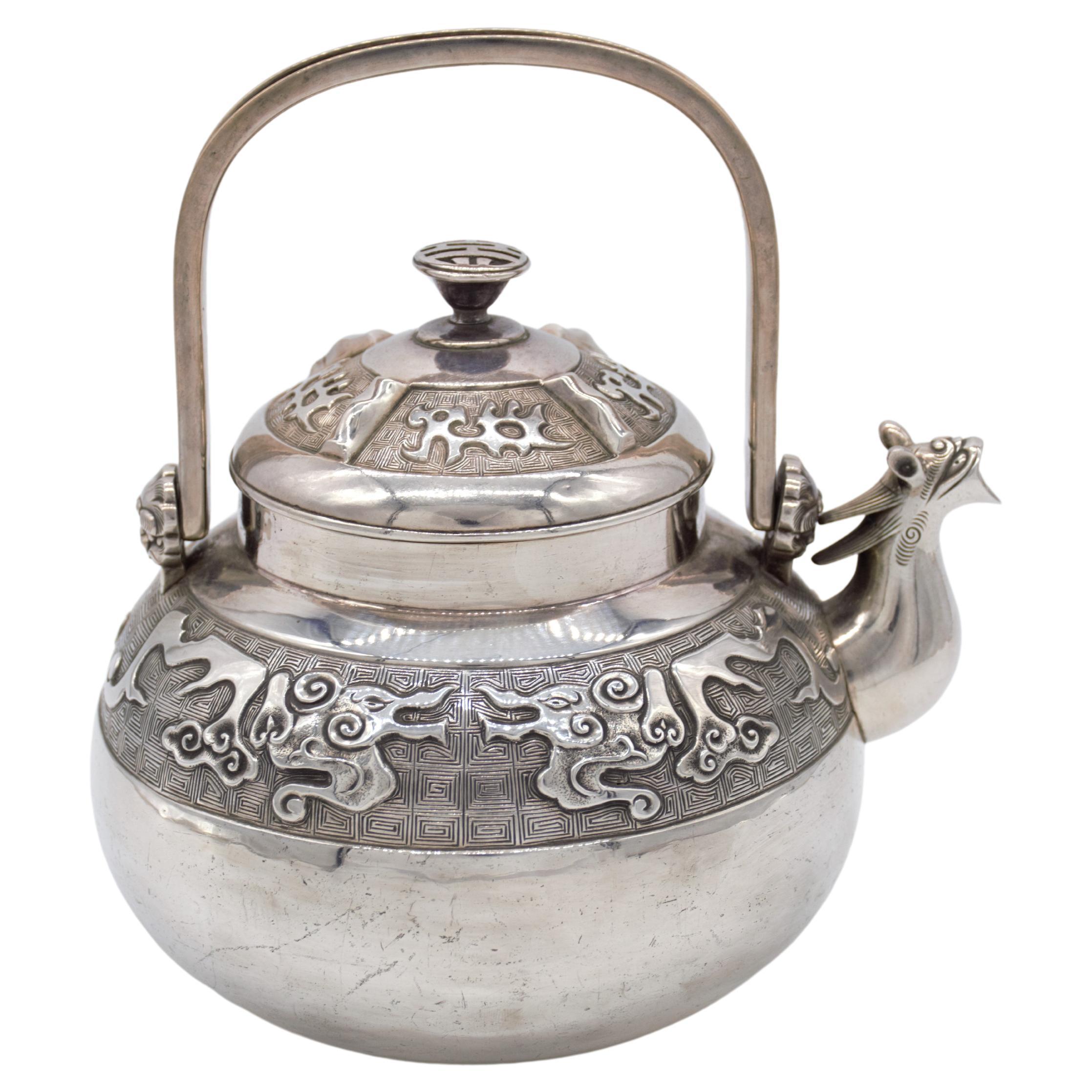
View AllAmazing Japanese silver teapot and cover, dragon spout Meiji period 19TH century
Located in Tel Aviv - Jaffa, IL
amazing rare archaistic style silver ewer or tea pot with cover, the design is Of archaistic style dragons on the main frieze and on the cover, this style came from ancient Chinese a...
Category
Antique 1890s Japanese Metalwork
Materials
Silver
$12,000
Free Shipping
Exceptional George III Teapot by Preeminent Silversmith Paul Storr, 1793
By Paul Storr
Located in Tel Aviv - Jaffa, IL
This rare and exceptional George III teapot is the work of preeminent Georgian silversmith Paul Storr, it is one of his earliest works, the date mark on this pieces of the year 1793 which is the first year Storr marked items with his own initials (P S)
The teapot is designed in the neoclassical taste with some Chinese influences, or Chinoiserie taste, though the decoration shows signs of later 19th century enhancement in the technique and style of the chasing.
It is very hard to impossible to find works from this early period with this interesting Royalty provenance.
The family crest on the front is of the Tollemache family, and dating of The teapot indicate It belonged and probably commissioned by or as a gift to William Manners Tollemache, Lord Huntingtower, William, On 12 January 1793, at the Age of 26, he was created a Baronet, of Hanby Hall in the County of Lincoln.
So this teapot was commissioned to celebrate the occasion.
William Manners Tollemache:
Lord Huntingtower (19 May 1766 – 11 March 1833), known as Sir William Manners, Bt, between 1793 and 1821, was a British nobleman And Tory politician.
Born William Manners, he was the eldest son of John Manners and Louisa Tollemache, 7th Countess of Dysart. On 12 January 1793, at the age of 26, he was Ceated a Baronet, of Hanby Hall in the County of Lincoln.On his mother's Succession to the earldom in 1821, he was styled Lord Huntingtower, and adopted The surname of Talmash or Tollemache
Paul Storr:
(baptised 28 October 1770 in London – 18 March 1844 in London) was an English goldsmith and silversmith working in the Neoclassical and other styles During the late eighteenth and early nineteenth centuries. His works range from Simple tableware to magnificent sculptural pieces made for royalty
Paul Storr was England's most celebrated silversmith during the first half of the Nineteenth century and his legacy lives on today. His pieces historically and Currently adorn royal palaces and the finest stately homes throughout Europe and The world. Storr's reputation rests on his mastery of the grandiose neo-Classical Style developed in the Regency period. He quickly became the most prominent Silversmith of the nineteenth century, producing much of the silver purchased by King George III and King George IV. Storr entered his first mark in the first part of 1792, which reflects his short-lived partnership with William Frisbee. Soon after, he Began to use his PS mark, which he maintained throughout his career with only Minor changes. His first major work was a gold font commissioned by the Duke of Portland...
Category
Antique 1790s English Neoclassical Tea Sets
Materials
Silver
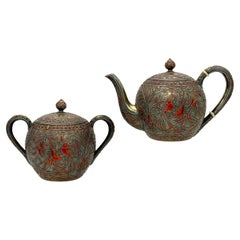
Russian silver 2 piece Tea set, Chinese market, DMITRY EGOROV, Moscow 1895
Located in Tel Aviv - Jaffa, IL
Here we a have a fine rare example of the cross-cultural ties between Russia and China, tea that was an important ingredient in Russian culture was brought from China, but the Russia...
Category
Antique 1890s Tea Sets
Materials
Gold Plate, Silver, Enamel
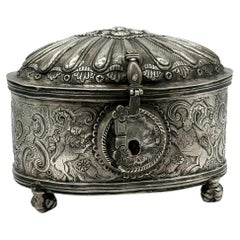
Rare silver Herb Box (Yerbera), Upper Peru, Potosí, c. 1775–90 great repoussé
Located in Tel Aviv - Jaffa, IL
Herb Box (Yerbera), Upper Peru, possibly Potosí, c. 1775–90, cast, repoussé, and chased silver,
the design is very intricate, with lions, cats and some other animals, and a women on the lid, it is made in a shell shape with a classical women on top of the lid, the body is all hand made with lions and wild cats with leafs designs, the inner part is divided into two compartments, as usually in this type of boxes. lock is not working but it is very nice and "primitive" looking.
Boxes have a long history across cultures and time. In Spanish America, containers of many types, styles, and materials were cherished as gifts. Known today as yerberas (herb boxes) or coqueras (coca boxes...
Category
Antique Late 18th Century Snuff Boxes and Tobacco Boxes
Materials
Silver
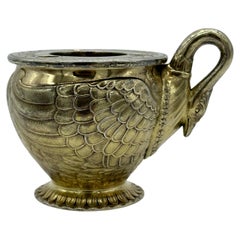
Rare George iv Gilt-Silver Inkwell, Rundell and Bridge
By Rundell, Bridge
Rundell
Located in Tel Aviv - Jaffa, IL
Very rare and important piece of George IV silver, highly important silver-gilt Inkwell probably by John Bridge of the renowned silversmiths Rundell & Bridge, Royal Silversmiths to t...
Category
Antique 1820s English Sterling Silver
Materials
Gold Plate, Silver
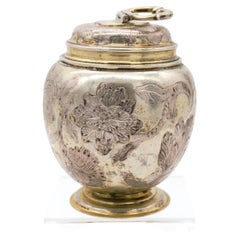
Rare German Parcel-Gilt Silver Canister, Abraham Drentwett i, Augsburg 1649-1666
Located in Tel Aviv - Jaffa, IL
Important German parcel-gilt silver canister, Abraham Drentwett I, Augsburg, circa 1649-1666 Abraham Drentwett I is one of Augsburg's foremost silversmiths during the Baroque period. He was Active 1641-1666 , he is best known for having executed Queen Christina's silver throne...
Category
Antique 17th Century German Baroque Sterling Silver
Materials
Silver
You May Also Like
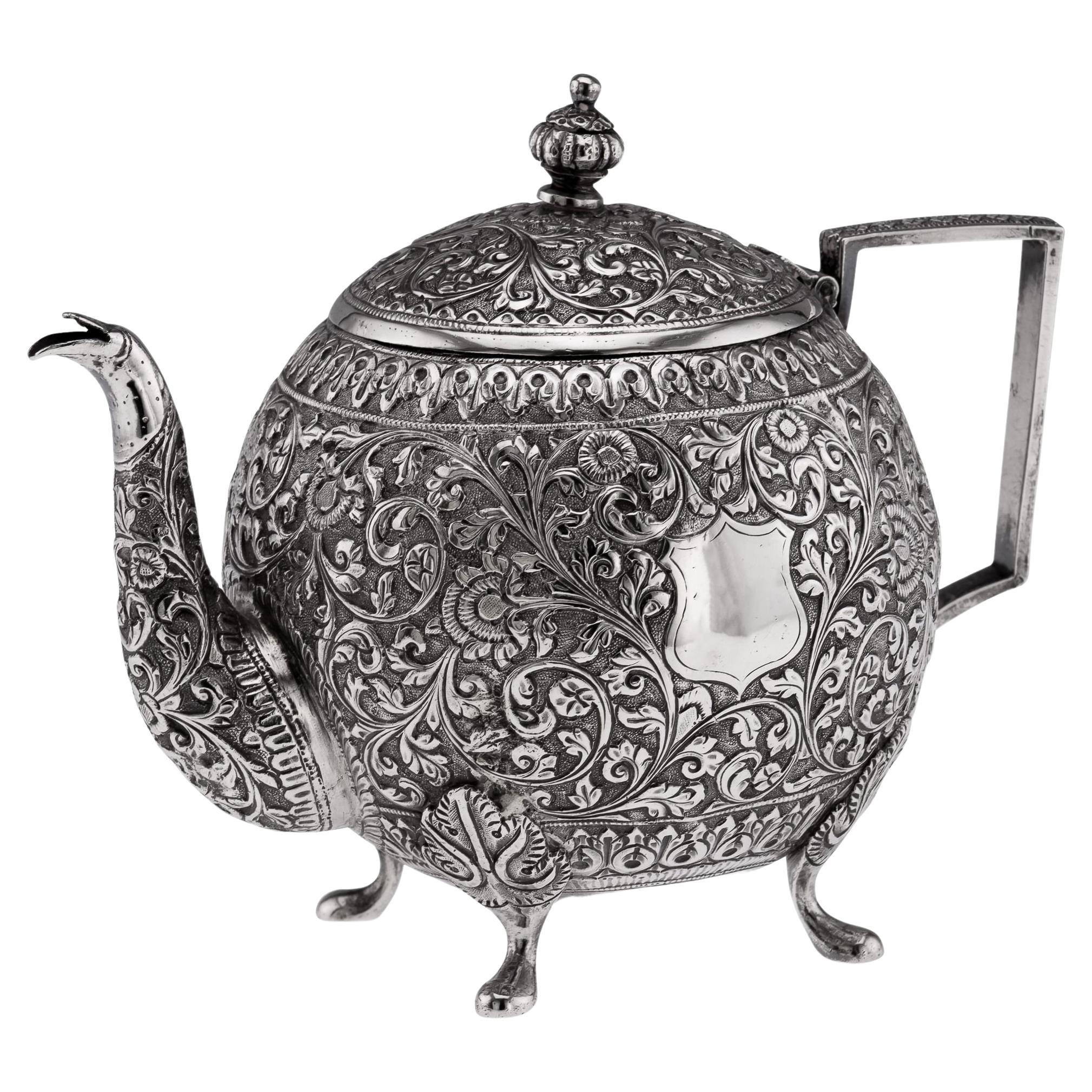
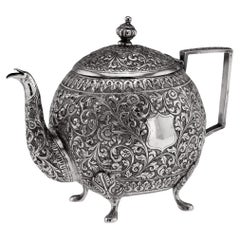
Antique 19th Century Indian Kutch Solid Silver Teapot c.1890
Located in Royal Tunbridge Wells, Kent
Antique 19th Century Indian (Kutch) solid silver teapot featuring a spherical body and a rounded bud-shaped finial on the lid. Finely decorated in high relief with scrolling foliage ...
Category
Antique 19th Century Indian Other Tea Sets
Materials
Silver
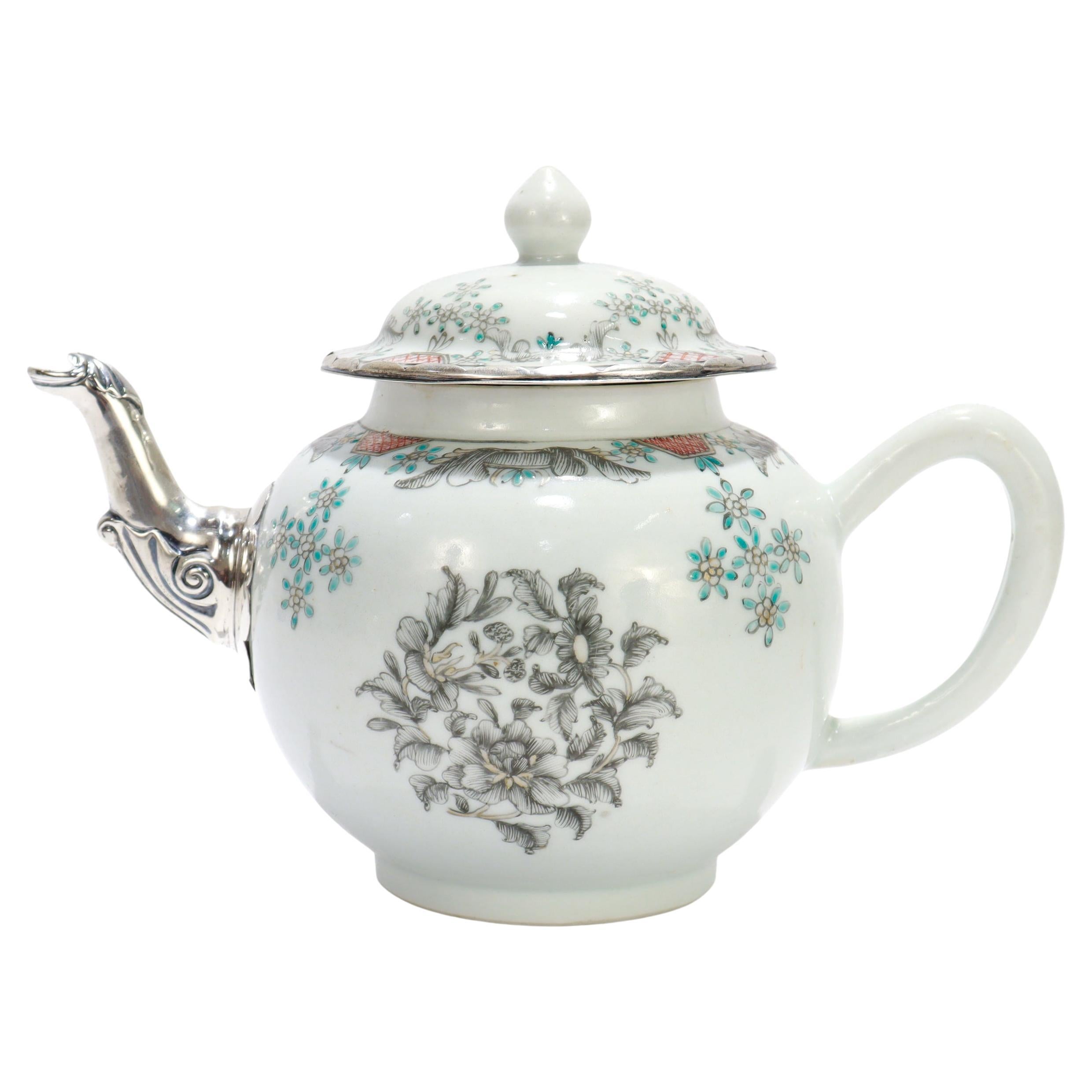
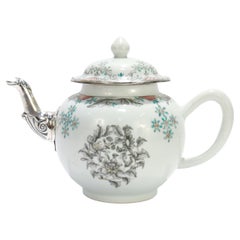
Antique 18th Century Chinese Export Porcelain Teapot with Silver Spout
Located in Philadelphia, PA
A fine 18th century Chinese Export porcelain teapot.
Decorated throughout with flowers & floral sprays en grisaille and with red, turquoise, and gilt embellishments.
The pot with a...
Category
Antique 18th Century Chinese Chinese Export Ceramics
Materials
Silver
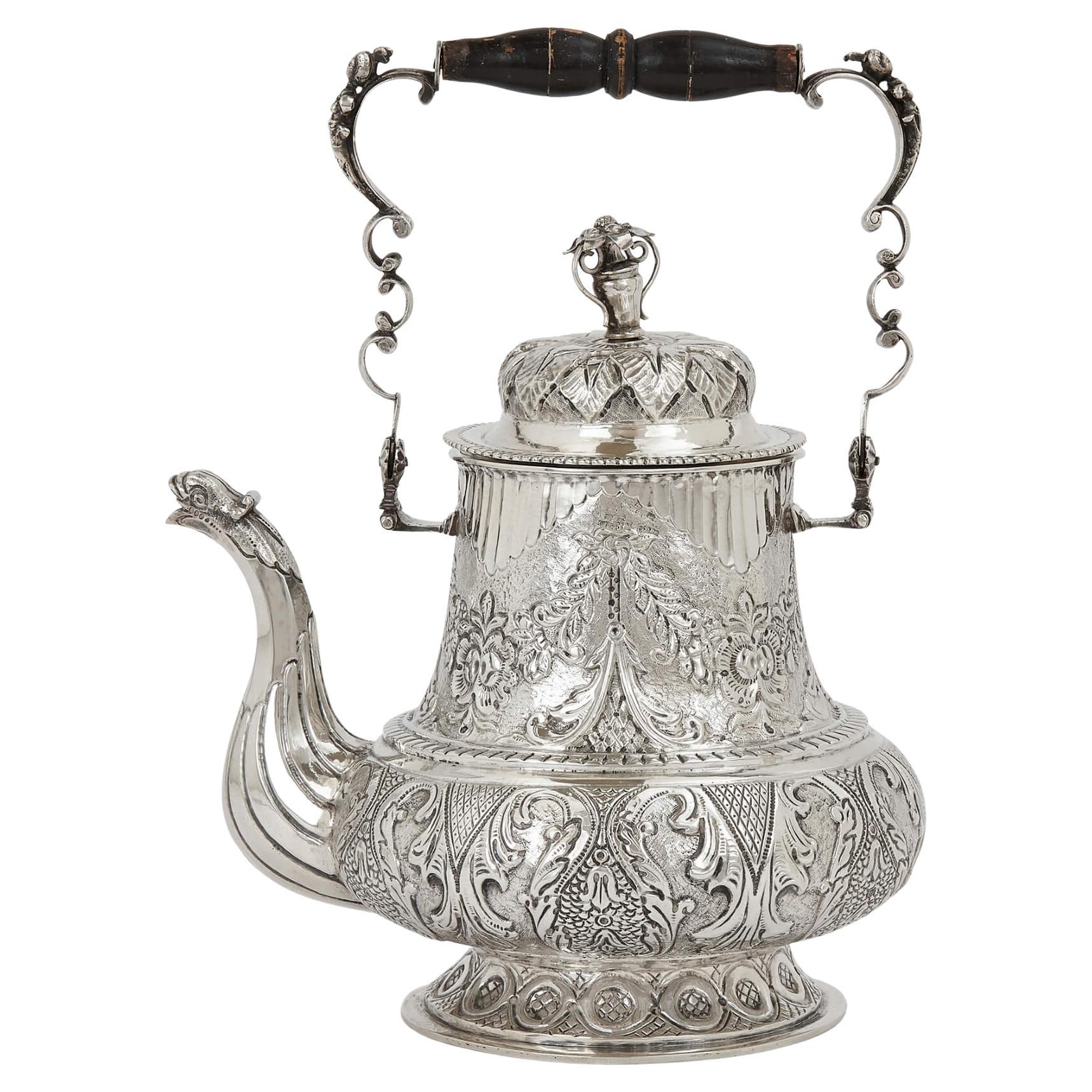
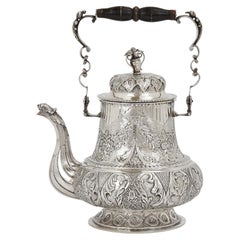
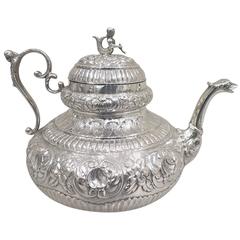
Antique Swedish Repoussé and Engraved Silver Teapot
Located in London, GB
Antique Swedish repoussé and engraved silver teapot
Swedish, 18th Century
Measures: height 28cm, width 24cm, depth 17cm
This elegant Swedish teapot is designed in an ornate styl...
Category
Antique 18th Century Swedish Sterling Silver
Materials
Silver
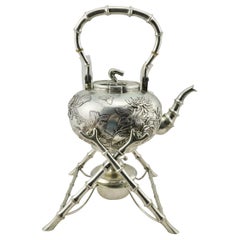
Chinese Export Silver Teapot or Kettle on a Stand by Leeching, circa 1900
By Leeching
Located in Sarasota, FL
Chinese export silver teapot or kettle on a stand decorated with butterflies by Leeching.. The surface of the teapot has chased and applie...
Category
Early 20th Century Chinese Other Urns
Materials
Silver
Mid-18th Century Antique Sterling 925/°°° Silver Dutch Teapot
Located in Torino, IT
Antique mid-18th century (1750) sterling 925/°°° silver Dutch teapot, finely
chased with maritime decorations/garnish/adornment.
Category
Antique Mid-18th Century Dutch Tea Sets
Materials
Sterling Silver
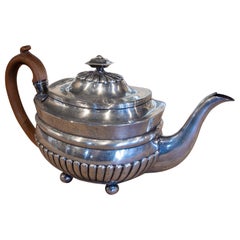
19th Century English Silver Teapot with English Wooden Lid and Handle
Located in Marbella, ES
19th century English silver teapot with English wooden lid and handle.
Category
Antique Early 1900s English Serving Pieces
Materials
Silver
More Ways To Browse
Silver Teapots
Chinese Teapot
Pair Of Chinese Qing Dynasty Vases
Antique Chinese Teapots
Lotus Vase
Chinese Silver Teapot
Early 20th Century Teapots
Antique Fish Vase
Endless Knot
Antique Boxer
Antique Chinese Silver Teapot
Chinese Export Teapots
Ruyi Scepter
Rare Antique Teapots
Book Pendant
Chinese Ruyi Scepter
Japanese Censer
Japanese Bronze Incense