Items Similar to An Indian part-gilt silver-clad ceremonial sceptre or mace with a tiger’s head
Want more images or videos?
Request additional images or videos from the seller
1 of 4
An Indian part-gilt silver-clad ceremonial sceptre or mace with a tiger’s head
$52,405.36
£39,187.42
€43,750
CA$72,201.49
A$78,745.87
CHF 41,714.25
MX$944,051.16
NOK 531,254.12
SEK 485,792.47
DKK 333,392.43
About the Item
Northern India or Deccan, late 19th century
L. approx. 82 cm (excl. stand)
Provenance:
Private collection, United Kingdom
This remarkable gilt-silver soonta (ceremonial sceptre) also known as choba (ceremonial mace) with a tiger's head stands out as an unparalleled example. It has a wooden base, clad with thick sheet part-gilt silver and has fine details such as teeth and a curling tongue. Especially with the inlaid glass eyes, in combination with the grand sculptural design, it would have been integral to an Indian maharaja’s attire, known as lawajama in North India and biruthus in South India, as referenced by Jackson
Jaffer. They would symbolise authority, power, and sometimes an attribute of various deities, particularly those associated with strength or combat. For instance, the Hindu god Hanuman, known for his immense strength, is often depicted holding a mace (*chob* or gada in Sanskrit). Similarly, the god Vishnu and his avatar Krishna are also frequently depicted with a mace among their other attributes.
Courtiers would raise these sceptres wrapped in rich brocades, with the head visible, during processions, signalling their association with the monarch. Alongside fly-whisks and standards, they were indispensable in ceremonial parades, underscoring the ruler's prestige. Terlinden notes that a soonta berdar was tasked with carrying the sceptre. These individuals, proficient in courtly manners, played key roles during audiences, from managing entrances to introducing guests. Their esteemed position often earned them generous rewards, including land grants. See for a depiction of sceptres in use the top right of a painting in the collection of the V&A, titled Processional scene with Amar Singh, ruler of Thanjavur (Tanjore), and Sarabhoji, from circa 1797.
For a very comparable piece, but with an elephant’s head, see the collection of the Indian Museum, Kolkata. For other less similar examples, see the V&A Museum London.
Sources:
A. Jackson
A. Jaffer, Maharaja: The Splendour of India’s Royal Courts, London, V&A Publishing, 1999
Christiane Terlinden Serra, Mughal Silver Magnificence: 16th-19th century, Brussels, 1987, p. 64
- Dimensions:Height: 32.29 in (82 cm)Width: 9.85 in (25 cm)Depth: 13.78 in (35 cm)
- Materials and Techniques:
- Place of Origin:
- Period:
- Date of Manufacture:Circa 1850-1900
- Condition:Wear consistent with age and use.
- Seller Location:Amsterdam, NL
- Reference Number:1stDibs: LU5458237782132
About the Seller
5.0
Recognized Seller
These prestigious sellers are industry leaders and represent the highest echelon for item quality and design.
Established in 1985
1stDibs seller since 2020
23 sales on 1stDibs
Typical response time: 11 hours
- ShippingRetrieving quote...Shipping from: Amsterdam, Netherlands
- Return Policy
More From This Seller
View AllLarge Brazilian or Guyana Amazon Indigenous Macana War Club, 18th or Earlier
Located in Amsterdam, NL
A splendid and rare Amazon indigenous wamara wood Macana war-club
Southern-Guyana or Northern Brazil, Wapitxana group of the Aruak peoples, 18th century, possibly earlier
Measure: H. 43 cm
The deep patina of the club present, and the residue on the part where it was held, attest to its great age.
This unusually large Macana is decorated with several incised whitened anthropomorphic and human figures, a decoration only found on one other documented club in the British Museum, which is illustrated in: Hjalmar Stolpe, Amazon Indian...
Category
Antique Early 18th Century Brazilian Native American Objects
Materials
Hardwood
Ashanti African Chief’s ceremonial gold and gilt-metal crown and sash on stand
Located in Amsterdam, NL
An Ashanti Chief’s ceremonial gold and gilt-metal crown and sash
Ghana, early 20th century
Diam. 20 cm (crown)
L. 128 cm (sash)
H. 102 cm (incl. st...
Category
Early 20th Century Ghanaian Art Nouveau Tribal Art
Materials
Gold, Gold Plate, Metallic Thread
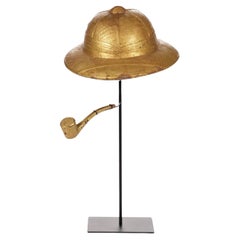
African Chief’s gilt Crown and Sceptre in the form of a Pith helmet and pipe
Located in Amsterdam, NL
A splendid Bouelé Chief’s gilt-wood crown and sceptre in the form of a Pith helmet and pipe
Ivory coast, late 19th/early 20th century
H. 13 x L. 33.5 x D. 26 cm (crown)
L. 14 cm ...
Category
Antique Early 1900s Ivorian Tribal Art
Materials
Giltwood
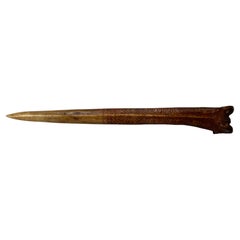
An engraved Sepik cassowary bone dagger
Located in Amsterdam, NL
Papua New Guinea, Sepik Region, Abelam people, early 20th century
Bone daggers in the Sepik region are traditionally crafted from the thigh bone of the ca...
Category
Antique Late 19th Century Papua New Guinean Tribal Art
Materials
Bone
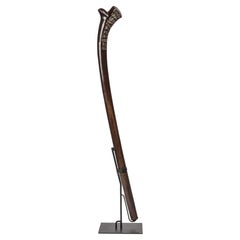
18th Century Polynesian Ironwood Gata Waka or War Club from Fiji
Located in Amsterdam, NL
A Polynesian ironwood Gata waka or war club
Fiji, probably 18th century or earlier
Measures: Height. 97 cm
Including museum-quality powder-coated stand.
Provenance:
Private collection, France
Polynesian culture is traditionally a culture of power and prestige, and there was a fine line between battle and ceremony. Warrior people par excellence, the Fijians had at their disposal a large panoply of weapons, each for a specific use.
The elegant Gata are called gun-sticks by Europeans due to the recognizable form. However, they are designed after a snake, gata in Fijian language. The Ula throwing clubs...
Category
Antique 18th Century Fijian Tribal Art
Materials
Hardwood
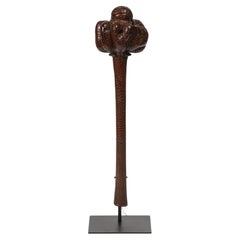
18th Century Polynesian Hardwood Ula Tavatava or Throwing War Club from Fiji
Located in Amsterdam, NL
A Polynesian hardwood Ula tavatava or throwing war club
Fiji, probably 18th century
All-over decorated in incised pattern, the bulbous top seems to have a stone grown into it.
H. 42 cm
Including museum-quality powder-coated stand.
Provenance:
Private collection, France
Polynesian culture is traditionally a culture of power and prestige, and there was a fine line between battle and ceremony. Warrior people par excellence, the Fijians had at their disposal a large panoply of weapons, each for a specific use.
The elegant Gata are called gun-sticks by Europeans due to the recognizable form. However, they are designed after a snake, gata in Fijian language. The Ula throwing clubs...
Category
Antique 18th Century Fijian Tribal Art
Materials
Hardwood
You May Also Like
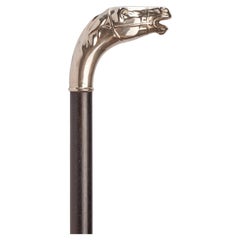
Silver handle walking stick, depicting the head of a horse Germany 1900.
Located in Milan, IT
Walking stick: silver handle, depicting the head of a horse. Ebony wood shaft. Metal ferrule, brass and iron. Germany circa 1900.
Category
Early 20th Century German Antiquities
Materials
Metal, Silver, Brass, Iron
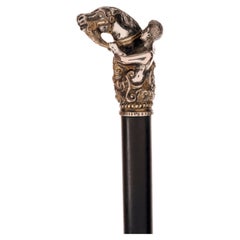
Silver handle walking stick, depicting a horse head and a jockey, England 1900.
Located in Milan, IT
Walking stick: golden silver handle depicting a horse head and a jockey. Ebony wood shaft, metal ferrule. United Kingdom early 1900s.
Category
Early 20th Century English Antiquities
Materials
Silver
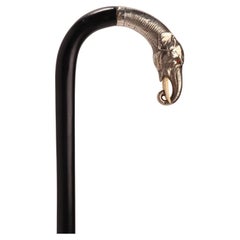
Walking stick, silver handle depicting an elephant head, Germany 1890.
Located in Milan, IT
Walking stick: silver and bone knob, which depicts at its end an elephant head with rolled trunk in pure Art Nouveau style. Bone fangs and sulfur glass eyes. Wooden barrel painted bl...
Category
Antique Late 19th Century German Antiquities
Materials
Silver
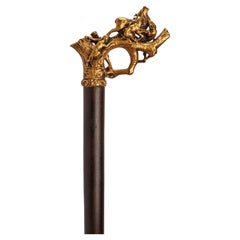
Silver gilt handle walking stick depicting an hunting scene, Germany 1890.
Located in Milan, IT
Walking stick: handle, made out of silver gilt representing an hunting scene, with hunter and dogs. Ebony wood shaft. Metal ferrule. Germany circa 1890.
Category
Antique Late 19th Century German Antiquities
Materials
Metal, Silver
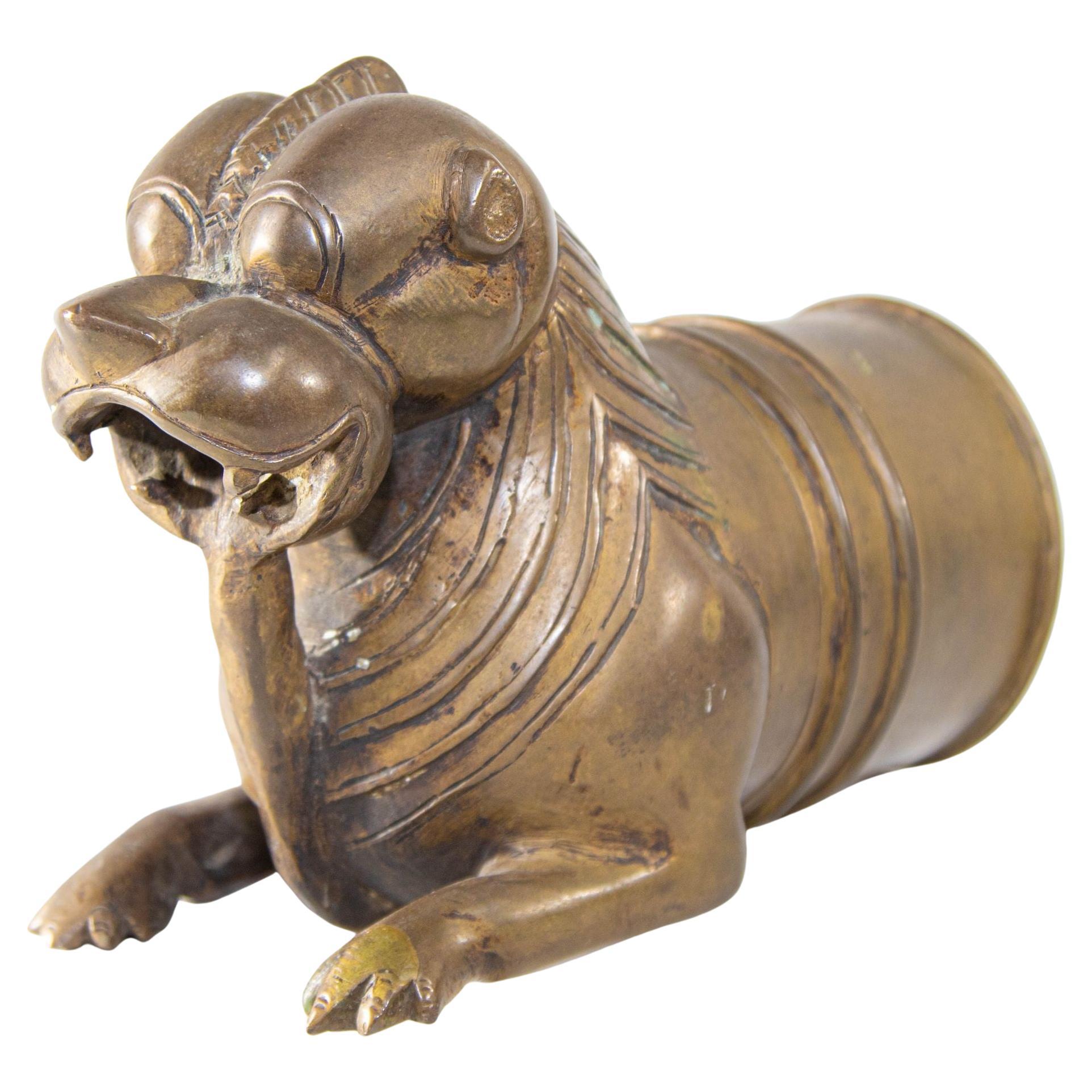
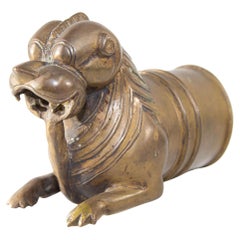
Antique Mythical Tiger Finial Bronze Palanquin Handle 18-19th Century
Located in Moreno Valley, CA
Antique 18th 19th Century Palanquin Mythical Lion or Tiger Finial Bronze Handle.
Large heavy Indian Mythological bronze palanquin fitting cast via the lost wax technique, beautifully stylized and crafted in the form of protective mythological creature.
Palanquin finials were used to adorn the pole ends of the palanquin or palki.
A fine and massive example of a palanquin pole finial with good detail and fine patina.
India, circa: 18th/19thc.
The Palanquin handle...
Category
Antique 19th Century Indian Folk Art Metalwork
Materials
Bronze
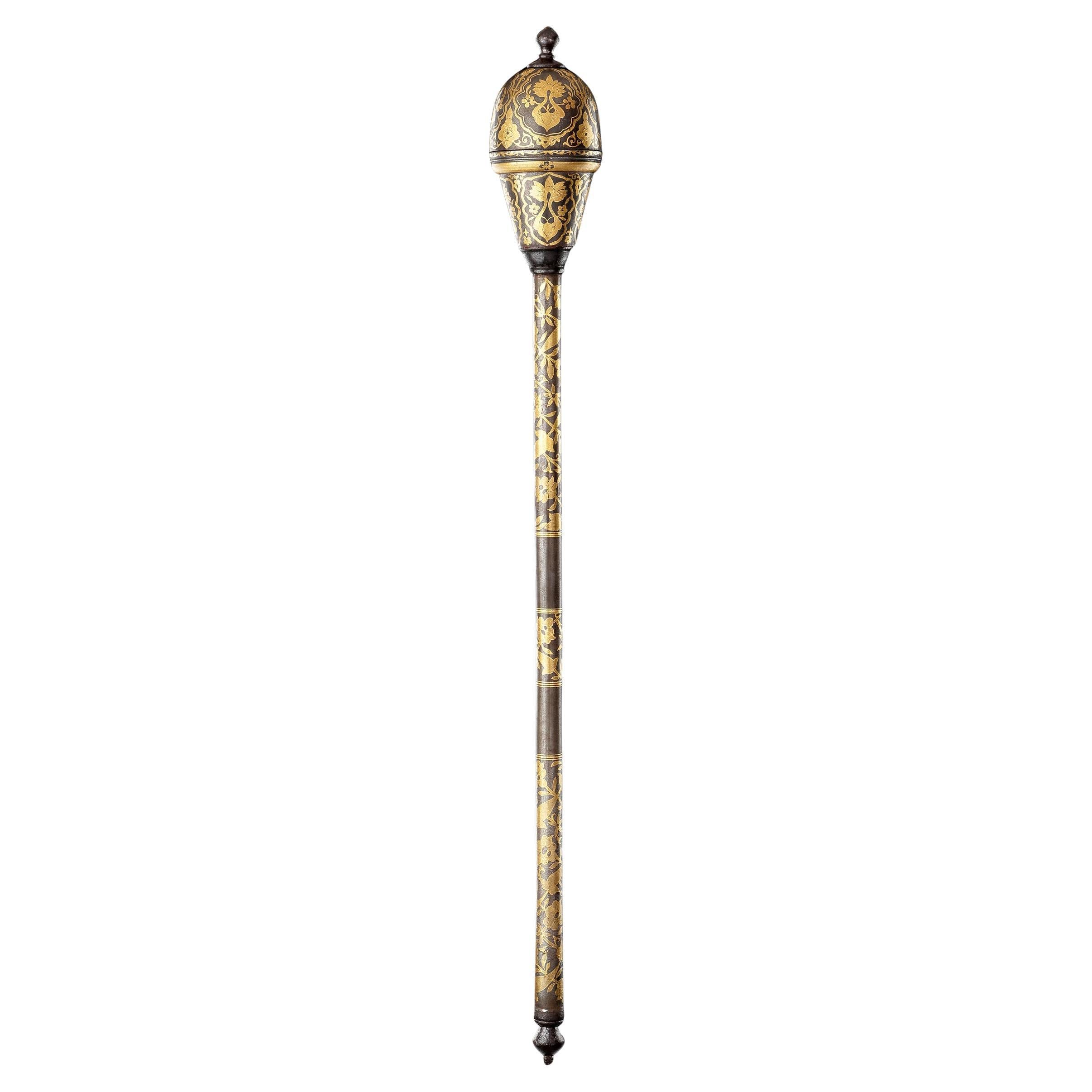
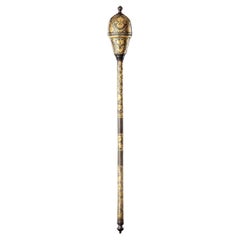
Fine Ceremonial Mace
Located in London, GB
Fine Ceremonial Mace
Steel with gold
Turkey
19th Century
Size: 62cm long - 24½ ins long
Provenance:
Ex Oliver Hoare, Cabinet of Curiosities Exhibition, June 2012
Ex Private ...
Category
Antique 19th Century Turkish Metalwork
Materials
Gold, Steel
$17,500