Want more images or videos?
Request additional images or videos from the seller
1 of 9
Japanese Bronze Group of Mice, Pumpkin and Pomegranate
$8,305.90List Price
About the Item
- Dimensions:Height: 6.3 in (16 cm)Width: 7.88 in (20 cm)Depth: 7.29 in (18.5 cm)
- Materials and Techniques:
- Place of Origin:
- Period:
- Date of Manufacture:1868-1912
- Condition:
- Seller Location:PARIS, FR
- Reference Number:Seller: 2022-10641stDibs: LU8311234268782
About the Seller
No Reviews Yet
Vetted Professional Seller
Every seller passes strict standards for authenticity and reliability
Established in 2013
1stDibs seller since 2023
5 sales on 1stDibs
Typical response time: 7 hours
Authenticity Guarantee
In the unlikely event there’s an issue with an item’s authenticity, contact us within 1 year for a full refund. DetailsMoney-Back Guarantee
If your item is not as described, is damaged in transit, or does not arrive, contact us within 7 days for a full refund. Details24-Hour Cancellation
You have a 24-hour grace period in which to reconsider your purchase, with no questions asked.Vetted Professional Sellers
Our world-class sellers must adhere to strict standards for service and quality, maintaining the integrity of our listings.Price-Match Guarantee
If you find that a seller listed the same item for a lower price elsewhere, we’ll match it.Trusted Global Delivery
Our best-in-class carrier network provides specialized shipping options worldwide, including custom delivery.You May Also Like
Japanese Meiji Bronze Rats Okimono by Shosai with Pumpkin and Pomegranate
Located in Newark, England
FREE WORLDWIDE SHIPPING
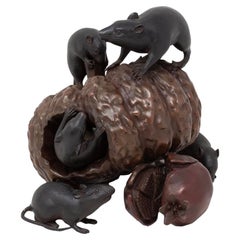
From our Japanese collection, we’re pleased to offer this finely cast Meiji period bronze okimono by Shosai. The group depicts several rats gathered around ...
Category
Antique Late 19th Century Japanese Meiji Metalwork
Materials
Bronze
$7,541
Free Shipping
H 6.7 in W 7.68 in D 6.7 in
Group of 5 Small Japanese Cloisonne and Ginbari Vases, Early 20th Century, Japan
Located in Austin, TX
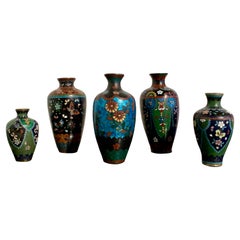
A charming group of five Japanese cloisonné and ginbari foiled vases, Meiji period, early 20th century, Japan.
The group consists of one vase with cloisonné chrysanthemum blossoms against bold and bright turquoise ginbari foil background, two similar vases of primarily black and burgundy cloisonné - one with a butterfly motif, the other with a floral motif, and two similar vases of primarily dark blue and green cloisonné, both with floral and butterfly motifs.
Turquoise ginbari vase...
Category
Early 20th Century Japanese Meiji Metalwork
Materials
Copper, Enamel, Foil, Wire
$1,050 / set
H 5 in Dm 2.5 in
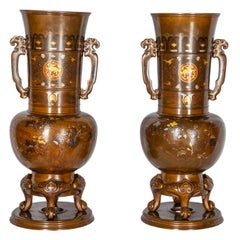
Pair of Japanese Meiji Period Bronze and Gilt Vases
By Zo Miyao 1
Located in Brighton, Sussex
Pair of fine quality Japanese Meiji period (1868-1912) patinated bronze Miyao style gold and silver overlay two handled vases, each with twin handles, classical motif decoration with...
Category
Antique Late 19th Century Japanese Japonisme Vases
Materials
Bronze
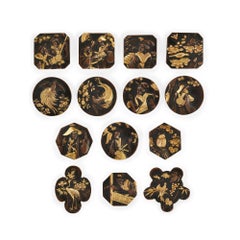
Group of Fourteen Japanese Meiji Period Gilt Metal Plaques
Located in London, GB
Group of fourteen Japanese Meiji period gilt metal plaques
Japanese, Late 19th Century
Height 2cm, width 2cm
These beautiful Japanese Meiji period plaque...
Category
Antique Late 19th Century Japanese Meiji Metalwork
Materials
Metal
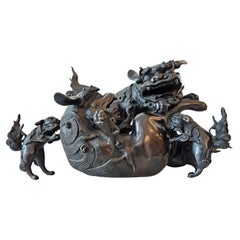
19th Century Japanese Meiji Era Patinated Bronze Foo Dog Lion Group Censer
Located in Forney, TX
A large and impressive Japanese Meiji period (1852-1912) patinated bronze guardian lion censer.
Late 19th century, Japan, exceptionally executed, the group consisting of four shishi...
Category
Antique Late 19th Century Japanese Meiji Metalwork
Materials
Bronze
$3,500
H 10 in W 15.5 in D 9 in
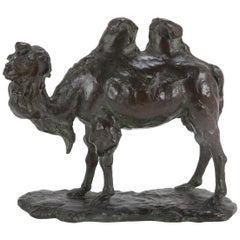
A Japanese Bronze of a Bactrian Camel
Located in Stamford, CT
A sculpted Japanese bronze of a Bactrian camel.
Category
Antique Early 1900s Japanese Showa Animal Sculptures
Materials
Bronze
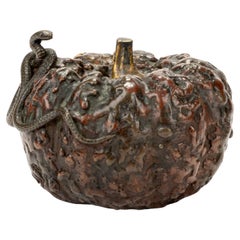
Bronze suiteki in the shape of a pumpkin with a snake, signed Masayuki
Located in Milano, IT
Suiteki, water dispenser, made of finely molded bronze in the shape of a gourd, with a snake coiled on one side.
Signed Masayuki.
Period: Edo 19th cent.
Dimensions: 7 x 9 x 9 cm.
...
Category
Antique 19th Century Japanese Metalwork
Materials
Bronze
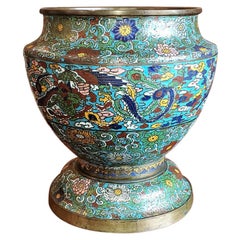
Japanese Meiji Champleve and Bronze Urn
Located in Dallas, TX
Presenting a gorgeous Japanese Meiji Champleve and bronze urn.
Made in Japan during the Meiji Period circa 1880.
The body of ...
Category
Antique Late 19th Century Japanese Meiji Metalwork
Materials
Bronze, Enamel
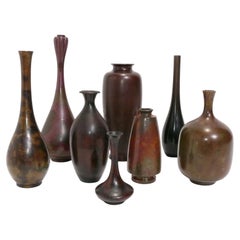
Japanese Bronze Vases Collection of Eight
Located in Atlanta, GA
Collection of Eight Japanese Bronze Vases, Japan, at least circa 1950s, some much earlier. The largest vase measures 12.75"H x 4.25"W. The smallest vase measures 5.25"H x 3"W. They r...
Category
Vintage 1950s Japanese Japonisme Metalwork
Materials
Bronze
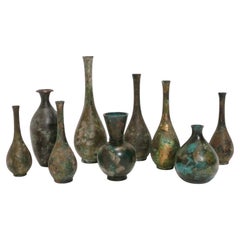
Japanese Bronze Vases Collection of Nine
Located in Atlanta, GA
Collection of Nine Japanese Bronze Vases, Japan, at least circa 1950s, some much earlier. The largest vase measures 11"H x 3.5"W. The smallest vase measures 5.25"H x 3"W. They retain...
Category
Vintage 1950s Japanese Japonisme Metalwork
Materials
Bronze
More From This Seller
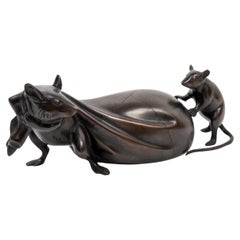
View AllJapan mice treasure bag Meiji
Located in PARIS, FR
Japanese bronzewith brown patina representing two mice. One is pulling pulling a treasure bag. crouching down with its head turned to the left. While the other mouse is standing on i...
Category
Late 20th Century Japanese Japonisme Metalwork
Materials
Bronze
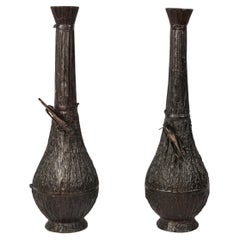
Pair of Japanese Bronze Grasshopper Vases
Located in PARIS, FR
Insects (mushi) occupy an important place in Japanese culture. Hunting for insects is a popular pastime, especially among children. Using plastic nets and cages, they catch cicadas and beetles to observe them.
Between 1830 and 1832, Hokusai composed an untitled series of ten large horizontal prints...
Category
Antique Late 19th Century Japanese Metalwork
Materials
Bronze
$5,932 / set
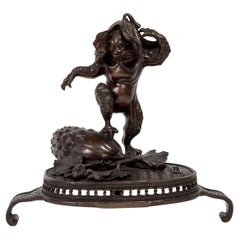
Japanese Bronze Kappa
Located in PARIS, FR
Dark brown patina bronze figure of a standing kappa with its right leg leaning on a cucumber. The figure is put on four-legged rattan-like bronze stand.
The kappa (??) is a aquatic creature taken from Japanese folklore having the appearance of an anthropomorphic turtle.
His skull is either slightly hollowed out to accommodate water, from which it derives its power, or hidden with a water lily leaf hiding this sag. Naturally polite, it is advisable to bow to him in order that it should do so in return, thus losing all the water he has gathered and leaving it harmless.
Kappa has the reputation of attempting to lure both humans and animals into the water. In some areas, it ravages fields, stealing eggplants and cucumbers. Some people prefer to worship it and give it offerings rather than be its victims.
Signed Shokaken (???). His real name is Ôshima Yasutarô. He was born in 1849 and is the third generation of a metalworkers family. Together with his brother Ôshima Joun...
Category
Antique Late 19th Century Japanese Metalwork
Materials
Bronze
$5,339
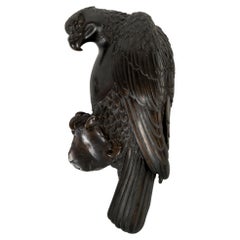
Japanese Bronze Hawk Ikebana
Located in PARIS, FR
Bronze intended for hanging (? dô kakenanaike, « hanging bronze ») depicting a hawk, placed on a branch. The inside is hollow so a bouquet a flowers can be put inside and thus, serve...
Category
Antique Late 19th Century Japanese Metalwork
Materials
Bronze
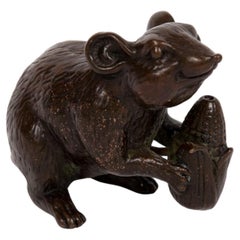
Japanese Bronze sculpture of a Mouse holding a korn knob
Located in PARIS, FR
An interesting bronze sculpture of a seated mouse holding a small corn knob. Realistic treatment of the fur, eyes, hears nose and mouth, its tail is curving on the left side of the s...
Category
Antique Late 19th Century Japanese Meiji Metalwork
Materials
Bronze
Pair of japanese bronze vase imitating hay and decorated with a grass hopper
Located in PARIS, FR
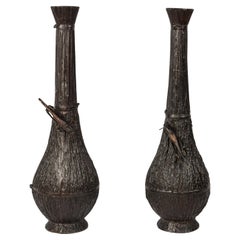
Detailed pair of vases in bronze of baluster form, textured to represent straws of hay, bound together by three knots that divide each vase in three, just under le second ring, a well detailed grasshopper is detached from the rest of the composition.
Insects (mushi) occupy an important place in Japanese culture. Hunting for insects is a popular pastime, especially among children. Using plastic nets and cages, they catch cicadas and beetles to observe them.
Between 1830 and 1832, Hokusai composed an untitled series of ten large horizontal prints...
Category
Antique Late 19th Century Japanese Meiji Metalwork
Materials
Bronze