Items Similar to Japanese Meiji Period Cloisonne Enamel Vase by Ando Jubei
Want more images or videos?
Request additional images or videos from the seller
1 of 19
Japanese Meiji Period Cloisonne Enamel Vase by Ando Jubei
$3,846.17
£2,800
€3,280.02
CA$5,284.07
A$5,744.85
CHF 3,045.92
MX$68,866.14
NOK 38,712.13
SEK 35,465.58
DKK 24,513.98
About the Item
Free international shipping
Ando Cloisonne Company Mark
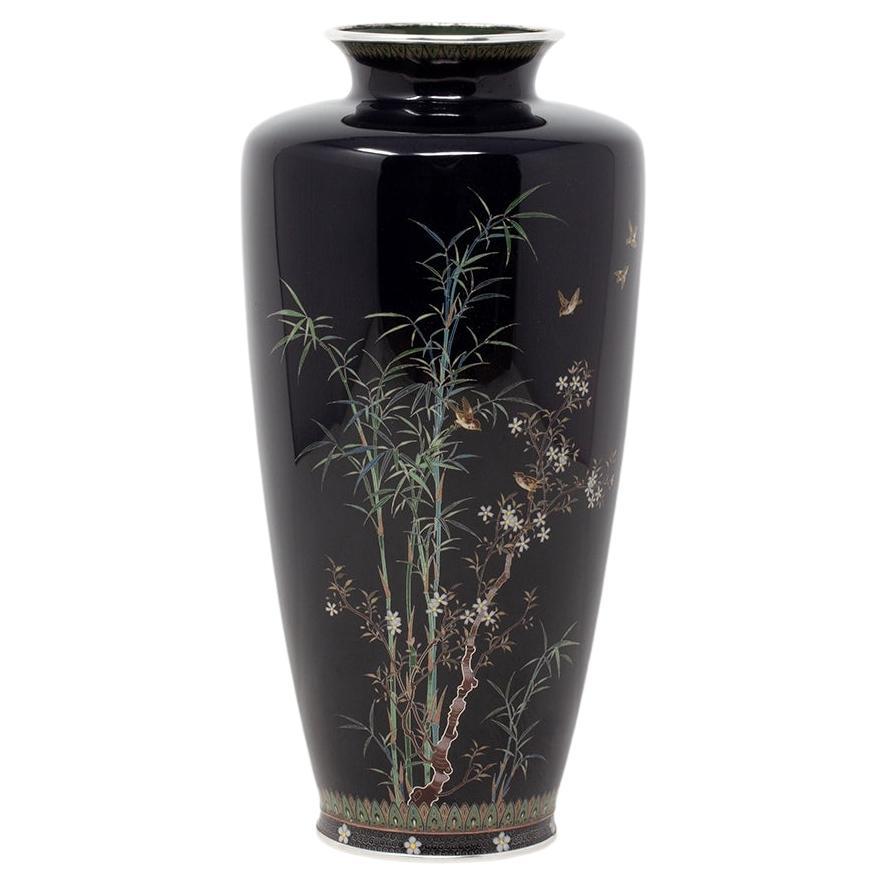
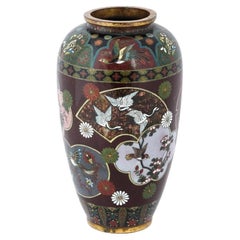
From our Japanese collection, we are delighted to introduce this Japanese Cloisonne Enamel Vase by Ando Jubei. The Cloisonne Enamel Vase is of petite squared tapered form with a waisted neck and rounded shoulders raised upon a circular foot. The Cloisonne Enamel composed on a dark blue ground with cicada lappet borders to the top and bottom rims, the body of the vase beautifully inlaid with silver wire of varying gauge with a central scene depicting large cherry blossom above two roosters stood upon a bamboo screens with Hanashobu (Iris flowers), Kosumosu (Cosmos flowers) and a flowing river. The vase is mounted to the top and bottom in silver and features the Ando Cloisonne Company mark to the centre of the base. The Japanese Cloisonne Enamel Vase dates to the late Meiji Period (1868-1912) and the early 20th century circa 1900.
Ando Jubei (1876–1956) was a renowned Japanese cloisonne artist from Nagoya, Aichi prefecture, Japan. Jubei was considered the Meiji periods most prolific creator of presentation cloisonne, that of which were commissioned by members of the Imperial family for gifts to foreign dignitaries. Jubei alongside another artist named Hayashi Kodenji dominated Nagoya’s enamelling industry in the late Meiji era. Jubei, Namikawa Yasuyuki, and Namikawa Sosuke are considered the three artists whose technical innovations brought in the “Golden Age for Japanese cloisonné” in the late 19th century. Jubei along with his brother in law Ando Juzaemon went on to form the Ando cloisonne company in the late 19th century lead by cloisonne artist Kawade Shibataro (1856–1921).
Ando Cloisonné Company (安藤七宝店) is a Japanese cloisonne making company located in Sakae, Nagoya, central Japan. Founded in the late 19th century by Ando Jubei (Jusaburo 1876-1953) and his brother in law Andō Juzaemon they made the cloisonne company a huge success. They recruited Kawade Shibataro (1856–1921) a renowned cloisonne artist in his own right to be the head of the Ando Company studio who further developed plique-à-jour technique. During the 30 years of the 20th century Ando company employed over 50 cloisonne artists and the company was given an Imperial Warrant of Appointment to the Japanese court.
Cloisonne is a technique of decorating metalwork objects with coloured material separated by wire often made from precious metals. In the first instance the decoration is formed by creating a stencil on the metal object by affixing wires to the surface which will be visible once the product is finished allowing the artisan to craft beautiful scenes such as blossoming flowers or mythical animals by filling in the spaces with various colours.
Enamel (vitreous enamel) also known as porcelain enamel, is a material made by fusing powdered glass to a substrate by firing, usually between 750 and 850 °C. The powder melts, flows, and then hardens to a smooth, durable vitreous coating. The word vitreous comes from the Latin vitreous, meaning “glassy”.
Meiji Period was an era of Japanese history that spanned from 1868 to 1912. It was the first half of the Empire of Japan, when the Japanese people began to build a paradigm of a modern, industrialised nation state and emergent great power, influenced by Western countries and aesthetics. As a result of radically different ideas, the changes to Japan were profound and it affected the social structure, politics, economy, military, and foreign relations across the board. The period corresponded to the reign of Emperor Meiji and was preceded by the Keio era and was succeeded by the Taisho era.
Cultural Art during the Meiji Period was of particular interest to the government and they overhauled the art export market which in turn promoted Japanese arts via various world’s fairs, beginning in Vienna at the world fair in 1873. The government heavily funded the fairs and took an active role organising how Japan’s culture was presented to the world including creating a semi-public company named Kiritsu Kosho Kaisha (First Industrial Manufacturing Company). The Kiritsu Kosho Kaisha was used to promote and commercialise exports of Japanese art and established the Hakurankai Jimukyoku (Exhibition Bureau) to maintain quality standards. For the 1876 Centennial International Exhibition in Philadelphia, the Japanese government created a Centennial Office and sent a special envoy to secure space for the 30,000 items that would be displayed. The Imperial Household also took an active interest in arts and crafts, commissioning works by select artists to be given as gifts for foreign dignitaries further emphasising the high quality and importance of Japanese art. Just before the end of the 19th century in 1890, the Teishitsu Gigeiin (Artist to the Imperial Household) system was created to recognise distinguished artists. These artists were selected for their exceptionally high quality wares and talent in their own industry. Over a period of 54 years Seventy artists were appointed, amongst these were ceramicist Makuzu Kozan and cloisonné enamel artist Namikawa Yasuyuki.
- Creator:Ando Jubei (Maker)
- Dimensions:Height: 4.73 in (12 cm)Width: 2.37 in (6 cm)Depth: 1.97 in (5 cm)
- Style:Meiji (Of the Period)
- Materials and Techniques:
- Place of Origin:
- Period:1900-1909
- Date of Manufacture:Circa 1900
- Condition:Wear consistent with age and use.
- Seller Location:Newark, GB
- Reference Number:Seller: SPRD1stDibs: LU6971241421432
About the Seller
5.0
Vetted Professional Seller
Every seller passes strict standards for authenticity and reliability
Established in 2019
1stDibs seller since 2022
40 sales on 1stDibs
Typical response time: 3 hours
- ShippingRetrieving quote...Shipping from: Newark, United Kingdom
- Return Policy
More From This Seller
View AllJapanese Antique Cloisonne Enamel Vase Hayashi Kodenji
Located in Newark, England
MEIJI PERIOD (1868-1912)
From our Japanese collection, we are delighted to introduce this good size Japanese Cloisonne Enamel Vase. The Vase of gently tapered form with a pinched n...
Category
Antique Early 1900s Japanese Meiji Metalwork
Materials
Gold, Silver, Enamel
Japanese Cloisonné Enamel Vase by Ando Company, Showa Period
By Ando Jubei
Located in Newark, England
Striking Blue Cloisonne Enamel Vase
From our Japanese collection, we’re pleased to offer this cloisonné enamel vase by the Ando Company, dating to the late Showa period, circa 1945....
Category
Mid-20th Century Japanese Showa Vases
Materials
Silver, Enamel
Japanese Meiji Period Satsuma Vase by Kinkozan
By Kinkozan
Located in Newark, England
FREE WORLDWIDE SHIPPING
FROM KYOTO’S FAMED KINKOZAN WORKSHOP, A MEIJI-PERIOD SATSUMA VASE OF EXCEPTIONAL ENAMEL AND GILT.
From our Japanese Satsuma collection, we are delighted to ...
Category
Antique Late 19th Century Meiji Ceramics
Materials
Ceramic, Earthenware, Pottery
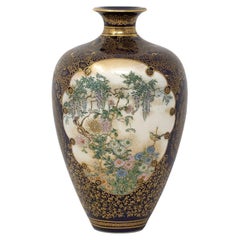
Japanese Antique Earthenware Satsuma Vase by Kinkozan Meiji Period
By Kinkozan
Located in Newark, England
FREE WORLDWIDE SHIPPING
MEIJI PERIOD (1868-1912)
From our Japanese Satsuma collection, we are delighted to present this exceptional Meiji period Satsuma vase by Kinkozan
This tal...
Category
Antique Late 19th Century Japanese Meiji Ceramics
Materials
Ceramic, Earthenware, Pottery
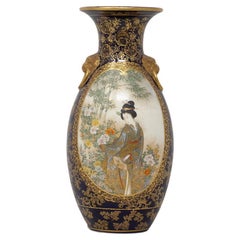
Japanese Meiji Period Satsuma Vase by Ryokuzan
Located in Newark, England
From our Japanese Satsuma Collection, we are delighted to offer this Japanese Satsuma Vase by Ryokuzan 緑山. The Satsuma vase of ovoid shape with a tapered body, circular foot rim, wai...
Category
Antique Early 1900s Japanese Meiji Ceramics
Materials
Ceramic, Earthenware, Pottery

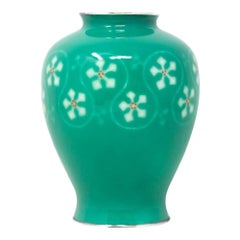
Japanese Wireless Cloisonne Enamel Vase by the Ando Company
By Ando Jubei
Located in Newark, England
Art Deco
From our Japanese collection, we are delighted to offer this Japanese Cloisonne Enamel Vase by the Ando Company. The Cloisonne Enamel Vase of globular form decorated in a m...
Category
Mid-20th Century Japanese Art Deco Vases
Materials
Silver, Enamel
You May Also Like
Very Large Japanese Meiji Period Cloisonne Enamel Vase
Located in London, GB
This stunning Meiji period vase is a wonderful example of the quality of craftsmanship during the late 19th century Japanese Meiji period. The Meiji era was famed for being the perio...
Category
Antique Late 19th Century Japanese Meiji Vases
Materials
Enamel
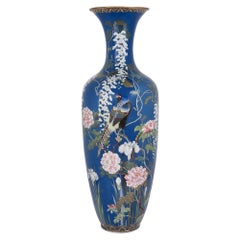
Large Antique Japanese Meiji Cloisonne Enamel Vase
Located in Long Island City, NY
An antique Japanese copper vase with polychrome cloisonne enamel decor. Late Meiji period, before 1912. Baluster shape, flower brunches and birds decor against turquoise background. ...
Category
Antique Late 19th Century Japanese Meiji Vases
Materials
Copper, Enamel
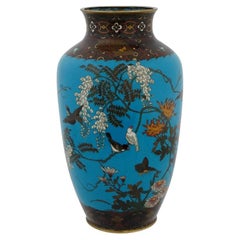
Antique Japanese Cloisonne Meiji Era Enamel Vase Signed Hayashi Yojiro
Located in Long Island City, NY
An antique Japanese, late Meiji period, enamel over brass vase. The vase has an amphora shaped body and a narrow fluted neck. The ware is enameled with a polychrome image of a bird i...
Category
Antique Late 19th Century Japanese Meiji Vases
Materials
Enamel, Brass
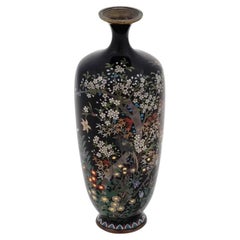
Large Meiji Period Cloisonne Enamel Vase
Located in London, GB
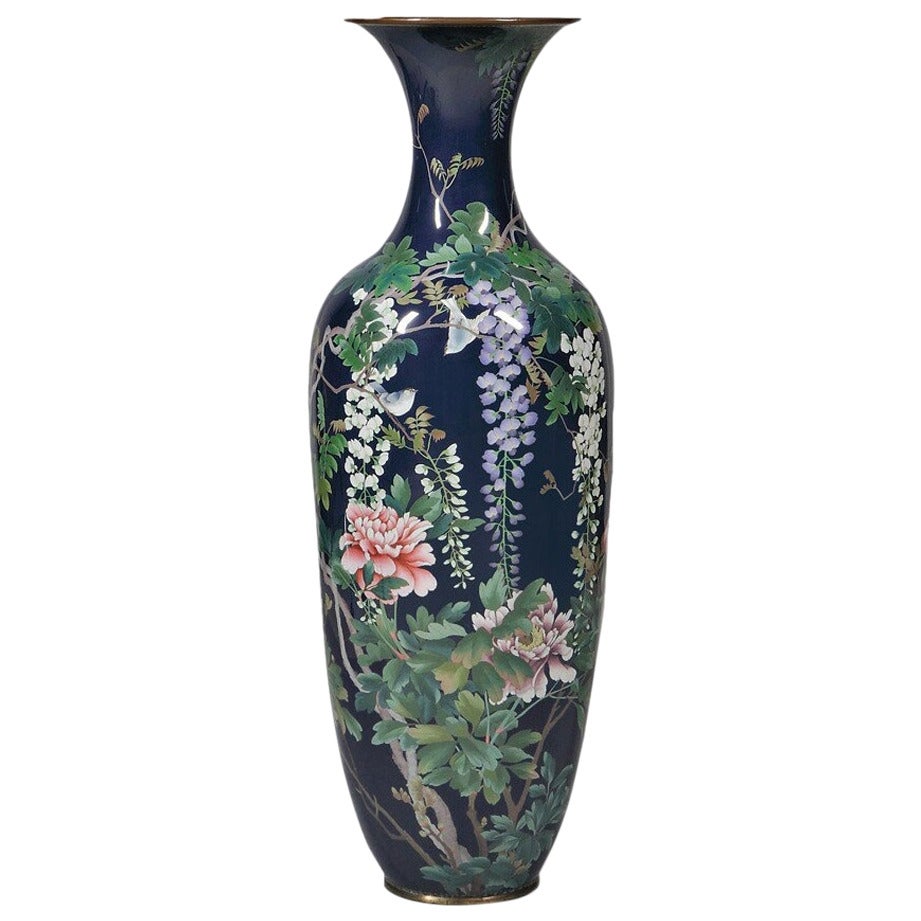
Of ovoid form, with a narrow neck and outward flaring rim, on dark blue ground depicting wisteria blossoms in white and purple cascading from the shoulder with birds throughout and w...
Category
Antique Late 19th Century Japanese Meiji Vases
Materials
Enamel
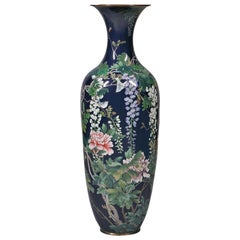
A Large Japanese Cloisonne Enamel vase attributed to Ando Jubei
By Ando Jubei
Located in London, GB
A Large Japanese Cloisonne Enamel vase attributed to Ando Jubei.
Taisho period (1912 – 1926)
A large baluster Cloisonne-Enamel vase worked in musen and silver wire of varying gauge...
Category
Early 20th Century Japanese Metalwork
Materials
Enamel
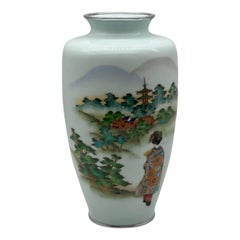
Large Antique Japanese Cloisonne Enamel Vase Attributed to Kyoto Shibata
Located in Long Island City, NY
A large antique Japanese Meiji period vase attributed to Kyoto Shibata. Features vivid depictions of birds and floral motifs, showcasing the meticulous application of cloisonne ename...
Category
Antique Late 19th Century Japanese Meiji Vases
Materials
Enamel, Brass
More Ways To Browse
Meiji Cloisonne
Meiji Cloisonne Furniture
Japanese Meiji Period Cloisonne Enamel Vases
Centennial 1876
Japanese Meiji Period Silver Vase
Vitreous Enamel
1900 Japanese Vase
Inlaid Vase
Arts And Crafts Fire Screen
Japanese Antique Marks
Ando Cloisonne
Ando Cloisonne Vase
Antique Cicada
Hayashi Kodenji
Namikawa Sosuke
Antique Metal Stencils
Chinese Silver Filigree
India Oil Lamp