Gold Plate Metalwork
to
1
1
1
1,850
1,834
638
360
353
1
1
1
1
1
1
1
Material: Gold Plate
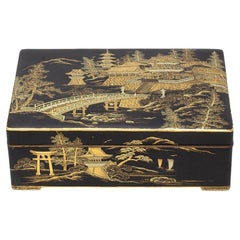
Japanese Mixed Metals Box by Fujii Yoshitoyo, Meiji Period
Located in Newark, England
IMPRESSIVE SIZE MIXED METALS BOX
From our Japanese collection, we are pleased to offer this Japanese Mixed Metals Box by Fujii Yoshitoyo.
This substantial rectangular box, raised u...
Category
Late 19th Century Japanese Meiji Antique Gold Plate Metalwork
Materials
Metal, Gold Plate, Silver, Brass
Related Items
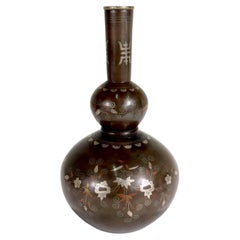
Antique Signed Japanese Meiji Period Mixed Metals Bronze Double Gourd Form Vase
Located in Philadelphia, PA
A fine antique Japanese bronze vase.
From the Meiji Period.
With copper and silver floral and vine and butterfly inlay as well a kanji symbol to the neck (possibly a stylized f...
Category
Early 20th Century Japanese Meiji Gold Plate Metalwork
Materials
Silver, Bronze, Copper

$895
H 6.88 in Dm 3.88 in
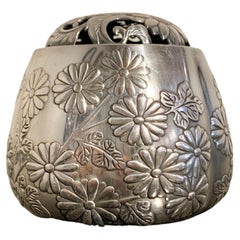
Japanese Silver Incense Burner, Akoda Koro, by Nomura, Meiji Period, Japan
Located in Austin, TX
A lovely and luxurious Japanese silver incense burner of lobed melon form, akoda koro, marked jungin and signed Nomura, Meiji Period, circa 1900, Japan.
The silver koro...
Category
1910s Japanese Meiji Vintage Gold Plate Metalwork
Materials
Silver, Sterling Silver
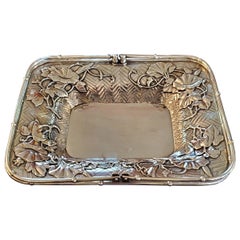
Japanese Meiji Period Sterling Silver 2 Handled Basket by Katsu Miyamoto
Located in Dallas, TX
PRESENTING a GORGEOUS, VERY HIGH QUALITY and EXTREMELY RARE piece of Japanese Meiji Period Sterling Silver 2 Handled Basket by Katsu Miyamoto.
EXQUISITE, EXCEPTIONAL, RARE & IMPORTANT!
This is definitely a Meiji Period piece due to the fact that it is marked with the sterling silver mark “jungin”.
The Meiji period was from 1868 to 1912 and in 1928 a law was introduced in Japan compelling the use of decimal marks for silver.
This pre-dates that decimalization law.
We are of the opinion that it is from circa 1900.
Miyamoto Shoko was founded in 1880 as the first silverware specialty shop. In 1899, Miyamoto Shoko’s silverwares were ordered by the family members of the Emperor of Japan, and to this day, they are making fine and graceful handicrafts with skillful craftsmen.
Loved by numerous customers since the Meiji era, Miyamoto Shoko’s products have also been given to Princess Mako and Princess Kako of Akishino, as well as Princess Aiko Toshinomiya, on their birthdays.
Katsu Miyamoto (宮本勝), in 1880, in order to increase the sales of tobacco and cigarettes to foreigners founded the Moyamoto Shoko company, which produced different silverwares in general and particularly silver cigarette cases. Miyamoto’s first name, Katsu (勝) in some sources is written as “Masaru”, since 勝 kanji can be pronounced in both ways.
This basket is of the HIGHEST QUALITY imaginable!
The top of the basket has the MOST GORGEOUS repousse work of flowers, probably lotus flowers, with leaves and foliage. It has an underlying chevron effect chasing, reflecting parquetry.
The 2 handles are cast in the form of bamboo handles.
The rim of the top likewise is cast as bamboo.
The base is equally stunning in a different way!
It is chased with a chevron effect, like parquetry flooring and the four feet simulate pieces of sliced bamboo with an interlinking gallery of support columns, likewise, simulating bamboo.
The QUALITY of WORKMANSHIP is OUTSTANDING!
The pieces weighs exactly 525 grams.
This piece takes my breath away!
This is one for the SERIOUS COLLECTOR of EXQUISITE AND RARE Japanese silver. You will not find another like it, for sale ANYWHERE ELSE IN THE WORLD …… I know as I have searched!
Provenance: Acquired from a Dallas Private Collector.
Dimensions: 9.6 inches wide, 7.6 inches deep and 2.75 inches tall ( 7.25 inches tall with handles up)
Condition: Very good. It looks like the base 4 legged gallery, has been repaired/re-attached to the base, but otherwise it is excellent and of Museum quality.
The Meiji period (明治時代 Meiji-jidai?), also known as the Meiji era, is a Japanese era which extended from October 23, 1868 through July 30, 1912.[1] This period represents the first half of the Empire of Japan during which Japanese society moved from being an isolated feudal society to its modern form. Fundamental changes affected its social structure, internal politics, economy, military, and foreign relations. The period corresponded with the reign of Emperor Meiji after 1868, and lasted until his death in 1912. It was succeeded by the Taishō period upon the accession of Emperor Taishō to the throne.
Solid silver pieces...
Category
Early 20th Century Japanese Meiji Gold Plate Metalwork
Materials
Sterling Silver
$7,250
H 7.25 in W 9.6 in D 7.6 in
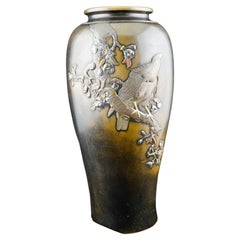
Japanese MIxed Metals and Bronze Meiji Period Vase by Nogawa
By Ando Jubei
Located in Sarasota, FL
Japanese mixed metal and bronze Meiji period finely cast and inlaid vase of an eagle in a tree. Marked for Nogawa workshop and signed by maker on the side.
Category
Late 19th Century Anglo-Japanese Antique Gold Plate Metalwork
Materials
Silver, Bronze
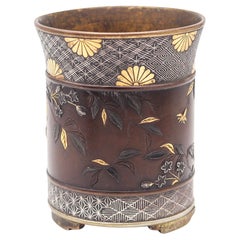
MEIJI Period Japan 1890 Imperial Shakudo Gold Mixed Metals Brush Vase-Pot
Located in Miami, FL
A brush pot from the Meiji imperial period.
This is a beautiful brush vase-pot created in the Imperial Japan during the early Meiji period (1868-1912), circa 1890. The fabulous roun...
Category
1890s Japanese Meiji Antique Gold Plate Metalwork
Materials
Gold, Silver, Bronze
$4,025 Sale Price
30% Off
H 3.3 in Dm 2.75 in
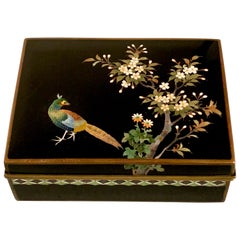
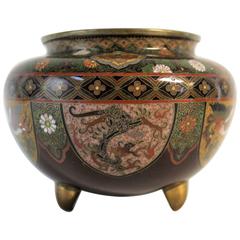
Japanese Cloisonne Box by Inaba, Meiji Period, circa 1900, Japan
Located in Austin, TX
A fine Japanese cloisonne hinged box with pheasant and autumn foliage, by Inaba Nanaho and the Inaba Cloisonne Company, Meiji period, circa 1900, ...
Category
Early 1900s Japanese Meiji Antique Gold Plate Metalwork
Materials
Copper, Enamel, Metal
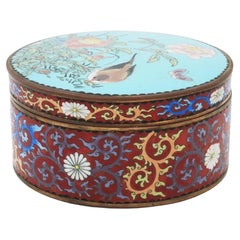
Antique Japanese Meiji Cloisonne Enamel Trinket Box
Located in Long Island City, NY
An antique Japanese, late Meiji era, covered enamel over brass jewelry or trinket box. The body of the ware is enameled with floral and foliage motifs made in the Cloisonne technique...
Category
Late 19th Century Japanese Meiji Antique Gold Plate Metalwork
Materials
Brass, Enamel
Japanese Meiji Period Cloisonne Bowl
Located in Hamilton, Ontario
Japanese Meiji period cloisonne bowl.
Category
19th Century Japanese Meiji Antique Gold Plate Metalwork
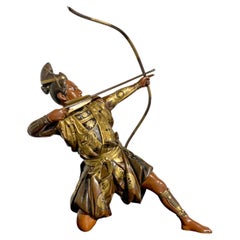
Japanese Miyao Style Gilt Bronze Samurai Archer, Meiji Period, Japan
Located in Austin, TX
A spectacular Japanese cast, carved, and parcel gilt bronze sculpture, okimono, of a kneeling samurai archer, signed Kiyotsugu (died 1894), Meiji ...
Category
Late 19th Century Japanese Meiji Antique Gold Plate Metalwork
Materials
Bronze
$12,500
H 14.5 in W 11.5 in D 5.5 in
Meiji Period Signed Bronze and Mixed Metal Bonsai Planter or Brush Pot
Located in Ottawa, Ontario
Meiji period (1868-1912) signed bronze and mixed metal bonsai planter or brush pot, polygon shaped (six sided) decorated with different scenes on each p...
Category
Late 19th Century Japanese Meiji Antique Gold Plate Metalwork
Materials
Metal, Bronze

$895
H 5.25 in W 4.13 in D 4.13 in
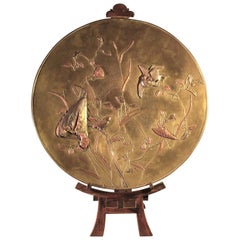
Large Japanese Patinated Bronze Mixed Metal Charger Meiji Period, circa 1880
Located in Ottawa, Ontario
A large Japanese patinated bronze
Mixed metal charger
Meiji period
Finely decorated in gold, silver, copper and bronze.
Naturalistically accurate...
Category
Late 19th Century Japanese Meiji Antique Gold Plate Metalwork
Materials
Gold, Silver, Copper, Bronze
$1,650
H 1.5 in Dm 17.75 in
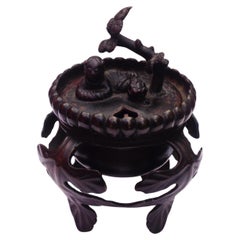
19th Century Japanese Meiji Period Bronze Censer
Located in Rochester, NY
Antique 19th century Meiji period Japanese bronze censer. Top lid decorated with finely sculpted reclining anthropomorphic figure / bonsai tree / acorn and cut out hearts. Overall be...
Category
19th Century Japanese Meiji Antique Gold Plate Metalwork
Materials
Bronze
Previously Available Items
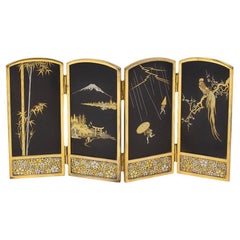
Japanese Meiji period (1868-1912) Damascene Table Screen by Masamitsu
Located in Newark, England
FEATURING FOUR FOLDING PANELS
MEASUREMENTS
16cm High x 29.5cm Wide – each panel 7.15cm (6.3 x 11.6 – 2.81)
From our Japanese collection, we are delighted to introduce this Japanese Damascene Table...
Category
Early 1900s Japanese Meiji Antique Gold Plate Metalwork
Materials
Gold, Gold Plate, Silver, Brass
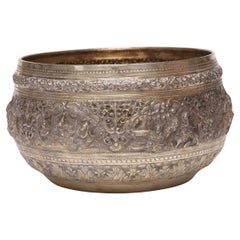
Burmese Repoussé Offering Bowl
Located in Chicago, IL
This elegant Burmese offering bowl is formed of hand-worked copper and finished with silver and gold plating for a lavish exterior. The form is based on Buddhist alms or begging bowls, or thabeik, used by Burmese monks. The copper alloy body was first hammered to a rounded shape, then intricately decorated in relief using repoussé and chasing techniques.
The sides of the bowl are decorated with a story told in multiple vignettes, including figures visiting a Buddhist stupa...
Category
20th Century Burmese Gold Plate Metalwork
Materials
Gold Plate, Silver Plate, Copper
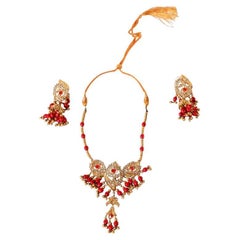
Yellow Gold Plated Necklace and Earrings Set, India
Located in Moreno Valley, CA
Vintage beautiful yellow gold plated India jewelry earrings and necklace set.
Vintage chocker or headpiece embellished with colorful glass beads in red.
South Indian gold...
Category
Mid-20th Century Indian Agra Gold Plate Metalwork
Materials
Gold Plate
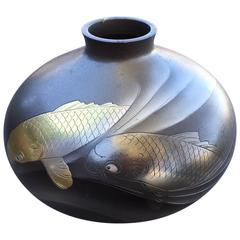
Fine Signed Japanese Bronze "Double Koi" Silver and Gold Fish Vase
Located in South Burlington, VT
A fine signed Japanese cast bronze "Double Koi" silver and gold fish vase- symbolic of prosperity, perseverance and good fortune. Mint condition. Today these older works of...
Category
Mid-20th Century Japanese Showa Gold Plate Metalwork
Materials
Bronze, Gold Plate, Silver
Still Thinking About These?
All Recently ViewedMore Ways To Browse
Tibetan Singing Bowl
Bronze Hibachi
China Brazier
Elephant Censer
Foo Censer
Japanese Bronze Crane And Turtle
Miyao Bronze
Quran Verse
Small Incense Burner
Tibetan Metal Art
Zhou Bronze
Antique Arabic Coffee Pot Dallah
Antique Chinese Bronze Marks
Antique Lime Boxes
Bidri Art
Burmese Bell
Cast Iron Kettle
Chinese Cloisonne Censer