16th Century Metalwork
to
1
6
2
8
124
868
841
31
439
178
51
38
14
22
8
9
10
20
8
6
2
8
6
2
2
1
7
5
2
1
1
8
8
8
Period: 16th Century
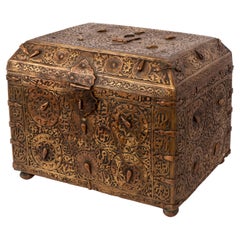
Antique 16th Century Islamic Safavid Al Jazari Combination Locking Brass Casket
Located in Portland, OR
A highly important engraved Islamic combination locking brass casket, based on a design by the 12th Century Arab inventor & artist Ismail Al Jazari. Circa...
Category
Iraqi Islamic Antique 16th Century Metalwork
Materials
Brass

$24,500 Sale Price
30% Off
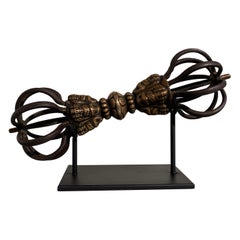
Large Himalayan Inlaid Bronze Vajra with Wrathful Faces, 15th-16th Century
Located in Austin, TX
A large and unusual Himalayan bronze and mixed metal nine prong vajra featuring wrathful faces. In the style of the Tangut (Western Xia) Kingdom (1038 to 1227), but probably later, most likely 15th-16th century.
The body of the vajra crafted from a copper alloy, with five wrathful faces on either side and gold and silver inlays to the center. The prongs crafted of iron, with each side having eight prongs arcing outwards around a central prong before coming back to a copper alloy point.
The vajra is meditational tool...
Category
Mongolian Antique 16th Century Metalwork
Materials
Iron, Gold, Silver, Bronze
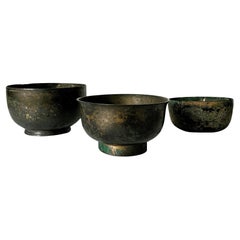
Collection of Three Korean Antique Bronze Bowls
Located in Atlanta, GA
A collection of three bronze bowls from Korean dated to 14-17th century (late Goryeo to early Joseon Dynasty). It consists of an early example with a slight curvy wall and a high foo...
Category
Korean Other Antique 16th Century Metalwork
Materials
Bronze
$3,800 / set
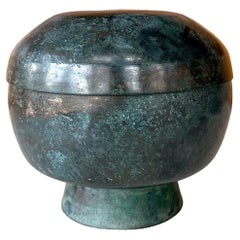
Korean Antique Bronze Footed Vessel with Lid Early Joseon Dynasty
Located in Atlanta, GA
A bronze bowl shape vessel with fitted lid from Korean dated to 15-16th century (early Joseon Dynasty). In an elegant minimalistic form with thin wall and supported by a high foot ri...
Category
Korean Other Antique 16th Century Metalwork
Materials
Bronze
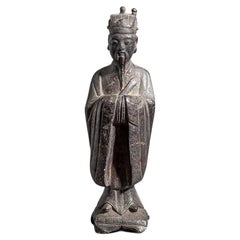
16th Century Chinese Standing Bronze Figure of a Nobleman
Located in Hudson, NY
Hongzhi Period (1487 - 1505) sculpture of an important man, possibly Confucius. Comes with box.
Category
Chinese Antique 16th Century Metalwork
Materials
Bronze
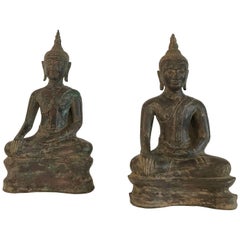
Very Exceptional Almost Identical Pair of Bronze Buddhas
Located in Schellebelle, BE
Two bronze Buddhas, Ayutthaya, 16th century, Thailand
with great patina
dimensions
26 cm X 13 cm X 8 cm
24 cm X 14 cm X 8 cm.
Category
Antique 16th Century Metalwork
Materials
Bronze
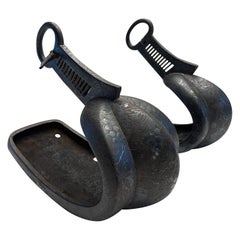
Antique Japanese Iron Stirrups with Silver Inlay Signed
Located in Atlanta, GA
A pair of antique Japanese Abumis, stirrup for horse-riding, in cast iron with elaborate silver inlay, circa 16th century Muramachi to Momoyama period. The prototype of Japanese abum...
Category
Japanese Japonisme Antique 16th Century Metalwork
Materials
Silver, Iron
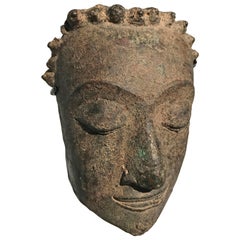
Fragment of Bronze Head of Buddha, Thailand
Located in Schellebelle, BE
Fragment of Bronze Head of Buddha
Thailand
16th Century
Category
Thai Antique 16th Century Metalwork
Materials
Bronze
Related Items
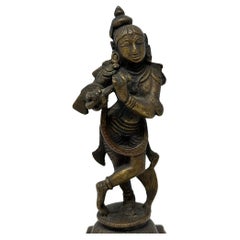
Antique Hindu Bronze of Krishna Sculpture
Located in Moreno Valley, CA
Antique Hindu bronze sculpture of Krishna playing the flute.
Circa late 19th century
Exquisite lost wax bronze statue figurine depicting Lord Krishna Venu...
Category
Indian Folk Art 16th Century Metalwork
Materials
Bronze
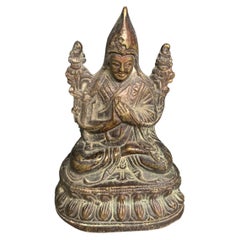
Small Tibetan Seated Buddha from Bronze, c. 1850
Located in Jimbaran, Bali
A wonderful Tibetan bronze seated buddha on a lotus pedestal from the 19th century. This buddha features a lovely age related patina as well as rich detailing.
Category
Tibetan Other Antique 16th Century Metalwork
Materials
Bronze
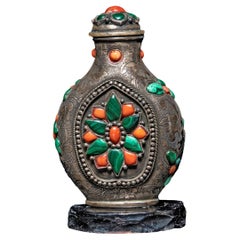
Chinese Coral
Malachite Inlaid Brass Snuff Bottle, c. 1850
Located in Chicago, IL
A mixture of finely powdered tobacco, herbs, and spices, snuff was introduced to China in the 17th century by Western diplomats. Initially reserved for ranking members of Qing-dynast...
Category
Chinese Qing Antique 16th Century Metalwork
Materials
Coral, Malachite, Brass
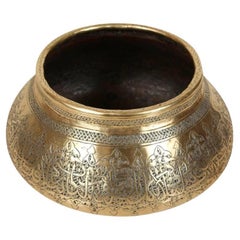
Antique Islamic Brass Bowl Fine Metalwork Hand Etched Bowl
Located in Moreno Valley, CA
Antique Middle Eastern Islamic art Moorish brass bowl engraved with Thuluth Arabic calligraphy.The polished brass bowl is profusely chased with vines and vegetal motifs and inscribed with Islamic verses of the Holly Koran.This bowl has been professionally cleaned and polished.Measures: Diameter 7.25" x 4" height Mouth opening: 5".Great Middle Eastern brass metalwork decorative Islamic art objects.Handcrafted Moorish hand-etched Islamic metal brass bowl.Engraved, incised and hammered with very fine Arabic Islamic calligraphy writing and geometric designs on brass vessel.Very Intricate fine Middle eastern Moorish Islamic Art metalwork, museum quality artwork.Late 19th Century.Date of Manufacture: Circa 1880.Condition: Wear consistent with age and use.
Islamic brass metalwork is an intricate and beautiful form of art that originated in the Islamic world. It encompasses a wide range of decorative objects made from brass or other metals such as copper, bronze, and silver. Brass trays, in particular, are highly regarded for their craftsmanship and intricate designs.
Islamic brass metalwork has a rich history that dates back to the early Islamic period, with its roots in the metalworking traditions of ancient civilizations such as the Persians, Greeks, and Romans. However, Islamic artisans developed their own unique styles and techniques, blending elements from various cultures and creating distinctive motifs that reflected Islamic aesthetics and religious beliefs.
The process of creating brass trays involves several steps, each requiring specialized skills. Here is a general overview of the traditional techniques involved:
1) Design: A skilled artist or calligrapher creates the design for the brass object. Islamic brass metalwork often incorporates intricate geometric patterns, arabesques, floral motifs, and calligraphy inspired by Quranic verses or poetry.
2) Metalworking: The object is typically made from a sheet of brass or another metal. The metal is cut into the desired shape and then hammered or pressed to create the object. Traditional techniques such as repoussé (hammering from the reverse side) or chasing (hammering on the front side) may be employed to shape the metal.
3) Engraving: The surface of the metal is often decorated with intricate engravings or etchings. Skilled artisans use chisels, gravers, or other specialized tools to create fine details and elaborate patterns.
4) Filigree and Inlay: Some brass trays feature additional decorative elements such as filigree or inlay work. Filigree involves shaping thin wires of brass into delicate patterns and soldering them onto the tray's surface. Inlay work, on the other hand, involves embedding contrasting materials such as silver or copper into the brass, creating intricate designs.
5) Surface Treatment: After the main decorative work is complete, the tray may undergo surface treatments to enhance its appearance. This can include processes like polishing, buffing, or applying various chemical patinas to create an aged or oxidized effect.
While this bowl has certainly witnessed the passage of time, it remains in remarkably good condition, with only minor signs of age that add character to its appearance. The patina on the brass enhances its antique allure, making it a truly authentic and captivating collectible.
Arabic Calligraphy: The Arabic writing on the bowl is a work of art in itself. The calligraphy showcases the mastery of the scribe's hand, with flowing curves and intricate details that form an elegant script. The script may include Quranic verses, blessings, or poetic verses, depending on the bowl's origin and purpose. The inscriptions are not only visually striking but also carry profound meaning, making this bowl a beautiful representation of Islamic heritage.
Intricate Patterns: In addition to the Arabic calligraphy, the bowl features intricate geometric patterns and motifs that further enhance its visual appeal. These patterns are a hallmark of Islamic art and reflect the mathematical precision and artistic creativity that defined Islamic craftsmanship.
This antique Islamic brass bowl...
Category
Turkish Islamic Antique 16th Century Metalwork
Materials
Brass
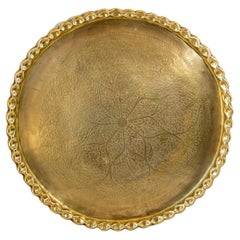
Antique Islamic Mughal Rajasthani Large Moorish Round Brass Tray with Crest Edge
Located in Moreno Valley, CA
Asian Mughal Rajasthani Large Polished Round Brass Tray with Crest Edges.
Asian Antique Islamic Mughal Rajasthani Large Polished round Brass Tray with crest edges, 3o inches in diameter.
Rare find, large antique...
Category
Indian Islamic 16th Century Metalwork
Materials
Brass
$3,500
H 1.25 in Dm 30 in
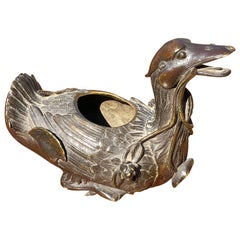
18th Century Chinese Qing Bronze Duck Incense Burner Sculpture
Located in Haddonfield, NJ
18th Century Chinese bronze duck incense burner, Qing period
Please note that one foot is missing, broken off, see detailed image.
Category
Chinese Qing Antique 16th Century Metalwork
Materials
Bronze
$760 Sale Price
49% Off
H 5.25 in W 7.25 in D 3.9 in
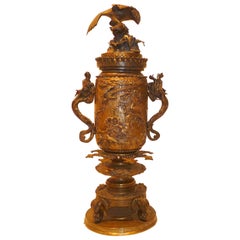
Japanese Bronze Vessel with Dragon Handles and Falcon Lid
Located in Greenwich, CT
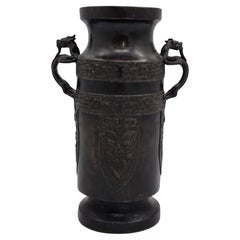
Japanese bronze vessel with pair of dragon handles, falcon lid, birds in landscape and elephant heads base.
Category
Japanese Meiji Antique 16th Century Metalwork
Materials
Bronze
$3,500 Sale Price
27% Off
H 26 in W 12 in D 8 in
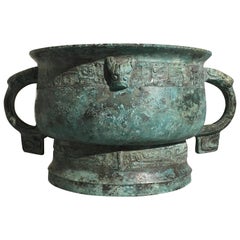
Archaic Chinese Bronze Ritual Vessel, Gui, Early Western Zhou, 11th century BCE
Located in Austin, TX
A stunning and rare Chinese archaic bronze gui, a type of ritual bronze vessel used to hold grain, either for feasting, or for making offerings ...
Category
Chinese Archaistic Antique 16th Century Metalwork
Materials
Bronze
$48,000
H 5.13 in Dm 10 in
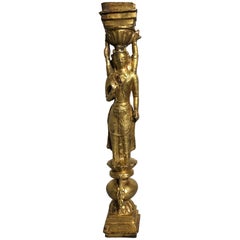
Densatil Gilt Bronze Caryatid Figure, Tibet, 15th Century
Located in Austin, TX
A heavy and solidly cast, richly gilt, bronze caryatid figure from Densatil Monastery, Central Tibet, early 15th century or earlier.
Cast in the form of two four armed figures standing back to back in tribhanga (thrice bent position) on a lotus platform, this piece would originally have served as a pillar for a larger seated deity...
Category
Tibetan Tibetan Antique 16th Century Metalwork
Materials
Bronze
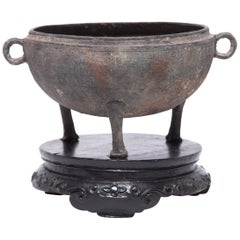
Chinese Bronze Vessel with Tripod Feet, c. 1750
Located in Chicago, IL
This 18th century bronze vessel with tripod feet was crafted by hand in a traditional Chinese shape known as "ding," that dates back to 1600 BC. Tripod bowls were originally used for making religious offerings to ancestral gods. This ding is mounted on a finely carved hardwood...
Category
Chinese Qing Antique 16th Century Metalwork
Materials
Bronze
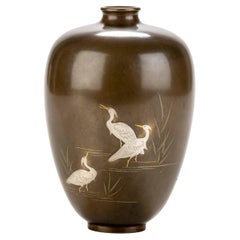
A Japanese bronze vase with three egrets
Located in Milano, IT
Bulbous vase in bronze with a shiny patina and three elegant white egrets in inlaid silver with golden beaks and feet.
Period: Meiji, late 19th century.
Dimensions: 11 x 8.5 cm.
Con...
Category
Japanese Japonisme Antique 16th Century Metalwork
Materials
Bronze
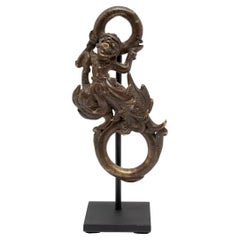
Bronze Wrathful Deity Ring, c. 1900
Located in Chicago, IL
This sculptural bronze object is a charming example of 19th-century metalwork. The bronze figure is formed as a Buddhist wrathful deity, weari...
Category
Chinese Qing 16th Century Metalwork
Materials
Bronze
Previously Available Items
Ming Dynasty Bronze Vase ( 1368- 1644 )
Located in Hoddesdon, GB
Chinese Ming dynasty bronze vase ( 1368- 1644 ) A genuine Ming vase dating from the early to middle of the ming dynasty. Archaistic decoration...
Category
Chinese Antique 16th Century Metalwork
Materials
Bronze
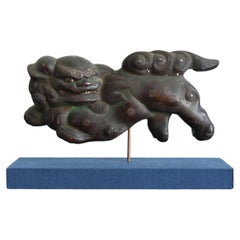
Rare Japanese Copper Lion Ornament/1500-1650/Engraved Copper Figurine
Located in Sammu-shi, Chiba
We have a unique Japanese aesthetic sense.
And only we can introduce unique items through our purchasing channels in Japan and the experience we have gained so far, in such a way th...
Category
Japanese Other Antique 16th Century Metalwork
Materials
Copper
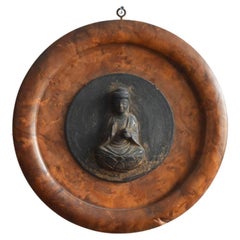
1500-1650 Japanese Antique Copper Cast Buddha Statue / Wall Hanging Decoration
Located in Sammu-shi, Chiba
We Japanese introduce unique items with unique aesthetics, purchasing routes and methods that no one can imitate.
This is what is called a hanging Buddha. (Called kakebutu in Japan)
A hanging Buddha is a cast of a disk and a Buddha statue, and was hung at a temple.
It can be said to be one of the genres of Japanese cultural properties.
And this Kakebutsu is believed to date from the 16th century to the beginning of the 17th century.
In other words, it is from the latter half of the Muromachi period to the beginning of the Edo period.
Originally it was gold, but the color has faded and turned black to copper.
However, this Buddha statue still has gold.
It is rare for gold to remain, indicating that it is in good condition.
The name of this Buddha statue is "Yakushi Nyorai...
Category
Japanese Other Antique 16th Century Metalwork
Materials
Copper
H 14.18 in W 14.18 in D 2.37 in
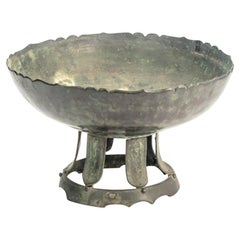
Japanese Bronze Buddhist Water Bowl from the Momoyama Period
Located in Prahran, Victoria
Japanese bronze water bowl which has led a previous life within a Buddhist temple, possibly as a vessel offering water for the cleansing of many hands, or perhaps placed at a doorway, providing nurture to a passing bird or animal. It would happily find it's place and tell it's story within your courtyard, or at your front door, sing it's song to all who pass, your favourite flowers adrift on the water it holds in it's lotus shaped arms.
From the Momoyama period...
Category
Japanese Antique 16th Century Metalwork
Materials
Bronze
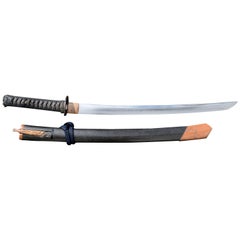
Wakizashi Samurai Short Sword Tsunahiro School Circa 1550-1650 by Tsunaie
Located in Soquel, CA
Superb and precious Samurai Wakizashi Sword with superior mountings and Shirasaya. With crests of the Hikone-Tachibana (Ii-clan) on the sword Habaki (sword collar) (The Ii became pow...
Category
Japanese Antique 16th Century Metalwork
Materials
Wrought Iron
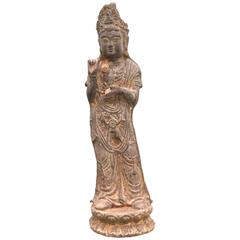
Ming Dynasty Iron Figure of a Standing Guanyin
Located in Torino, IT
The figure has been cast in iron. There are traces of polychrome red lacquer that was highlighting the robe, and the petals of the double lotus base.
Ming Dynasty (1368-1644), China.
Guanyin is known to be the female bodhisattva of infinite compassion and mercy to East Asian Buddhism. Her full name is Guan Shi Yina; Guan means to observe, watch, or monitor, Shi means the world, Yin means sounds, specifically sounds of those who suffer. Thus, Guanyin is believed to be a compassionate being who watches for and responds to the people in the world who cry out for help. To be compassionate is the supreme Virtue of Mahayana Buddhism. She is also associated with vegetarianism, being an act of compassion toward animals. Guanyin was introduced to China as early as the 1st century AD and spread to Japan through Korea soon after Buddhism was first introduced into the country in the mid seventh century. Historically, the worship of Guanyin was represented as the male Indian Bodhisattva Avalokitesvara, who is portrayed as a healer to the sick and injured. When the worship of Avalokitesvara migrated into China it was worshiped in its masculine form. Since Avalokitesvara is considered to be the personification of compassion and kindness, and these traits are associated with the Chinese concept of Yin, the feminine aspect of creation, the representation of Avalokitesvara in China metamorphosed to an all female form around the twelfth century due to Taoist influence on Buddhism. Avalokitesvara has the largest number of forms and is the most popular Buddhist deity. Guanyin is thought to be neither male or female but in accordance with the lotus sutra the body can take on any form necessary to relieve suffering.
In a modern period, Guanyin is to be depicted as a beautiful woman wearing a white flowing robe (white representing purity) who brings wealth and children made by her devotees. This depiction derives from the earlier Pandaravaisni also known as Padmapani in the sanskrit from. The name Padmapani means "born of the lotus", the lotus leaf symbolizing purity, peace, and harmony. Along with the white flowing robe, Guanyin is also often shown wearing necklaces or adornments of Indian and or Chinese royalty...
Category
Chinese Ming Antique 16th Century Metalwork
Still Thinking About These?
All Recently ViewedMore Ways To Browse
Japanese Bronze Crane And Turtle
Miyao Bronze
Quran Verse
Small Incense Burner
Tibetan Metal Art
Zhou Bronze
Antique Arabic Coffee Pot Dallah
Antique Chinese Bronze Marks
Antique Lime Boxes
Bidri Art
Burmese Bell
Cast Iron Kettle
Chinese Cloisonne Censer
Chinese Cloisonne Incense Burner
Chinese Tripod Bronze Censer
Hand Hammered Raj
Islamic Safavid
Japanese Bronze Miyao