1 of 8
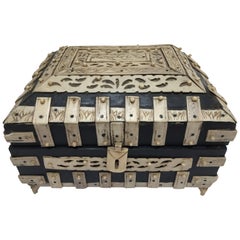
18th century Dutch-Colonial ‘Vizagapatam’ pen-engraved bone inlaid ebony box
$41,605.92List Price
About the Item
- Dimensions:Height: 4.26 in (10.8 cm)Width: 18.51 in (47 cm)Depth: 13.39 in (34 cm)
- Style:Dutch Colonial (Of the Period)
- Materials and Techniques:
- Place of Origin:
- Period:
- Date of Manufacture:circa 1720-1740
- Condition:Wear consistent with age and use.
- Seller Location:Amsterdam, NL
- Reference Number:1stDibs: LU5458231950892
Authenticity Guarantee
In the unlikely event there’s an issue with an item’s authenticity, contact us within 1 year for a full refund. DetailsMoney-Back Guarantee
If your item is not as described, is damaged in transit, or does not arrive, contact us within 7 days for a full refund. Details24-Hour Cancellation
You have a 24-hour grace period in which to reconsider your purchase, with no questions asked.Vetted Professional Sellers
Our world-class sellers must adhere to strict standards for service and quality, maintaining the integrity of our listings.Price-Match Guarantee
If you find that a seller listed the same item for a lower price elsewhere, we’ll match it.Trusted Global Delivery
Our best-in-class carrier network provides specialized shipping options worldwide, including custom delivery.You May Also Like
Anglo-Indian Vizagapatam Bombay Mughal Style Footed Box With Bone Overlay
Located in Moreno Valley, CA
Nice and unusual Indian Mughal style large decorative box, filigree and carved horn.
Anglo-Indian footed domed box with exceptional engraved details throughout with filigree and carved veneered bone plaques with arabesque carving.
Vizagapatam, late 19th century.
History of the Anglo-Indian Boxes
Beginning in the early part of the 18th century, Indian artisans made what came to be known as Anglo-Indian boxes for the English residents living in India, who eventually brought or sent them back to England. At the beginning of the 19th century, India began exporting these boxes commercially, although not in any significant numbers until the 1850s. People valued them so highly that manufacturers of tins copied the designs on them in the late 19th and early 20th century.
Anglo-Indian boxes fall into four groups: Rosewood or ebony boxes inlaid;
sandalwood boxes veneered; sandalwood boxes covered with Sadeli mosaic; and carved boxes often combined with Sadeli mosaic/
The first two categories came from Vizagapatam in East India while the last two came from Bombay in West India.
English traders discovered the rich woods and intricate workmanship of Indian artisans, so colonial government officials began to recognize the work of the Indian artists and craftsmen as a source for satisfying the need for furniture and boxes, which would both serve to enhance English households in India. This gave rise to the cabinetmaking workshops in Vizagapatam between Calcutta and Madras.
Craftsmen made the first boxes to be decorated with Sadeli mosaic of rosewood or ebony, incised to give further definition to the decoration, directly inlaid into the wood. The shape of the early boxes was either sloping at the front with a flatter section at the back, reminiscent of English writing slopes, or rectangular. Artisans inlaid the borders with stylized floral scrolls and the centers with a single floral motif following a circular or oval symmetrical or asymmetrical pattern. The edging was ornamental and protective, both helped protect the end grain against the weather.
Made in Vizagapatam, situated on the south east coast of India, near Madras
These exotic boxes...
Category
Antique Late 19th Century Indian Anglo Raj Decorative Boxes
Materials
Wood
$1,650
H 6.5 in W 9.75 in D 8 in
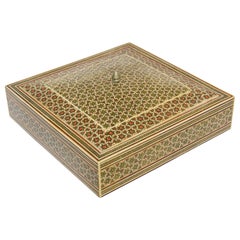
Moorish Micro Mosaic Inlaid Jewelry Box
By Rajhastani
Located in Moreno Valley, CA
Moorish style micro mosaic marquetry inlaid jewelry box with lid.
Intricate inlaid Anglo Indian box with floral and geometric Islamic
Moorish mosaic Sadeli design in a square shape form with mosaic inlay and marquetry, very fine artwork, lined in red velvet.
Museum collector piece like the one in Doris Duke Islamic Art Museum.
The repeating geometric patterns of Sadeli Mosaic are what give it beauty and richness. This decorative technique is a type of micro mosaic featuring repeating geometric patterns. A highly skilled craft, it has had a long history in India and the Middle East with early examples dating back to the 16th century. In the 1800s, it became popular as a decoration on a variety of boxes, card cases, and chess boards imported from India. Since Bombay became a center of making them, they became known as Bombay boxes...
Category
Mid-20th Century Indian Agra Jewelry Boxes
Materials
Wood
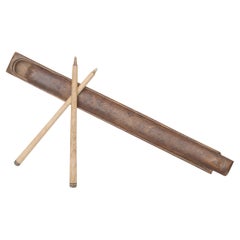
Provincial Chinese Wooden Box with Bone Chopstick Handles
Located in Chicago, IL
A narrow wooden box with a sliding lid and a pair of carved bone chopstick handles with contrasting dark inlay at the ends. The bone handles were likely originally affixed to chopsti...
Category
Antique Mid-19th Century Chinese Qing More Asian Art, Objects and Furniture
Materials
Wood, Bone
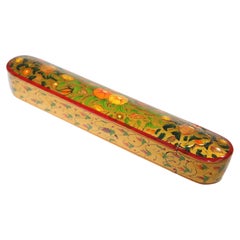
Persian Lacquer Pen Box Hand Painted with Floral and Gilt Design
Located in Moreno Valley, CA
Persian hand painted lacquer pen box in rectangular shape.
Decorated with floral designs on gold background, black interior.
Moorish Mughal pen box papier maché with miniature floral painting in the Persian style.
Great Islamic Art collector museum quality piece on this miniature painting on box.
Nice Mughal Indo Persian pen Box...
Category
Early 20th Century Indian Moorish Decorative Boxes
Materials
Paper
Handcrafted White Mother of Pearl Inlaid Moorish Octagonal Box
Located in Moreno Valley, CA
Exquisite handcrafted white mother of pearl inlaid and hand carved lidded box.
Small octagonal Anglo Indian decorative box intricately decorated with Moorish motif designs which hav...
Category
Mid-20th Century Indian Moorish Decorative Boxes
Materials
Shell, Fruitwood, Abalone, Mother-of-Pearl
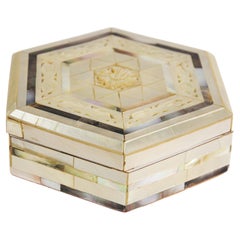
19th Century Asian Wooden Decorative Storage Box
Located in Germantown, MD
Mid 19th Century Asian Wooden decorative storage box with lid.
Measures 13.5"W x 11"D x 11.5"H.
Category
Antique Mid-19th Century Chinese Chinese Export Decorative Boxes
Materials
Metal
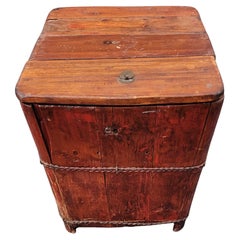
Anglo-Indian Footed Box with Lidded Compartments, 19th Century
Located in Moreno Valley, CA
19th century Anglo-Indian wooden box fitted with various compartments finely hand carved.
The top is finely hand carved with the Taj Mahal.
The interior with removable hand carved nine-lidded compartments, the front cover has a mirror, the whole exhibiting very fine workmanship.
This fine late Victorian Anglo-Indian box from India is in great condition for it age.
A beautiful example of an Anglo-Indian fine art...
Category
Antique Late 19th Century Indian Anglo-Indian Decorative Boxes
Materials
Sandalwood
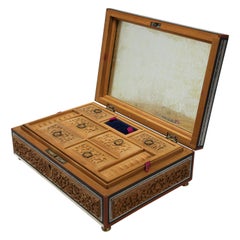
Gilt Lacquer Wood Manuscript Storage Box Burma 19th Century
Located in Moreno Valley, CA
Gilt Lacquer Wood Manuscript storage box Burma 19th century.
This wooden box is entirely covered in moulded lacquer-work in relief (known as thayo w...
Category
Antique Late 19th Century Thai Other Decorative Boxes
Materials
Teak
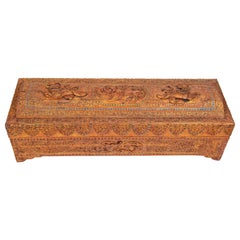
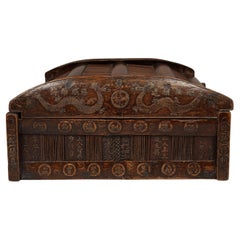
Late 19th/20th Century Shopkeeper
s Money Box with Blessings, Southern China
Located in Point Richmond, CA
Shopkeeper’s Money Box with Blessings
Southern China
Late 19th/early 20th century
Wood, bamboo
H: 7 in x W: 14.75 in x D: 11.75 in
Two dragons sit surrounding a pearl of wisdom on t...
Category
Antique Late 19th Century Chinese Tribal More Asian Art, Objects and Fur...
Materials
Wood, Bamboo
$1,500
H 7 in W 14.75 in D 11.75 in
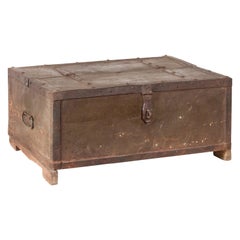
Indian 19th Century Box with Metal Sheathing and Bracketed Wooden Base
Located in Yonkers, NY
An Indian antique box from the 19th century with metal sheathing and bracketed base. Created in India during the 19th century, this antique box features a linear silhouette made of m...
Category
Antique 19th Century Indian Decorative Boxes
Materials
Metal
$750
H 8 in W 17.25 in D 12.5 in