Items Similar to 17th Century Japanese Screen Pair. Flock of Cranes. Ink and color on gold leaf.

Want more images or videos?
Request additional images or videos from the seller
1 of 14
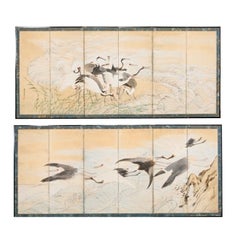
17th Century Japanese Screen Pair. Flock of Cranes. Ink and color on gold leaf.
$72,000per set
£54,919.24per set
€62,673.62per set
CA$101,250.85per set
A$111,125.22per set
CHF 58,397.95per set
MX$1,322,367.84per set
NOK 746,499.24per set
SEK 682,152.58per set
DKK 468,234.20per set
About the Item
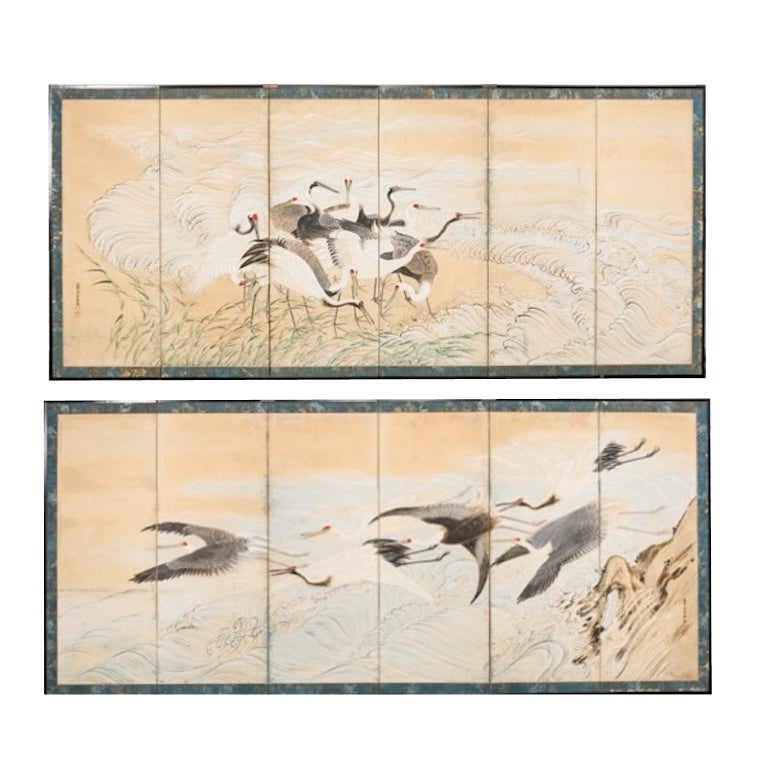
A pair of six-fold Japanese screens from the 17th century depicting a flock of cranes arriving at their wintering grounds. The expansive scene is heavily atmospheric. The cranes are flying into the wind, beaks open in high pitched calls, wings beating heavily. Painted in dark and largely uniform tones the cranes present almost as silhouettes, conveying the lateness of the day and heightening the tension of the scene. The faintly ink brushed rice fields and stubs of harvested rice denote season and surroundings, but are subtle indicators rather than firmly delineated elements. The rocky precipice is similarly faintly brushed in light ink, effectively conveying the sense without intruding on the wide open expanse of gold. The scene is anchored at its left and right extremes by subtle clusters of foliage; dwarf bamboo and reeds.
The scene is unique. The artist has presented the work like a hand-scroll, emphasizing the wide expanse and telling a story as we read it from right to left. This is grounded in the Yamato-e tradition as revived by earlier Tosa school artists. The work speaks to an age before the crane took on a more decorative and patternated form such as we see with the Unkoku school by the mid 17th century. The telltale brushwork and landscapes of the all powerful Kano school are not evident. Perhaps the influence of the Hasegawa school is to be found in the resting cranes and the singular precipice, along with the artist’s pursuit of atmosphere. The almost all-gold background is more representative of the Rinpa style. The silhouettes of the cranes in flight bring to mind the stenciled works of Sotatsu in his hand-scroll held in the Freer Gallery of Art. Similar cranes in flight can also be found in a Momoyama period ink screen held in the Hikone Castle Museum. This unique scene points to the artists propensity for experimentation with composition and sensitivity to the tastes of the time.
- Dimensions:Height: 66.5 in (168.91 cm)Width: 149.5 in (379.73 cm)Depth: 0.75 in (1.91 cm)
- Sold As:Set of 2
- Style:Edo (Of the Period)
- Materials and Techniques:
- Place of Origin:
- Period:
- Date of Manufacture:Circa 1650
- Condition:Refinished. Wear consistent with age and use. The screens have recently been completely remounted in Kyoto utilizing traditional craftsmen and techniques.
- Seller Location:Kyoto, JP
- Reference Number:1stDibs: LU2472341871532
About the Seller
5.0
Recognized Seller
These prestigious sellers are industry leaders and represent the highest echelon for item quality and design.
Gold Seller
Premium sellers maintaining a 4.3+ rating and 24-hour response times
Established in 2001
1stDibs seller since 2016
75 sales on 1stDibs
Typical response time: 6 hours
- ShippingRetrieving quote...Shipping from: Kyoto, Japan
- Return Policy
More From This Seller
View All19th Century Japanese Screen Pair - Birds
Flowers of the Four Seasons
Located in Kyoto, JP
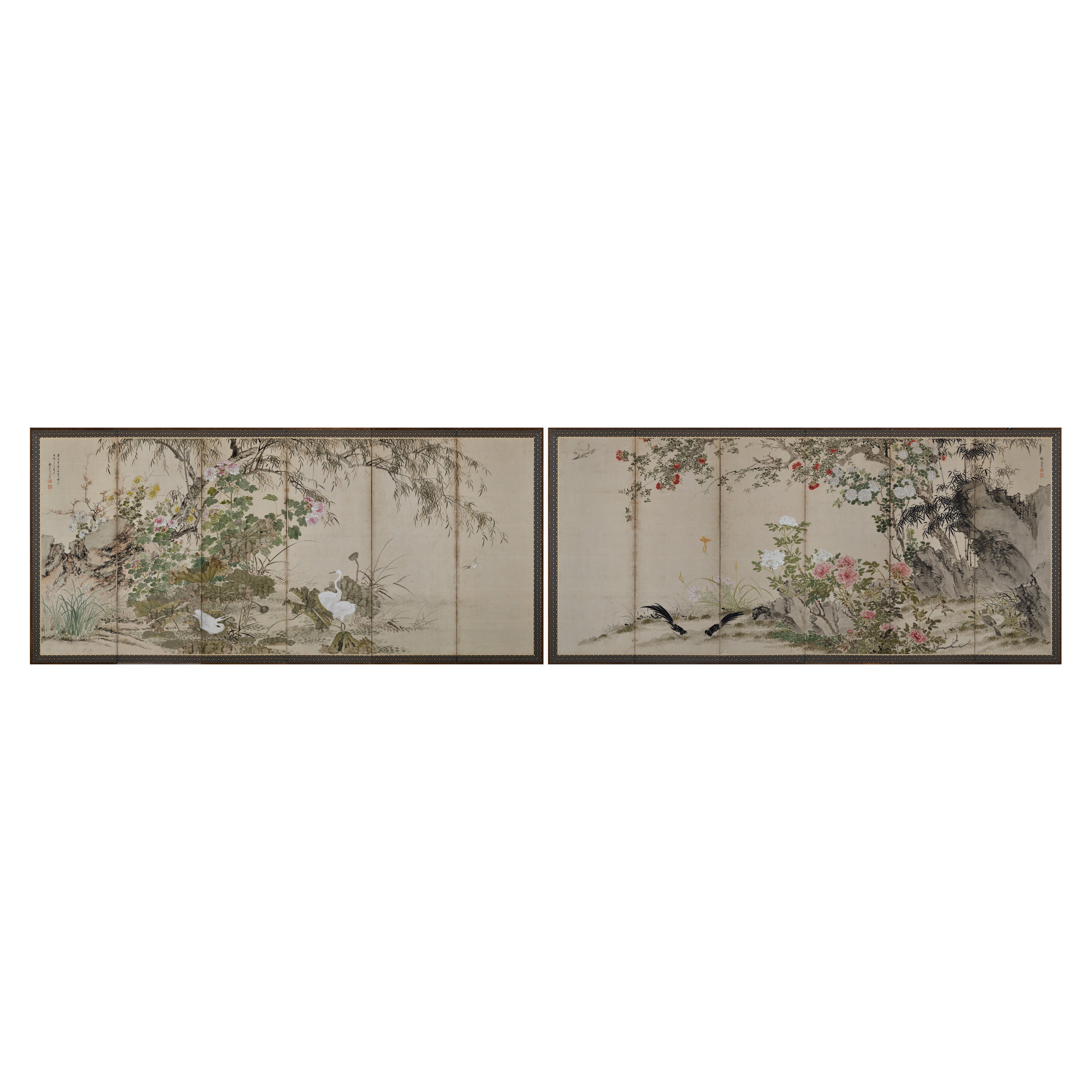
Birds & Flowers of the Four Seasons
Yamamoto Baiitsu (1783-1856)
Late Edo period, Dated 1850
A magnificent pair of six-panel Japanese folding screens by Yamamoto Baitsu, representin...
Category
Antique Mid-19th Century Japanese Edo Paintings and Screens
Materials
Wood, Paper
Meiji era Japanese Screen Pair, Two-panel. Spring
Autumn Birds
Flowers.
Located in Kyoto, JP
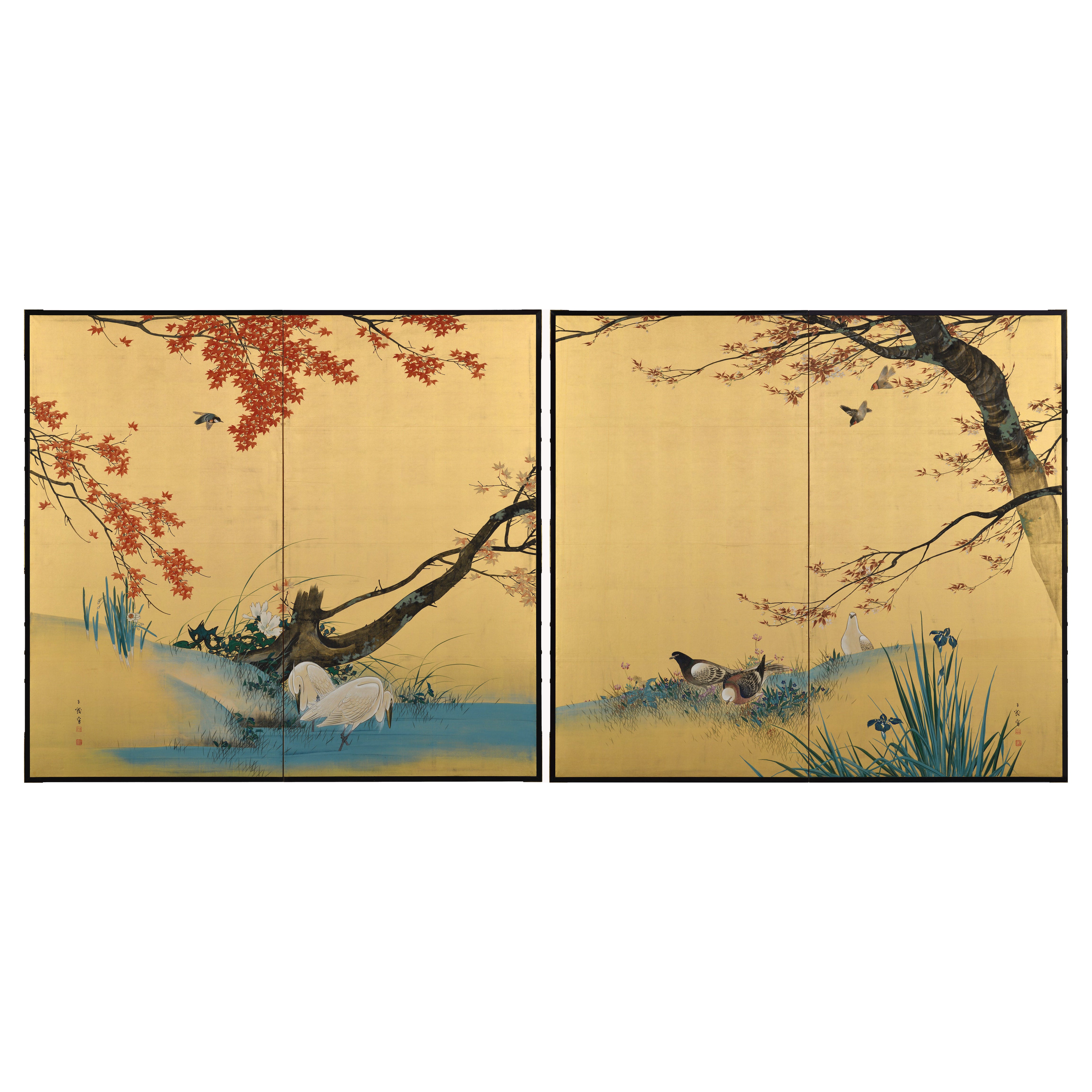
Spring and Autumn Birds & Flowers
Hasegawa Gyokujun (1863-1921)
Meiji period, circa 1900.
Ink, color and gofun on silk.
Dimensions of each screen:
H. 172 cm x W. 188 cm (68’’ x 7...
Category
Early 20th Century Japanese Meiji Paintings and Screens
Materials
Gold Leaf
Mid 18th Century Japanese Screen Pair. Crows
Pines by Unkoku Toshuku.
Located in Kyoto, JP
Unkoku Toshuku (1722-1779)
Crows and Pines
A pair of six-panel Japanese Screens. Ink and gold leaf on paper.
Dimensions: Each Screen: H. 170.5 cm x W. 375 cm
Haha-cho or mynah birds, whose forms resemble crows in artwork, were commonly depicted in Japanese art. These types of paintings were originally modeled on paintings attributed to the 13th century Chinese painter Muqi (Mokkei), whose art was enormously influential in Japan. Crows only became a theme among Japanese artists from the later 1500s onward. They likely were inspired by these imported Chinese paintings of myna birds, which are not native to Japan, substituting the native species of crow instead.
The best known early examples of the depiction of Japanese crows are two Momoyama screen...
Category
Antique Mid-18th Century Japanese Edo Paintings and Screens
Materials
Gold Leaf
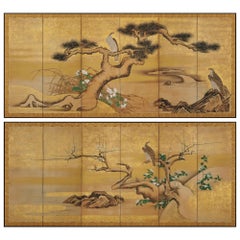
17th Century Japanese Screen Pair by Soga Nichokuan, Hawks on Pine
Plum Trees
Located in Kyoto, JP
Hawks on plum and pine
Soga Nichokuan (active circa 1625-1660)
Pair of six-fold screens.
Ink, mineral pigments, gofun, gold and speckled gold l...
Category
Antique 1640s Japanese Edo Paintings and Screens
Materials
Wood, Paper
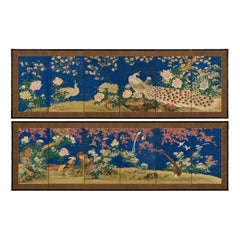
Mid 19th Century Japanese Screen Pair. Flowers
Birds of the Four Seasons.
Located in Kyoto, JP
Shioka Sorin (1781-1850)
Flowers & Birds of the Four Seasons
Pair of six-panel Japanese Screens. Ink, gofun and pigments on silk.
Dimensions (each screen): H. 91.5cm x W. 285cm (3...
Category
Antique Mid-19th Century Japanese Edo Paintings and Screens
Materials
Silk
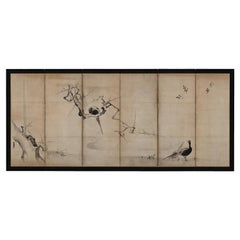
17th Century Japanese Screen. Ink Plum Tree
Birds by Kano Naonobu.
Located in Kyoto, JP
Kano Naonobu (1607-1650)
Plum Tree and Birds
Six-fold Japanese Screen. Ink and slight color on paper.
In this evocative ink work spread over a six-panel folding screen, we see the consummation of the elegance and refinement of the Edo Kano school. This 17th century screen is a rare surviving example of a large-scale bird and flower painting by Kano Naonobu, the younger brother of Kano Tanyu...
Category
Antique 17th Century Japanese Edo Paintings and Screens
Materials
Wood, Paper
You May Also Like
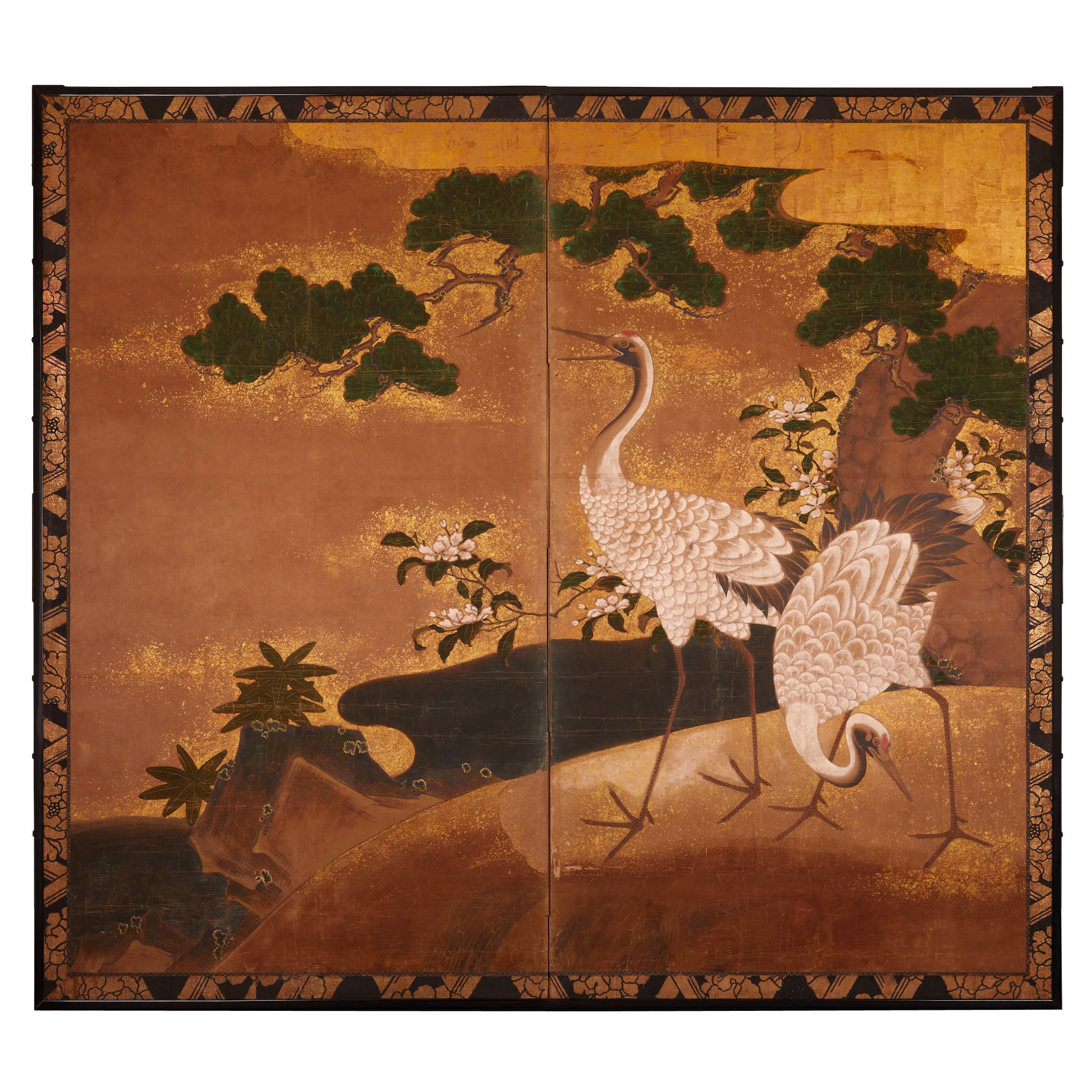
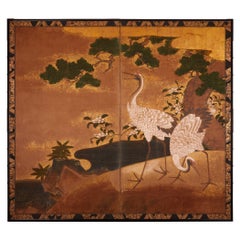
Japanese Two-Panel Screen: Cranes on Gold
Located in Hudson, NY
Early Kano School painting of pine trees overlooking two beautifully painted cranes and floral design in a natural setting by water’s edge. Mineral pig...
Category
Antique Late 18th Century Japanese Paintings and Screens
Materials
Gold, Gold Leaf
Pair of Japanese Meiji Six Panel Screen Cranes Above Cresting Waves
Located in Rio Vista, CA
Amazing 19th century pair of large Japanese Meiji period six panel screens each depicting a sedge of Manchurian red-crowned cranes along the shore. The screens are crafted in the Nihonga school style with intricate details and beautifully depicted cresting waves. Each screen is signed by artist Hakundo Keikan and studio name of Watahiki Tokai (Japanese 1837-1915). Both screens are signed with red seals on the left and right side. Tokai was a Chinese scholar from the late Edo period and served in the Imperial Household...
Category
Antique 19th Century Japanese Meiji Paintings and Screens
Materials
Brass
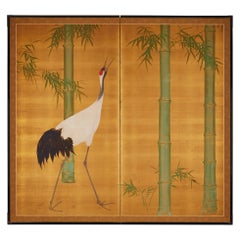
Japanese Two Panel Screen: Bamboo and Manchurian Crane
Located in Hudson, NY
Kano style painting in mineral pigments on silk with a silk brocade border.
Category
Early 20th Century Japanese Paintings and Screens
Materials
Brocade, Silk
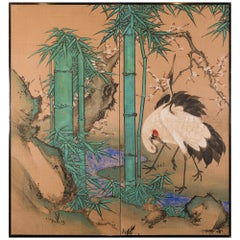
Japanese Two Panel Screen Amorous Cranes and Turtles
Located in Hudson, NY
Japanese two panel screen: Amorous Cranes and Turtles. In Japan, cranes symbolize fidelity as they mate for life and turtles symbolize longevity. Additionally, this screen also has the Japanese motif of sho-chiku-bai, or the three friends of winter (pine, plum, and bamboo). So called the three friends of winter because all three flourish during the cold months. This screen was originally fusuma doors...
Category
Antique 1850s Japanese Edo Paintings and Screens
Materials
Wood, Paper
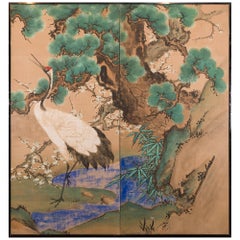
Japanese Two Panel Screen Manchurian Crane and Turtles
Located in Hudson, NY
In Japan, cranes symbolize fidelity as they mate for life and turtles symbolize longevity. Additionally, this screen also has the Japanese motif of sho-chiku-bai, or the three friends of winter (pine, plum, and bamboo). So called the three friends of winter because all three flourish during the cold months. This screen was originally fusuma doors...
Category
Antique Mid-19th Century Japanese Edo Paintings and Screens
Materials
Paper
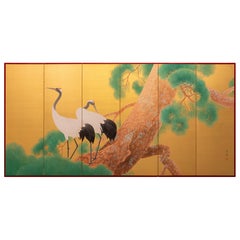
A six-panel folding screen with a pair of Manchurian cranes on gilt silk
Located in Milano, IT
A Japanese six-panel folding screen painted on silk with a golden ground, depicting two Manchurian cranes perched on a pine (matsu) branch.
The work bears the signature and seal of ...
Category
Early 20th Century Japanese Paintings and Screens
Materials
Silk, Paper
More Ways To Browse
Gold Cranes
Flying Cranes
Pair Of Crane
Japanese Crane Art
Rice Field
Crane Screen
Pair Of Japanese Screens
Antique Brown Paint Color
Pair Of Japanese Paintings
17th Century Japanese Paintings
17th Century Japanese Screens
Japanese Crane Screen
Gold Crane Japanese
Japanese Screens Six Fold
Tosa School
Gold Screen Crane
Gold Leaf Cranes
Japanese Art Of Cranes