Items Similar to 17th Century Japanese Screen Pair by Soga Nichokuan, Hawks on Pine
Plum Trees

Want more images or videos?
Request additional images or videos from the seller
1 of 13
17th Century Japanese Screen Pair by Soga Nichokuan, Hawks on Pine
Plum Trees
$85,000per set
£64,832.09per set
€73,828.08per set
CA$119,450.93per set
A$130,278.02per set
CHF 69,012.51per set
MX$1,561,848.48per set
NOK 878,912.58per set
SEK 803,700.33per set
DKK 551,568.06per set
About the Item
Hawks on plum and pine
Soga Nichokuan (active circa 1625-1660)
Pair of six-fold screens.
Ink, mineral pigments, gofun, gold and speckled gold leaf on paper.
Upper seal: Hoin
Lower seal: Nichokuan
The combination of pine trees and hawks was a favourite subject of Japanese warrior-patrons from the 15th century on. Such representations painted on large screens or panels made impressive backdrops in main reception rooms. The painter of these screens, Soga Nichokuan, specialized in painting hawks, as did his father Soga Chokuan.
This pair of screens feature hawks on plum and pine trees, referencing winter and summer. They are painted on a paper ground which exhibits both gold wash and speckled gold leaf, which fills the pictorial surface and gives the effect of a bright and boundless atmosphere. The hawks have a dignified silhouette, their features carefully portrayed with jewel-like precision. The rock formations are textured with broad, parallel brush strokes. The clear, concise geometrical composition is counterbalanced with clusters of flowering camellias and hibiscus, which further emphasize the seasonal nature of the screens. The pine branches are characterized by their eccentric, knobbly forms. The plum tree is bent to form bold curves and its broken branches end abruptly with a broad sweep of the brush. This screen pair shares strong similarities with a pair of Nichokuan screens held at Kousanji (Kosan-ji) temple in Hiroshima prefecture and a pair of Nichokuan screens held at the Shimane Art Museum.
Each screen bears two seals reading Hoin and Nichokuan. Both of these seals are well-known. Soga Nichokuan was a highly respected and talented artist whose works are preserved in major temples throughout the Kansai region of Japan to this day. Nichokuan was succeeded by a number of painters, including Sanchokuan and Tamura Chokuou. Paintings by Soga Nichokuan are held at Daitoku-ji temple in Kyoto, Fumon-in in Wakayama, and Kosan-ji and Choen-ji in Hiroshima. Works by both Chokuan and Nicokuan are also preserved at a number of temples on Mount Koya in Wakayama. The pair of screens by Nichokuan held at Daitoku-ji temple is registered as an Important Cultural Property. In 1989, an important exhibition with an accompanying catalogue was held in Nara. It was dedicated to the screen and scroll paintings of Soga Chokuan and Nichokuan. Paintings of Soga Chokuan and Nichokuan; Elizabeth Ann Lillehoj, Nara Prefectural Museum of Art (1989).
- Dimensions:Height: 67.5 in (171.45 cm)Width: 148 in (375.92 cm)Depth: 0.75 in (1.91 cm)
- Sold As:Set of 2
- Style:Edo (Of the Period)
- Materials and Techniques:
- Place of Origin:
- Period:1640-1649
- Date of Manufacture:circa 1640
- Condition:Refinished. The screens have been completely remounted.
- Seller Location:Kyoto, JP
- Reference Number:1stDibs: LU2472320570842
About the Seller
5.0
Recognized Seller
These prestigious sellers are industry leaders and represent the highest echelon for item quality and design.
Gold Seller
Premium sellers maintaining a 4.3+ rating and 24-hour response times
Established in 2001
1stDibs seller since 2016
75 sales on 1stDibs
Typical response time: 6 hours
- ShippingRetrieving quote...Shipping from: Kyoto, Japan
- Return Policy
More From This Seller
View AllMid 18th Century Japanese Screen Pair. Crows
Pines by Unkoku Toshuku.
Located in Kyoto, JP
Unkoku Toshuku (1722-1779)
Crows and Pines
A pair of six-panel Japanese Screens. Ink and gold leaf on paper.
Dimensions: Each Screen: H. 170.5 cm x W. 375 cm
Haha-cho or mynah birds, whose forms resemble crows in artwork, were commonly depicted in Japanese art. These types of paintings were originally modeled on paintings attributed to the 13th century Chinese painter Muqi (Mokkei), whose art was enormously influential in Japan. Crows only became a theme among Japanese artists from the later 1500s onward. They likely were inspired by these imported Chinese paintings of myna birds, which are not native to Japan, substituting the native species of crow instead.
The best known early examples of the depiction of Japanese crows are two Momoyama screen...
Category
Antique Mid-18th Century Japanese Edo Paintings and Screens
Materials
Gold Leaf
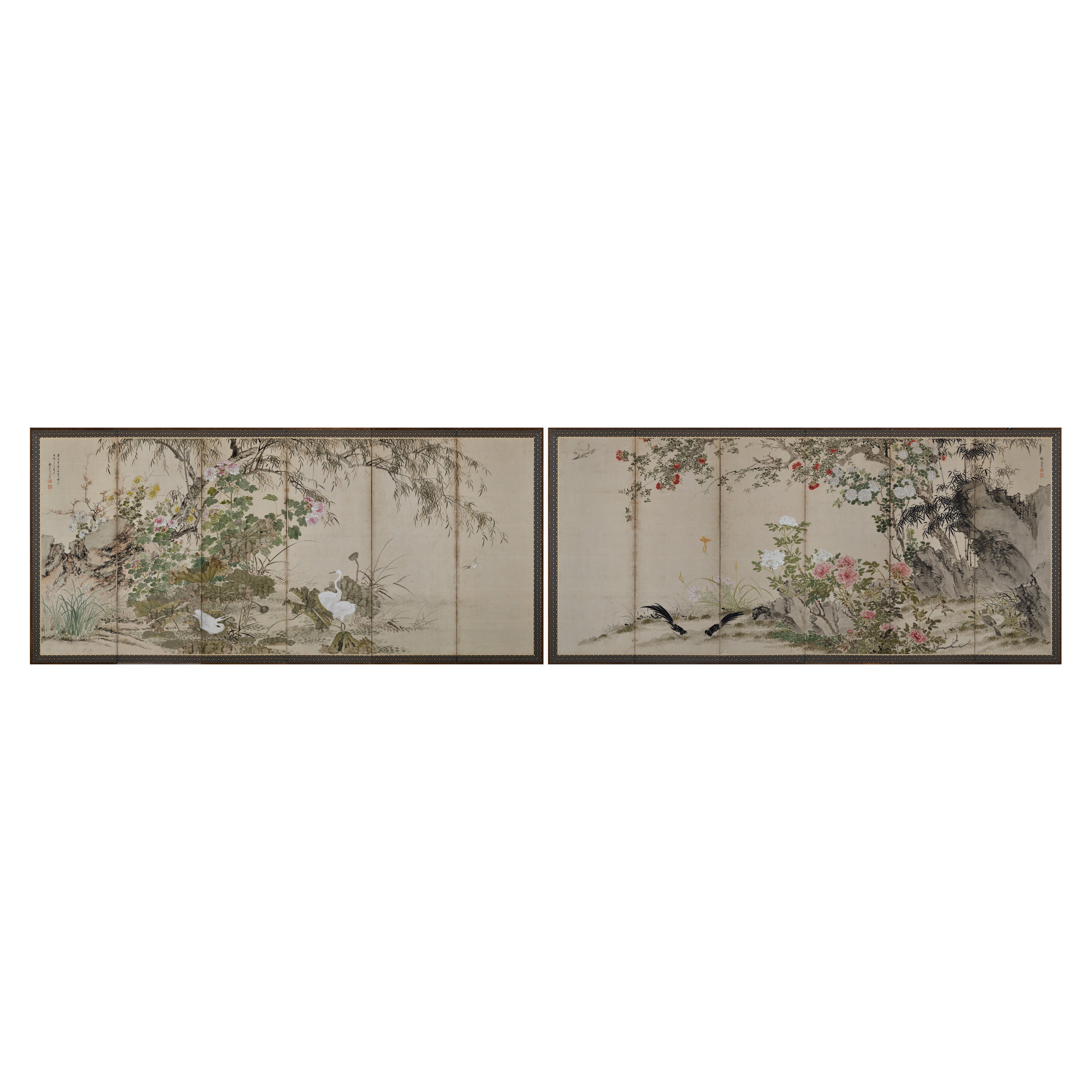
19th Century Japanese Screen Pair - Birds
Flowers of the Four Seasons
Located in Kyoto, JP
Birds & Flowers of the Four Seasons
Yamamoto Baiitsu (1783-1856)
Late Edo period, Dated 1850
A magnificent pair of six-panel Japanese folding screens by Yamamoto Baitsu, representin...
Category
Antique Mid-19th Century Japanese Edo Paintings and Screens
Materials
Wood, Paper
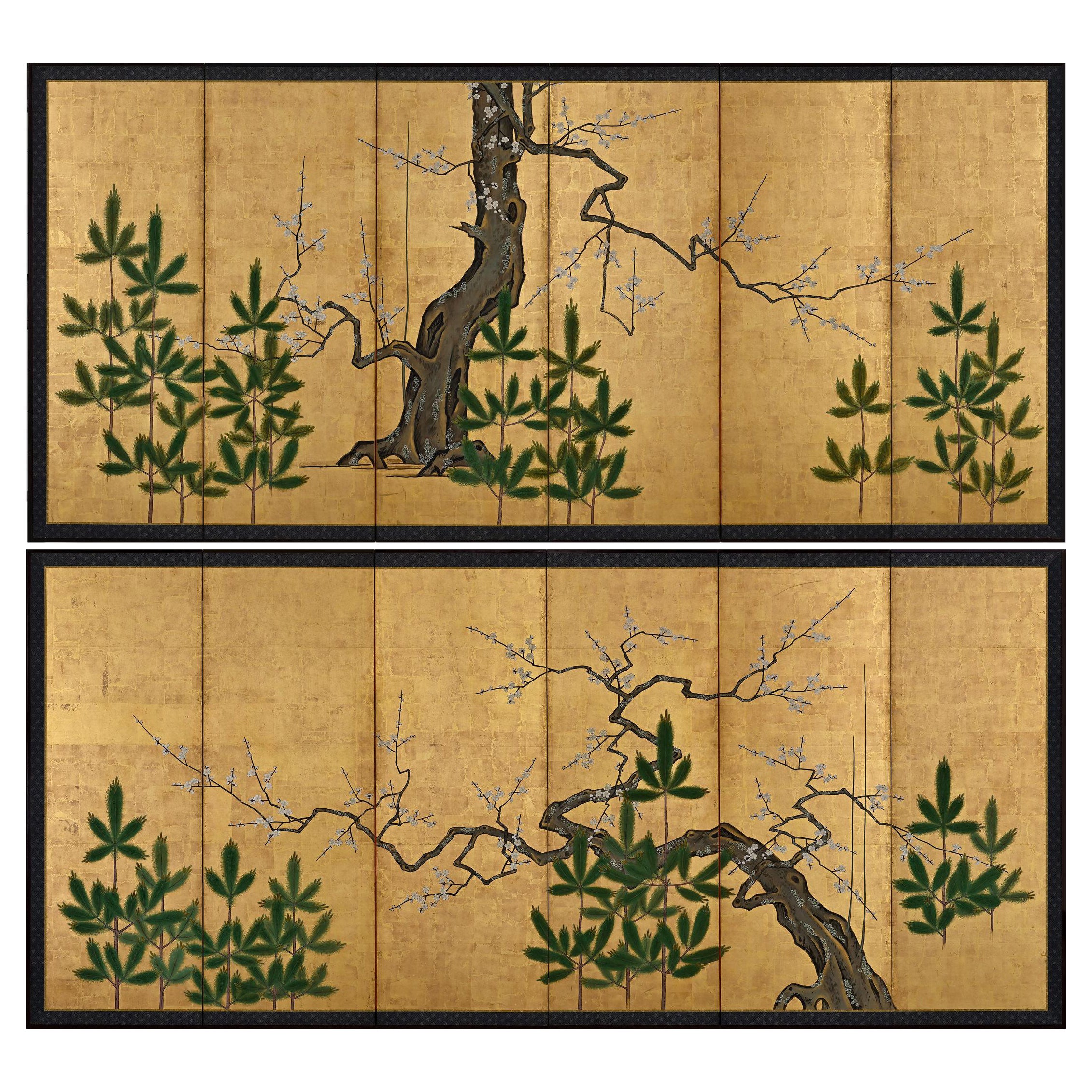
18th Century Japanese Screen Pair. Plum
Young Pines. Kano School.
Located in Kyoto, JP
Dimensions (Each screen): H. 176 cm x W. 378 cm (69’’ x 149’’)
This pair of Japanese folding screens depict blossoming plum trees amongst young pines. They are designed to capture t...
Category
Antique Late 18th Century Japanese Edo Paintings and Screens
Materials
Gold Leaf
Mid 19th Century Japanese Screen Pair. Flowers
Birds of the Four Seasons.
Located in Kyoto, JP
Shioka Sorin (1781-1850)
Flowers & Birds of the Four Seasons
Pair of six-panel Japanese Screens. Ink, gofun and pigments on silk.
Dimensions (each screen): H. 91.5cm x W. 285cm (3...
Category
Antique Mid-19th Century Japanese Edo Paintings and Screens
Materials
Silk
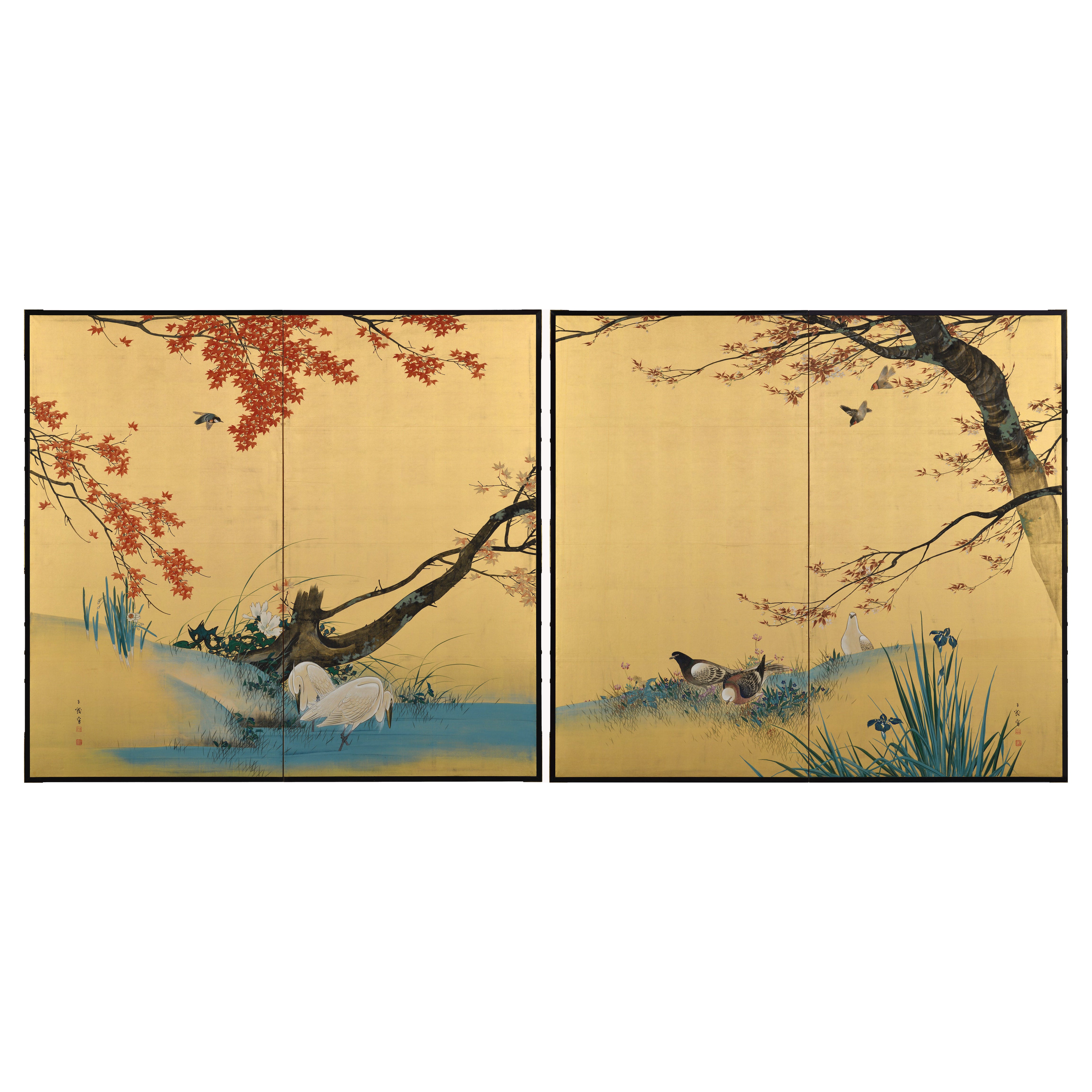
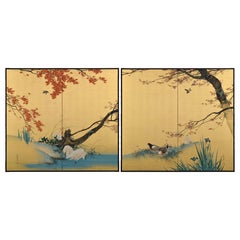
Meiji era Japanese Screen Pair, Two-panel. Spring
Autumn Birds
Flowers.
Located in Kyoto, JP
Spring and Autumn Birds & Flowers
Hasegawa Gyokujun (1863-1921)
Meiji period, circa 1900.
Ink, color and gofun on silk.
Dimensions of each screen:
H. 172 cm x W. 188 cm (68’’ x 7...
Category
Early 20th Century Japanese Meiji Paintings and Screens
Materials
Gold Leaf
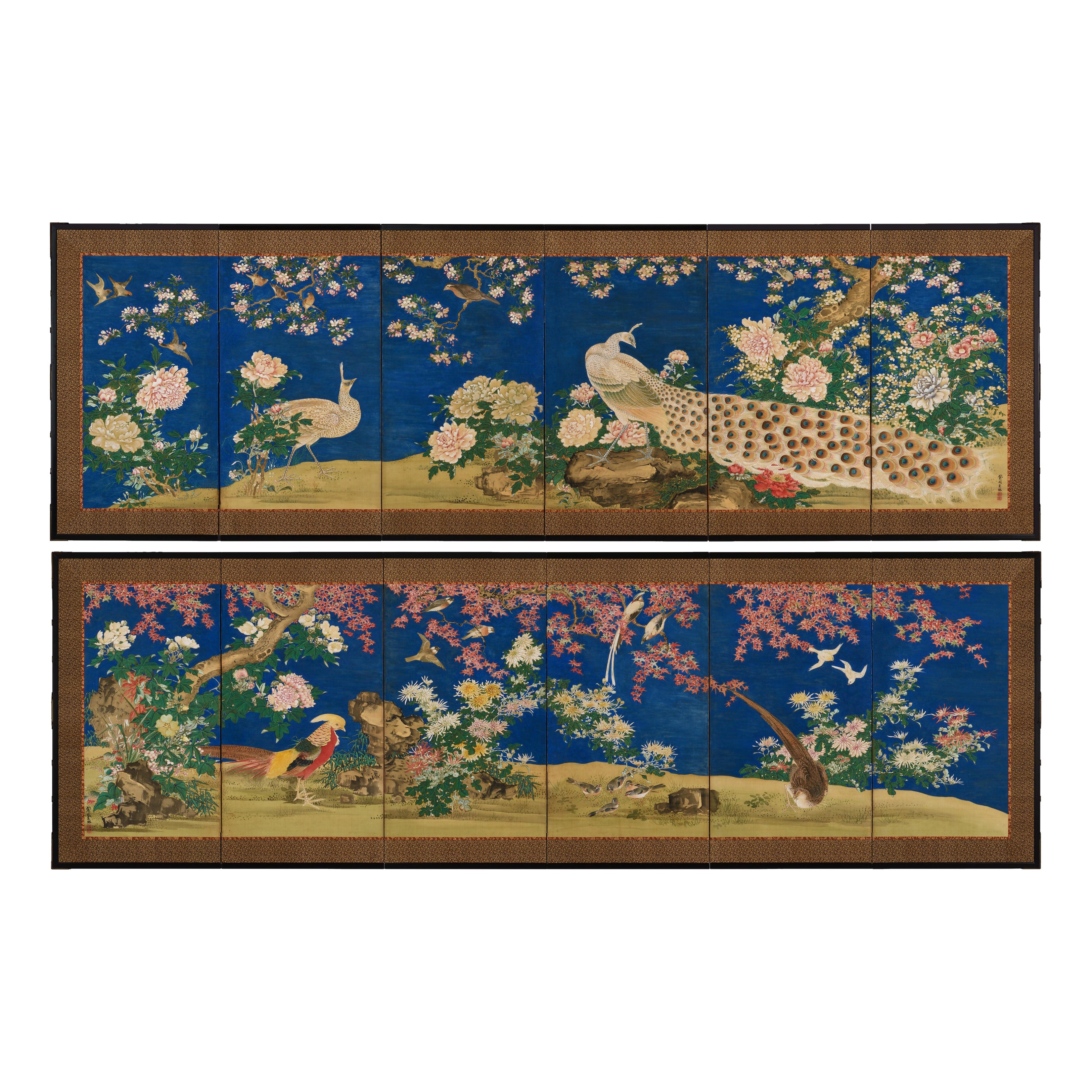
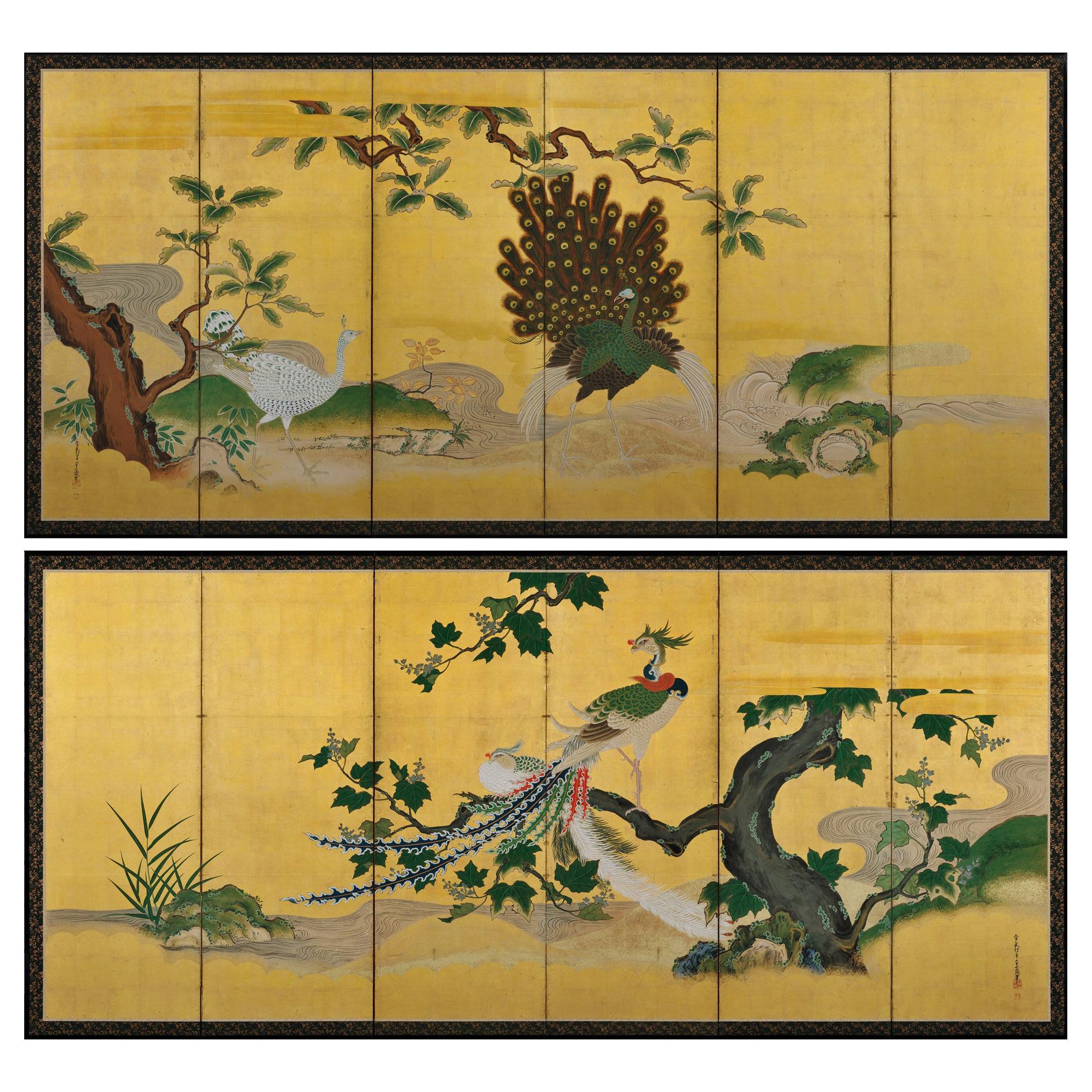
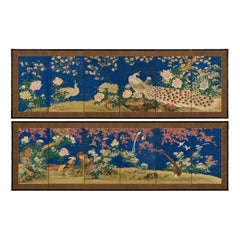
Japanese Screen Pair, circa 1730, Peacocks and Phoenix, Kano School
Located in Kyoto, JP
Phoenix and Peacocks.
A pair of six-panel Japanese folding screens by Tsunetake Yotei (n.d.)
First half of the 18th century.
The signature reads 67 year old Tsunetake.
The seals read:
-Tsunetake no in,
-Yotei,
-Seishin
Dimensions:
Each screen – H. 69” x W. 149” (176 cm x 378 cm)
A pair of Kano Grand Picture (Waga) screens depicting phoenix and peacocks rich with symbolic meaning. Dating to the first half of the 18th century, from the Kobikicho Kano school in Edo, this pair of folding...
Category
Antique Early 18th Century Asian Edo Paintings and Screens
Materials
Gold Leaf
You May Also Like
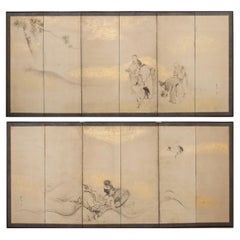
Pair of 18th Century Japanese Edo Screens of Chinese Immortals
Located in Rio Vista, CA
Mesmerizing pair of late 18th/early 19th century Japanese Edo period byobu screens by Shibata Gito (Japanese 1780-1819). The paintings depict Chinese immortals in a dreamy landscape....
Category
Antique 18th Century Japanese Edo Paintings and Screens
Materials
Silk, Wood, Paper
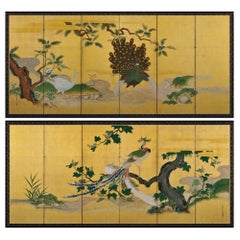
Pair of Japanese Edo Rimpa School Screens after Tawaraya Sōtatsu
Located in Rio Vista, CA
Impressive pair of 17th century Japanese Edo period Rinpa school screens made in the manner and style of Autumn Grasses by Tawaraya Sōtatsu (1570-1640). Beautifully decorated with wi...
Category
Antique 17th Century Japanese Edo Paintings and Screens
Materials
Gold Leaf
Pair of Japanese Edo Six Panel Screens the Seven Sages
Located in Rio Vista, CA
Fantastic pair of 19th century Japanese late Edo/early Meiji period six-panel screens titled The seven sages of the bamboo grove. The Kano school screens...
Category
Antique 19th Century Japanese Edo Paintings and Screens
Materials
Brass, Gold Leaf

Pair of Japanese Edo/Tokugawa Screens Tale of Heiki
Located in Rio Vista, CA
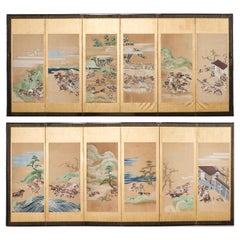
Monumental pair of late 18th century Japanese Edo/Tokugawa period byobu screens depicting the battles between Taira and Minamoto. The screens have six panels each with individual sce...
Category
Antique 19th Century Japanese Edo Paintings and Screens
Materials
Brass, Gold Leaf
Japanese Two Panel Screen Manchurian Crane and Turtles
Located in Hudson, NY
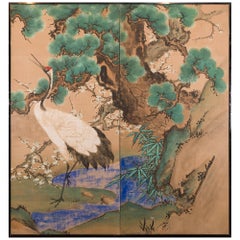
In Japan, cranes symbolize fidelity as they mate for life and turtles symbolize longevity. Additionally, this screen also has the Japanese motif of sho-chiku-bai, or the three friends of winter (pine, plum, and bamboo). So called the three friends of winter because all three flourish during the cold months. This screen was originally fusuma doors...
Category
Antique Mid-19th Century Japanese Edo Paintings and Screens
Materials
Paper
Antique 19th Century Japanese Two-Panel Screen ‘Byobu’, Kano School, Edo Period
Located in London, GB
Japanese Kano School Edo period two-panel screen depicting flowering prunus and bamboo on a rock formation, with colorful birds next to a body of water. ...
Category
Antique Mid-19th Century Japanese Edo Paintings and Screens
Materials
Gold Leaf

More Ways To Browse
Asian Art On Paper
Antique Japanese Lacquer Screens
Plum Wood
Painting Antique Pine Furniture
Asian Art Painting Pair Wood Panel
Japanese Warrior
Japanese Painting Tree
17th Century Japanese Paintings
17th Century Japanese Screens
Japanese Screens Pines
Japanese Screen Tree
Japanese Hawks
Antique Hawk Painting
Japanese Screen Hawk
Antique Chinese Screens
Asian Silk Paintings Antique
Antique Silk Screen Painting
19th Century Japanese Screen