Want more images or videos?
Request additional images or videos from the seller
1 of 5
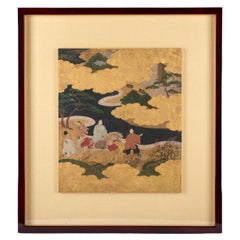
17th Century Japanese Tale of Genji Painting, Takekawa, Tosa School
Price:$3,200
About the Item
- Dimensions:Height: 6.7 in (17.02 cm)Width: 6 in (15.24 cm)Depth: 0.1 in (2.54 mm)
- Style:Edo (Of the Period)
- Materials and Techniques:
- Place of Origin:
- Period:Late 17th Century
- Date of Manufacture:circa 1650-1700
- Condition:Wear consistent with age and use.
- Seller Location:Kyoto, JP
- Reference Number:1stDibs: LU2472312639422
About the Seller
5.0
Recognized Seller
These prestigious sellers are industry leaders and represent the highest echelon for item quality and design.
Gold Seller
Premium sellers maintaining a 4.3+ rating and 24-hour response times
Established in 2001
1stDibs seller since 2016
75 sales on 1stDibs
Typical response time: 6 hours
Authenticity Guarantee
In the unlikely event there’s an issue with an item’s authenticity, contact us within 1 year for a full refund. DetailsMoney-Back Guarantee
If your item is not as described, is damaged in transit, or does not arrive, contact us within 7 days for a full refund. Details24-Hour Cancellation
You have a 24-hour grace period in which to reconsider your purchase, with no questions asked.Vetted Professional Sellers
Our world-class sellers must adhere to strict standards for service and quality, maintaining the integrity of our listings.Price-Match Guarantee
If you find that a seller listed the same item for a lower price elsewhere, we’ll match it.Trusted Global Delivery
Our best-in-class carrier network provides specialized shipping options worldwide, including custom delivery.You May Also Like
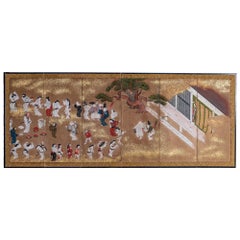
Japanese Six Panel Screen: Tosa School Painting of Theatre Scene
Located in Hudson, NY
with thought to be Izumo no Okuni (1578-1613). Mineral pigments and gold dust on mulberry paper with silk brocade border.
Category
Antique 18th Century Japanese Paintings and Screens
Materials
Gold
$97,750
H 45.75 in W 111 in D 0.75 in
17th Century Japanese Two-Panel Screen, Gibbons of Folklore
Located in Hudson, NY
Japanese two-panel screen: Gibbons of Folklore, Edo period (17th century) Kano School painting of gibbons in Japanese fables. The left panel represents a Japanese fable of a monkey a...
Category
Antique Late 17th Century Japanese Edo Paintings and Screens
Materials
Silk, Wood, Paper

Late 17th-Early 18th Century Japanese Six-Panel Screen, Battle at Uji Bridge
Located in Hudson, NY
Japanese six-panel screen: Battle at Uji Bridge, the first battle at Uji was in 1180 and it marked the start of the Heike Wars. The Genji troops crossed the...
Category
Antique Late 17th Century Japanese Edo Paintings and Screens
Materials
Gold Leaf

$135,000
H 63.25 in W 143.25 in D 0.75 in
Painting of a Tale of Genji Scene, Tosa School
By Tosa School
Located in Kittery Point, ME
Japanese 17th century school "Tale of Genji Scene" painting on paper, mounted to board. Nicely framed and boxed.
Professor Melissa McCormick at Harvard b...
Category
Antique 17th Century Japanese Japonisme Decorative Art
Materials
Paint, Paper
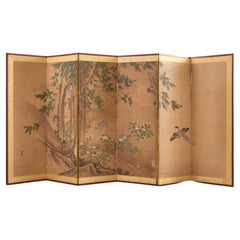
19th Century Japanese Edo Six Panel Kano School Landscape Screen
Located in Rio Vista, CA
Late Edo period 19th century Japanese six-panel landscape screen featuring a cypress tree over a flowering hibiscus with a pair of hototogisu birds. Kano school painted with ink and ...
Category
Antique 19th Century Japanese Edo Paintings and Screens
Materials
Silk, Wood, Paper
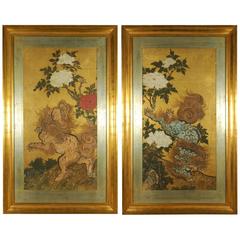
Pair of Antique Japanese Paintings of Karashishi, Edo Period, 18th Century
Located in Prahran, Victoria
A rare pair of antique Japanese Karashishi paintings in a landscape of rocks and peony flowers on gold leaf ground in fine handmade frames, Edo period, early 18th century. The Karash...
Category
Antique Early 18th Century Japanese Edo Paintings and Screens
Materials
Gold Leaf
$50,000 / set
H 77.96 in W 48.04 in D 3.15 in
Chinese Early Qing Dynasty "Water and Land Ritual" Painting, 17th Century
Located in Austin, TX
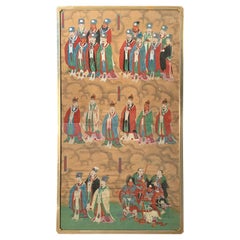
An important Chinese 17th century early Qing Dynasty "Water and Land Ritual" painting, mineral pigment and ink on silk, mounted as a scroll, framed and glazed.
The painting depicting groups of heavenly court officials and deities descending from the clouds to participate in the Liberation Rite of Land and Water. The figures all wear full, sumptuous robes, complete with hats indicating their station. The blue, green, red, black and white of the robes decorated with gilt dragon and geometric designs.
This painting is interesting in that it incorporates Daosit deities and heavenly officials coming down to participate in the Buddhist rite. There are five distinct groups of figures, each with a small inscribed plaque. Some of the groups are identified as Tian Xian, or Heavenly Immortals.
The group at the bottom left are identified as the Sanguan Dadi, or Three Great Emperor-Officials. The Emperor of Heaven is dressed in blue robes with gilt painted dragons. The Emperor of Water wears black robes. The Emperor of Earth wears yellow robes...
Category
Antique 17th Century Chinese Qing Paintings and Screens
Materials
Silk, Glass, Giltwood, Paint
$9,500
H 69 in W 38.25 in D 1.25 in
Pair of Antique Japanese Flower Paintings by Yanagisawa Kien, circa 18th Century
By Yanagisawa Kien
Located in Prahran, Victoria
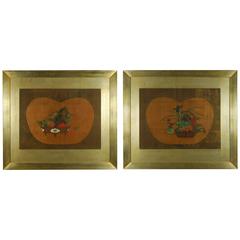
Pair of antique Japanese Nagasaki School paintings by Yanagisawa Kien (1704-1758), depicting classical ikebana flower arrangements. Each painted on silk in mineral pigments and beari...
Category
Antique Mid-18th Century Japanese Edo Paintings and Screens
Materials
Silk
$7,500 / set
H 28.75 in W 42.13 in D 1.58 in
Pair of Japanese Edo Rimpa School Screens after Tawaraya Sōtatsu
Located in Rio Vista, CA
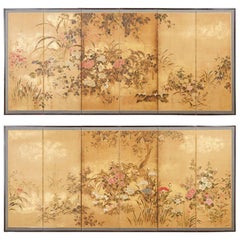
Impressive pair of 17th century Japanese Edo period Rinpa school screens made in the manner and style of Autumn Grasses by Tawaraya Sōtatsu (1570-1640). Beautifully decorated with wi...
Category
Antique 17th Century Japanese Edo Paintings and Screens
Materials
Gold Leaf
$26,000 / set
H 60.5 in W 131 in D 0.75 in
Set of 6 Large Kakemonos Japanese Mythology, 19th Century Japan circa 1800 Edo
Located in Beuzevillette, FR
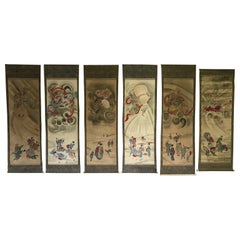
Beautiful set of 6 large kakemonos from 19th century Japanese mythology.
Paper support with a canvas pasted on the paper
Wonderful set that is part of Japan's history and beliefs
When not hung, the Kakemonos are rolled up.
circa 1800 - Japan - Edo Period
A kakemono translates as "object to hang". In Japan this refers to a painting or calligraphy, most often done on silk or paper framed in a scroll that was intended to be hung on walls or in public lighting. This particular form, which allows them to be in a roll, dates back to the Tang dynasty in China (this would be related to the copying and preservation of ancient Buddhist texts). A Kami is a deity or spirit worshipped in the Shinto religion. A Yokai is a spirit, ghost, demon, or strange apparition from the creatures of Japanese folklore.
Each of these kakemonos represents a unique story:
- A kami, a Japanese deity, is shown painting a rainbow. Indeed, he performs the action with his right hand while his left hand holds a kind of basket with three pots of paint. This kami has a rather closed attitude. He is standing in a dark and tormented sky. Below this figure, 8 villagers are dressed in traditional Japanese clothes. Their faces are softened. They are not afraid of the elements made by the kami above their heads.
- A character with an unreal look is holding a kind of jar with his two hands, which he spills on human figures above. This being is floating in the air, probably a character from mythology, perhaps Susanoo. Underneath, villagers on umbrellas. They are trying to protect themselves as best they can from what is falling on them. One of them is carrying baskets with fish on her shoulders. A character in the background is thrown forward and falls.
- On this kakemono, the god Raijin, dressed in a white and blue outfit, strikes the sky with his two drum hammers to create lightning and its thunderous sound. Surrounded by Tomoe and a long red scarf, Raijin, enraged and with dishevelled hair, creates a dark and violent storm. The villagers seem frightened by this meteorological phenomenon. One of the villagers can be seen fainting in the arms of a man. This scene may seem chaotic, but Japanese legend tells us that once a field is struck by lightning, the harvest is good.
- On this kakemono, we see an unreal-looking figure holding a fan, as if he were sweeping away the bad weather, or simply producing gusts of wind. He is probably the kami of wind and air, Shina tsu-hiko. The figures below him seem surprised by so much wind. An umbrella flies away on the left, the women hold their hair and scarf, the clothes are caught in the power of the wind, there is even a woman on the ground on the bottom left.
- This Kakemono represents a short moment. This Raiju is a yokai (ghost spirit...
Category
Antique 19th Century Japanese Edo Paintings
Materials
Paper
$2,591 Sale Price / set
20% Off
H 63.78 in W 20.48 in D 0.04 in
More From This Seller
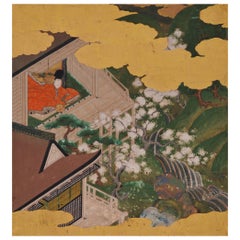
View AllJapanese Painting, 17th Century, Tale of Genji, Tosa School
Located in Kyoto, JP
Illustration to an unidentified chapter of the Tale of Genji (Genji Monogatari)
Tosa School (second half of the 17th Century)
Ink, pigment, gofun and...
Category
Antique Late 17th Century Japanese Edo Paintings and Screens
Materials
Gold Leaf
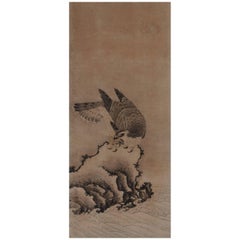
17th century Japanese Falcon Painting, Mitani Toshuku, Unkoku School
By Mitani Toshuku
Located in Kyoto, JP
Mitani Toshuku (1577-1654)
“Falcon”
Wall panel, ink and light color on paper.
Upper Seal: Mitani
Lower Seal: Toshuku
Dimensions:
Each 118.5 cm x 51 cm x 2 cm (46.5” x 20” x .75”)
Individual falcon paintings by Mitani Toshuku (1577-1654), an early artist of the Unkoku School. Founded by Unkoku Togan (1547–1618), a master of the Momoyama period, the Unkoku school enjoyed long lasting patronage in southern Japan. Togan was a retainer of the Mori family in present day Yamaguchi prefecture. Members of the school considered themselves to be in the artistic lineage of Sesshu Toyo...
Category
Antique Early 17th Century Japanese Edo Paintings and Screens
Materials
Paper
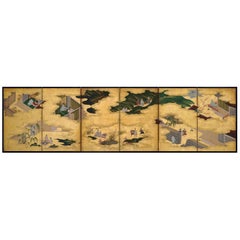
Japanese Screen Painting, Circa 1700
Tales of Ise
by Tosa Mitsusuke
By Tosa Mitsusuke 1
Located in Kyoto, JP
A six-fold Japanese screen by Tosa Mitsusuke (1675-1710), Japan 17th-18th century, Edo period.
The signature reads Shoroku-i ge Tosa sa Konoe Shogen Mit...
Category
Antique Late 17th Century Japanese Edo Paintings and Screens
Materials
Gold Leaf
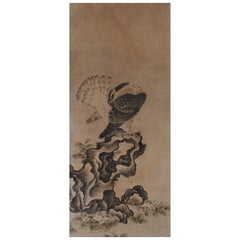
Japanese Painting, Framed Panel, 17th Century Falcon by Mitani Toshuku
By Mitani Toshuku
Located in Kyoto, JP
Mitani Toshuku (1577-1654)
“Falcon”
Wall panel, ink and light color on paper.
Upper seal: Mitani
Lower seal: Toshuku
Dimensions:
Each 118.5 cm x 51 cm x 2 cm (46.5” x 20” x .75”)
Individual falcon paintings by Mitani Toshuku (1577-1654), an early artist of the Unkoku School. Founded by Unkoku Togan (1547–1618), a master of the Momoyama period, the Unkoku school enjoyed long lasting patronage in southern Japan. Togan was a retainer of the Mori family in present day Yamaguchi prefecture. Members of the school considered themselves to be in the artistic lineage of Sesshu Toyo...
Category
Antique Early 17th Century Japanese Edo Paintings and Screens
Materials
Wood, Paper
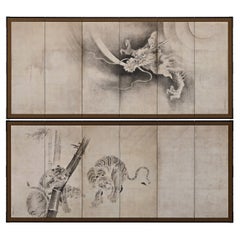
17th Century Japanese Screen Pair. Tiger
Dragon by Kaiho Yusetsu
Located in Kyoto, JP
Kaiho Yusetsu (1598-1677)
Tiger and Dragon
Early Edo Period, Circa 1650
A Pair of Six-fold Japanese Screens. Ink and slight color on paper.
Dimensions:
Each screen: H. 171 cm x W. 380 cm (67.5’’ x 149.5’’)
In this pair of early Edo period Japanese screens a group of tigers prowl in a bamboo grove whipped with fierce wind, while a dragon claws through clouds and mist. The dragon embodies elemental qualities - looming out of the mist, the coils of its body disappearing in the clouds. The dragon is calling for rain, symbolizing spring which is considered the fountain of life. On the other side, the tigers calls for the wind, symbolizing autumn which is considered the end of life. Tigers were familiar motifs within Japanese art from ancient times though the animals were imaginary to the people in the 17th century. While dragons and tigers are usually associated as sacred and ferocious, in this painting, both animals have rather amusing expressions. The tigers appear to glare at the dragon with cat-like eyes, and the look on the swirling dragon’s face appears almost affectionate - lending a playful flair to an otherwise magnificent theme.
The tiger and dragon are cosmological symbols of the balancing forces in the world. Screens such as this were originally meant to express the fluctuating nature of the world. For Japanese in the early Edo period, they likely suggested the powers of the cosmos. In Japan the tiger and dragon motif was originally absorbed into the circles of Zen monasteries before spreading into the secular world. The theme especially appealed to the military classes with the Kano school, the official painters to the Shogun and the samurai, being the leading contributors. The painter of this pair of screens, Kaiho Yusetsu (1598-1677), was closely patronized by the third Shogun Tokugawa Iemitsu. In his later years he worked with Kano school artists...
Category
Antique Mid-17th Century Japanese Edo Paintings and Screens
Materials
Silk, Wood, Paper
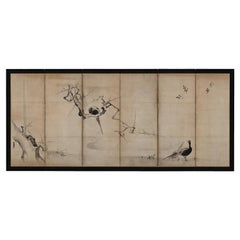
17th Century Japanese Screen. Ink Plum Tree
Birds by Kano Naonobu.
Located in Kyoto, JP
Kano Naonobu (1607-1650)
Plum Tree and Birds
Six-fold Japanese Screen. Ink and slight color on paper.
In this evocative ink work spread over a six-panel folding screen, we see the consummation of the elegance and refinement of the Edo Kano school. This 17th century screen is a rare surviving example of a large-scale bird and flower painting by Kano Naonobu, the younger brother of Kano Tanyu...
Category
Antique 17th Century Japanese Edo Paintings and Screens
Materials
Wood, Paper
Still Thinking About These?
All Recently ViewedMore Ways To Browse
Asian Shutters
Antique Balinese Textiles
1950s Japanese Cranes
Carlota Ige
Copper Plate Moroccan
Fabrice Dupre
Ge Ba Textiles
Ge Ba
Japanese Fox Screen
Japanese Herons On Silk
Japanese Rice Paper Art
Kudzu Vine
Scroll Painting Buddha
Wah Cheong
Mori Tetsuzan
Tiger Art On Silk
Burmese Wood Screens
Japanese Silver Hawk