Items Similar to 1838 Japanese Screen Pair. Flowers
Grasses of the Four Seasons.

Want more images or videos?
Request additional images or videos from the seller
1 of 13
1838 Japanese Screen Pair. Flowers
Grasses of the Four Seasons.
$22,500per set
£17,041.66per set
€19,571.76per set
CA$31,529.86per set
A$34,279.31per set
CHF 18,174.93per set
MX$410,922.05per set
NOK 230,994.05per set
SEK 211,621.95per set
DKK 146,274.12per set
About the Item
Maruyama Oshin (1790-1838)
Flowers and grasses of the four seasons: dated 1838
Pair of eight-panel Japanese screens; ink, color and gold leaf on silk
Dimensions: each (2) H. 38.5 cm x W. 218.5 cm (15” x 86”)
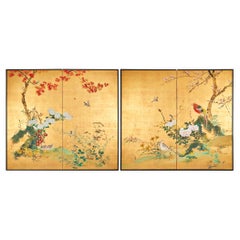
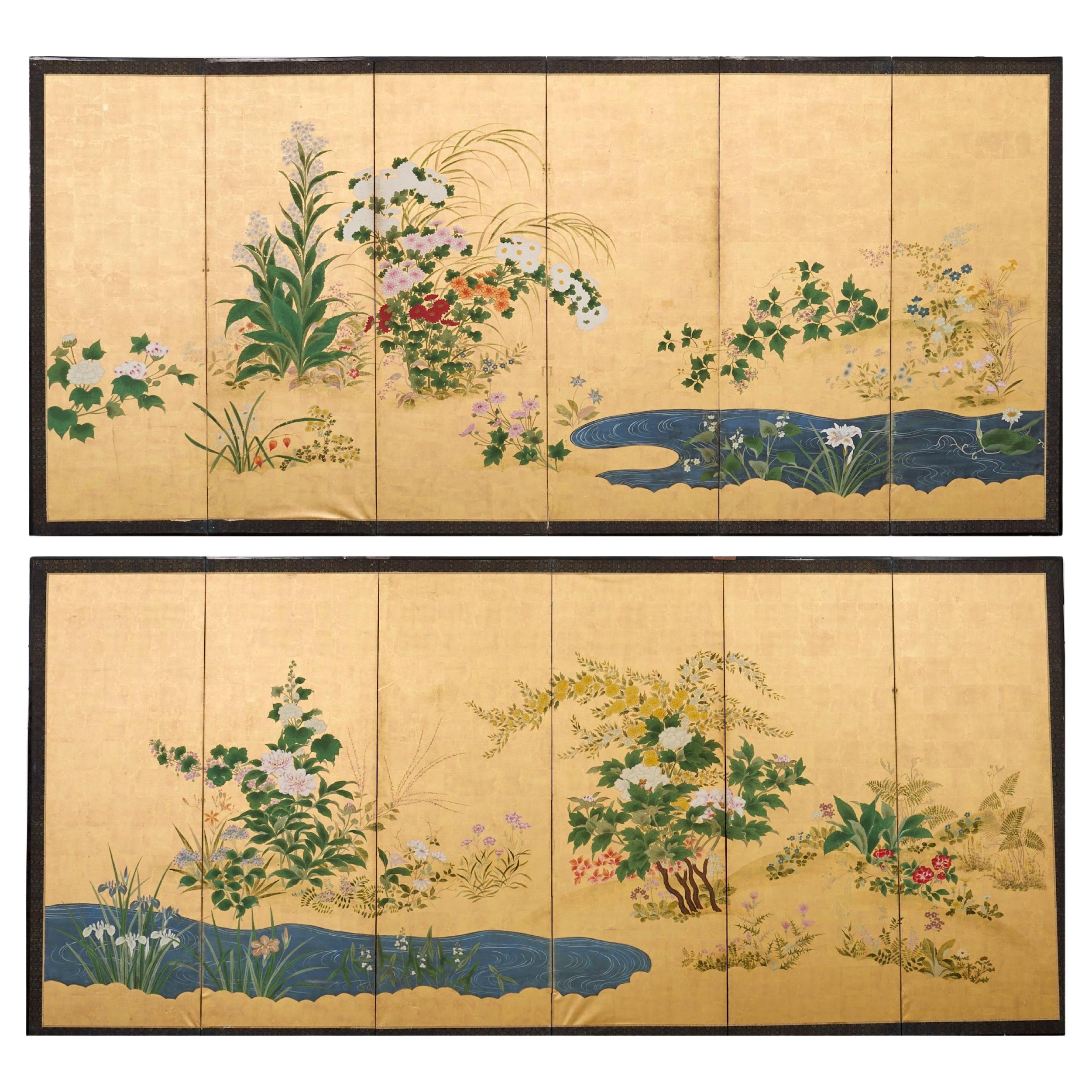
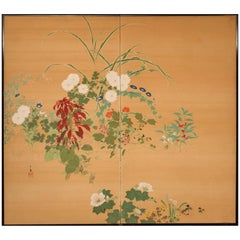
This pair of Edo period Japanese screens is composed to be read from right to left in the classical manner, moving through a refined and continuous progression of the seasons. Both screens are eight-panel compositions, but with a distinctly low, horizontal flow.
The first screen begins in late spring, with Thistle and Lilies, before shifting into a sequence of wetland plants characteristic of high summer: Arrowhead, Iris, Fringed Pink, Spatterdock, and the rare White Egret Orchid. Each species is observed with exquisite clarity and balanced restraint, forming a luminous evocation of water’s edge in full summer light.
The second screen carries the seasonal movement into late summer and autumn, opening with the soft lavender-blue of Tatarian Aster, followed by Japanese Bellflower, a classical emblem of autumn in poetry and painting. The gently arching stems of Bush Clover introduce a note of early autumn melancholy, while Hardy Begonia and the silvery plumes of Susuki grass complete the passage, marking the quiet settling of the season. The painter’s touch is deliberate and assured: form, color, and gold ground are held in subtle, harmonious balance.
Maruyama Oshin (1790-1838) was the son of Maruyama (Kinoshita) Oju (1777 – 1815) and a grandson of Maruyama Okyo (1733 – 1795). He received artistic education from all the members of the artistic family including his uncle Maruyama Ozui (1766 – 1829) who later adopted him. He was adopted by his uncle so that he could officially become the third generation head of the Maruyama School of Japanese painting. Oshin specialized in the genres of landscapes, and birds and flowers. Painted in 1838, the final year of his life, this pair represents the mature expression of his naturalistic vision — observant and quietly luminous.
This pair of screens were sold through Christies New York in March 2012.
- Dimensions:Height: 15 in (38.1 cm)Width: 86 in (218.44 cm)Depth: 0.5 in (1.27 cm)
- Sold As:Set of 2
- Style:Edo (Of the Period)
- Materials and Techniques:
- Place of Origin:
- Period:
- Date of Manufacture:1838
- Condition:Wear consistent with age and use.
- Seller Location:Kyoto, JP
- Reference Number:1stDibs: LU2472347477072
About the Seller
5.0
Recognized Seller
These prestigious sellers are industry leaders and represent the highest echelon for item quality and design.
Established in 2001
1stDibs seller since 2016
77 sales on 1stDibs
Typical response time: 6 hours
- ShippingRetrieving quote...Shipping from: Kyoto, Japan
- Return Policy
More From This Seller
View AllEarly 20th Century Japanese Screen. Flowers of the Four Seasons.
Located in Kyoto, JP
Anonymous
Flowers of the Four Seasons
A four-panel Japanese screen. Ink, gofun and pigments on gold leaf.
This Japanese screen is a rich visual celebration of the flowers of the fo...
Category
Early 20th Century Japanese Taisho Paintings and Screens
Materials
Gold Leaf
Mid-18th Century Japanese Screen Pair, One Hundred Flowers, Chrysanthemums
Located in Kyoto, JP
Omori Soun (b. 1704)
Chrysanthemums - One Hundred Flowers
A Pair of Six-fold Japanese Screens. Ink, color, gofun and gold leaf on paper.
Dating ...
Category
Antique Mid-18th Century Japanese Edo Paintings and Screens
Materials
Gold Leaf
Mid 19th Century Japanese Screen Pair. Flowers
Birds of the Four Seasons.
Located in Kyoto, JP
Shioka Sorin (1781-1850)
Flowers & Birds of the Four Seasons
Pair of six-panel Japanese Screens. Ink, gofun and pigments on silk.
Dimensions (each screen): H. 91.5cm x W. 285cm (3...
Category
Antique Mid-19th Century Japanese Edo Paintings and Screens
Materials
Silk
Japanese Screen Painting, Early 19th Century, Autumn Flowers by Sakai Hoitsu
Located in Kyoto, JP
A two-fold Japanese screen by the Rimpa school artist Sakai Hoitsu (1761-1828), Japan, 19th century, Edo period.
This small Japanese folding screen pai...
Category
Antique Early 19th Century Japanese Edo Paintings and Screens
Materials
Wood, Silk
19th Century Japanese Screen Pair - Birds
Flowers of the Four Seasons
Located in Kyoto, JP
Birds & Flowers of the Four Seasons
Yamamoto Baiitsu (1783-1856)
Late Edo period, Dated 1850
A magnificent pair of six-panel Japanese folding screens by Yamamoto Baitsu, representin...
Category
Antique Mid-19th Century Japanese Edo Paintings and Screens
Materials
Wood, Paper
Meiji Era, Circa 1900 Japanese Screen Pair, Flowers
Birds of Spring
Autumn
Located in Kyoto, JP
Flowers & Birds of Spring and Autumn
Unknown artist.
Japan. Meiji period, circa 1900.
A pair of six-fold screens. Ink, color, gofun and gold leaf on paper.
Signed: Gaga S...
Category
Antique 1890s Japanese Meiji Paintings and Screens
Materials
Gold Leaf
You May Also Like
Pair of Japanese Meiji Screens Blossoms of Spring, Summer and Autumn
Located in Rio Vista, CA
Amazing pair of late 19th/early 20th century Japanese Meiji period byobu screens depicting flowering plants and blossoms of the spring, summer, and autumn. Painted in the Nihonga sch...
Category
Antique 19th Century Japanese Meiji Paintings and Screens
Materials
Brass, Gold Leaf
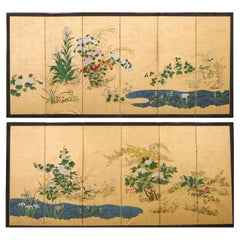
Japanese Two Panel Screen: Seasonal Flowers
Located in Hudson, NY
Peonies, irises, lillies, paperwhites, cockscombs, thistle and other various seasonal flowers in mineral pigmnets on mulberry paper. Oxblood lacquer trim with beautiful bronze mount...
Category
Early 20th Century Japanese Paintings and Screens
Materials
Bronze
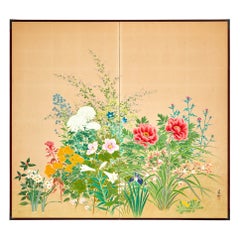
Japanese Two Panel Screen: Summer Flowers
Located in Hudson, NY
Screen depicts Summer flowers and birds on gilded silk. Signature reads: Konishi Fukunen. Notes about Artist: Konishi Fukunen (1887-1959) was born the second son of the Paper mounting specialist Konishi Uhei in Takeo, Fukui prefecture in the mid Meiji period. In 1902 he was sent to Kyoto to study painting under Suzuki Shonen...
Category
Mid-20th Century Japanese Paintings and Screens
Materials
Silk
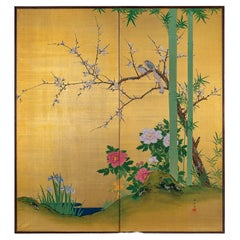
Japanese Two Panel Screen: Moon and Flowers
Located in Hudson, NY
Showa period (1926 - 1989) painting with a strong design of exotic lilies and a cluster of nadeshiko (dianthus) under a silver moon on gold. This painting has a modern flair, which ...
Category
20th Century Japanese Paintings and Screens
Materials
Silver
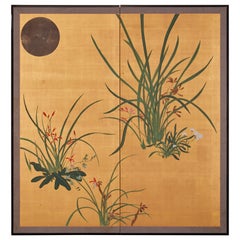
Japanese Two-Panel Screen, Summer Flowers on Silk
Located in Hudson, NY
Rimpa painting of flowers including morning glories, hollyhocks, sweet peas, nadeshiko, and daisies. Signature and seal read: Bisui
Category
Antique Late 19th Century Japanese Meiji Paintings and Screens
Materials
Silk, Wood
Pair of Japanese Two Panel Screens: Seasonal Landscape – Summer/ Autumn
Located in Hudson, NY
Screen A: Quail in autumn landscape with autumnal flowers in mineral pigments on gold with black lacquer trim. Signature and seal read: Keika.
Screen B: Chinese pheasant in a summer...
Category
Early 20th Century Japanese Paintings and Screens
Materials
Gold