Want more images or videos?
Request additional images or videos from the seller
1 of 5
18th Century Japanese Buddhist Scroll Painting of Guanyin in Celestial Setting
$2,380List Price
About the Item
- Dimensions:Height: 91.5 in (232.41 cm)Width: 26 in (66.04 cm)Depth: 1 in (2.54 cm)
- Style:Meiji (Of the Period)
- Materials and Techniques:
- Place of Origin:
- Period:
- Date of Manufacture:circa 1790
- Condition:Wear consistent with age and use.
- Seller Location:Chicago, IL
- Reference Number:Seller: BTC0041stDibs: LU82002717852
About the Seller
5.0
Platinum Seller
Premium sellers with a 4.7+ rating and 24-hour response times
Established in 1997
1stDibs seller since 2006
1,753 sales on 1stDibs
Typical response time: 2 hours
Authenticity Guarantee
In the unlikely event there’s an issue with an item’s authenticity, contact us within 1 year for a full refund. DetailsMoney-Back Guarantee
If your item is not as described, is damaged in transit, or does not arrive, contact us within 7 days for a full refund. Details24-Hour Cancellation
You have a 24-hour grace period in which to reconsider your purchase, with no questions asked.Vetted Professional Sellers
Our world-class sellers must adhere to strict standards for service and quality, maintaining the integrity of our listings.Price-Match Guarantee
If you find that a seller listed the same item for a lower price elsewhere, we’ll match it.Trusted Global Delivery
Our best-in-class carrier network provides specialized shipping options worldwide, including custom delivery.You May Also Like
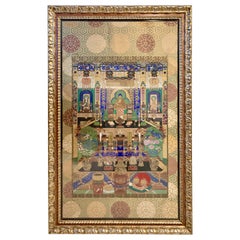
Large Framed Japanese Buddhist Amida Temple Hall Painting, Mid-19th Century
Located in Austin, TX
A large and incredible Japanese painting of a Buddhist temple hall with Amida Nyorai, late Edo or early Meiji period, mid-19th century, Japan. Mounted wit...
Category
Antique Mid-19th Century Japanese Meiji Paintings and Screens
Materials
Brocade, Silk, Acrylic, Wood, Paint
$17,500
H 76.25 in W 50 in D 3.25 in
Japanese Hanging Scroll, Late 19th Century
Located in New York, NY
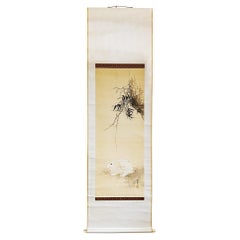
A Japanese hanging scroll or Kakejiku, circa 1890, depicting bamboo grass and a rabbit, framed by top and bottom ribbons of brocade silk.
In ...
Category
Antique 1890s Japanese Meiji Paintings
Materials
Silk, Paper
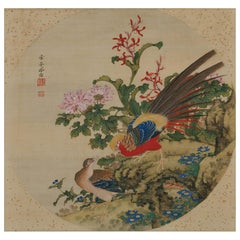
Japanese Scroll Painting, 19th Century Chinese Pheasants by Yoshizawa Setsuan
Located in Kyoto, JP
Chinese Pheasants
Yoshizawa Setsuan (1809-1889)
Hanging scroll, ink and color on silk.
Painting inscription: Setsuan Houyou
Upper seal: Y...
Category
Antique Mid-19th Century Asian Meiji Paintings and Screens
Materials
Silk
$5,200
Free Shipping
H 69 in W 38 in D 1 in
Japanese Painting, Hanging Scroll, 19th Century Bamboo in Moonlight
Located in Kyoto, JP
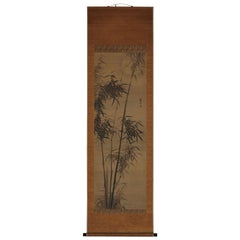
Bamboo in moonlight
Gamo Rakan (1784-1866)
Hanging scroll, ink on silk.
Dimensions:
Scroll: 201 cm x 58 cm
Image: 137 cm x 45 cm
In this early 19th century work by Gamo Rakan a light ink wash applied to the silk background silhouettes the moon and suggests the atmosphere of early evening. Even though it is a literati subject, Rakan’s bamboo is quite realistic with a strong decorative style. The painting finds its inspiration from Chinese Ming dynasty painters who often used a single-tone, jet black stroke to emphasize the calligraphic nature of bamboo.
In a different era, decorative would have been seen as somewhat unrefined. But increasingly in the Edo period, it was the hallmark of high style. The Japanese people, in particular the rising merchant class, had gradually become apathetic toward the traditional Sesshu and Kano schools of painting. Chinese professional and amateur painters living in the port of Nagasaki during the 18th century had a profound effect on Japanese painting and the freshness of their style and its decorative appeal contributed greatly to its popularity. Gamo Rakan’s teacher, Tani Buncho...
Category
Antique Early 19th Century Japanese Edo Paintings and Screens
Materials
Silk
Pair of Antique Japanese Paintings of Karashishi, Edo Period, 18th Century
Located in Prahran, Victoria
A rare pair of antique Japanese Karashishi paintings in a landscape of rocks and peony flowers on gold leaf ground in fine handmade frames, Edo period, early 18th century. The Karash...
Category
Antique Early 18th Century Japanese Edo Paintings and Screens
Materials
Gold Leaf
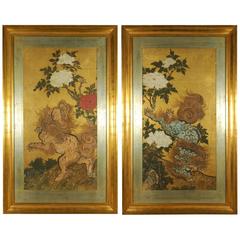
$50,000 / set
H 77.96 in W 48.04 in D 3.15 in
19th Century Japanese Shunga Hand-Scroll, Katsukawa School
Located in Kyoto, JP
Shunga
Unknown artist
Meiji era, circa 1880
Hand-scroll mounted with 12 paintings
Ink, pigment and gofun on silk
Dimensions:
Each image measures H. 23.2 cm x W. 34.4 cm (9.15” x 13.5”)
The hand-scroll measures H. 28 cm x W. 540 cm (11” x 212”)
A set of 12 late 19th century Japanese Shunga paintings mounted as a hand-scroll. Two of the leaves bear the signature and seal ‘Setsuzan’, although we are unable to confirm the identity of the artist using this art name. 6 of the 12 images are taken almost directly from Katsukawa Shuncho’s late 18th century woodblock series, ‘Erotic Pictures...
Category
Antique Late 19th Century Japanese Meiji Paintings and Screens
Materials
Silk
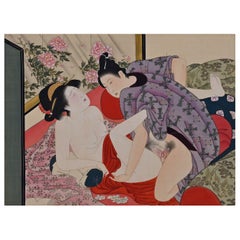
$10,750
Free Shipping
H 11 in W 212 in D 0.5 in
19th Century Japanese Scroll Painting, Birds
Flowers of the Four Seasons
Located in Kyoto, JP
Birds and flowers of the four seasons
Early to mid-19th century
Ink, pigment and gofun on silk
Unidentified artist
Signature: S...
Category
Antique 1830s Japanese Edo Paintings and Screens
Materials
Silk
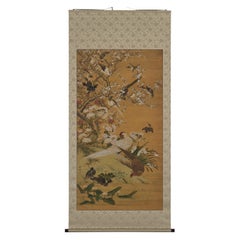
$10,800
H 86.5 in W 40 in D 1 in
Late 18th Century Japanese Framed Painting, God of Thunder by Yamaguchi Soken
Located in Kyoto, JP
Raijin - God of Thunder
Yamaguchi Soken (1759-1818)
Mid to Late Edo period, circa 1800.
Framed painting. Ink and light color on paper.
This humorous painting depicts the Thunder God, Raijin, tumbling from the sky, presumably being struck down by one of his own lighting bolts. He clings to one drumstick as the other is in free-fall along with his Taiko drums...
Category
Antique Late 18th Century Asian Edo Paintings and Screens
Materials
Paper

$8,500
H 45.5 in W 22.5 in D 0.75 in
Pair of Antique Japanese Flower Paintings by Yanagisawa Kien, circa 18th Century
By Yanagisawa Kien
Located in Prahran, Victoria
Pair of antique Japanese Nagasaki School paintings by Yanagisawa Kien (1704-1758), depicting classical ikebana flower arrangements. Each painted on silk in mineral pigments and beari...
Category
Antique Mid-18th Century Japanese Edo Paintings and Screens
Materials
Silk
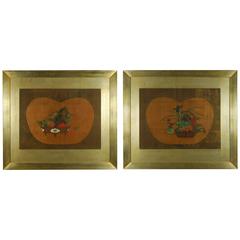
$7,500 / set
H 28.75 in W 42.13 in D 1.58 in
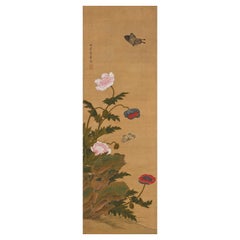
19th Century Japanese Scroll Painting by Igarashi Chikusa, Poppies
Butterflies
Located in Kyoto, JP
Poppies & Butterflies
Ink, pigment and gofun on silk
Igarashi Chikusa (1774-1844)
Signature: Chikusa Ran Zen
Upper Seal: Ran Shuzen
Lower Seal: Kyoho
Dimensions:
Scroll: H. 68” x W. 18” (172cm x 45cm)
Image: H. 38.5’’ x W. 12.5’’ (98cm x 32cm)
This composition shows elegant images of poppies and the butterflies that are inevitably drawn to them. It captures a momentary glimpse into a world both visually dazzling and startlingly realistic. The painting is infused with sensitivity and attention to seasonal change and weather conditions. The thin and fragile poppies are beautifully depicted with brilliant colors and the butterflies are similarly infused with life. The painting is on silk which requires extremely precise painting skills as no element once painted can be removed.
Poppies were a favorite subject of Rinpa school artists through the ages. Originally they were somewhat abstracted but by the age of Sakai Hoitsu...
Category
Antique Early 19th Century Japanese Edo Paintings and Screens
Materials
Silk
$4,800
H 68 in W 18 in D 1 in
More From This Seller
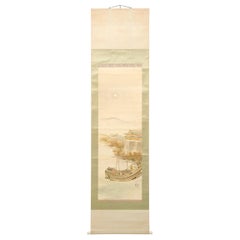
View AllJapanese Meiji Riverside Scroll Painting, c. 1900
Located in Chicago, IL
Although western painting was initially embraced during Japan’s Meiji period (1868-1912), artists brought on a revival of traditional painting styles as they sought to create a modern Japanese style with roots in the past. This exquisite hanging scroll demonstrates the preference for soft layering of gray tones with judicious use of color. The landscape is rendered in soft ink washes that subtly distinguish between water, mountain, and sky. The scroll painting...
Category
Early 20th Century Japanese Meiji Paintings and Screens
Materials
Paper
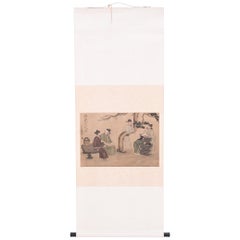
"Literary Gathering" Chinese Scroll Painting, c. 1923
Located in Chicago, IL
Exquisitely painted with delicate line work and a subdued color palette, this Chinese scroll painting is an Late 20th-century reproduction of a...
Category
Late 20th Century Chinese Paintings and Screens
Materials
Silk, Paper
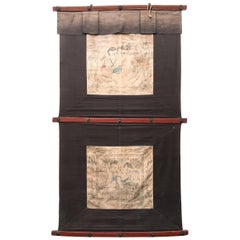
Love and Lotus Boys
Early 20th Century Chinese Folk Painting
Located in Chicago, IL
Drawn with a fine line and fresh, sketched quality, this folk hanging unites two scenes of lucky hoho lotus boys circumscribed in frames punctuated with fruits such as pomegranate, symbolic of prosperity and good fortune. On top, the two explore the natural wonders of the world...
Category
Early 20th Century Chinese Qing Paintings and Screens
Materials
Wood, Linen
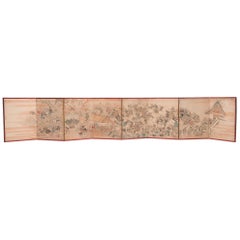
Japanese Edo Period Festival Screen, c. 1750
Located in Chicago, IL
This 18th century folding screen is a stunning example of Japanese artistry. Beautifully painted with delicate brushwork, the evocative sc...
Category
Antique Mid-18th Century Japanese Edo Paintings and Screens
Materials
Paper
Set of Four Chinese Immortals Screen Paintings, c. 1850
Located in Chicago, IL
Since the 12th century people in China have used folding screens and doors to partition and decorate their homes—the vivid scenes backing the screens added life and color to a room. ...
Category
Antique Mid-19th Century Chinese Qing Paintings and Screens
Materials
Paper

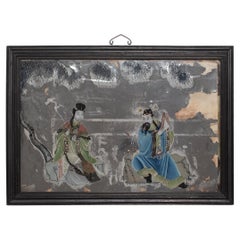
Chinese Reverse Glass Painting of Taoist Immortals, c. 1900
Located in Chicago, IL
Popularized during the Qing dynasty, reverse glass painting requires an artist to essentially work backwards, starting with details and shading before adding color and form. Lending the finished work a subtle three-dimensional effect, this exacting technique doesn't allow for any corrections, and is only revealed to its full effect when the glass pane is turned around. This example dates to the late 19th century and depicts the Taoist immortals He Xiangu and Cao Guojiu. Said to have attained immortality through their studies of the natural world, the Eight Immortals each represent a different condition in life and impart blessings of prosperity and longevity. The charming scene is likely one of a set of...
Category
Early 20th Century Chinese Paintings and Screens
Materials
Glass, Wood
Still Thinking About These?
All Recently ViewedMore Ways To Browse
Guanyin Painting
Sakai Hoitsu
Shibata Zeshin
12 Panel Asian Screen
4 Chinese Silk Panels
6 Panel Byobu Screen
Antique Chinese 4 Panel Screen
Asian Gold Leaf Divider
Chinese Scroll Bird Painting
Company School Paintings
Coromandel Screen Crane
Go Board Game
Gold Leaf Ducks
Guanyin Painting
Indian Portrait Miniatures
Japanese Art Ocean
Japanese Calligraphy Brushes
Japanese Painting Women