Want more images or videos?
Request additional images or videos from the seller
1 of 6
18th Century Japanese Floral Paintings, Set of 5, Mineral Pigments on Gold Leaf
Price:$3,800
About the Item
- Dimensions:Height: 5 in (12.7 cm)Width: 4.2 in (10.67 cm)Depth: 0.01 in (0.26 mm)
- Sold As:Set of 5
- Style:Edo (Of the Period)
- Materials and Techniques:
- Place of Origin:
- Period:
- Date of Manufacture:circa 1750
- Condition:Wear consistent with age and use.
- Seller Location:Kyoto, JP
- Reference Number:1stDibs: LU2472317053131
About the Seller
5.0
Recognized Seller
These prestigious sellers are industry leaders and represent the highest echelon for item quality and design.
Gold Seller
Premium sellers maintaining a 4.3+ rating and 24-hour response times
Established in 2001
1stDibs seller since 2016
75 sales on 1stDibs
Typical response time: 6 hours
Authenticity Guarantee
In the unlikely event there’s an issue with an item’s authenticity, contact us within 1 year for a full refund. DetailsMoney-Back Guarantee
If your item is not as described, is damaged in transit, or does not arrive, contact us within 7 days for a full refund. Details24-Hour Cancellation
You have a 24-hour grace period in which to reconsider your purchase, with no questions asked.Vetted Professional Sellers
Our world-class sellers must adhere to strict standards for service and quality, maintaining the integrity of our listings.Price-Match Guarantee
If you find that a seller listed the same item for a lower price elsewhere, we’ll match it.Trusted Global Delivery
Our best-in-class carrier network provides specialized shipping options worldwide, including custom delivery.You May Also Like
18th Century Japanese Two-Panel Screen Collection of Fans on Gold
Located in Hudson, NY
18th century Japanese Screen of a Collection of Fans. Paintings on fans depict famous Japanese painting subjects, this screen was most li...
Category
Antique 18th Century Japanese Edo Paintings and Screens
Materials
Gold Leaf

Pair of Antique Japanese Paintings of Karashishi, Edo Period, 18th Century
Located in Prahran, Victoria
A rare pair of antique Japanese Karashishi paintings in a landscape of rocks and peony flowers on gold leaf ground in fine handmade frames, Edo period, early 18th century. The Karash...
Category
Antique Early 18th Century Japanese Edo Paintings and Screens
Materials
Gold Leaf
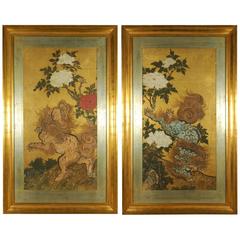
$50,000 / set
H 77.96 in W 48.04 in D 3.15 in
Pair of Antique Japanese Flower Paintings by Yanagisawa Kien, circa 18th Century
By Yanagisawa Kien
Located in Prahran, Victoria
Pair of antique Japanese Nagasaki School paintings by Yanagisawa Kien (1704-1758), depicting classical ikebana flower arrangements. Each painted on silk in mineral pigments and beari...
Category
Antique Mid-18th Century Japanese Edo Paintings and Screens
Materials
Silk
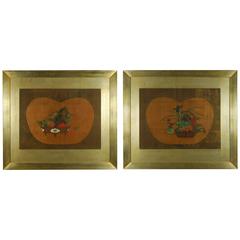
$7,500 / set
H 28.75 in W 42.13 in D 1.58 in
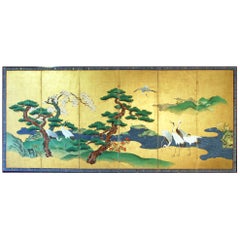
Japanese Folding Screen Six Panels Painted on Gold Leaf
By Japanese Studio
Located in Brescia, IT
Paravento a sei pannelli di scuola giapponese Kano: paesaggio con bellissime ed eleganti gru vicino al fiume, con alberi di pino e sakura.
Dipinto a mano con pigmenti minerali ed inc...
Category
Antique Early 19th Century Japanese Edo Paintings and Screens
Materials
Gold Leaf
Set of 6 Large Kakemonos Japanese Mythology, 19th Century Japan circa 1800 Edo
Located in Beuzevillette, FR
Beautiful set of 6 large kakemonos from 19th century Japanese mythology.
Paper support with a canvas pasted on the paper
Wonderful set that is part of Japan's history and beliefs
When not hung, the Kakemonos are rolled up.
circa 1800 - Japan - Edo Period
A kakemono translates as "object to hang". In Japan this refers to a painting or calligraphy, most often done on silk or paper framed in a scroll that was intended to be hung on walls or in public lighting. This particular form, which allows them to be in a roll, dates back to the Tang dynasty in China (this would be related to the copying and preservation of ancient Buddhist texts). A Kami is a deity or spirit worshipped in the Shinto religion. A Yokai is a spirit, ghost, demon, or strange apparition from the creatures of Japanese folklore.
Each of these kakemonos represents a unique story:
- A kami, a Japanese deity, is shown painting a rainbow. Indeed, he performs the action with his right hand while his left hand holds a kind of basket with three pots of paint. This kami has a rather closed attitude. He is standing in a dark and tormented sky. Below this figure, 8 villagers are dressed in traditional Japanese clothes. Their faces are softened. They are not afraid of the elements made by the kami above their heads.
- A character with an unreal look is holding a kind of jar with his two hands, which he spills on human figures above. This being is floating in the air, probably a character from mythology, perhaps Susanoo. Underneath, villagers on umbrellas. They are trying to protect themselves as best they can from what is falling on them. One of them is carrying baskets with fish on her shoulders. A character in the background is thrown forward and falls.
- On this kakemono, the god Raijin, dressed in a white and blue outfit, strikes the sky with his two drum hammers to create lightning and its thunderous sound. Surrounded by Tomoe and a long red scarf, Raijin, enraged and with dishevelled hair, creates a dark and violent storm. The villagers seem frightened by this meteorological phenomenon. One of the villagers can be seen fainting in the arms of a man. This scene may seem chaotic, but Japanese legend tells us that once a field is struck by lightning, the harvest is good.
- On this kakemono, we see an unreal-looking figure holding a fan, as if he were sweeping away the bad weather, or simply producing gusts of wind. He is probably the kami of wind and air, Shina tsu-hiko. The figures below him seem surprised by so much wind. An umbrella flies away on the left, the women hold their hair and scarf, the clothes are caught in the power of the wind, there is even a woman on the ground on the bottom left.
- This Kakemono represents a short moment. This Raiju is a yokai (ghost spirit...
Category
Antique 19th Century Japanese Edo Paintings
Materials
Paper
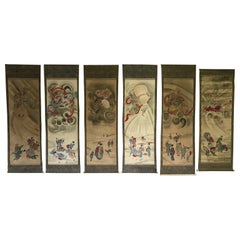
$2,594 Sale Price / set
20% Off
H 63.78 in W 20.48 in D 0.04 in
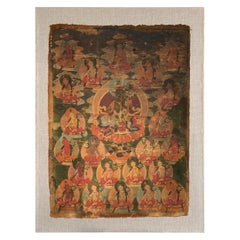
18th Century Tibetan Thangka Painting
Located in Chicago, IL
A rare striking 18th century Tibetan Thangka depicting the Green Tara seated on a lotus throne ready to step down to offer comfort and pro...
Category
Antique 18th Century Tibetan Tibetan Paintings and Screens
Materials
Linen, Paint
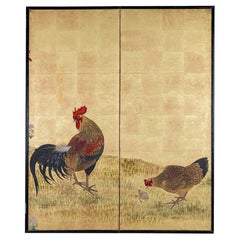
Japanese Two Panel Screen: Family of Chickens on Gold Leaf
Located in Hudson, NY
Mineral pigments on gold. Not signed, by Baikei Hitsu.
Category
Antique 1880s Japanese Paintings and Screens
Materials
Gold Leaf
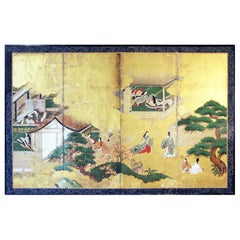
18°th Century Japanese Gold Leaf Screen
By Japanese Studio
Located in Brescia, IT
Four-panel folding screen depicting the famous legend of Hikaru Genji, a nobleman of extraordinary grace and beauty, and his gallant adventures at court.
The novel Genji Monogatari, ...
Category
Antique 18th Century Japanese Edo Paintings and Screens
Materials
Gold Leaf
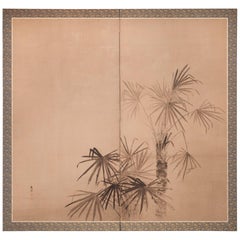
Japanese Two-Panel Screen Ink Painting of Palm Trees on Paper
Located in Hudson, NY
Japanese two-panel screen: ink painting of Palm Trees on paper, Edo period (1787) beautiful painting of Japanese windmill palm trees. Ink paint...
Category
Antique 18th Century Japanese Edo Paintings and Screens
Materials
Silk, Wood, Paper
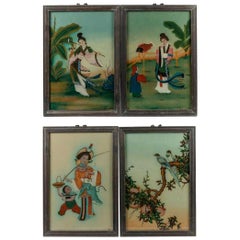
Set of Four Japanese Reverse Paintings
Located in Locust Valley, NY
Set of four Japanese reverse paintings.
Category
Early 20th Century Japanese Paintings and Screens
Materials
Glass
More From This Seller
View AllLate 18th Century Japanese Framed Painting, God of Thunder by Yamaguchi Soken
Located in Kyoto, JP
Raijin - God of Thunder
Yamaguchi Soken (1759-1818)
Mid to Late Edo period, circa 1800.
Framed painting. Ink and light color on paper.
This humorous painting depicts the Thunder God, Raijin, tumbling from the sky, presumably being struck down by one of his own lighting bolts. He clings to one drumstick as the other is in free-fall along with his Taiko drums...
Category
Antique Late 18th Century Asian Edo Paintings and Screens
Materials
Paper

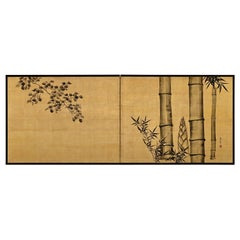
19th Century Japanese Screen for Tea-Ceremony, Ink Bamboo and Plum on Gold Leaf
Located in Kyoto, JP
Three Friends of Winter
Nakajima Raisho (1796-1871)
Late Edo period, circa 1850
Ink and gold leaf on paper.
This is a double-sided Japanese Furosaki or tea-ceremony screen from the mid 19th century; bamboo and plum on the front, young pines the back. It by Nakajima Raisho, a master painter of the Maruyama school in the late Edo and early Meiji periods. In this work Raisho combines exquisite ink brushwork with large open spaces of brilliant gold-leaf to inspire the viewers imagination. Rather than naturalism, he is searching for the phycological impression of the motifs, resulting in abstraction and stylization. His simplification of the motifs the result of looking to capture the inner nature of the objects. This art motif is known as Sho Chiku Bai, or the Three Friends of Winter. Evergreen pine connotes steadfastness, bamboo suggests both strength and flexibility, while plum blossoms unfurling on snow-laden branches imply hardiness. Combined, this trio is emblematic of Japanese new year. Chinese literati were the first to group the three plants together due to their noble characteristics. Like these resilient plants flowering so beautifully in winter, it was expected of the scholar-gentleman to cultivate a strong character with which he would be able to show the same degree of perseverance and steadfastness even during times of adverse conditions.
The screen would have been placed near the hearth of a room used for the Japanese tea ceremony, shielding the fire from draughts and also forming a stimulating and decorative backdrop behind the tea utensils. It would have been used in the Hatsugama, or first tea-ceremony of the new year.
Nakajima Raisho (1796-1871) originally studied under Watanabe Nangaku before entering the school of Maruyama Ozui. He was the highest ranking Maruyama school painter at the end of the Edo period and was known as one of the ‘Four Heian Families’ along with Kishi...
Category
Antique Mid-19th Century Japanese Edo Paintings and Screens
Materials
Gold Leaf
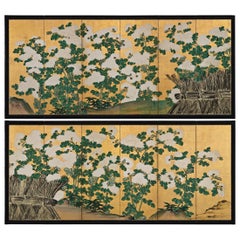
Mid-18th Century Japanese Screen Pair, One Hundred Flowers, Chrysanthemums
Located in Kyoto, JP
Omori Soun (b. 1704)
Chrysanthemums - One Hundred Flowers
A Pair of Six-fold Japanese Screens. Ink, color, gofun and gold leaf on paper.
Dating ...
Category
Antique Mid-18th Century Japanese Edo Paintings and Screens
Materials
Gold Leaf
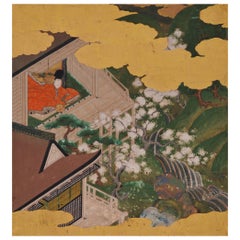
Japanese Painting, 17th Century, Tale of Genji, Tosa School
Located in Kyoto, JP
Illustration to an unidentified chapter of the Tale of Genji (Genji Monogatari)
Tosa School (second half of the 17th Century)
Ink, pigment, gofun and...
Category
Antique Late 17th Century Japanese Edo Paintings and Screens
Materials
Gold Leaf
19th Century Japanese Scroll Painting, Birds
Flowers of the Four Seasons
Located in Kyoto, JP
Birds and flowers of the four seasons
Early to mid-19th century
Ink, pigment and gofun on silk
Unidentified artist
Signature: S...
Category
Antique 1830s Japanese Edo Paintings and Screens
Materials
Silk
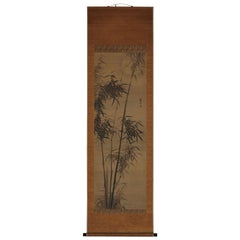
Japanese Painting, Hanging Scroll, 19th Century Bamboo in Moonlight
Located in Kyoto, JP
Bamboo in moonlight
Gamo Rakan (1784-1866)
Hanging scroll, ink on silk.
Dimensions:
Scroll: 201 cm x 58 cm
Image: 137 cm x 45 cm
In this early 19th century work by Gamo Rakan a light ink wash applied to the silk background silhouettes the moon and suggests the atmosphere of early evening. Even though it is a literati subject, Rakan’s bamboo is quite realistic with a strong decorative style. The painting finds its inspiration from Chinese Ming dynasty painters who often used a single-tone, jet black stroke to emphasize the calligraphic nature of bamboo.
In a different era, decorative would have been seen as somewhat unrefined. But increasingly in the Edo period, it was the hallmark of high style. The Japanese people, in particular the rising merchant class, had gradually become apathetic toward the traditional Sesshu and Kano schools of painting. Chinese professional and amateur painters living in the port of Nagasaki during the 18th century had a profound effect on Japanese painting and the freshness of their style and its decorative appeal contributed greatly to its popularity. Gamo Rakan’s teacher, Tani Buncho...
Category
Antique Early 19th Century Japanese Edo Paintings and Screens
Materials
Silk
Still Thinking About These?
All Recently ViewedMore Ways To Browse
Antique Mineral
Japanese Washi
Paintings Of Japan
Japanese Gold Leaf
Japan Gold Painting
Japanese Gold Paintings
Asian Gold Leaf Art
18th Century Japanese Art
Japanese Painting Gold Leaf
18th Century Screen
Floral Screen
Japanese Screen Gold Leaf
Antique Gold Leaf Screens
Japanese Mid Century Painting
Edo Screen Gold
18th Century Japanese Screens
18th Century Hand Screen
Floral Paintings 18th Century