Want more images or videos?
Request additional images or videos from the seller
1 of 15
18th Century Japanese Screen: Takagari ( Hawk Falconary )
Price:$7,800
About the Item
- Dimensions:Height: 134.65 in (342 cm)Diameter: 68.12 in (173 cm)
- Materials and Techniques:
- Place of Origin:
- Period:
- Date of Manufacture:unknown
- Condition:
- Seller Location:Fukuoka, JP
- Reference Number:1stDibs: LU8121235966962
About the Seller
5.0
Vetted Professional Seller
Every seller passes strict standards for authenticity and reliability
Established in 1998
1stDibs seller since 2023
62 sales on 1stDibs
Typical response time: 1 hour
Authenticity Guarantee
In the unlikely event there’s an issue with an item’s authenticity, contact us within 1 year for a full refund. DetailsMoney-Back Guarantee
If your item is not as described, is damaged in transit, or does not arrive, contact us within 7 days for a full refund. Details24-Hour Cancellation
You have a 24-hour grace period in which to reconsider your purchase, with no questions asked.Vetted Professional Sellers
Our world-class sellers must adhere to strict standards for service and quality, maintaining the integrity of our listings.Price-Match Guarantee
If you find that a seller listed the same item for a lower price elsewhere, we’ll match it.Trusted Global Delivery
Our best-in-class carrier network provides specialized shipping options worldwide, including custom delivery.You May Also Like
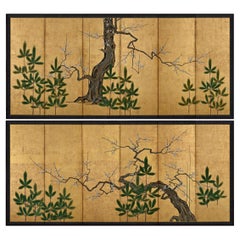
18th Century Japanese Screen Pair. Plum
Young Pines. Kano School.
Located in Kyoto, JP
Dimensions (Each screen): H. 176 cm x W. 378 cm (69’’ x 149’’)
This pair of Japanese folding screens depict blossoming plum trees amongst young pines. They are designed to capture t...
Category
Antique Late 18th Century Japanese Edo Paintings and Screens
Materials
Gold Leaf
$42,000 / set
H 69 in W 149 in D 0.75 in
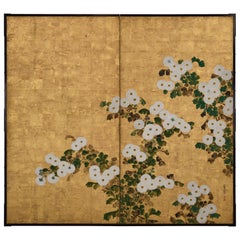
18th Century Japanese Rinpa Screen. White Chrysanthemums. School of Korin.
Located in Kyoto, JP
School of Ogata Korin
White Chrysanthemums
18th Century, Edo period.
A two-panel Japanese screen. Ink, color, gofun and gold leaf on paper.
Dimensions: H. 171 cm x W. 188 cm (67.5” x 74”)
On this two-panel Japanese screen we see blooming chrysanthemums, a flower which embodies the essence of autumn in Japan. Here the traditional floral theme has been simplified and stylized. The bright colors and asymmetrical composition against the delicate gold leaf create a luxurious and ornate work of art. Its background, a strikingly patinated grid of gold leaf, denies any sense of place or time and imbues everything with an ethereal glow. The leaves and stems of the plants are nothing more than pools of mottled color and ink without any outline whatsoever. These are typical Rinpa adaptations of traditional ink painting methods; tarashikomi, or diluted washes of color blended while very wet, and mokkotsu, or “bonelessness,” which creates forms without exterior outlines. The relief work of the rounded flower petals has been obtained by the moriage process (a mixture based on ground shells modeled on the surface of the paper).
On the lower right of the screen, the siganture “Hokyo Korin Jakumyo” and the “Hoshuku” seal can be read. Korin is Ogata Korin, famed for the Irises (Nezu Museum) and Red and White Plum Blossom (MOA Museum of Art) folding screens, both National Treasures. Korin worked in both Kyoto and Edo in the mid-Edo period. Korin was using the art name “Jakumyo” just after he received the Hokyo level, which was in 1701.
This particular screen was published in May of 1961 in the Japanese Sansai Fine Art Magazine*. An in depth article accompanies the photograph of the screen and and a photograph of the signature and seal. This article devotes much of its body to discussing the moriage technique, how it enlivens the chrysanthemum flowers and Korin’s specific skill in using the technique. The article goes on to discuss the most famous works of Korin, utilizing this technique, which were known at the time. Specifically a two-panel screen held in the Honolulu Museum which was discovered in the store-house of Takahashi Soan. A two-panel screen pair which the Nakano family own. A two-panel screen pair with chrysanthemums in moriage in fan designs owned by the Nomura family. Also a small folding screen featuring chrysanthemums held in the Yamato Bunkakan. The article goes on to say that this particular two-fold screen came from the Nijo family. Korin is known to have had a strong connection with the aristocratic Nijo family. The article explains that Korin received a lot of favors from the Nijo family and that this screen would have been gifted to them.
Since that time the Honolulu screen has been amended to ‘attributed to Ogata Korin’ and I do not know further details of the other 3 screens. Other Chrysanthemum screens...
Category
Antique 18th Century Japanese Edo Paintings and Screens
Materials
Gold Leaf
$32,000
H 67.5 in W 74 in D 0.75 in
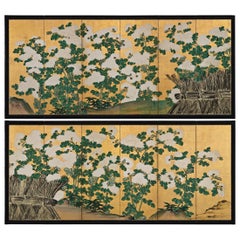
Mid-18th Century Japanese Screen Pair, One Hundred Flowers, Chrysanthemums
Located in Kyoto, JP
Omori Soun (b. 1704)
Chrysanthemums - One Hundred Flowers
A Pair of Six-fold Japanese Screens. Ink, color, gofun and gold leaf on paper.
Dating ...
Category
Antique Mid-18th Century Japanese Edo Paintings and Screens
Materials
Gold Leaf
$48,000 / set
H 67.5 in W 149 in D 0.75 in
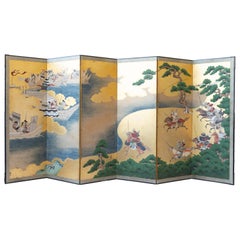
18th Century Six Panel japanese Screen with Samurai on Horses
Located in New York, NY
A spectacular six-panel Japanese screen dating to the 18th century. The screen depicts samurai warriors from the Tairo and Minamoto clans, who fought for control of Japan in the 12t...
Category
Antique Late 18th Century Japanese Paintings and Screens
Materials
Gold Leaf
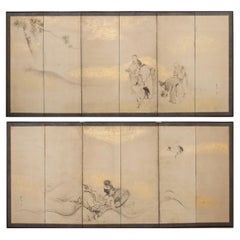
Pair of 18th Century Japanese Edo Screens of Chinese Immortals
Located in Rio Vista, CA
Mesmerizing pair of late 18th/early 19th century Japanese Edo period byobu screens by Shibata Gito (Japanese 1780-1819). The paintings depict Chinese immortals in a dreamy landscape....
Category
Antique 18th Century Japanese Edo Paintings and Screens
Materials
Silk, Wood, Paper
$9,000 / set
H 66 in W 142 in D 0.75 in
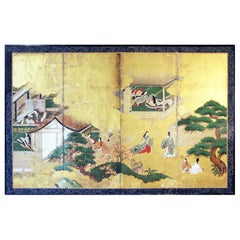
18°th Century Japanese Gold Leaf Screen
By Japanese Studio
Located in Brescia, IT
Four-panel folding screen depicting the famous legend of Hikaru Genji, a nobleman of extraordinary grace and beauty, and his gallant adventures at court.
The novel Genji Monogatari, ...
Category
Antique 18th Century Japanese Edo Paintings and Screens
Materials
Gold Leaf
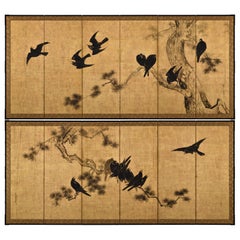
Mid 18th Century Japanese Screen Pair. Crows
Pines by Unkoku Toshuku.
Located in Kyoto, JP
Unkoku Toshuku (1722-1779)
Crows and Pines
A pair of six-panel Japanese Screens. Ink and gold leaf on paper.
Dimensions: Each Screen: H. 170.5 cm x W. 375 cm
Haha-cho or mynah birds, whose forms resemble crows in artwork, were commonly depicted in Japanese art. These types of paintings were originally modeled on paintings attributed to the 13th century Chinese painter Muqi (Mokkei), whose art was enormously influential in Japan. Crows only became a theme among Japanese artists from the later 1500s onward. They likely were inspired by these imported Chinese paintings of myna birds, which are not native to Japan, substituting the native species of crow instead.
The best known early examples of the depiction of Japanese crows are two Momoyama screen...
Category
Antique Mid-18th Century Japanese Edo Paintings and Screens
Materials
Gold Leaf
$64,000 / set
H 67 in W 147.5 in D 0.75 in
18th Century Japanese Two-Panel Screen Collection of Fans on Gold
Located in Hudson, NY
18th century Japanese Screen of a Collection of Fans. Paintings on fans depict famous Japanese painting subjects, this screen was most li...
Category
Antique 18th Century Japanese Edo Paintings and Screens
Materials
Gold Leaf

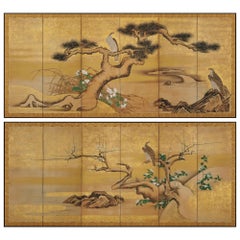
17th Century Japanese Screen Pair by Soga Nichokuan, Hawks on Pine
Plum Trees
Located in Kyoto, JP
Hawks on plum and pine
Soga Nichokuan (active circa 1625-1660)
Pair of six-fold screens.
Ink, mineral pigments, gofun, gold and speckled gold l...
Category
Antique 1640s Japanese Edo Paintings and Screens
Materials
Wood, Paper
$85,000 / set
H 67.5 in W 148 in D 0.75 in
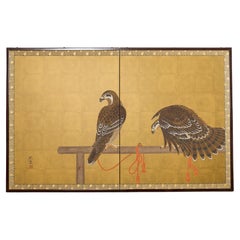
Japanese Showa Two Panel Screen Pair of Tethered Hawks
Located in Rio Vista, CA
Captivating Japanese Showa period two-panel folding byobu screen featuring a pair of hawks or birds or prey tethered to a wooden perch. The painting has ink and natural colored pigme...
Category
20th Century Japanese Showa Paintings and Screens
Materials
Brass
More From This Seller
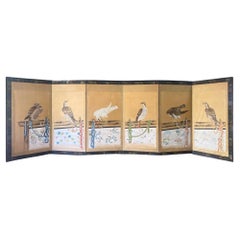
View AllLate 18th to Early 19th Century Hawk Screen
Located in Fukuoka, JP
Late 18th to Early 19th Century Hawk Screen
Period: Late Edo
Size: 372 x 125 cm (146.4 x 49.2 inches)
Behold the grandeur of the late Edo period encaps...
Category
Antique 18th Century Japanese Edo Paintings and Screens
Materials
Paper, Wood
$5,800 Sale Price
32% Off
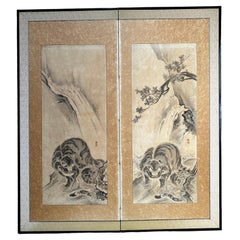
18th Century Nagasaki School Tiger Screen
Located in Fukuoka, JP
18th Century Nagasaki School Tiger Screen
Period: Edo
Size: 165 x 172 cm (65 x 67.7 inches)
SKU: PTA69
This exceptional 18th-century screen from the Edo...
Category
Antique Early 18th Century Japanese Edo Paintings and Screens
Materials
Wood, Paper
$3,128 Sale Price
62% Off
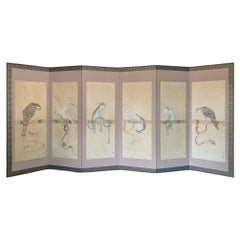
Mid-Edo Hawk Screen
Located in Fukuoka, JP
Step into the world of Mid Edo Japan with our six-panel Hawk screen, each depicting a different hawk. In this period, hawks were revered not only for their majestic beauty but also f...
Category
Antique 18th Century Japanese Edo Paintings and Screens
Materials
Wood, Paper
$2,520
Majestic Hawks Edo Screen by Tosa School
Located in Fukuoka, JP
Majestic Hawks Edo Screen
Period: Edo
Size: 150x168 cm (59x66 inches)
SKU: PTA93
Step back in time to the Edo period with our superb Tosa school screen d...
Category
Antique 19th Century Edo Paintings and Screens
Materials
Gold Leaf
Japanese Screen: Spring Offering
Located in Fukuoka, JP
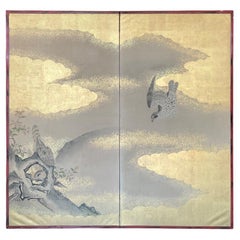
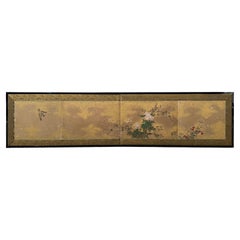
Spring Offering is a small yet exquisitely refined Edo-period screen originally created as a backdrop for a Girls’ Day altar. Against a softly shimmering gold-leaf background, delica...
Category
Antique 18th Century Japanese Edo Paintings and Screens
Materials
Paper, Wood
$1,250 Sale Price
56% Off
Japanese Screens: Echo of Chrysanthemums
Located in Fukuoka, JP
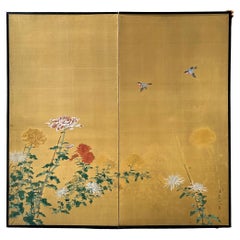
Echo of Chrysanthemums captures the quiet dialogue between form and reflection. Against a radiant gold-leaf ground, blooming chrysanthemums rise in graceful color harmony — white, cr...
Category
Antique 19th Century Japanese Edo Paintings and Screens
Materials
Gold Leaf
$5,785 Sale Price
35% Off
Still Thinking About These?
All Recently ViewedMore Ways To Browse
Japanese Hawks
Antique Falconry
Antique Hawk Painting
Japanese Screen Hawk
The Imperial Palace Of China
Japanese Painting Silk Gold
Japanese Flower Painting
Japanese Showa Screen
20th Century Japanese Folding Screen
Japanese Folding Screen Art
19th Century Chinese Painting On Silk
Byobu Panel
Four Panel Asian Art
Gold Folding Screen
China Silk Panels
Chinese Silk Panel
Japanese Lacquer Panel Screen
Flower And Bird Painting