Want more images or videos?
Request additional images or videos from the seller
1 of 12
18th Century Japanese Scroll of Shogun, Ashikaga Takauji
Price:$5,300
$6,500List Price
About the Item
- Dimensions:Height: 72 in (182.88 cm)Width: 22.25 in (56.52 cm)Depth: 1 in (2.54 cm)
- Style:Edo (Of the Period)
- Materials and Techniques:
- Place of Origin:
- Period:
- Date of Manufacture:18th Century
- Condition:Wear consistent with age and use. Excellent 18th century condition.
- Seller Location:Hudson, NY
- Reference Number:Seller: SC10241stDibs: LU855113472882
About the Seller
5.0
Recognized Seller
These prestigious sellers are industry leaders and represent the highest echelon for item quality and design.
Established in 1971
1stDibs seller since 2008
170 sales on 1stDibs
Typical response time: 5 hours
Associations
The Art and Antique Dealers League of AmericaAntiques Associations Members
Authenticity Guarantee
In the unlikely event there’s an issue with an item’s authenticity, contact us within 1 year for a full refund. DetailsMoney-Back Guarantee
If your item is not as described, is damaged in transit, or does not arrive, contact us within 7 days for a full refund. Details24-Hour Cancellation
You have a 24-hour grace period in which to reconsider your purchase, with no questions asked.Vetted Professional Sellers
Our world-class sellers must adhere to strict standards for service and quality, maintaining the integrity of our listings.Price-Match Guarantee
If you find that a seller listed the same item for a lower price elsewhere, we’ll match it.Trusted Global Delivery
Our best-in-class carrier network provides specialized shipping options worldwide, including custom delivery.You May Also Like
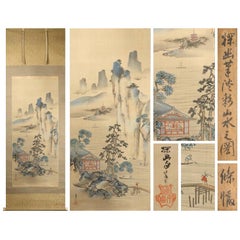
Lovely 17th-18th Century Scroll Painting Japan Artist Kano Soyu Painted
Located in Amsterdam, Noord Holland
It is a work that is said to have been drawn by Kano Soyu as you can see.
It is a picture of the light-colored Sansui map carefully drawn to the smallest detail, and the
towering m...
Category
Antique 17th Century Japanese Edo Paintings and Screens
Materials
Silk
$3,002 Sale Price
20% Off
H 79.73 in W 26.58 in D 0.04 in
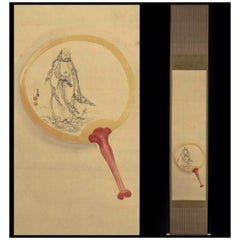
Lovely Japanese 18th-19th Century Edo or Meiji Scroll Painting Japan
Located in Amsterdam, Noord Holland
Maruyama–Shijo style painting
C0ndition; Good but some stains.
Overall dimensions: width of about 28.2 cm and Length of about 173.8 cm
Painting width of about 25.5 cm × leng...
Category
Antique 19th Century Japanese Meiji Paintings and Screens
Materials
Bronze
$667 Sale Price
20% Off
H 11.42 in Dm 0.04 in
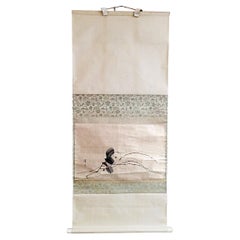
Silk Scroll Painting by Matsumura Keibun, 18th Century
By Matsumura Keibun
Located in New York, NY
A silk parchment scroll with a Camellia Flower painting, by Japanese artist Matsumura Keibun (1779-1843).
The younger half-brother to Matsumura Goshun, founder of the Shijo schoo...
Category
Antique 1790s Asian Edo Paintings and Screens
Materials
Silk, Parchment Paper
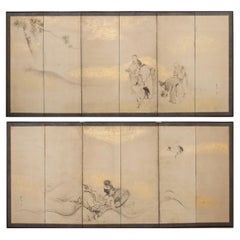
Pair of 18th Century Japanese Edo Screens of Chinese Immortals
Located in Rio Vista, CA
Mesmerizing pair of late 18th/early 19th century Japanese Edo period byobu screens by Shibata Gito (Japanese 1780-1819). The paintings depict Chinese immortals in a dreamy landscape....
Category
Antique 18th Century Japanese Edo Paintings and Screens
Materials
Silk, Wood, Paper
$9,000 / set
H 66 in W 142 in D 0.75 in
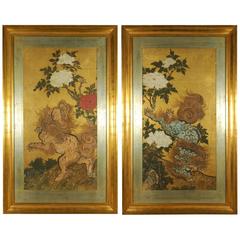
Pair of Antique Japanese Paintings of Karashishi, Edo Period, 18th Century
Located in Prahran, Victoria
A rare pair of antique Japanese Karashishi paintings in a landscape of rocks and peony flowers on gold leaf ground in fine handmade frames, Edo period, early 18th century. The Karash...
Category
Antique Early 18th Century Japanese Edo Paintings and Screens
Materials
Gold Leaf
$50,000 / set
H 77.96 in W 48.04 in D 3.15 in
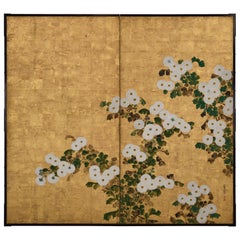
18th Century Japanese Rinpa Screen. White Chrysanthemums. School of Korin.
Located in Kyoto, JP
School of Ogata Korin
White Chrysanthemums
18th Century, Edo period.
A two-panel Japanese screen. Ink, color, gofun and gold leaf on paper.
Dimensions: H. 171 cm x W. 188 cm (67.5” x 74”)
On this two-panel Japanese screen we see blooming chrysanthemums, a flower which embodies the essence of autumn in Japan. Here the traditional floral theme has been simplified and stylized. The bright colors and asymmetrical composition against the delicate gold leaf create a luxurious and ornate work of art. Its background, a strikingly patinated grid of gold leaf, denies any sense of place or time and imbues everything with an ethereal glow. The leaves and stems of the plants are nothing more than pools of mottled color and ink without any outline whatsoever. These are typical Rinpa adaptations of traditional ink painting methods; tarashikomi, or diluted washes of color blended while very wet, and mokkotsu, or “bonelessness,” which creates forms without exterior outlines. The relief work of the rounded flower petals has been obtained by the moriage process (a mixture based on ground shells modeled on the surface of the paper).
On the lower right of the screen, the siganture “Hokyo Korin Jakumyo” and the “Hoshuku” seal can be read. Korin is Ogata Korin, famed for the Irises (Nezu Museum) and Red and White Plum Blossom (MOA Museum of Art) folding screens, both National Treasures. Korin worked in both Kyoto and Edo in the mid-Edo period. Korin was using the art name “Jakumyo” just after he received the Hokyo level, which was in 1701.
This particular screen was published in May of 1961 in the Japanese Sansai Fine Art Magazine*. An in depth article accompanies the photograph of the screen and and a photograph of the signature and seal. This article devotes much of its body to discussing the moriage technique, how it enlivens the chrysanthemum flowers and Korin’s specific skill in using the technique. The article goes on to discuss the most famous works of Korin, utilizing this technique, which were known at the time. Specifically a two-panel screen held in the Honolulu Museum which was discovered in the store-house of Takahashi Soan. A two-panel screen pair which the Nakano family own. A two-panel screen pair with chrysanthemums in moriage in fan designs owned by the Nomura family. Also a small folding screen featuring chrysanthemums held in the Yamato Bunkakan. The article goes on to say that this particular two-fold screen came from the Nijo family. Korin is known to have had a strong connection with the aristocratic Nijo family. The article explains that Korin received a lot of favors from the Nijo family and that this screen would have been gifted to them.
Since that time the Honolulu screen has been amended to ‘attributed to Ogata Korin’ and I do not know further details of the other 3 screens. Other Chrysanthemum screens...
Category
Antique 18th Century Japanese Edo Paintings and Screens
Materials
Gold Leaf
$32,000
H 67.5 in W 74 in D 0.75 in
18th Century Buddhist Chinese Scroll Painting
Located in New York, NY
18th century Buddhist Chinese Scroll Painting.
This is a temple piece and has been re-backed numerous times over its life span. The practice...
Category
Antique Late 18th Century Chinese Paintings and Screens
Materials
Paper

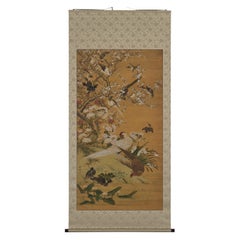
19th Century Japanese Scroll Painting, Birds
Flowers of the Four Seasons
Located in Kyoto, JP
Birds and flowers of the four seasons
Early to mid-19th century
Ink, pigment and gofun on silk
Unidentified artist
Signature: S...
Category
Antique 1830s Japanese Edo Paintings and Screens
Materials
Silk
$10,800
H 86.5 in W 40 in D 1 in
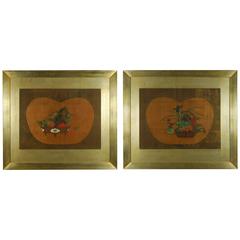
Pair of Antique Japanese Flower Paintings by Yanagisawa Kien, circa 18th Century
By Yanagisawa Kien
Located in Prahran, Victoria
Pair of antique Japanese Nagasaki School paintings by Yanagisawa Kien (1704-1758), depicting classical ikebana flower arrangements. Each painted on silk in mineral pigments and beari...
Category
Antique Mid-18th Century Japanese Edo Paintings and Screens
Materials
Silk
$7,500 / set
H 28.75 in W 42.13 in D 1.58 in
Late 18th Century Japanese Framed Painting, God of Thunder by Yamaguchi Soken
Located in Kyoto, JP
Raijin - God of Thunder
Yamaguchi Soken (1759-1818)
Mid to Late Edo period, circa 1800.
Framed painting. Ink and light color on paper.
This humorous painting depicts the Thunder God, Raijin, tumbling from the sky, presumably being struck down by one of his own lighting bolts. He clings to one drumstick as the other is in free-fall along with his Taiko drums...
Category
Antique Late 18th Century Asian Edo Paintings and Screens
Materials
Paper

$8,500
H 45.5 in W 22.5 in D 0.75 in
More From This Seller
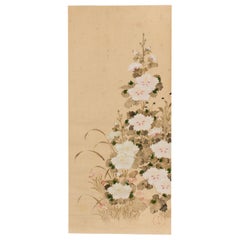
View All19th Century Japanese Scroll of Hollyhocks
Located in Hudson, NY
Seal on lower right reads: I'nen. Beautiful and delicate Rimpa painting using tarashikomi (painting-in) technique of wet on wet painting. Painted in a style reminiscent of the famous...
Category
Antique 19th Century Japanese Paintings and Screens
Materials
Silk, Wood, Paper
18th Century Japanese Two-Panel Screen Collection of Fans on Gold
Located in Hudson, NY
18th century Japanese Screen of a Collection of Fans. Paintings on fans depict famous Japanese painting subjects, this screen was most li...
Category
Antique 18th Century Japanese Edo Paintings and Screens
Materials
Gold Leaf

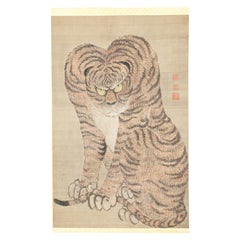
Large Japanese Scroll of a Tiger
Located in Hudson, NY
Wonderfully large and bold tiger painted in ink and mineral pigments on silk mounted with silk brocade border. Seal reads: Miyaguchi (alternative reading: ...
Category
Antique Early 1800s Japanese Edo Paintings and Screens
Materials
Silk
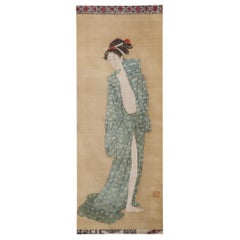
Early 19th Century Japanese Scroll Bijin after the Bath in Summer
Located in Hudson, NY
Early 19th century Japanese Scroll: Bijin after the bath in summer. Painted in pigments on silk. Signature reads: Yamauchi Sentsu.
Japan,...
Category
Antique Early 19th Century Japanese Edo Paintings and Screens
Materials
Silk, Wood
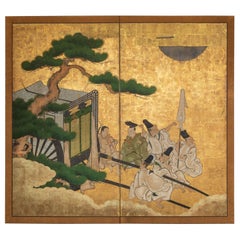
Japanese Two-Panel Screen, Shogun
s Journey to Edo
Located in Hudson, NY
Kano school painting of nobles at rest (some yawning) under moonlit sky. Mostly likely a representation of the last story in the Ise Monogatari: chapter 16, Sekiya (The Gatehouse). A...
Category
Antique Mid-19th Century Japanese Paintings and Screens
17th Century Japanese Two-Panel Screen, Gibbons of Folklore
Located in Hudson, NY
Japanese two-panel screen: Gibbons of Folklore, Edo period (17th century) Kano School painting of gibbons in Japanese fables. The left panel represents a Japanese fable of a monkey a...
Category
Antique Late 17th Century Japanese Edo Paintings and Screens
Materials
Silk, Wood, Paper

Still Thinking About These?
All Recently ViewedMore Ways To Browse
18th Century Japanese Silk Painting
Edo Scroll
Shogun Painting
Antique Japanese Painting
Used Silk Screens
Japanese Framed
Antique Japanese Screens
Japanese Panels
Antique Brocade
Scrolls Art
Asian Screens And Panels
Asian Silk Screens And Paintings
Scroll Painting
Vintage Painted Screens
Japanese Painting On Wood Panel
Vintage Asian Art Paintings
Hand Painted Silk
Japanese Brass