1 of 11
19th Century Japanese Ink Painted Screens with Chinese Poets by Kano Eigaku
$9,563.93List Priceper set
About the Item
- Creator:Kano Eigaku (Artist)
- Dimensions:Height: 68.9 in (175 cm)Width: 65.75 in (167 cm)Depth: 0.4 in (1 cm)
- Sold As:Set of 2
- Style:Edo (Of the Period)
- Materials and Techniques:
- Place of Origin:
- Period:
- Date of Manufacture:circa 1850
- Condition:Wear consistent with age and use. Minor losses. Paper has light brown stains. Painting shows some minor losses at marginal parts. Black lacquered frames show some scratches and minor damages. There is a hole in the backing paper.
- Seller Location:Berlin, DE
- Reference Number:1stDibs: LU4555114240772
Authenticity Guarantee
In the unlikely event there’s an issue with an item’s authenticity, contact us within 1 year for a full refund. DetailsMoney-Back Guarantee
If your item is not as described, is damaged in transit, or does not arrive, contact us within 7 days for a full refund. Details24-Hour Cancellation
You have a 24-hour grace period in which to reconsider your purchase, with no questions asked.Vetted Professional Sellers
Our world-class sellers must adhere to strict standards for service and quality, maintaining the integrity of our listings.Price-Match Guarantee
If you find that a seller listed the same item for a lower price elsewhere, we’ll match it.Trusted Global Delivery
Our best-in-class carrier network provides specialized shipping options worldwide, including custom delivery.You May Also Like
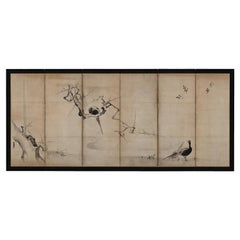
17th Century Japanese Screen. Ink Plum Tree
Birds by Kano Naonobu.
Located in Kyoto, JP
Kano Naonobu (1607-1650)
Plum Tree and Birds
Six-fold Japanese Screen. Ink and slight color on paper.
In this evocative ink work spread over a six-panel folding screen, we see the consummation of the elegance and refinement of the Edo Kano school. This 17th century screen is a rare surviving example of a large-scale bird and flower painting by Kano Naonobu, the younger brother of Kano Tanyu...
Category
Antique 17th Century Japanese Edo Paintings and Screens
Materials
Wood, Paper
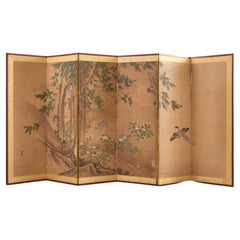
19th Century Japanese Edo Six Panel Kano School Landscape Screen
Located in Rio Vista, CA
Late Edo period 19th century Japanese six-panel landscape screen featuring a cypress tree over a flowering hibiscus with a pair of hototogisu birds. Kano school painted with ink and ...
Category
Antique 19th Century Japanese Edo Paintings and Screens
Materials
Silk, Wood, Paper
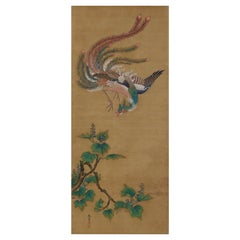
19th Century Japanese Silk Painting by Kano Chikanobu, Phoenix
Paulownia
Located in Kyoto, JP
Birds & Flowers of the seasons
Pheasants & Plum in Snow
Unframed painting. Ink, pigment and gofun on silk
Kano Chikanobu 1819-1888
Signature...
Category
Antique Mid-19th Century Asian Edo Paintings and Screens
Materials
Silk
$4,500
H 46 in W 19.5 in D 0.01 in
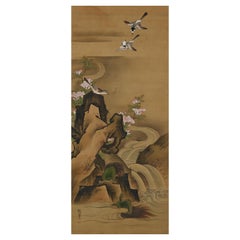
19th Century Japanese Silk Painting by Kano Chikanobu, Turtles
Azalea
Located in Kyoto, JP
Birds & flowers of the seasons
Pheasants & plum in snow
Unframed painting. Ink, pigment and gofun on silk
Kano Chikanobu 1819-1888
Signature...
Category
Antique Mid-19th Century Asian Edo Paintings and Screens
Materials
Silk
$4,500
H 45.5 in W 19.5 in D 0.01 in
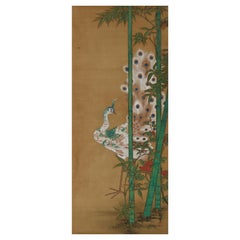
19th Century Japanese Silk Painting by Kano Chikanobu, Peacock
Bamboo
Located in Kyoto, JP
Birds & Flowers of the Seasons
Pheasants & Plum in Snow
Unframed painting. Ink, pigment and gofun on silk
Kano Chikanobu 1819-1888
Signature...
Category
Antique Mid-19th Century Asian Edo Paintings and Screens
Materials
Silk
$4,500
H 46 in W 19.5 in D 0.01 in
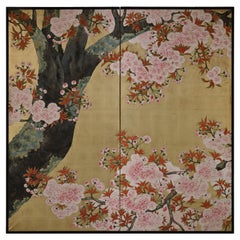
Early 20th Century Japanese Cherry Blossom Screen by Kano Sanrakuki
Located in Kyoto, JP
Cherry Blossoms
Kano Sanrakuki (1898-1981)
Showa period, circa 1930
2-panel Japanese Screen
Color, gofun and gold leaf on paper
Against a backdrop of gold-leafed ground, the lichen covered trunk and branches of the life-sized cherry blossom tree reach out and beyond the confines of the pictorial surface. The overall composition has a feeling of flatness which draws emphasis to the surface and the three-dimensionality of the cherry blossoms. Painstakingly built-up layers of thickly applied shell-white gofun detail the voluminous blossoms and cover large areas of this tour-de-force of Japanese Nihonga painting. By simplifying the background, minimizing the number of colors and depicting the blossoms with such heavy relief, the artist has emphasized the stunning presence of the cherry tree. The type of tree depicted is the Yae-Zakura; a double-layered type of cherry blossom famed for its beauty and strength. When we think of Japanese cherry blossoms, the first thing that comes to mind is Somei Yoshino variety, which has a single flower with five almost white petals. This type is fragile and easily blown away by strong wind or rain. Most of the double-flowered cherry blossoms begin to bloom when the Somei-Yoshino falls, and the flowering period lasts longer than that of the Somei-Yoshino.
Kano Sanrakuki originally studied painting at the Kyoto City Arts and Crafts School under the tutelage of Yamamoto Shunkyo...
Category
Early 20th Century Japanese Showa Paintings and Screens
Materials
Gold Leaf
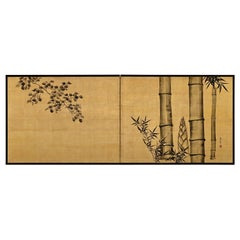
19th Century Japanese Screen for Tea-Ceremony, Ink Bamboo and Plum on Gold Leaf
Located in Kyoto, JP
Three Friends of Winter
Nakajima Raisho (1796-1871)
Late Edo period, circa 1850
Ink and gold leaf on paper.
This is a double-sided Japanese Furosaki or tea-ceremony screen from the mid 19th century; bamboo and plum on the front, young pines the back. It by Nakajima Raisho, a master painter of the Maruyama school in the late Edo and early Meiji periods. In this work Raisho combines exquisite ink brushwork with large open spaces of brilliant gold-leaf to inspire the viewers imagination. Rather than naturalism, he is searching for the phycological impression of the motifs, resulting in abstraction and stylization. His simplification of the motifs the result of looking to capture the inner nature of the objects. This art motif is known as Sho Chiku Bai, or the Three Friends of Winter. Evergreen pine connotes steadfastness, bamboo suggests both strength and flexibility, while plum blossoms unfurling on snow-laden branches imply hardiness. Combined, this trio is emblematic of Japanese new year. Chinese literati were the first to group the three plants together due to their noble characteristics. Like these resilient plants flowering so beautifully in winter, it was expected of the scholar-gentleman to cultivate a strong character with which he would be able to show the same degree of perseverance and steadfastness even during times of adverse conditions.
The screen would have been placed near the hearth of a room used for the Japanese tea ceremony, shielding the fire from draughts and also forming a stimulating and decorative backdrop behind the tea utensils. It would have been used in the Hatsugama, or first tea-ceremony of the new year.
Nakajima Raisho (1796-1871) originally studied under Watanabe Nangaku before entering the school of Maruyama Ozui. He was the highest ranking Maruyama school painter at the end of the Edo period and was known as one of the ‘Four Heian Families’ along with Kishi...
Category
Antique Mid-19th Century Japanese Edo Paintings and Screens
Materials
Gold Leaf
$9,200
H 29 in W 74 in D 0.75 in
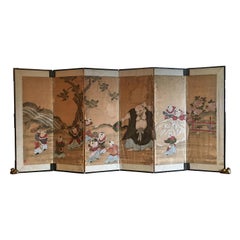
Japanese Six Panel Screen with Hotei, Edo Period, Early 19th Century
Located in Austin, TX
A delightful Japanese six panel painted paper screen featuring the beloved figure Hotei, Edo Period, early 19th century.
Hotei, called Budai in China, and known as the Laughing Buddha or Fat Buddha in the West, is considered to be an emanation of Maitreya, the Buddha of the Future.
In Japan, he also holds a special place as one of the Seven Lucky Gods, being the god of fortune, and protector of children.
He is always portrayed as a mirthful and corpulent man, dressed in loose robes that show off his round belly. He carries a sack with him, said to be filled with treasure. As the protector of children, he is often portrayed with them playing on or around him, as he is here. The children portrayed in this screen are dressed in Chinese style clothing...
Category
Antique Early 19th Century Japanese Edo Paintings and Screens
Materials
Silk, Paper
$6,500
H 54.5 in W 111 in D 0.75 in
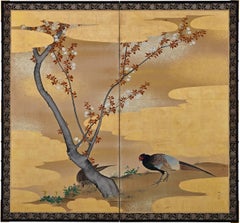
Early 19th Century Japanese Screen. Cherry Blossom
Pheasants by Mori Tetsuzan
Located in Kyoto, JP
Mori Tetsuzan (1775-1841)
Pheasants and Cherry Blossoms
Two-fold Japanese screen. Ink, color, gofun, gold and silver on paper.
A two-fold Japanese bir...
Category
Antique Early 19th Century Japanese Edo Paintings and Screens
Materials
Gold Leaf
$29,500
H 69 in W 75 in D 0.75 in
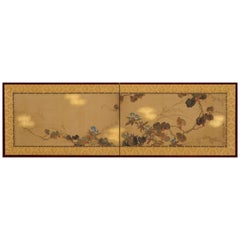
Japanese Screen Painting, Early 19th Century, Autumn Flowers by Sakai Hoitsu
Located in Kyoto, JP
A two-fold Japanese screen by the Rimpa school artist Sakai Hoitsu (1761-1828), Japan, 19th century, Edo period.
This small Japanese folding screen pai...
Category
Antique Early 19th Century Japanese Edo Paintings and Screens
Materials
Wood, Silk
$34,500
H 18 in W 56 in D 1 in
Still Thinking About These?
All Recently ViewedMore Ways To Browse
19th Century Chinese Painting On Silk
19th Century Japanese Lacquer Screen
Chinese Four Panel Lacquer Screen
Japanese Four Panel Silk Screen
Four Panel Japanese Folding Screen
Japanese Signed Two Panel Screen
Crane Panel
Chinese Japanese Screens
Japan Hand Painted China
Antique Chinese Painting On Silk Panel
Japanese Kano Screen
Two Panel Folding Screen
Cranes Garden
Antique Hand Painted Japanese China
Edo Japanese Screen Kano
Chinese Folding Silk Screen Art
Japanese Panels
Antique Brocade