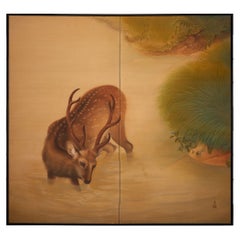
Items Similar to 19th Century Japanese Screen, Deer in Spring, Maruyama Shijo School
Want more images or videos?
Request additional images or videos from the seller
1 of 6
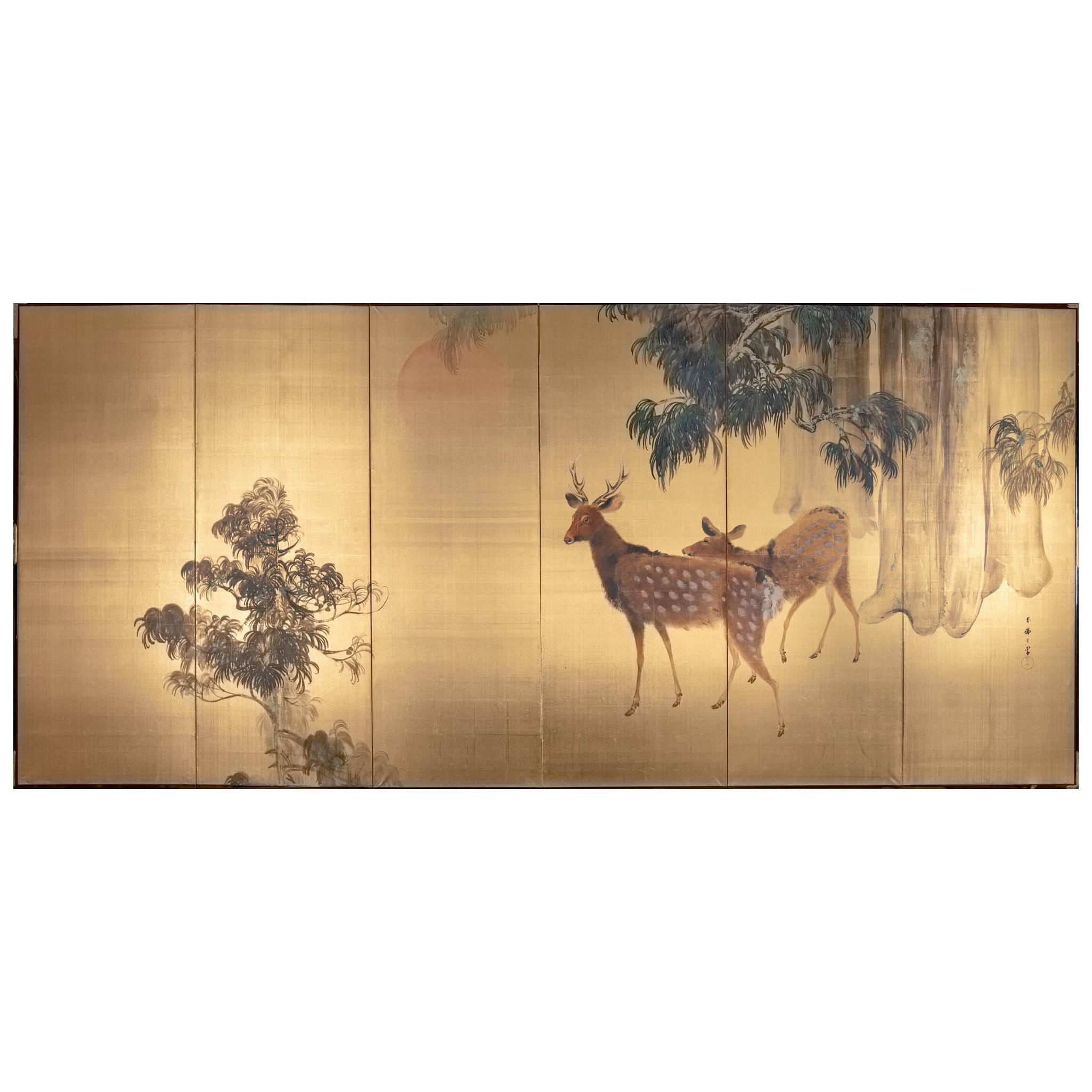
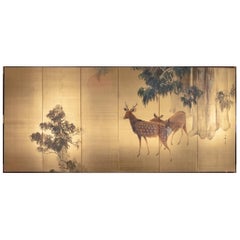
19th Century Japanese Screen, Deer in Spring, Maruyama Shijo School
$28,000
£21,273.09
€24,447.25
CA$39,329.43
A$42,809.10
CHF 22,683.01
MX$514,844.18
NOK 288,408.68
SEK 264,294.64
DKK 182,619.44
About the Item
A six-panel Japanese folding screen from the leading Maruyama-Shijo artist Okamoto Toyohiko (1773-1845). Simply featuring three deer and a few sprigs of foliage on a sumptuous gold-leaf background this work emphasizes naturalistic expression and a masterful use of negative space. Reduced to its most basic elements, the blank spaces inspire imagination and evoke the smells, sounds and even the weather of the scene. Whilst deer are traditionally depicted in association with autumn, here the green growth on the tops of the foliage indicates the season of spring. The work references Maruyama Okyo’s two-panel deer screen in the Kyoto National Museum, and is similarly painted in color on gold-leaf. Although famed as a painter of landscapes, Toyohiko seemed particularly fond of and talented at painting naturalistic deer on a large scale. Among the more famous works by him depicting deer are a two-panel screen held at the Mitsui Memorial Museum and a two-fold screen at the Museum of Fine Arts Boston in which Toyohiko depicts a deer and Keibun depicts a pine tree.
Okamoto Toyohiko (1773-1845) was the best pupil of Goshun and through him learned the emotional literary and landscape styles of painting. Toyohiko inherited the naturalist sketching style from Maruyama Okyo. He collaborated with the most senior painting masters of his time and was friendly with the Arisugawa family. Perhaps due to this association he received painting orders from the Imperial court and some of his works remain at the Shugakuin Imperial Villa. After Maruyama Okyo and Goshun founded the Kyoto based Maruyama-Shijo school, Matsumura Keibun and Okamoto Toyohiko successfully continued and secured the lineage. After Goshun’s death they opened their own art school and trained many disciples, among them Shibata Zeshin, Shiokawa Bunrin and Tanaka Nikka.
Works by Okamoto Toyohiko are held in the Kyoto National Museum, British Museum, LACMA, Shizuoka Prefectural Museum of Art, Okayama Prefectural Museum of Art, Osaka City Museum of Art, Boston Museum of Fine Arts, Mitsui Memorial Museum and Shugakuin Imperial Villa.
- Dimensions:Height: 67 in (170.18 cm)Width: 148 in (375.92 cm)Depth: 0.75 in (1.91 cm)
- Style:Edo (Of the Period)
- Materials and Techniques:
- Place of Origin:
- Period:
- Date of Manufacture:Circa 1830
- Condition:Wear consistent with age and use.
- Seller Location:Kyoto, JP
- Reference Number:1stDibs: LU2472334533682
About the Seller
5.0
Recognized Seller
These prestigious sellers are industry leaders and represent the highest echelon for item quality and design.
Established in 2001
1stDibs seller since 2016
77 sales on 1stDibs
Typical response time: 6 hours
- ShippingRetrieving quote...Shipping from: Kyoto, Japan
- Return Policy
More From This Seller
View AllEarly 20th Century Pair of Japanese Folding Screens, Deer Under Maple Trees
Located in Kyoto, JP
Deer under maples
Late Taisho period, circa 1925-1930
Pair of two-panel screens. Ink and pigment on silk.
Signature: Goho
Seal: Goho
A pair of two-fold Japanese silk screens...
Category
Vintage 1920s Japanese Taisho Paintings and Screens
Materials
Wood, Paper, Silk
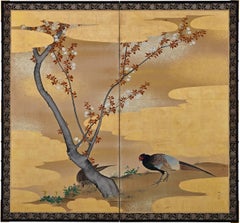
Early 19th Century Japanese Screen. Cherry Blossom
Pheasants by Mori Tetsuzan
Located in Kyoto, JP
Mori Tetsuzan (1775-1841)
Pheasants and Cherry Blossoms
Two-fold Japanese screen. Ink, color, gofun, gold and silver on paper.
A two-fold Japanese bir...
Category
Antique Early 19th Century Japanese Edo Paintings and Screens
Materials
Gold Leaf
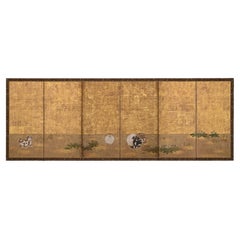
Late 17th Century Japanese Screen. Puppy and Kittens on Gold Leaf.
Located in Kyoto, JP
Anonymous
Late 17th century
Puppy & Kittens
A six-panel Japanese screen. Ink, color, gofun, gold-leaf and gold-fleck on paper.
A medium sized late 17th century Japanese screen fe...
Category
Antique Late 17th Century Japanese Edo Paintings and Screens
Materials
Gold Leaf
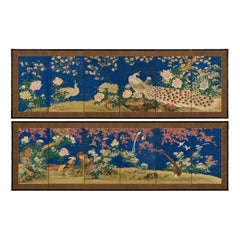
Mid 19th Century Japanese Screen Pair. Flowers
Birds of the Four Seasons.
Located in Kyoto, JP
Shioka Sorin (1781-1850)
Flowers & Birds of the Four Seasons
Pair of six-panel Japanese Screens. Ink, gofun and pigments on silk.
Dimensions (each screen): H. 91.5cm x W. 285cm (3...
Category
Antique Mid-19th Century Japanese Edo Paintings and Screens
Materials
Silk
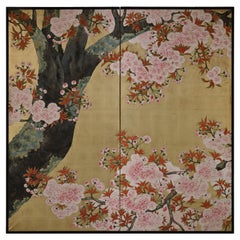
Early 20th Century Japanese Cherry Blossom Screen by Kano Sanrakuki
Located in Kyoto, JP
Cherry Blossoms
Kano Sanrakuki (1898-1981)
Showa period, circa 1930
2-panel Japanese Screen
Color, gofun and gold leaf on paper
Against a backdrop of gold-leafed ground, the lichen covered trunk and branches of the life-sized cherry blossom tree reach out and beyond the confines of the pictorial surface. The overall composition has a feeling of flatness which draws emphasis to the surface and the three-dimensionality of the cherry blossoms. Painstakingly built-up layers of thickly applied shell-white gofun detail the voluminous blossoms and cover large areas of this tour-de-force of Japanese Nihonga painting. By simplifying the background, minimizing the number of colors and depicting the blossoms with such heavy relief, the artist has emphasized the stunning presence of the cherry tree. The type of tree depicted is the Yae-Zakura; a double-layered type of cherry blossom famed for its beauty and strength. When we think of Japanese cherry blossoms, the first thing that comes to mind is Somei Yoshino variety, which has a single flower with five almost white petals. This type is fragile and easily blown away by strong wind or rain. Most of the double-flowered cherry blossoms begin to bloom when the Somei-Yoshino falls, and the flowering period lasts longer than that of the Somei-Yoshino.
Kano Sanrakuki originally studied painting at the Kyoto City Arts and Crafts School under the tutelage of Yamamoto Shunkyo...
Category
Early 20th Century Japanese Showa Paintings and Screens
Materials
Gold Leaf
18th Century Japanese Screen Pair. Plum
Young Pines. Kano School.
Located in Kyoto, JP
Dimensions (Each screen): H. 176 cm x W. 378 cm (69’’ x 149’’)
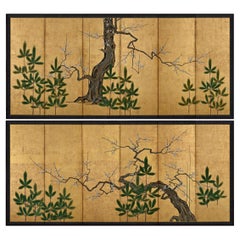
This pair of Japanese folding screens depict blossoming plum trees amongst young pines. They are designed to capture t...
Category
Antique Late 18th Century Japanese Edo Paintings and Screens
Materials
Gold Leaf
You May Also Like
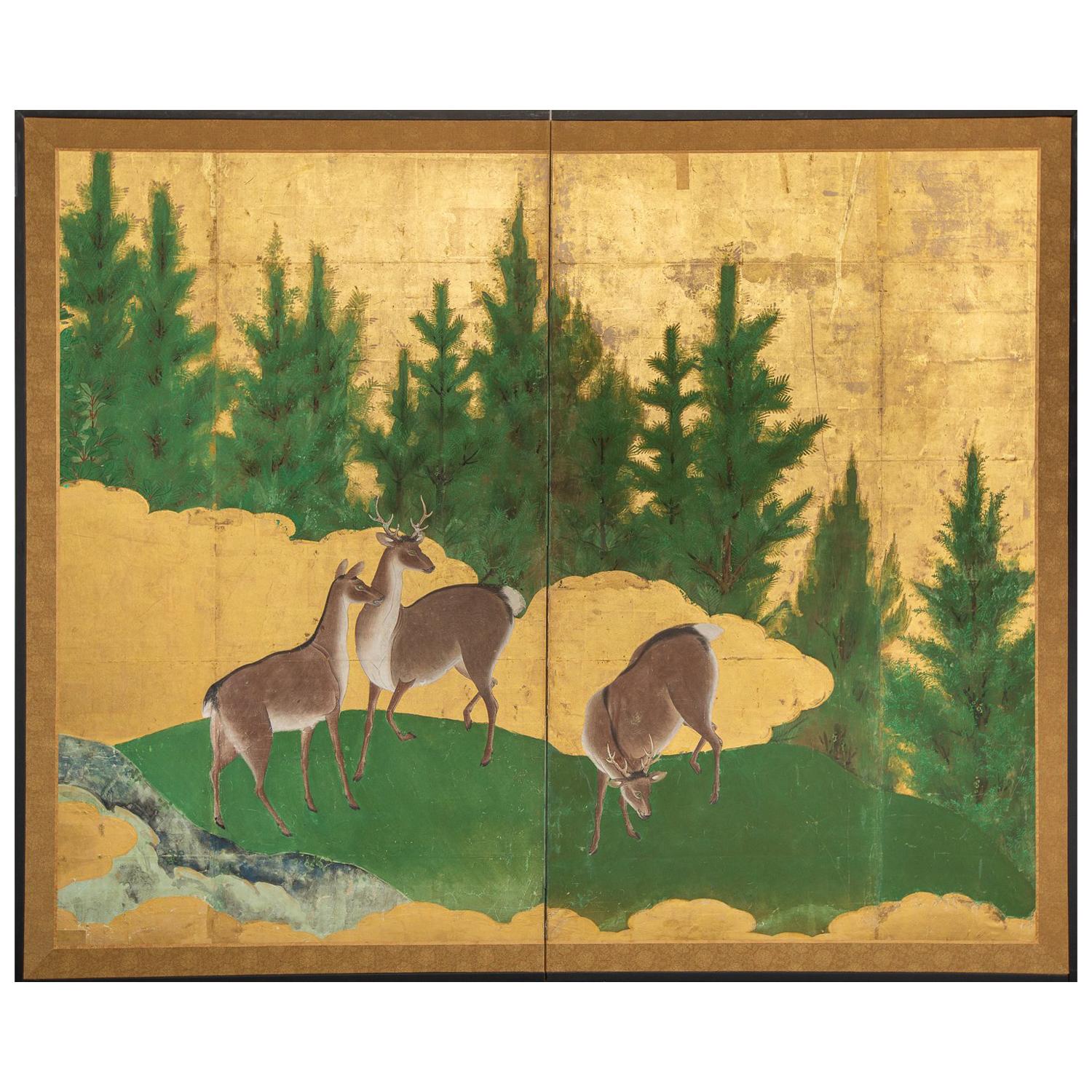
Japanese Two-Panel Screen, Deer in Cedar Landscape
Located in Hudson, NY
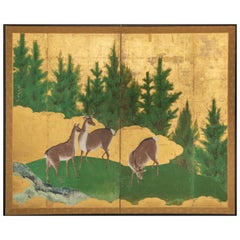
Originally fusuma doors, three deer stand in a clearing in a pine forest with gold leaf mist. Mid Edo period painting in mineral pigments on gold leaf wi...
Category
Antique 18th Century Japanese Edo Paintings and Screens
Materials
Gold
Japanese Two Panel Screen Nara Deer in Gentle Yoshino Landscape
Located in Hudson, NY
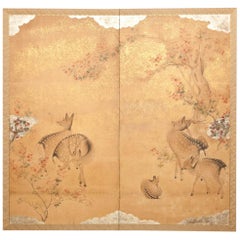
Japanese two panel screen: Nara Deer in Gentle Yoshino Landscape. Yoshino is in the Nara Prefecture, an area famous for these small and tame deer native to J...
Category
Antique Early 1900s Japanese Meiji Paintings and Screens
Materials
Gold Leaf, Silver Leaf
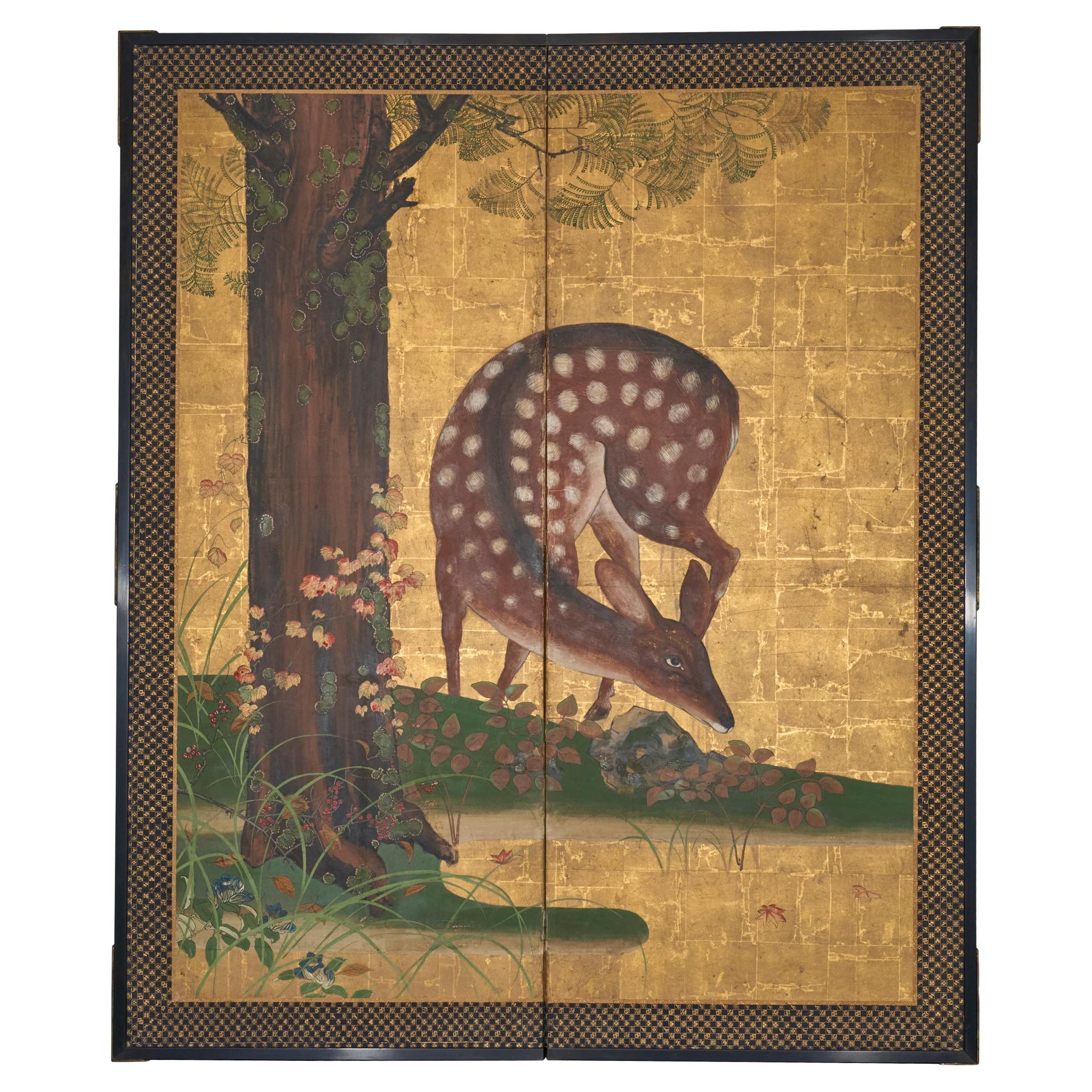
Japanese Two Panel Screen: Woodland Deer
Located in Hudson, NY
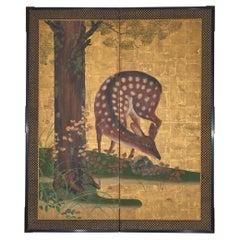
Foraging deer under hinoki tree in an autumn setting. Mineral pigments on heavy gold leaf with good veining on paper. Silk brocade border with a black lacquer trim and elaborate bron...
Category
Antique Early 19th Century Japanese Paintings and Screens
Materials
Bronze
Japanese Six-Panel Screen Buck and Doe at Dawn
Located in Hudson, NY
Japanese six-panel screen: Buck and doe at dawn. Showa period (1926-1989) painting of a rising sun seen through a woodland scene with a pair of deer. In Japan, deer are thought to be...
Category
Early 20th Century Japanese Showa Paintings and Screens
Materials
Bronze
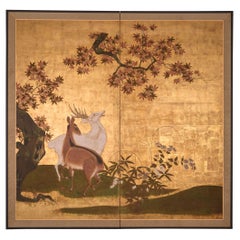
Japanese Two Panel Screen: Deer in Autumn Landscape
Located in Hudson, NY
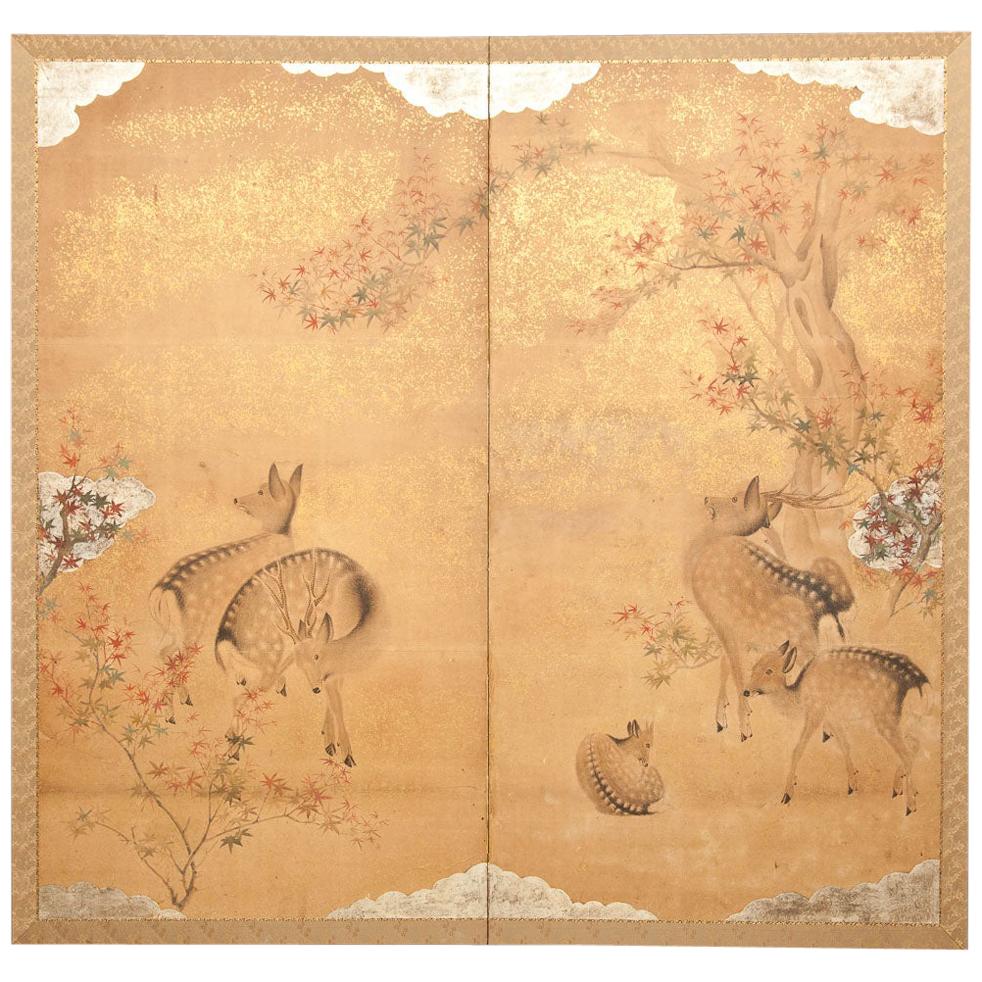
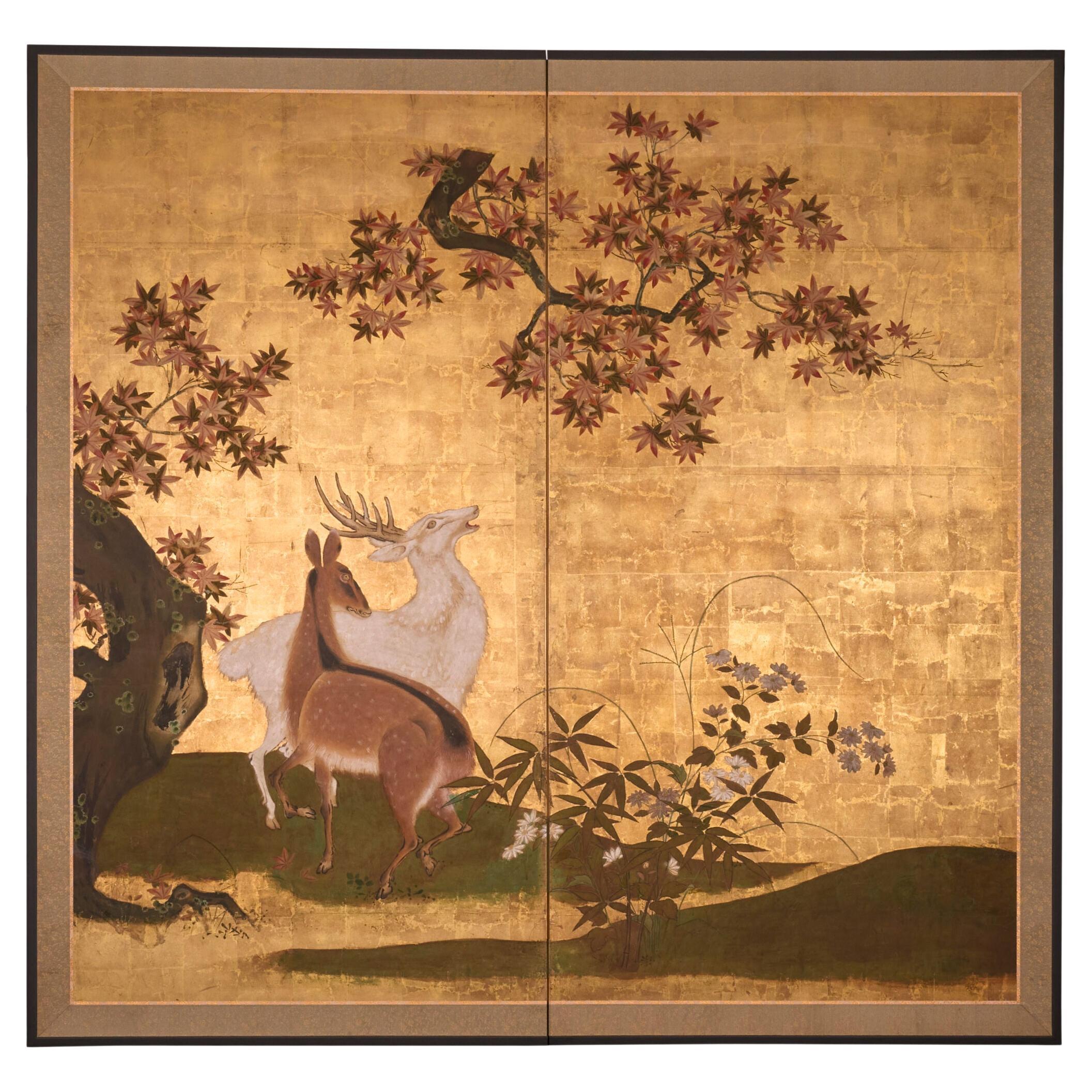
Buck and doe under a red maple on heavy gold. Mineral pigments on gold leaf on paper with silk brocade border and black lacquer trim. White deer are considered a symbol of longevity ...
Category
Antique Early 19th Century Japanese Paintings and Screens
Materials
Gold Leaf
Japanese Two-Panel Screen, Wading Deer
Located in Hudson, NY
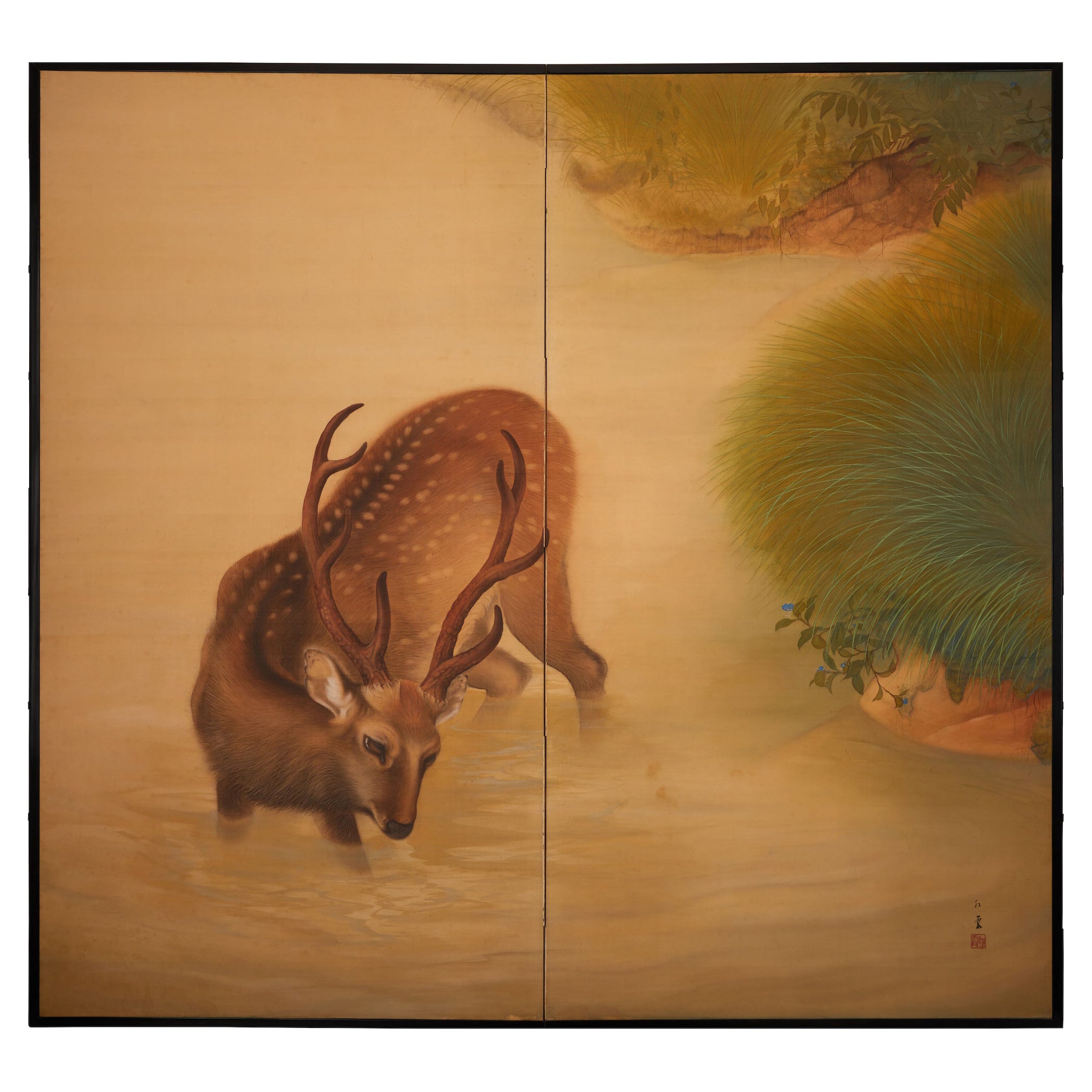
In Japan, it is a Shinto belief that the deer is a treasured and sacred animal. This admirable scene captures this gentle creature in its natural habitat with beautiful detail in bot...
Category
Early 20th Century Japanese Paintings and Screens
Materials
Silk, Lacquer