Want more images or videos?
Request additional images or videos from the seller
1 of 19
Antique Japanese Folding Floor Screen Kano School with Provenance
$15,000List Price
About the Item
- Dimensions:Height: 68 in (172.72 cm)Width: 25 in (63.5 cm)Depth: 15 in (38.1 cm)
- Style:Japonisme (Of the Period)
- Materials and Techniques:
- Place of Origin:
- Period:
- Date of Manufacture:18th Century
- Condition:Repaired: some old restoration and in paint discernible. The backing may have been replaced at some point. Wear consistent with age and use. Minor losses. No tears or punctures. Minor losses on the edge around the hinges in keeping with the age. minor nicks and bumps on the wood frame. The brass corner plate on the lower right is missing.
- Seller Location:Atlanta, GA
- Reference Number:1stDibs: LU945020414162
About the Seller
4.9
Platinum Seller
Premium sellers with a 4.7+ rating and 24-hour response times
Established in 2006
1stDibs seller since 2010
583 sales on 1stDibs
Authenticity Guarantee
In the unlikely event there’s an issue with an item’s authenticity, contact us within 1 year for a full refund. DetailsMoney-Back Guarantee
If your item is not as described, is damaged in transit, or does not arrive, contact us within 7 days for a full refund. Details24-Hour Cancellation
You have a 24-hour grace period in which to reconsider your purchase, with no questions asked.Vetted Professional Sellers
Our world-class sellers must adhere to strict standards for service and quality, maintaining the integrity of our listings.Price-Match Guarantee
If you find that a seller listed the same item for a lower price elsewhere, we’ll match it.Trusted Global Delivery
Our best-in-class carrier network provides specialized shipping options worldwide, including custom delivery.You May Also Like
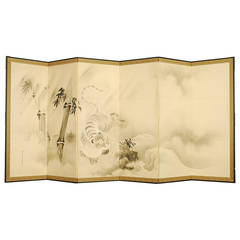
Antique Japanese Kano School Painting by Yosenin Korenobu
Located in Prahran, Victoria
Six-panel Kano School tiger screen by Yosenin Korenobu (1753-1808). Sumi-e ink on paper, late 18th century.
Dimensions: H 169cm x W 382cm.
Category
Antique Late 18th Century Japanese Edo Paintings and Screens
Materials
Wood, Paper
Antique Japanese Six-Panel Screen by Kano Chikanobu "Shushin"
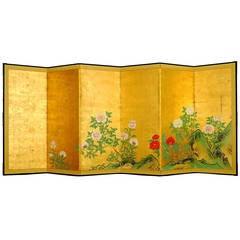
Located in Prahran, Victoria
Late 17th century Kano school peony landscape screens. Both screens signed: Hogan Josen Fujiwara Chikanobu Hitsu - Kano Chikanobu (Shushin) (1660 - 1728...
Category
Antique Early 18th Century Japanese Edo Paintings and Screens
Materials
Gold Leaf
$25,000
H 59.06 in W 145.67 in D 1.58 in
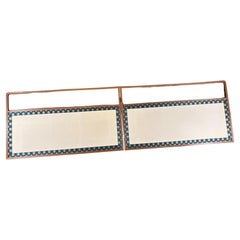
Japan Small Folding Two-Panel Blue Furosaki Tea Screen Contemporary Simplicity
Located in South Burlington, VT
Japan folding two-panel tea screen furosaki byobu depicting a simple cream colored back ground with a blue border, colors on paper 21.5” high and 74” wide when fully extended.
A lo...
Category
Mid-20th Century Japanese Showa Paintings and Screens
Materials
Paper, Fabric, Wood
$295
H 21.5 in W 74 in D 1 in
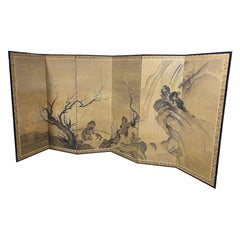
Japanese Asian Large Edo Six-Panel Folding Byobu Screen Landscape Monkeys Trees
Located in Studio City, CA
An absolutely gorgeous, wonderfully composed six-panel Japanese Byobu folding screen/room divider depicting a family of playful monkeys among the blooming trees and mountainous lands...
Category
Antique Early 19th Century Japanese Edo Paintings and Screens
Materials
Gold Leaf
$10,000
H 65.5 in W 140 in D 0.75 in
17th Century
Late 1600s
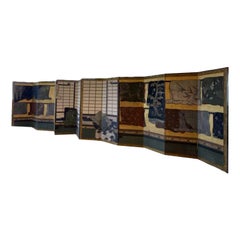
, Japanese Edo Period 12-Panel Folding Screen Painted
Located in North Miami, FL
A pair of 17th Century (Late 1600s) Japanese Edo screens made of 12-panels. This folding silk screen is painted on a gold leaf background. It has a...
Category
Antique 17th Century Japanese Edo Paintings and Screens
Materials
Silk, Wood, Paint, Paper
$595,000 / set
H 68.5 in W 292 in D 0.75 in
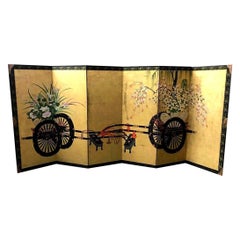
Japanese Asian Large Six-Panel Folding Byobu Flower Cart Screen, 19th Century
Located in Studio City, CA
A gorgeous six-panel Japanese Byobu folding screen. Listing as Meiji period but could very possibly Edo period. Decorated with peonies, irises and...
Category
Antique 19th Century Japanese Meiji Paintings and Screens
Materials
Gold Leaf
$8,500
H 68 in W 150 in D 1 in
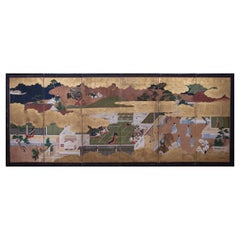
Important Japanese six-fold screen depicting The Tale of The Genji, 17th century
Located in Amsterdam, NL
An important Japanese six-fold screen, depicting episodes from The Tale of The Genji
Edo period, 17th century
Ink and colour on gilded paper, H. 155 x W. 380 cm
The Tale of Genji...
Category
Antique 17th Century Japanese Edo Paintings and Screens
Materials
Paint, Paper
$44,998
H 61.03 in W 149.61 in D 1.58 in
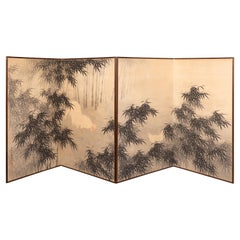
Japanese Four Panel Paper Screen
Located in Essex, MA
Pair of two panel screens with a rooster and a hen in amongst bamboo. Signed by the artist Ema Saiko 1787-1861. A Japanese painter, poet and calligrapher celebrated for her Chinese...
Category
Antique 1850s Japanese Screens and Room Dividers
Materials
Paper
Chinese Export Soapstone Folding Screen Room Divider
Located in West Sussex, Pulborough
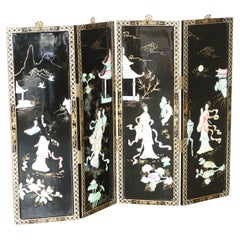
We are delighted to offer for sale this extremely well-made and highly collectable Chinese Export Soapstone room divider folding screen depicting court beauties
A truly stunning and...
Category
20th Century Chinese Chinese Export Paintings and Screens
Materials
Soapstone
Japanese Edo Period Two-Panel Screen
Located in Stamford, CT
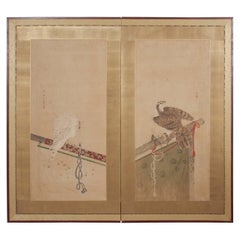
A Japanese Edo Period two panel folding screen with white and brown hawks of ink and color on paper.
Category
Antique Mid-19th Century Japanese Edo Paintings and Screens
Materials
Paper
More From This Seller
View AllRare Antique Japanese Folding Screen by Kano Tanshin
By Kano Tanshin
Located in Atlanta, GA
An exquisite Japanese folding screen painted and signed by Kano Tanshin (Morimasa) (1658-1719), circa early Edo Period. An important member of the Kano painter family, the son of Kano Tanyu...
Category
Antique 17th Century Japanese Japonisme Paintings and Screens
Materials
Brass
Pair of Rare Antique Japanese Folding Screens with Provenance
Located in Atlanta, GA
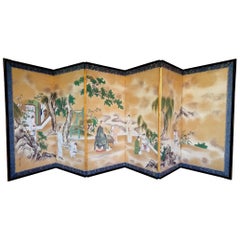
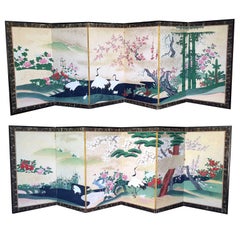
An amazing pair of matching antique Japanese folding screen predating 1812-1813, most likely from Kano School. Six panels each depict C...
Category
Antique 1810s Japanese Japonisme Paintings and Screens
Materials
Brass
Pair of Japanese Ink Hanging Scrolls Kano Tanyu
By Kano Tan
yu 1
Located in Atlanta, GA
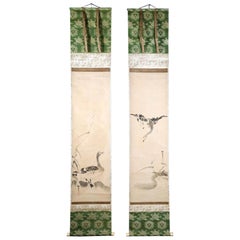
A fine matching pair of hanging scrolls ink on paper mounted in green brocade borders circa Edo period (17-18th century). The Kano school painting depicts wild geese in the reeds by the margin of water, a popular subject borrowed from the Chinese tradition. Both painting were signed as Tanyu with a red seal of Morinobu, his birth name. The storage box is also present and was inscribed with the title Painting of Geese and Reeds and Kano Tanyu...
Category
Antique Late 17th Century Japanese Japonisme Paintings and Screens
Materials
Wood, Paper
$6,000 / set
Korean Folding Chaekgeori Painted Scholar Floor Screen
Located in Atlanta, GA
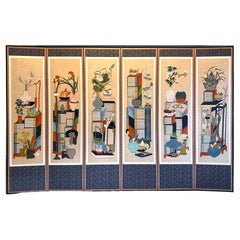
A six-panel painted folding floor screen from Korea circa early 20th century. This type of screen is called Chaekgeori (books and things) which is quite unique to Korea. It became popular at the end of 18th century favored and encouraged by King Jeongjo (1752-1800) as a political tool to promote social conservatism such as the traditional Confucianism value, especially considered important in a time when waves of new ideology influx came to Korea. Initially commissioned for the royal court, they became increasingly popular with the scholars of noble and affluent households and were used widely in their halls and studies. Early screens were painted with trompe-l’oeil bookcases displaying books and arrays of collectibles. Later, the bookcases were eliminated to focus on the assemblage of neatly stacked books and objects of scholarly pursue. On this screen, the six panels were neatly presented and framed in woven brocade borders. Among the stacked volumes, one can find many fine porcelain vases with flowers, potted orchids, pen holders with brush pens and scroll paintings, incense burner, ink stone, teapot, fan with ink painting, vessels of fruits, exotic plants such as lotus, plumeria and even a pair of glasses. It feels like a pleasant visual measure hunting for the viewers. Several words in Chinese found their way into the picture as well, including filial (xiao), longevity (shou) and luck (fu).
The painting was done in a meticulous way with no details overlooked and also with a rather western still-life dimensional perspective. In a rather unusual maximal but also minimalistic way, the screen exudes a historical charm with a folky flair but appears modern at the same time.
Each panel is 17.5"w by 70.2"h.
For general information on the subject see reference: Chaekgeori the Power and Pleasure of Possessions in Korean Painted Screens...
Category
20th Century Korean Folk Art Paintings and Screens
Materials
Brocade, Silk, Wood, Paper
Chinese Folding Floor Screen with Stone Insets
Located in Atlanta, GA
A six panel hinged folding floor screen from China circa end of the 19th- early 20th century. Each panel features three sections of black lacquere...
Category
Antique Late 19th Century Chinese Chinese Export Furniture
Materials
Stone

$16,000 Sale Price
20% Off
Rare Japanese Floor Screen of Perched Eagles Soga Shohaku Edo period
Located in Atlanta, GA
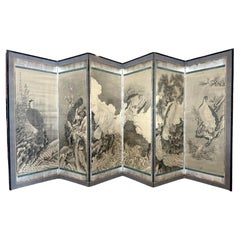
A rare six-panel Japanese folding floor screen (Byōbu) by Soga Shōhaku (1730-1781) from Edo period. The screen depicts six perched hawk-eagles in various poses positioned in a litera...
Category
Antique 18th Century Japanese Edo Paintings and Screens
Materials
Brocade, Wood, Paper
Still Thinking About These?
All Recently ViewedMore Ways To Browse
Antique Asian Folding Screen
Antique Japanese Wood Screens
Japanese Kano Screen
Japanese Screens Six Fold
Kano School Screen
Folding Floor Screen
Japanese Screen Kano School
Japanese Floor Screens
Antique Chinese Screens
Asian Silk Paintings Antique
Antique Silk Screen Painting
19th Century Japanese Screen
20th Century Japanese Screens
Hand Painted Japanese Screen
Japanese Gold Leaf
Antique Chinese Panel
Chinese Screen Painted
Japan Gold Painting