1 of 12
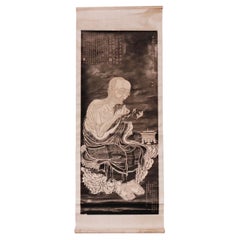
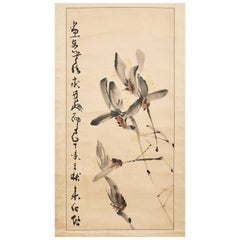
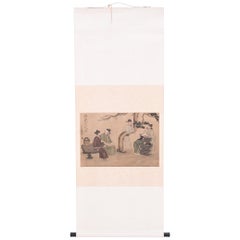
Chinese ink rubbing of cranes, mounted as a scroll.
$600List Price
About the Item
- Dimensions:Height: 85.5 in (217.17 cm)Width: 39.75 in (100.97 cm)Depth: 1.5 in (3.81 cm)
- Style:Qing (Of the Period)
- Materials and Techniques:
- Place of Origin:
- Period:
- Date of Manufacture:circa 1890
- Condition:Wear consistent with age and use. Remounting suggested.
- Seller Location:New York, NY
- Reference Number:Seller: UA031411stDibs: LU4546216384752
Authenticity Guarantee
In the unlikely event there’s an issue with an item’s authenticity, contact us within 1 year for a full refund. DetailsMoney-Back Guarantee
If your item is not as described, is damaged in transit, or does not arrive, contact us within 7 days for a full refund. Details24-Hour Cancellation
You have a 24-hour grace period in which to reconsider your purchase, with no questions asked.Vetted Professional Sellers
Our world-class sellers must adhere to strict standards for service and quality, maintaining the integrity of our listings.Price-Match Guarantee
If you find that a seller listed the same item for a lower price elsewhere, we’ll match it.Trusted Global Delivery
Our best-in-class carrier network provides specialized shipping options worldwide, including custom delivery.You May Also Like
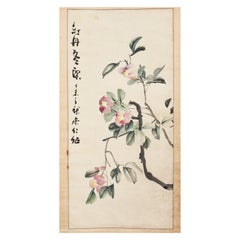
Chinese Hanging Scroll Painting of Camellias Signed Dated
Located in Rio Vista, CA
Seasonal autumn Chinese hanging scroll painting depicting colorful Camellias with a calligraphy signature and date. Crafted on hand-made mulberry paper wi...
Category
20th Century Chinese Qing Paintings and Screens
Materials
Wood, Paper
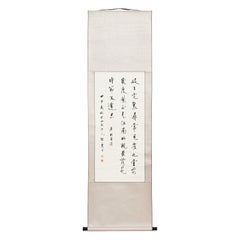
Chinese Hanging Scroll Pair of Poetic Couplets Signed
Located in Rio Vista, CA
Large Chinese hanging scroll having a pair of poetic couplets with a cyclical date autumn 1944/2004 Jishen and signed Zhang with 2 seals. The sight mea...
Category
21st Century and Contemporary Chinese Qing Paintings and Screens
Materials
Silk, Wood, Paper
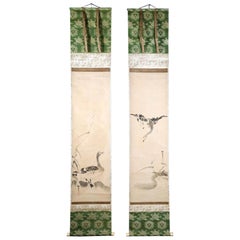
Pair of Japanese Ink Hanging Scrolls Kano Tanyu
By Kano Tan
yu 1
Located in Atlanta, GA
A fine matching pair of hanging scrolls ink on paper mounted in green brocade borders circa Edo period (17-18th century). The Kano school painting depicts wild geese in the reeds by the margin of water, a popular subject borrowed from the Chinese tradition. Both painting were signed as Tanyu with a red seal of Morinobu, his birth name. The storage box is also present and was inscribed with the title Painting of Geese and Reeds and Kano Tanyu...
Category
Antique Late 17th Century Japanese Japonisme Paintings and Screens
Materials
Wood, Paper
Chinese Floral Painted Scroll Signed and Dated
Located in Rio Vista, CA
Seasonal autumn Chinese hanging scroll featuring a painting of delicate flowers with a calligraphy signature and date. Crafted on hand-made mulberry paper...
Category
20th Century Chinese Qing Paintings and Screens
Materials
Brass
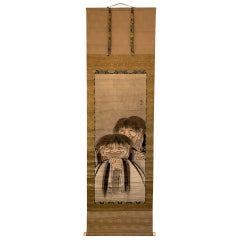
Chinese Patriarch and Matriarch Ancestral Scroll Painting
Located in Rio Vista, CA
Magnificent Chinese scroll ancestor painting showing patriarch and matriarch of a high ranking status civil official. This unusual scroll depicts the dignitary couple seated below a ...
Category
Early 20th Century Chinese Qing Paintings and Screens
Materials
Wood, Paint, Paper

$2,640 Sale Price
44% Off
H 76 in W 48 in D 1 in
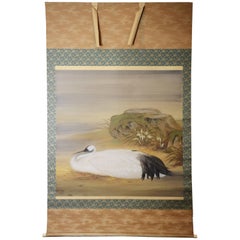
Large Antique Japanese Scroll Depicting a Nesting Crane, Taisho Period
Located in Prahran, Victoria
Large and exceptional Japanese hanging scroll with a realistically painted depiction of a nesting crane by Yoshifuji Yoshio, Taisho/Showa perio...
Category
Early 20th Century Japanese Taisho Paintings and Screens
Materials
Paper, Silk
$7,040 Sale Price
20% Off
H 100.79 in W 64.18 in D 1.19 in
Large Antique Zen Japanese Ink Scroll After Sesson Shukei
Located in Atlanta, GA
A Japanese Sumi ink painting with light color wash mounted with brocade borders as a hanging scroll (Kakejiku). The painting depicts the famously eccentric Buddhist monks Hanshan and Shide (known in Japan as Kanzan and Jittoku). Often as a pair, they have been a popular motif in Japanese Zen painting...
Category
Antique 18th Century Japanese Japonisme Paintings and Screens
Materials
Silk, Paper
Japanese Ink and Wash Scroll Painting by Watanabe Seitei
Located in Atlanta, GA
Watanabe Seitei, also known as Watanabe Shotei (1851–1918), was born in late Edo period. He was one of the earliest Japanese artists who visited and be...
Category
Antique Early 1900s Japanese Japonisme Paintings and Screens
Materials
Brocade, Silk, Paper
"Literary Gathering" Chinese Scroll Painting, c. 1923
Located in Chicago, IL
Exquisitely painted with delicate line work and a subdued color palette, this Chinese scroll painting is an Late 20th-century reproduction of a...
Category
Late 20th Century Chinese Paintings and Screens
Materials
Silk, Paper
Antique Chinese Printed Ink Rubbing of Panthaka Arhat, (scroll mounted)
Located in Point Richmond, CA
Chinese ink rubbing printing depicting Panthaka Arhat, no.4 of the 16 arhat images immortalized in stone at the former stupa at Shengyin Temple. Depicted here sitting on a rock with a book in his left hand and snapping his fingers in his right hand, symbolic of the speed at which he obtained enlightenment, accompanied by a beggar’s bowl and an incense burner, complete with colophons and silk scroll mounting. The Emperor Qianlong ordered the stone stele to be carved in 1764 after the arhat designs painted by the famed artist Guanxiu (832-912). Even though the temple was destroyed in the Taiping rebellion, the steles remain and have been reinstalled at the Hangzhou Stele Forest. Condition: Creases from rolling, otherwise fine condition. Mounting: 58” x 22”. 19th Century. Ex Collection: Frank “Till” & Peggy Durdin, San Diego.
For other rubbings of this stele see:
Penn Museum, object number 2010-26-4
The Metropolitan Museum of Art AN#: 59.195.15
Fine Arts Library of Harvard University, record id: W280021_urn-3:FHCL:478850
For another example of this image rendered in jade and lacquer see: “Screen Paintings of Guanxiu’s Sixteen Arhats in the Collection of the Palace Museum” Luo Wehhua translated by Bruce Doar, Orientations, September 2010, p. 104. In this article the image is identified as the sixteenth arhat Abheda, It is explained in this article that Qianlong re-identified the arhats, thus the 16th Arhat attribution for this image. Also in this article the identical colophon by Qianlong above the image is translated as: “These accurate portraits of the Sixteen Arhats were created by the Tang Dynasty painter Guanxiu, as recorded in Xuanhe Huapu (Record of paintings in the Xuanhe Reign), and during the millennium from the Guangming reign period to the present day, the original works were to be found in Zhejiang, where they were housed in the collection of Shengyin Temple in Qiantang (Huangzhou). In spring of the dingchou year (1757) of his reign, the Qianlong emperor undertook a southern tour of inspection and stayed at an imperial lodge on the West Lake. He went to the temple to pay his respects and there he saw the arhats on display and wrote a description of these marvels. The sequence of the arhats and their names had been passed down since ancient times, but they did not correspond to their Sanskrit titles; the sequence of the arhat names conformed instead to the interpretation of the Sanskrit classics by the Zhangjia State Preceptor. The emperor penned the original names and positions in the sequence below each of the figures in accordance with the readings supplied in Tongwen Yuntong (Unified Rhymes), and below each he penned an encomium, which he signed. Then the images were returned to the collection, to be passed down as a perpetual treasure. Now, the fourth great arhat had long gone missing and we did not know where his painting was. But it was merely a trifling matter of matching the images with the names, and now surely we have found him! This I, the emperor, believe.”
All 16 of these rubbings can be found in the Rubel Chinese Rubbings Collection at the Fine Arts Library of Harvard University with the following descriptive historical note: “Rubbing from stele depicting No. 4 of 16 arhats (Lohans, Buddhist saints) -- Nan ti mi duo luo qing you, Panthaka Arhat. Original painting attributed to Guanxiu, 832-912. Inscriptions written by Hongli, Emperor Qianlong (Gaozong, 1711-1799) of Qing Dynasty. 7 seals of Qianlong follow the inscriptions. Script style: in xing shu. Shi liu zun zhe -- "The 16 noble ones" are 16 lohans. Lohans are also called "a-lo-han" based on the transliteration of the Sanskrit term "arhat." (Japanese: Rakan; Chinese: Lohan; Tibetan: Gnas-brtan). Arhats or Arahants are saints or sages said to have renounced nirvana (freedom from the cycle of suffering and rebirth), vowed to remain in the world to protect the Dharma and propagate the Law of the Buddha in order to devote themselves more effectively to the relief of human misery, like the Bodhisattvas. These 16 Arhats, personal disciples distinguished by the Buddha, formed part of the 500 claimed by tradition to have attended the First Council in Rajagrha. The names and abodes of these 16 arhats are given in a work entitled "Record on the Duration of the Law, spoken by the Great arhat Nadimitra," which was translated into Chinese by the famous pilgrim Xuanzang (596-664) in 654. 16 lohans are quite often represented, especially in China and Japan, in sculpture and painting, in poses and with attributes. Every lohan can be easily with special icongraphic characteristics. Guanxiu (Jiang Deyin or Deyuan, a Buddhist monk also named Master Chan Yue, 832-912) -- painter during late Tang to Five Dynasties, specialized in painting lohan figures. Legend has it that the first portraits of the 18 Lohans...
Category
Antique 19th Century Chinese Qing Prints
Materials
Paper