Want more images or videos?
Request additional images or videos from the seller
1 of 9
Circa 1900 Japanese Pine Screen Pair. Aged Dragons by Suzuki Shonen.
Price:$27,200
$34,000List Price
About the Item
- Dimensions:Height: 67 in (170.18 cm)Width: 146 in (370.84 cm)Depth: 0.75 in (1.91 cm)
- Style:Meiji (Of the Period)
- Materials and Techniques:
- Place of Origin:
- Period:
- Date of Manufacture:Circa 1900
- Condition:Refinished. Wear consistent with age and use. The screens have recently been completely remounted and present beautifully.
- Seller Location:Kyoto, JP
- Reference Number:1stDibs: LU2472336649152
About the Seller
5.0
Recognized Seller
These prestigious sellers are industry leaders and represent the highest echelon for item quality and design.
Gold Seller
Premium sellers maintaining a 4.3+ rating and 24-hour response times
Established in 2001
1stDibs seller since 2016
75 sales on 1stDibs
Typical response time: 6 hours
Authenticity Guarantee
In the unlikely event there’s an issue with an item’s authenticity, contact us within 1 year for a full refund. DetailsMoney-Back Guarantee
If your item is not as described, is damaged in transit, or does not arrive, contact us within 7 days for a full refund. Details24-Hour Cancellation
You have a 24-hour grace period in which to reconsider your purchase, with no questions asked.Vetted Professional Sellers
Our world-class sellers must adhere to strict standards for service and quality, maintaining the integrity of our listings.Price-Match Guarantee
If you find that a seller listed the same item for a lower price elsewhere, we’ll match it.Trusted Global Delivery
Our best-in-class carrier network provides specialized shipping options worldwide, including custom delivery.You May Also Like
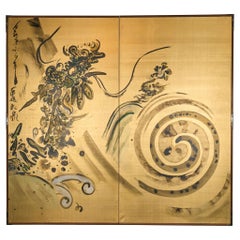
Japanese Two Panel Screen: Whimsical Dragon
Located in Hudson, NY
Extremely dramatic painting of a dragon in sumi-e ink and mineral pigments on gold silk in a dark brown lacquer trim. Signature and seal read: Shonan.
Category
Antique Early 1900s Japanese Paintings and Screens
Materials
Silk, Wood, Lacquer
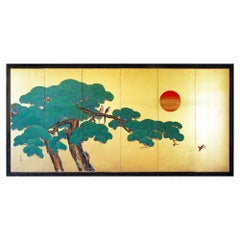
Byobu - Japanese Screen Gold Leaf Kano School Pine Sun
By Japanese Studio
Located in Brescia, IT
Japanese Screen of Kano school six panels hand painted with mineral pigments on gold leaf.
A very clean work with large pines and a red sun.
It is in good condition, with original l...
Category
Antique Late 19th Century Meiji Paintings and Screens
Materials
Gold Leaf
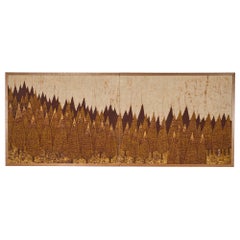
Japanese Two Panel Screen: Pine Grove
Located in Hudson, NY
A nice example of a textile screen in the design of pine trees in mass. Japanese Dyed fabric technique with natural wood trim. Signature reads: Nagemitsu
Category
20th Century Japanese Paintings and Screens
Materials
Fabric, Wood
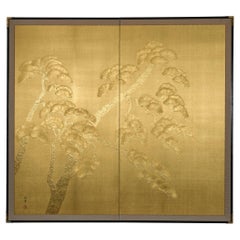
Japanese Two Panel Screen: Gilded Pine
Located in Hudson, NY
Luxurious golden pine with gold raised relief on gold silk with silk brocade border and black lacquer trim with bronze mounts. Signature and seal read: Takuyo.
Back Label Reads: ...
Category
Mid-20th Century Japanese Paintings and Screens
Materials
Brocade, Silk, Lacquer
Japanese Two Panel Screen Dragon in the Mist
Located in Hudson, NY
Ink (Sumi) on paper. Signature and Seal read: Kishi Ganku It is backed with paper covered in gold and silver flake. Kishi Ganku (1749 or 1756-1839) was the...
Category
Antique Early 19th Century Japanese Edo Paintings and Screens
Materials
Wood, Paper
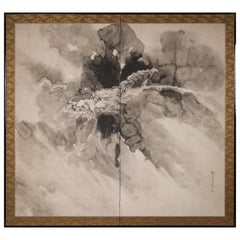
Japanese Two Panel Screen: Pine in Snow
Located in Hudson, NY
Kano School, Mineral pigments on gold leaf with silk brocade border and lacquer wood trim.
Category
Antique Mid-19th Century Japanese Paintings and Screens
Materials
Gold Leaf
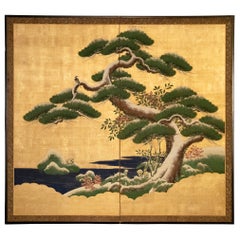
Pair of Japanese Screens
Located in Schellebelle, BE
Exceptional pair of Japanese screens, 20th century
Six parts, six times 45 cm wide
Gold spotted paper with parts of old screens.
Category
Mid-20th Century Japanese Paintings and Screens
Materials
Paper
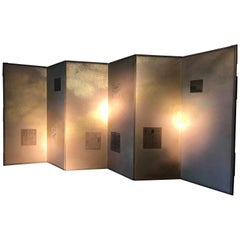
Antique Japanese Meiji Period Silk Embroidered Screen Room Divider Byobu C.1900
Located in London, GB
Antique Japanese Meiji period silk embroidered screen /room divider Byobu C.1900 Kyoto, Japan.
Silk embroidered satin lacquer framed panels....
Category
Antique Early 1900s Japanese Meiji Paintings and Screens
Materials
Silk, Lacquer
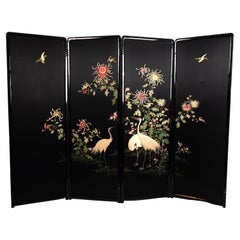
$12,083 Sale Price
35% Off
H 67.33 in W 88.98 in D 0.79 in
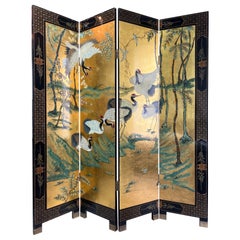
Japanese Folding Screen, circa 1970
Located in PARIS, FR
A japenese folding screen with gold leaf circa 1940.
Size is
H 183
W 164 cm.
Category
Vintage 1970s Japanese Mid-Century Modern Paintings and Screens
Materials
Hardwood
Japanese Six Panel Screen, Ancient Pines on the Shore under Silver Moon
Located in Hudson, NY
Venerable pine trees supported and cared for by temple Arborists. Artist signature reads: Koka Sugibayashi. Meiji period painting (1868-1912) in mineral pigments on silk with a silk ...
Category
Antique Early 1900s Japanese Meiji Paintings and Screens
Materials
Silk
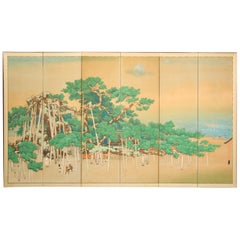
$20,500
H 60.75 in W 103.5 in D 0.75 in
More From This Seller
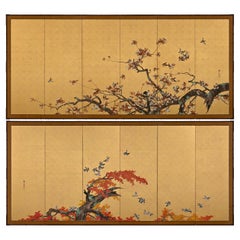
View AllMeiji Era, Circa 1900 Japanese Screen Pair, Flowers
Birds of Spring
Autumn
Located in Kyoto, JP
Flowers & Birds of Spring and Autumn
Unknown artist.
Japan. Meiji period, circa 1900.
A pair of six-fold screens. Ink, color, gofun and gold leaf on paper.
Signed: Gaga S...
Category
Antique 1890s Japanese Meiji Paintings and Screens
Materials
Gold Leaf
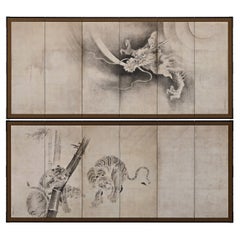
17th Century Japanese Screen Pair. Tiger
Dragon by Kaiho Yusetsu
Located in Kyoto, JP
Kaiho Yusetsu (1598-1677)
Tiger and Dragon
Early Edo Period, Circa 1650
A Pair of Six-fold Japanese Screens. Ink and slight color on paper.
Dimensions:
Each screen: H. 171 cm x W. 380 cm (67.5’’ x 149.5’’)
In this pair of early Edo period Japanese screens a group of tigers prowl in a bamboo grove whipped with fierce wind, while a dragon claws through clouds and mist. The dragon embodies elemental qualities - looming out of the mist, the coils of its body disappearing in the clouds. The dragon is calling for rain, symbolizing spring which is considered the fountain of life. On the other side, the tigers calls for the wind, symbolizing autumn which is considered the end of life. Tigers were familiar motifs within Japanese art from ancient times though the animals were imaginary to the people in the 17th century. While dragons and tigers are usually associated as sacred and ferocious, in this painting, both animals have rather amusing expressions. The tigers appear to glare at the dragon with cat-like eyes, and the look on the swirling dragon’s face appears almost affectionate - lending a playful flair to an otherwise magnificent theme.
The tiger and dragon are cosmological symbols of the balancing forces in the world. Screens such as this were originally meant to express the fluctuating nature of the world. For Japanese in the early Edo period, they likely suggested the powers of the cosmos. In Japan the tiger and dragon motif was originally absorbed into the circles of Zen monasteries before spreading into the secular world. The theme especially appealed to the military classes with the Kano school, the official painters to the Shogun and the samurai, being the leading contributors. The painter of this pair of screens, Kaiho Yusetsu (1598-1677), was closely patronized by the third Shogun Tokugawa Iemitsu. In his later years he worked with Kano school artists...
Category
Antique Mid-17th Century Japanese Edo Paintings and Screens
Materials
Silk, Wood, Paper
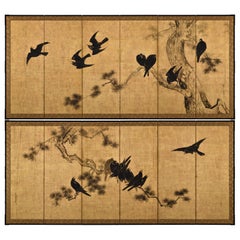
Mid 18th Century Japanese Screen Pair. Crows
Pines by Unkoku Toshuku.
Located in Kyoto, JP
Unkoku Toshuku (1722-1779)
Crows and Pines
A pair of six-panel Japanese Screens. Ink and gold leaf on paper.
Dimensions: Each Screen: H. 170.5 cm x W. 375 cm
Haha-cho or mynah birds, whose forms resemble crows in artwork, were commonly depicted in Japanese art. These types of paintings were originally modeled on paintings attributed to the 13th century Chinese painter Muqi (Mokkei), whose art was enormously influential in Japan. Crows only became a theme among Japanese artists from the later 1500s onward. They likely were inspired by these imported Chinese paintings of myna birds, which are not native to Japan, substituting the native species of crow instead.
The best known early examples of the depiction of Japanese crows are two Momoyama screen...
Category
Antique Mid-18th Century Japanese Edo Paintings and Screens
Materials
Gold Leaf
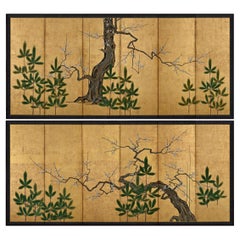
18th Century Japanese Screen Pair. Plum
Young Pines. Kano School.
Located in Kyoto, JP
Dimensions (Each screen): H. 176 cm x W. 378 cm (69’’ x 149’’)
This pair of Japanese folding screens depict blossoming plum trees amongst young pines. They are designed to capture t...
Category
Antique Late 18th Century Japanese Edo Paintings and Screens
Materials
Gold Leaf
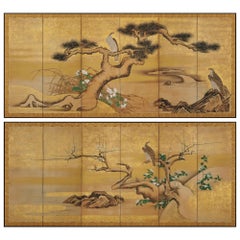
17th Century Japanese Screen Pair by Soga Nichokuan, Hawks on Pine
Plum Trees
Located in Kyoto, JP
Hawks on plum and pine
Soga Nichokuan (active circa 1625-1660)
Pair of six-fold screens.
Ink, mineral pigments, gofun, gold and speckled gold l...
Category
Antique 1640s Japanese Edo Paintings and Screens
Materials
Wood, Paper
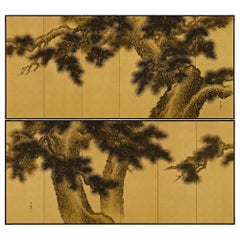
Early 20th Century Japanese Screen Pair - Ink Pine Trees on Gold
Located in Kyoto, JP
Imao Keisho (1902-1993)
Pine Trees
Early 20th Century, Circa 1930
Pair of six-panel Japanese screens. Ink on silk and gold leaf.
Dimensions: Each screen H. 67.5” x 148” (172 cm x 376 cm)
A pair of monumental six-panel Japanese pine screens by the renowned Nihonga artist Imao Keisho. Here Keisho entirely removed the background and brought the pine trees to the surface of the painting. This simplification of the elements makes the scene exceptionally direct and compelling and injects a very modern...
Category
Early 20th Century Japanese Showa Paintings and Screens
Materials
Gold Leaf
Still Thinking About These?
All Recently ViewedMore Ways To Browse
Pair Of Japanese Screens
Japanese Screens Pines
Asian Dragon Paintings
Gold Leaf Dragon
Japanese Dragon Painting
Japanese Dragon Screen
Suzuki Shonen
Japanese Showa Screen
20th Century Japanese Folding Screen
Japanese Folding Screen Art
19th Century Chinese Painting On Silk
Byobu Panel
Four Panel Asian Art
Gold Folding Screen
China Silk Panels
Chinese Silk Panel
Japanese Lacquer Panel Screen
Flower And Bird Painting