Items Similar to Circa 1920. Taisho era Japanese Nihonga Screen. Dahlias
Cockscomb.
Want more images or videos?
Request additional images or videos from the seller
1 of 10
Circa 1920. Taisho era Japanese Nihonga Screen. Dahlias
Cockscomb.
$28,000
£21,358.05
€24,333.29
CA$39,354.25
A$42,934.45
CHF 22,733.53
MX$514,476.98
NOK 289,524.14
SEK 264,748.34
DKK 181,693.01
About the Item
Kawabe Kasho (b.1892)
Dahlias
Cockscomb
Taisho era. Circa 1920
Two-panel Japanese Screen. Mineral pigments and ink on silk.
This exquisite two-panel Japanese folding screen, painted on silk with mineral pigments and ink, presents a vivid summer scene of flowering dahlias and cockscomb. Executed in the refined Nihonga tradition of the Taishō period (1912–1926), the composition is both ornate and complex, showcasing the artist’s meticulous attention to detail and reverence for nature. Nearly every inch of the painting surface is utilized, creating an immersive visual experience that captures the opulence of a midsummer afternoon.
Rendered with striking realism, the screen radiates an extravagant naturalism that flourished in Japanese painting during the early 20th century. The interplay of sunlight and shadow brings the lush foliage and blossoms to life, highlighting their delicate textures and vibrant hues. The scene pulsates with energy—bees hover eagerly around the dahlias, drawn to their rich colors and intricate forms. This pairing of dahlias and bees was a common motif in Taishō-era art.
The composition is elegantly upright, punctuated by the bold presence of brilliant blooms. The dahlia, an exotic import to Japan, first arrived during the early Meiji period (1868–1912). By the time of the Taishō era, these flowers had captured the fascination of Japanese horticulturists, who cultivated new varieties with passionate dedication. Dahlia-growing competitions became a nationwide phenomenon. They became a floral metaphor for exoticism and were frequently featured in Taishō-period art,
Softly receding into the background are the cockscomb flowers, whose velvety, undulating crests resemble a rooster’s comb. A member of the amaranth family, cockscomb thrives in full sun, and its distinctive, almost sculptural form adds a dynamic contrast to the dahlia’s soft, layered petals. Together, these flowers create a sumptuous tapestry of form and color, embodying the height of summer’s abundance.
Nihonga, meaning "Japanese-style painting," emerged as a response to the rapid Westernization of Japan’s art scene. While absorbing select influences from Western art, Nihonga artists of the Taishō period remained devoted to traditional Japanese techniques, employing delicate mineral pigments and fine silk. This period saw an evolution in the Nihonga aesthetic, as painters experimented with new color palettes, innovative compositions, and refined brush techniques.
Kawabe Kasho (b.1892) was a Kyoto based Nihonga artist from the early 20th century. He is a graduate of both the Kyoto City School of Arts and Crafts and the Kyoto Municipal Special School of Painting. The artist and teacher Kawakita Kaho was his most significant influence.
- Dimensions:Height: 67.5 in (171.45 cm)Width: 67.5 in (171.45 cm)Depth: 0.75 in (1.91 cm)
- Style:Taisho (Of the Period)
- Materials and Techniques:
- Place of Origin:
- Period:
- Date of Manufacture:Circa 1920
- Condition:Refinished. Wear consistent with age and use. The screen has been completely remounted in Kyoto utilizing traditional craftsmen and techniques.
- Seller Location:Kyoto, JP
- Reference Number:1stDibs: LU2472344123992
About the Seller
5.0
Recognized Seller
These prestigious sellers are industry leaders and represent the highest echelon for item quality and design.
Gold Seller
Premium sellers maintaining a 4.3+ rating and 24-hour response times
Established in 2001
1stDibs seller since 2016
75 sales on 1stDibs
Typical response time: 6 hours
- ShippingRetrieving quote...Shipping from: Kyoto, Japan
- Return Policy
More From This Seller
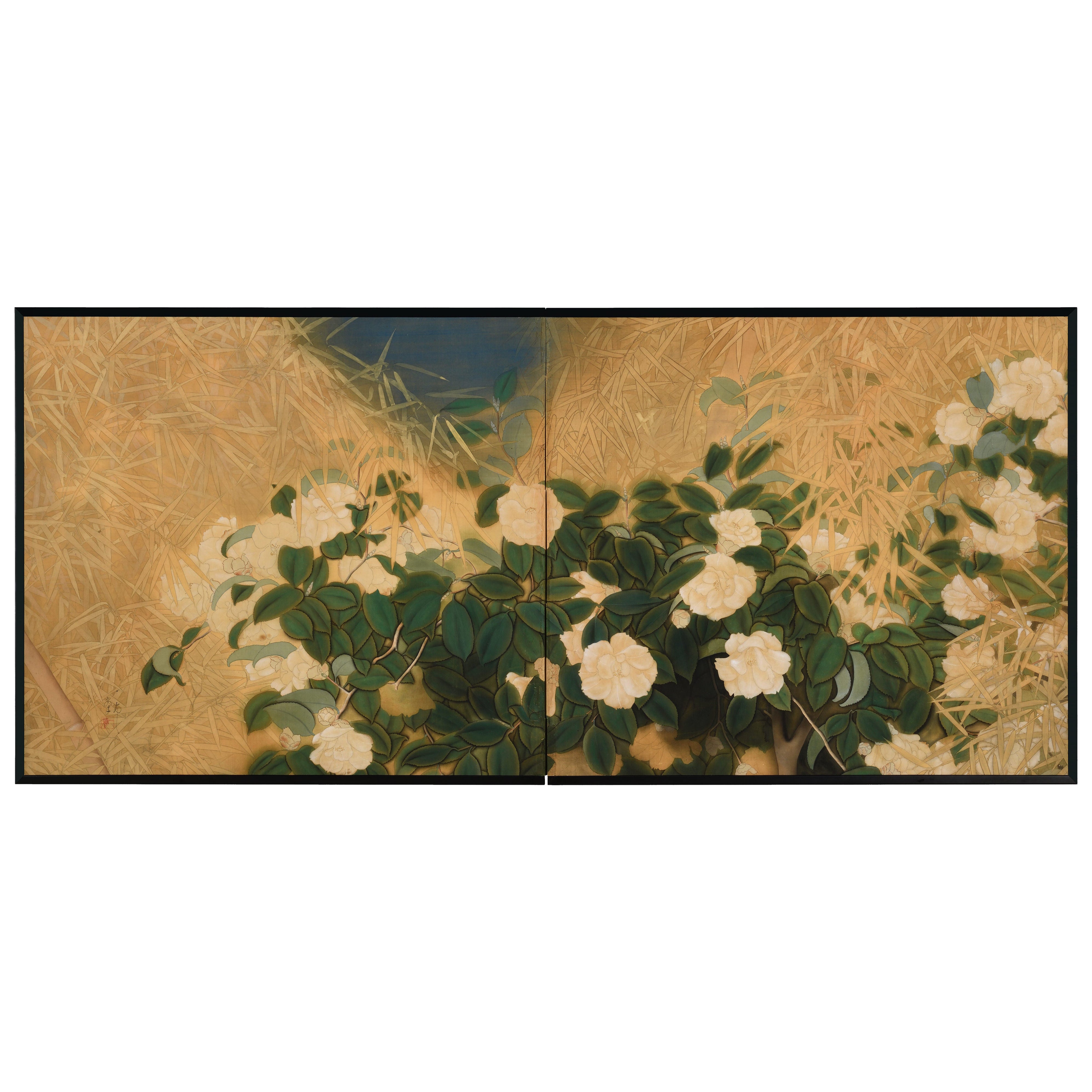
View AllCirca 1925. Taisho era Japanese Nihonga Screen. Camellia
Bamboo.
Located in Kyoto, JP
Anonymous
Camellia & Bamboo
Taisho era
Two-panel Japanese Screen. Mineral pigment, gofun and ink on silk.
A small Japanese Nihonga screen capturing...
Category
Early 20th Century Japanese Taisho Paintings and Screens
Materials
Silk
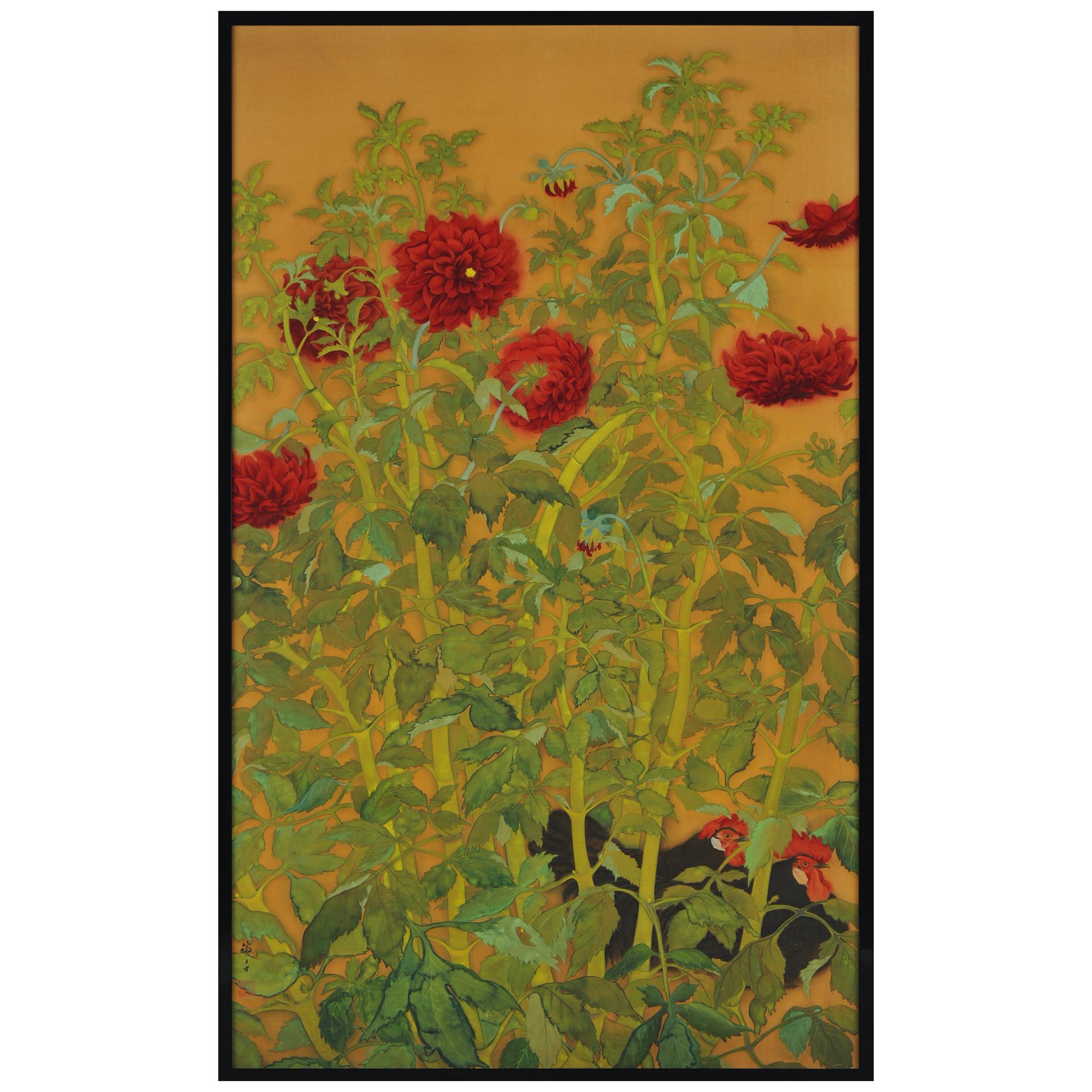
Japanese Painting, Framed Panel, Dahlias and Roosters, circa 1920
Located in Kyoto, JP
Tanaka Tessen (b.1890)
Dahlias and Roosters
Taisho period, circa 1920
Framed painting. Mineral pigments and ink on silk.
Dimensions (framed):
H. 159 cm x W. 97 cm x D. 2.5 cm (62.5” x 38” x 1”)
An ornate and complex composition in which the artist explores almost the entire painting surface. The coloration is bold and evocative and the tinted silk ground recreates the warm golden glow of sunset. Soft, luminous brushwork details the black feathers of the roosters, which seem to cloud and blur in counterpoint to the sharper points of the eyes and beaks. Their brilliant red combs balance the composition, echoing the rich burgundy hues of the dahlias; the flowers exquisite and lifelike. Dahlias were an exotic subject favored by painters of the Taisho era.
The painting belongs to the school of Kyoto Nihonga, exemplifying the principles of decorative elegance and consumate brush technique with which it was intimately associated. Painters of the time relied on the Shijo school method, basing the forms of the composition from life sketches. Sometimes they were then integrated with elements derived from Chinese bird and flower...
Category
Vintage 1920s Japanese Taisho Paintings and Screens
Materials
Wood, Silk
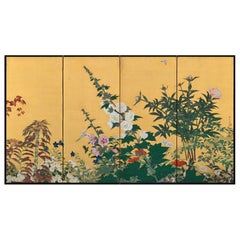
Early 20th Century Japanese Screen. Flowers of the Four Seasons.
Located in Kyoto, JP
Anonymous
Flowers of the Four Seasons
A four-panel Japanese screen. Ink, gofun and pigments on gold leaf.
This Japanese screen is a rich visual celebration of the flowers of the fo...
Category
Early 20th Century Japanese Taisho Paintings and Screens
Materials
Gold Leaf
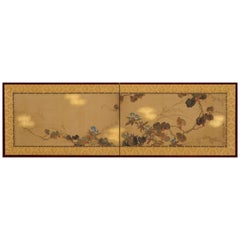
Japanese Screen Painting, Early 19th Century, Autumn Flowers by Sakai Hoitsu
Located in Kyoto, JP
A two-fold Japanese screen by the Rimpa school artist Sakai Hoitsu (1761-1828), Japan, 19th century, Edo period.
This small Japanese folding screen pai...
Category
Antique Early 19th Century Japanese Edo Paintings and Screens
Materials
Wood, Silk
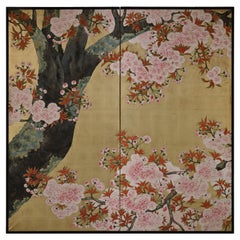
Early 20th Century Japanese Cherry Blossom Screen by Kano Sanrakuki
Located in Kyoto, JP
Cherry Blossoms
Kano Sanrakuki (1898-1981)
Showa period, circa 1930
2-panel Japanese Screen
Color, gofun and gold leaf on paper
Against a backdrop of gold-leafed ground, the lichen covered trunk and branches of the life-sized cherry blossom tree reach out and beyond the confines of the pictorial surface. The overall composition has a feeling of flatness which draws emphasis to the surface and the three-dimensionality of the cherry blossoms. Painstakingly built-up layers of thickly applied shell-white gofun detail the voluminous blossoms and cover large areas of this tour-de-force of Japanese Nihonga painting. By simplifying the background, minimizing the number of colors and depicting the blossoms with such heavy relief, the artist has emphasized the stunning presence of the cherry tree. The type of tree depicted is the Yae-Zakura; a double-layered type of cherry blossom famed for its beauty and strength. When we think of Japanese cherry blossoms, the first thing that comes to mind is Somei Yoshino variety, which has a single flower with five almost white petals. This type is fragile and easily blown away by strong wind or rain. Most of the double-flowered cherry blossoms begin to bloom when the Somei-Yoshino falls, and the flowering period lasts longer than that of the Somei-Yoshino.
Kano Sanrakuki originally studied painting at the Kyoto City Arts and Crafts School under the tutelage of Yamamoto Shunkyo...
Category
Early 20th Century Japanese Showa Paintings and Screens
Materials
Gold Leaf
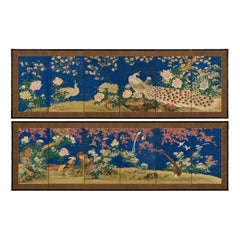
Mid 19th Century Japanese Screen Pair. Flowers
Birds of the Four Seasons.
Located in Kyoto, JP
Shioka Sorin (1781-1850)
Flowers & Birds of the Four Seasons
Pair of six-panel Japanese Screens. Ink, gofun and pigments on silk.
Dimensions (each screen): H. 91.5cm x W. 285cm (3...
Category
Antique Mid-19th Century Japanese Edo Paintings and Screens
Materials
Silk
You May Also Like
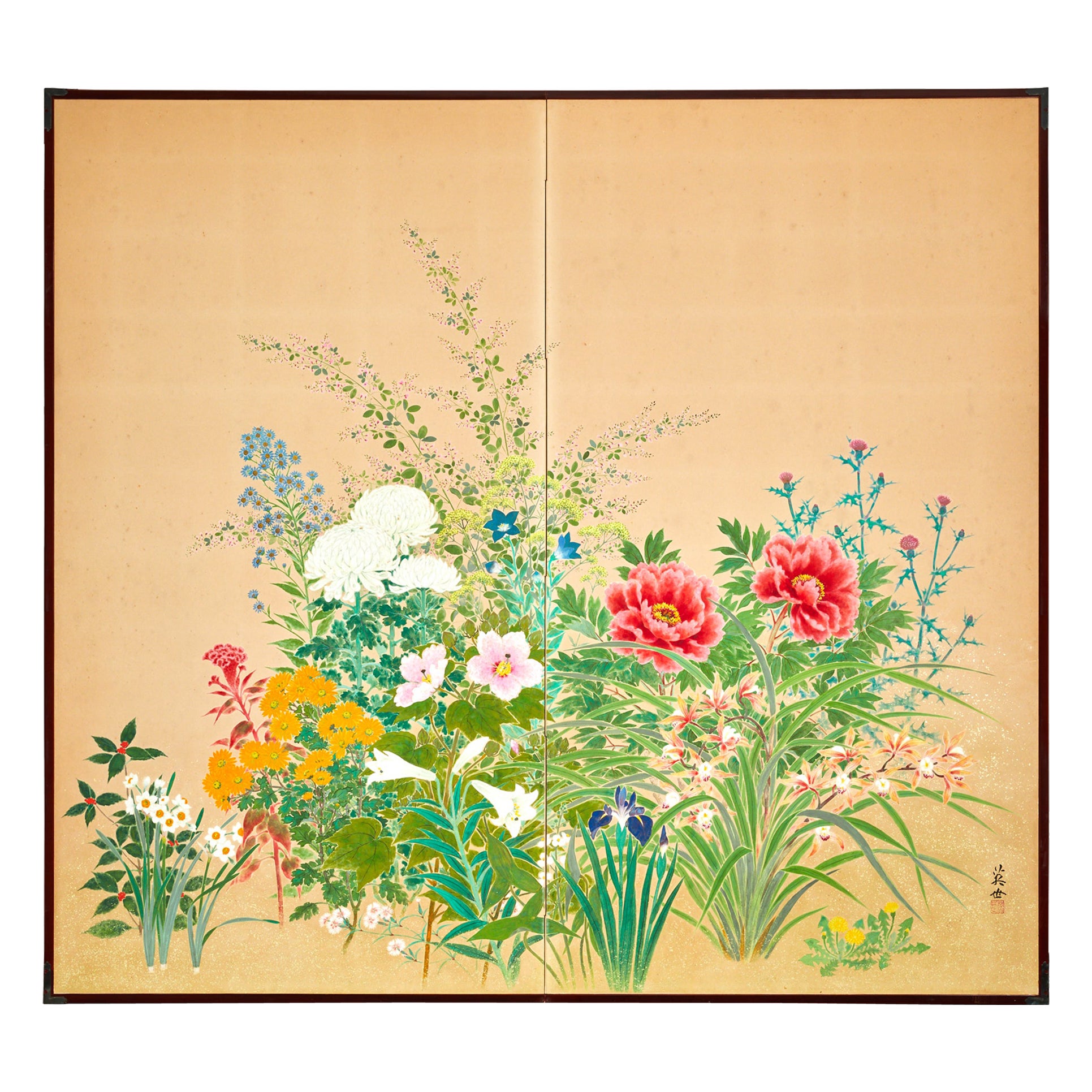
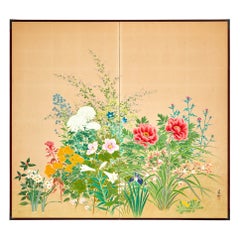
Japanese Two Panel Screen: Seasonal Flowers
Located in Hudson, NY
Peonies, irises, lillies, paperwhites, cockscombs, thistle and other various seasonal flowers in mineral pigmnets on mulberry paper. Oxblood lacquer trim with beautiful bronze mount...
Category
Early 20th Century Japanese Paintings and Screens
Materials
Bronze
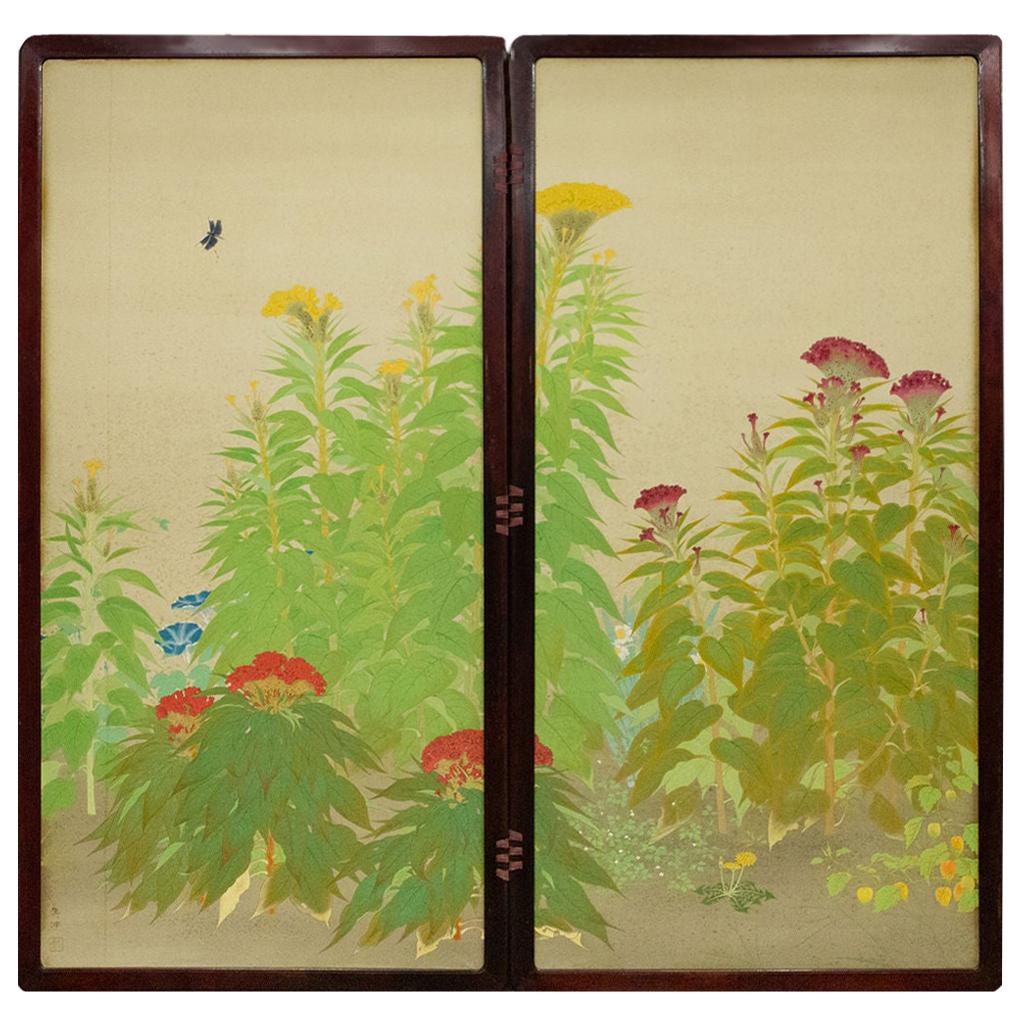
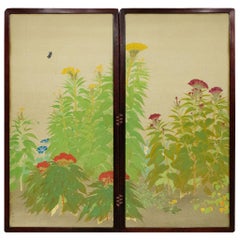
Japanese Two-Panel Screen, Cockscomb and Morning Glories
Located in Hudson, NY
Nihonga style, finely painted spring flowers with a dragonfly detail in mineral pigments on silk. Signed and sealed: "Seichu". Real name: Aoki Keinosuke (1891-1973), born in Kyoto, s...
Category
Early 20th Century Japanese Paintings and Screens
Materials
Cotton, Silk, Lacquer
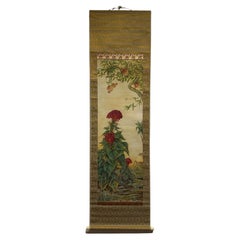
Fine Japanese Floral Painting Scroll, Taisho Period, Early 20th Century
Located in Fukuoka, JP
A superb early 20th-century Japanese hanging scroll (kakejiku) from the Taisho period, featuring an elegant and vibrant floral painting. The artwork is executed with refined skill an...
Category
Early 20th Century Japanese Taisho Paintings and Screens
Materials
Wood, Paper
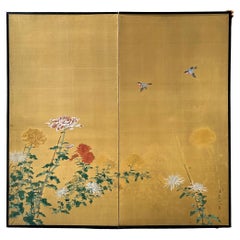
Japanese Screens: Echo of Chrysanthemums
Located in Fukuoka, JP
Echo of Chrysanthemums captures the quiet dialogue between form and reflection. Against a radiant gold-leaf ground, blooming chrysanthemums rise in graceful color harmony — white, cr...
Category
Antique 19th Century Japanese Edo Paintings and Screens
Materials
Gold Leaf
$5,785 Sale Price
35% Off
Japanese Six-Panel Screen, Chrysanthemums
Located in Hudson, NY
Japanese six-panel screen: Chrysanthemums, Edo period (circa 1800) painting of a variety of chrysanthemums in a garden landscape, with sparrows. Mineral p...
Category
Antique Early 1800s Japanese Edo Paintings and Screens
Materials
Gold Leaf
Japanese Two-Panel Screen, Summer Flowers on Silk
Located in Hudson, NY
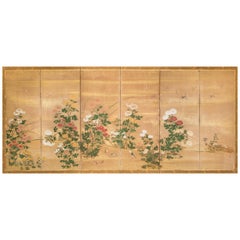
Rimpa painting of flowers including morning glories, hollyhocks, sweet peas, nadeshiko, and daisies. Signature and seal read: Bisui
Category
Antique Late 19th Century Japanese Meiji Paintings and Screens
Materials
Silk, Wood
More Ways To Browse
Painting Circa 1920
Fine Minerals
Nihonga Screens
Two Panel Folding Screen
Arts And Crafts Folding Screen
Japanese Maple
Qing Dynasty Panels
18th Century Japanese Silk Painting
De Gournay
Hand Painted Silk Panels
Japanese Screens Byobu
Wood Carved Asian Screen
Chinese Gold Leaf Painting
Japanese Paper Scroll
Japanese Screen Silver
Tibetan Thangka
Chinese Lattice
Chinese Scroll Art