Items Similar to Early 20th Century Japanese Cherry Blossom Screen by Kano Sanrakuki
Want more images or videos?
Request additional images or videos from the seller
1 of 9
Early 20th Century Japanese Cherry Blossom Screen by Kano Sanrakuki
$22,000
£16,734.41
€19,289.94
CA$31,235.36
A$33,522.56
CHF 17,969.41
MX$403,428.56
NOK 226,567.70
SEK 206,598.35
DKK 144,095.77
About the Item
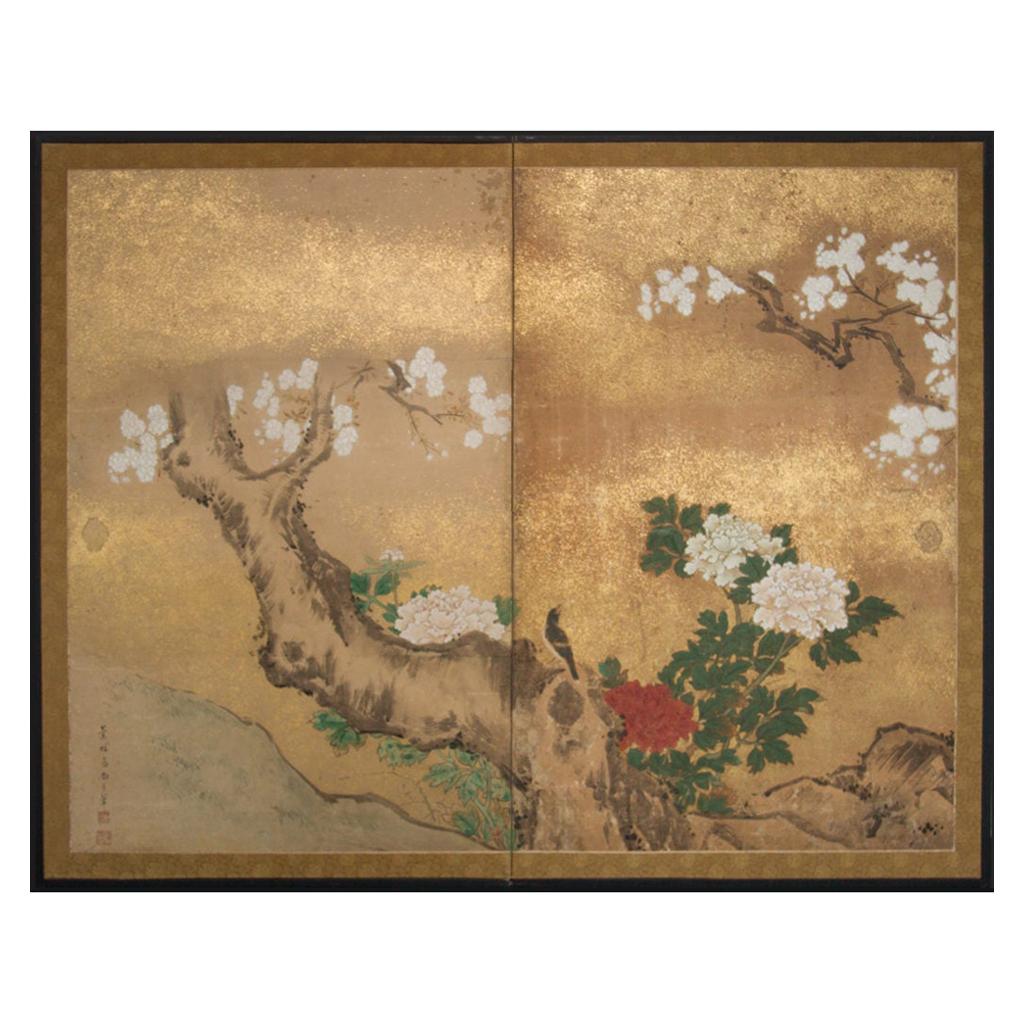
Cherry Blossoms
Kano Sanrakuki (1898-1981)
Showa period, circa 1930
2-panel Japanese Screen
Color, gofun and gold leaf on paper
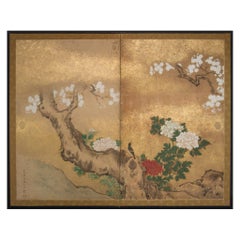
Against a backdrop of gold-leafed ground, the lichen covered trunk and branches of the life-sized cherry blossom tree reach out and beyond the confines of the pictorial surface. The overall composition has a feeling of flatness which draws emphasis to the surface and the three-dimensionality of the cherry blossoms. Painstakingly built-up layers of thickly applied shell-white gofun detail the voluminous blossoms and cover large areas of this tour-de-force of Japanese Nihonga painting. By simplifying the background, minimizing the number of colors and depicting the blossoms with such heavy relief, the artist has emphasized the stunning presence of the cherry tree. The type of tree depicted is the Yae-Zakura; a double-layered type of cherry blossom famed for its beauty and strength. When we think of Japanese cherry blossoms, the first thing that comes to mind is Somei Yoshino variety, which has a single flower with five almost white petals. This type is fragile and easily blown away by strong wind or rain. Most of the double-flowered cherry blossoms begin to bloom when the Somei-Yoshino falls, and the flowering period lasts longer than that of the Somei-Yoshino.
Kano Sanrakuki originally studied painting at the Kyoto City Arts and Crafts School under the tutelage of Yamamoto Shunkyo. In 1919 he moved to Tokyo and became a disciple of Yamamura Koka (1885-1942). Koka studied Nihonga (Japanese painting) and frequently exhibited at the Inten. Sanrakuki was first selected to exhibit with the Inten in 1928. Three years later he became a disciple of the Nihonga painter Kawabata Ryushi. He joined the Seiryusha painting group, which consisted of Ryushi’s disciples. He won prizes with his exhibited works of 1931, 32 and 33. His 1934 exhibition work was highly acclaimed both within the group and with the public and increased his reputation significantly. From that moment he joined Sakaguchi Isso as one of the two top rated disciples of Kawabata Ryushi.
- Dimensions:Height: 73 in (185.42 cm)Width: 73 in (185.42 cm)Depth: 0.75 in (1.91 cm)
- Style:Showa (Of the Period)
- Materials and Techniques:
- Place of Origin:
- Period:
- Date of Manufacture:circa 1930
- Condition:Wear consistent with age and use. Good, original condition.
- Seller Location:Kyoto, JP
- Reference Number:1stDibs: LU2472331552902
About the Seller
5.0
Recognized Seller
These prestigious sellers are industry leaders and represent the highest echelon for item quality and design.
Established in 2001
1stDibs seller since 2016
77 sales on 1stDibs
Typical response time: 5 hours
- ShippingRetrieving quote...Shipping from: Kyoto, Japan
- Return Policy
More From This Seller
View AllMeiji Era, Circa 1900 Japanese Screen Pair, Flowers
Birds of Spring
Autumn
Located in Kyoto, JP
Flowers & Birds of Spring and Autumn
Unknown artist.
Japan. Meiji period, circa 1900.
A pair of six-fold screens. Ink, color, gofun and gold leaf on paper.
Signed: Gaga S...
Category
Antique 1890s Japanese Meiji Paintings and Screens
Materials
Gold Leaf
Early 20th Century Japanese Screen. Flowers of the Four Seasons.
Located in Kyoto, JP
Anonymous
Flowers of the Four Seasons
A four-panel Japanese screen. Ink, gofun and pigments on gold leaf.
This Japanese screen is a rich visual celebration of the flowers of the fo...
Category
Early 20th Century Japanese Taisho Paintings and Screens
Materials
Gold Leaf
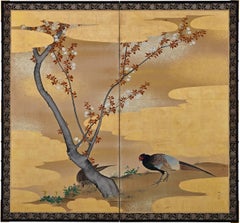
Early 19th Century Japanese Screen. Cherry Blossom
Pheasants by Mori Tetsuzan
Located in Kyoto, JP
Mori Tetsuzan (1775-1841)
Pheasants and Cherry Blossoms
Two-fold Japanese screen. Ink, color, gofun, gold and silver on paper.
A two-fold Japanese bir...
Category
Antique Early 19th Century Japanese Edo Paintings and Screens
Materials
Gold Leaf
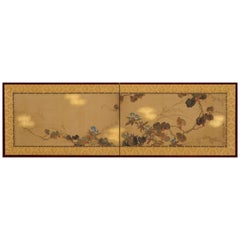
Japanese Screen Painting, Early 19th Century, Autumn Flowers by Sakai Hoitsu
Located in Kyoto, JP
A two-fold Japanese screen by the Rimpa school artist Sakai Hoitsu (1761-1828), Japan, 19th century, Edo period.
This small Japanese folding screen pai...
Category
Antique Early 19th Century Japanese Edo Paintings and Screens
Materials
Wood, Silk
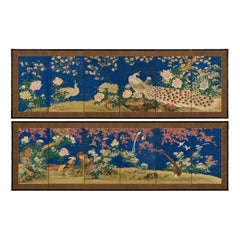
Mid 19th Century Japanese Screen Pair. Flowers
Birds of the Four Seasons.
Located in Kyoto, JP
Shioka Sorin (1781-1850)
Flowers & Birds of the Four Seasons
Pair of six-panel Japanese Screens. Ink, gofun and pigments on silk.
Dimensions (each screen): H. 91.5cm x W. 285cm (3...
Category
Antique Mid-19th Century Japanese Edo Paintings and Screens
Materials
Silk
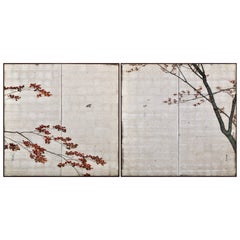
1895 Meiji Japanese Screen Pair. Cherry Blossoms
Autumn Maples on Silver Leaf
Located in Kyoto, JP
Cherry Blossoms and Autumn Maples
Isobe Hyakurin (1836–1906)
Dated Meiji 28, April: 1895
Pair of two-panel Japanese screens; ink and pigments on silver leaf
This refined pair of scr...
Category
Antique Late 19th Century Japanese Meiji Paintings and Screens
Materials
Silver Leaf
You May Also Like
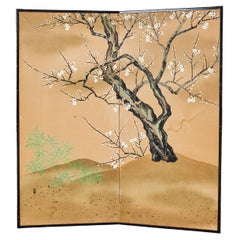
Japanese Showa Two Panel Screen Blossoming Prunus Tree
Located in Rio Vista, CA
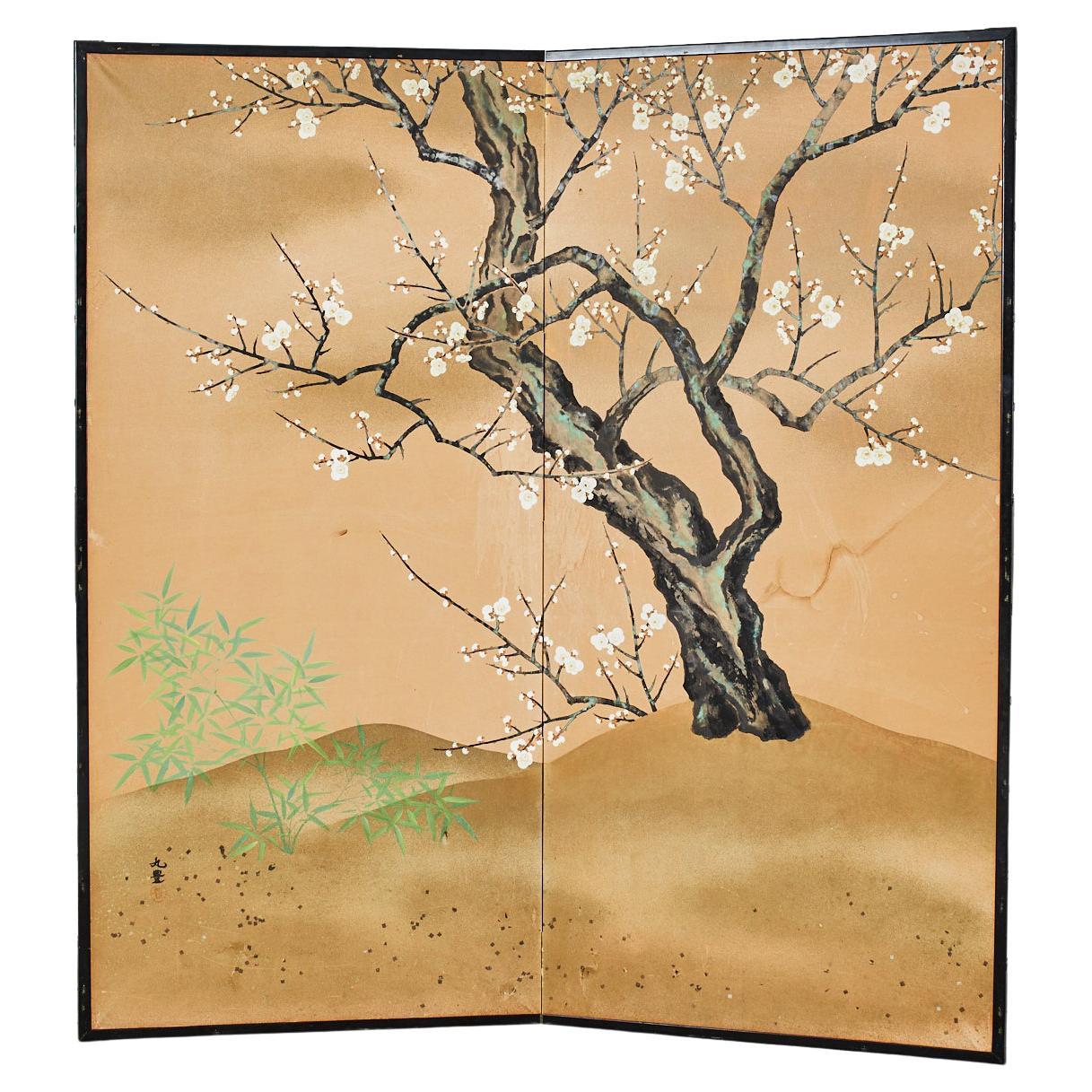
Serene Japanese Showa period two-panel folding byobu screen depicting a large spring blossoming prunus tree or plum tree. Beautifully painted with ink and natural color pigments on m...
Category
20th Century Japanese Showa Paintings and Screens
Materials
Brass
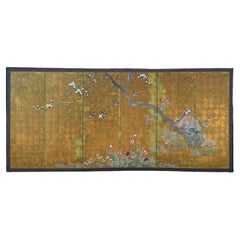
Japanese screen: Melody of Magnolia Blossoms
Located in Fukuoka, JP
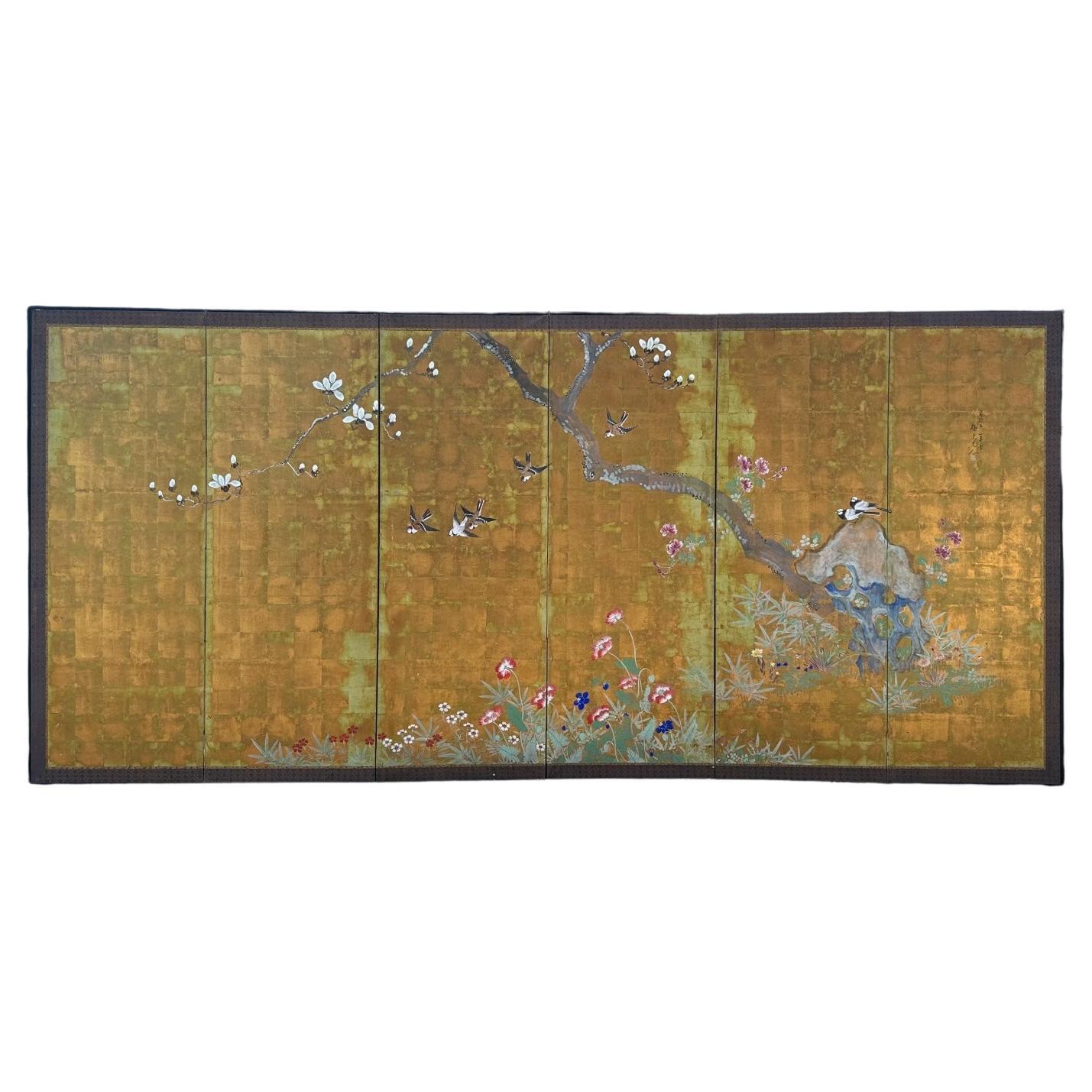
Bathed in radiant gold, Melody of Magnolia Blossoms captures the fleeting harmony of nature in bloom. A graceful magnolia branch arcs across the shimmering surface, its petals unfold...
Category
Antique Early 17th Century Japanese Edo Paintings and Screens
Materials
Paper, Wood
Japanese Two Panel Screen: Plum Blossom in the Mist
Located in Hudson, NY
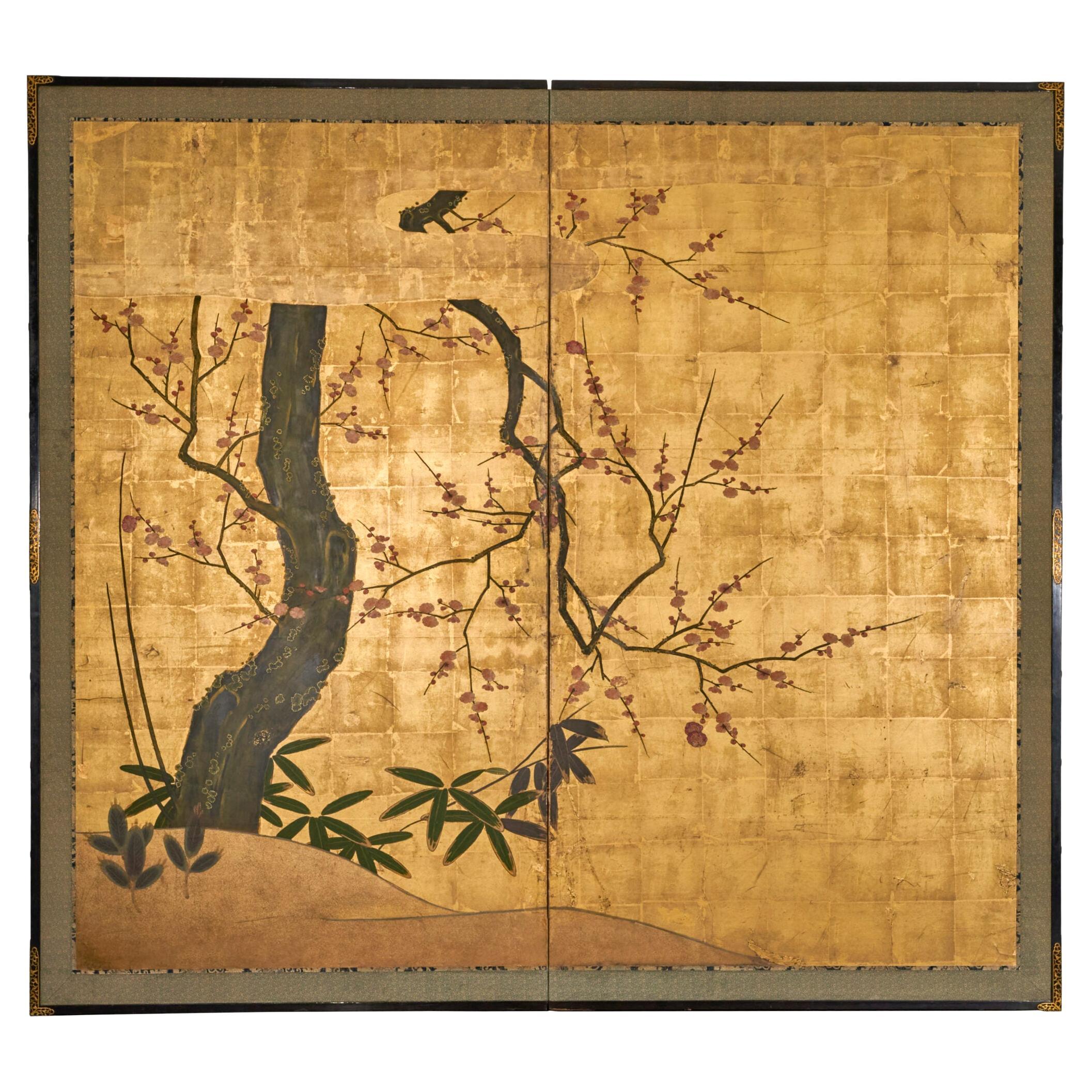
Plum blossom, baby pine and bamboo painted in mineral pigments on heavy gold leaf on paper. Silk brocade border with black lacquer trim and bronze hardware.
Category
Antique Early 1800s Japanese Paintings and Screens
Materials
Bronze, Gold Leaf

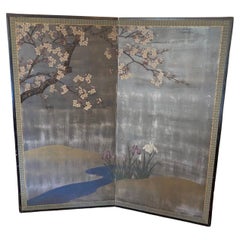
Japanese Asian Two Panel Meiji Edo Byobu Cherry Blossom Tree Folding Screen
Located in Studio City, CA
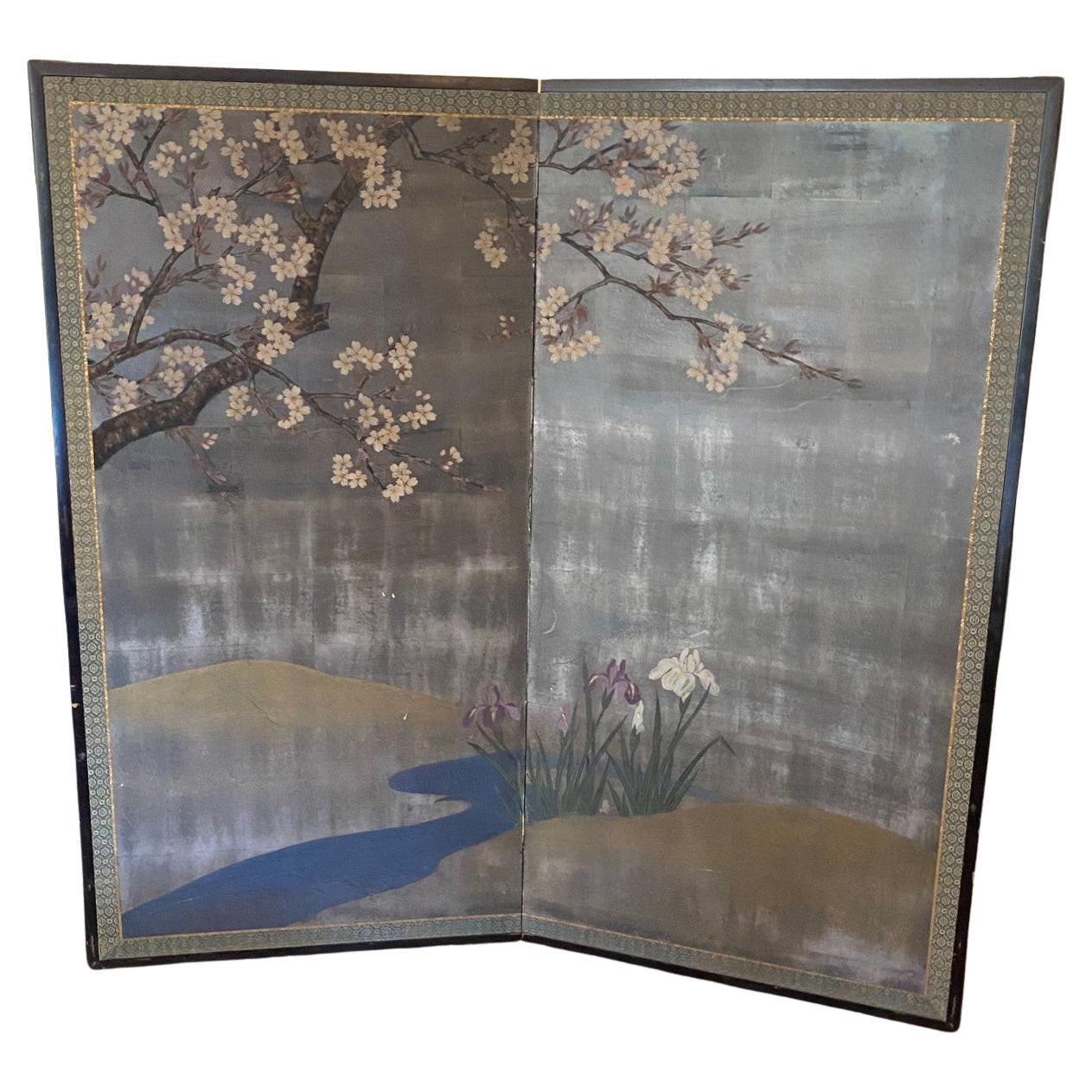
A gorgeous, large two-panel antique Japanese Byobu folding screen depicting a nature landscape scene with a venerable cherry blossom tree and a running river with blooming flowers. ...
Category
Antique 19th Century Japanese Meiji Paintings and Screens
Materials
Silver Leaf
Japanese Two Panel Screen: Summer Flowers
Located in Hudson, NY
Screen depicts Summer flowers and birds on gilded silk. Signature reads: Konishi Fukunen. Notes about Artist: Konishi Fukunen (1887-1959) was born the second son of the Paper mounting specialist Konishi Uhei in Takeo, Fukui prefecture in the mid Meiji period. In 1902 he was sent to Kyoto to study painting under Suzuki Shonen...
Category
Mid-20th Century Japanese Paintings and Screens
Materials
Silk
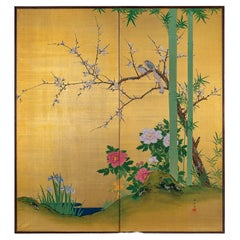
Japanese Two-Panel Screen Peony and Cherry
Located in Hudson, NY
Japanese two-panel screen: Peony and Cherry, Edo period (circa 1800) painting, formerly fusuma (Japanese sliding doors), executed in the Kano school style, featuring a cherry tree in...
Category
Antique Early 1800s Japanese Edo Paintings and Screens
Materials
Gold Leaf
More Ways To Browse
Cherry Blossom
Antique Cherry Blossom
Cherry Blossom Trees
Japanese Cherry Blossoms
Japanese Showa Screen
Japan Art Cherry
Japanese Kano Screen
2 Panel Screen
Japanese Screen Cherry
Cherry Blossom Screen
Cherry Blossom Painting Japanese
Japanese Cherry Blossom Screen
Yamamoto Shunkyo
Antique 2 Panel Japanese Screens
Chinese Lacquered Screen
Hanging Scrolls
Meiji Silk
Japanese Folding Screens