Items Similar to Early 20th Century Japanese Screen Pair - Ink Pine Trees on Gold
Want more images or videos?
Request additional images or videos from the seller
1 of 8
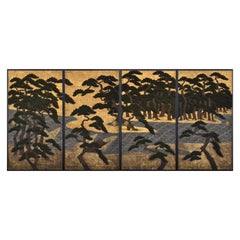
Early 20th Century Japanese Screen Pair - Ink Pine Trees on Gold
$35,000
£26,629.88
€30,683.04
CA$49,689.05
A$53,307.45
CHF 28,593.02
MX$641,814.60
NOK 360,448.62
SEK 328,679.19
DKK 229,243.27
About the Item
Imao Keisho (1902-1993)
Pine Trees
Early 20th Century, Circa 1930
Pair of six-panel Japanese screens. Ink on silk and gold leaf.
Dimensions: Each screen H. 67.5” x 148” (172 cm x 376 cm)
A pair of monumental six-panel Japanese pine screens by the renowned Nihonga artist Imao Keisho. Here Keisho entirely removed the background and brought the pine trees to the surface of the painting. This simplification of the elements makes the scene exceptionally direct and compelling and injects a very modern feel into the screens, which are extraordinary for their technical virtuosity. The work is both majestic and delicate, with Keisho’s exquisite brushwork defining the complex and visually stunning scene. The bright gold of the screens and the rich black of the ink demonstrate a magnificent visual power. Keisho’s complete and meticulous control of the ink is made possible by the design of the folding screens themselves. The fronts are first laid with silk before gold leaf is layered on top, allowing artists a highly refined silk canvas with all the visual benefits of the gold leaf.
Imao Keisho (1902-1993) is the adopted son of and successor to Imao Keinen (1845-1924). A highly talented Nihonga artist, Keisho fully inherited Imao Keinen’s painting style, and his brush skills are widely recognized. Like his father Keinen, Keisho did not affiliate himself with any painting association and their exhibitions, instead focusing on a series of one-man shows. His large-scale works were exhibited at various temples and shrines in Kyoto, including Kinkaku-ji, Ginkaku-ji, and Honen-in. He was favored with many private commissions, including fusuma sliding door panels in major Kyoto temples. His most famous work being his tiger paintings on the sliding doors of Konkai Komyo-ji temple in Kyoto. Keisho also presented his works to the Imperial family on several occasions.
- Dimensions:Height: 67.5 in (171.45 cm)Width: 148 in (375.92 cm)Depth: 0.75 in (1.91 cm)
- Style:Showa (Of the Period)
- Materials and Techniques:
- Place of Origin:
- Period:
- Date of Manufacture:circa 1930
- Condition:
- Seller Location:Kyoto, JP
- Reference Number:1stDibs: LU2472333182692
About the Seller
5.0
Recognized Seller
These prestigious sellers are industry leaders and represent the highest echelon for item quality and design.
Established in 2001
1stDibs seller since 2016
77 sales on 1stDibs
Typical response time: 5 hours
- ShippingRetrieving quote...Shipping from: Kyoto, Japan
- Return Policy
More From This Seller
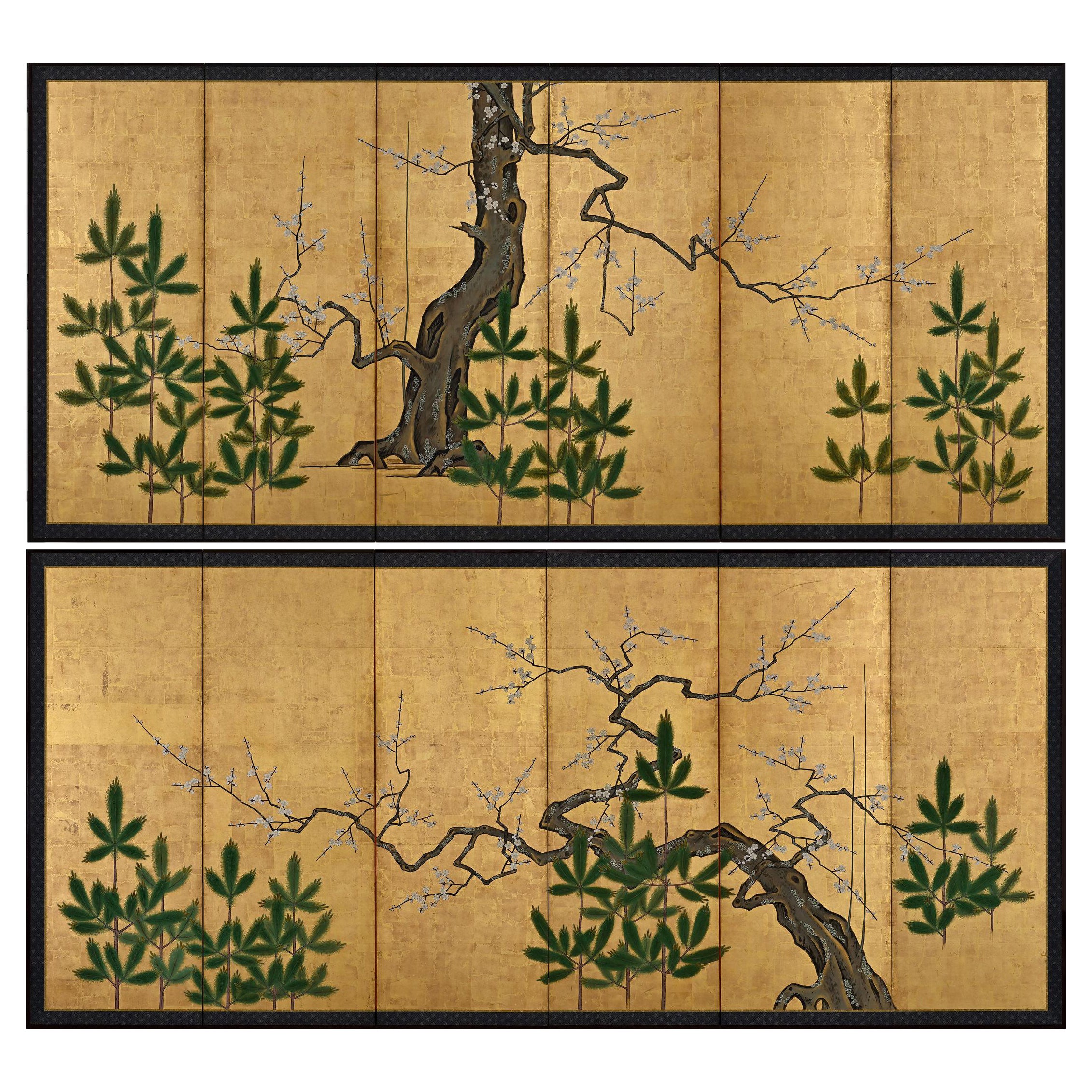
View All18th Century Japanese Screen Pair. Plum
Young Pines. Kano School.
Located in Kyoto, JP
Dimensions (Each screen): H. 176 cm x W. 378 cm (69’’ x 149’’)
This pair of Japanese folding screens depict blossoming plum trees amongst young pines. They are designed to capture t...
Category
Antique Late 18th Century Japanese Edo Paintings and Screens
Materials
Gold Leaf
17th Century Japanese Screen Pair by Soga Nichokuan, Hawks on Pine
Plum Trees
Located in Kyoto, JP
Hawks on plum and pine
Soga Nichokuan (active circa 1625-1660)
Pair of six-fold screens.
Ink, mineral pigments, gofun, gold and speckled gold l...
Category
Antique 1640s Japanese Edo Paintings and Screens
Materials
Wood, Paper
Circa 1700 Japanese Sliding Door (Fusuma) Set. Pine Trees on the Seashore.
Located in Kyoto, JP
"Pine Trees on the Seashore"
A set of four sliding doors (Japanese fusuma). Ink, color, gold-leaf and gold-fleck on paper.
Dimensions (total display si...
Category
Antique Late 17th Century Japanese Edo Paintings and Screens
Materials
Gold Leaf
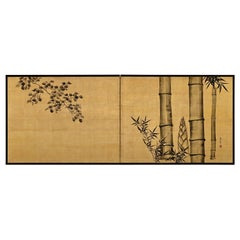
19th Century Japanese Screen for Tea-Ceremony, Ink Bamboo and Plum on Gold Leaf
Located in Kyoto, JP
Three Friends of Winter
Nakajima Raisho (1796-1871)
Late Edo period, circa 1850
Ink and gold leaf on paper.
This is a double-sided Japanese Furosaki or tea-ceremony screen from the mid 19th century; bamboo and plum on the front, young pines the back. It by Nakajima Raisho, a master painter of the Maruyama school in the late Edo and early Meiji periods. In this work Raisho combines exquisite ink brushwork with large open spaces of brilliant gold-leaf to inspire the viewers imagination. Rather than naturalism, he is searching for the phycological impression of the motifs, resulting in abstraction and stylization. His simplification of the motifs the result of looking to capture the inner nature of the objects. This art motif is known as Sho Chiku Bai, or the Three Friends of Winter. Evergreen pine connotes steadfastness, bamboo suggests both strength and flexibility, while plum blossoms unfurling on snow-laden branches imply hardiness. Combined, this trio is emblematic of Japanese new year. Chinese literati were the first to group the three plants together due to their noble characteristics. Like these resilient plants flowering so beautifully in winter, it was expected of the scholar-gentleman to cultivate a strong character with which he would be able to show the same degree of perseverance and steadfastness even during times of adverse conditions.
The screen would have been placed near the hearth of a room used for the Japanese tea ceremony, shielding the fire from draughts and also forming a stimulating and decorative backdrop behind the tea utensils. It would have been used in the Hatsugama, or first tea-ceremony of the new year.
Nakajima Raisho (1796-1871) originally studied under Watanabe Nangaku before entering the school of Maruyama Ozui. He was the highest ranking Maruyama school painter at the end of the Edo period and was known as one of the ‘Four Heian Families’ along with Kishi...
Category
Antique Mid-19th Century Japanese Edo Paintings and Screens
Materials
Gold Leaf
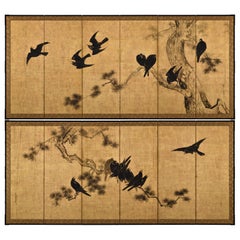
Mid 18th Century Japanese Screen Pair. Crows
Pines by Unkoku Toshuku.
Located in Kyoto, JP
Unkoku Toshuku (1722-1779)
Crows and Pines
A pair of six-panel Japanese Screens. Ink and gold leaf on paper.
Dimensions: Each Screen: H. 170.5 cm x W. 375 cm
Haha-cho or mynah birds, whose forms resemble crows in artwork, were commonly depicted in Japanese art. These types of paintings were originally modeled on paintings attributed to the 13th century Chinese painter Muqi (Mokkei), whose art was enormously influential in Japan. Crows only became a theme among Japanese artists from the later 1500s onward. They likely were inspired by these imported Chinese paintings of myna birds, which are not native to Japan, substituting the native species of crow instead.
The best known early examples of the depiction of Japanese crows are two Momoyama screen...
Category
Antique Mid-18th Century Japanese Edo Paintings and Screens
Materials
Gold Leaf
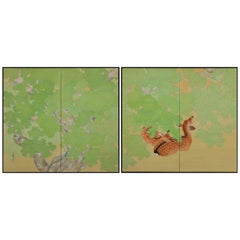
Early 20th Century Pair of Japanese Folding Screens, Deer Under Maple Trees
Located in Kyoto, JP
Deer under maples
Late Taisho period, circa 1925-1930
Pair of two-panel screens. Ink and pigment on silk.
Signature: Goho
Seal: Goho
A pair of two-fold Japanese silk screens...
Category
Vintage 1920s Japanese Taisho Paintings and Screens
Materials
Wood, Paper, Silk
You May Also Like
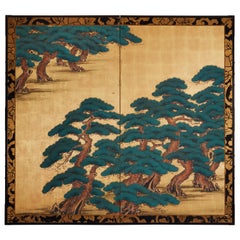
Japanese Two Panel Screen: Pine on Heavy Gold
Located in Hudson, NY
Kano School painting in mineral pigments on mulberry paper with heavy gold leaf and a silk brocade border made of antique monk's robes.
Category
Antique Late 19th Century Japanese Paintings and Screens
Materials
Gold Leaf
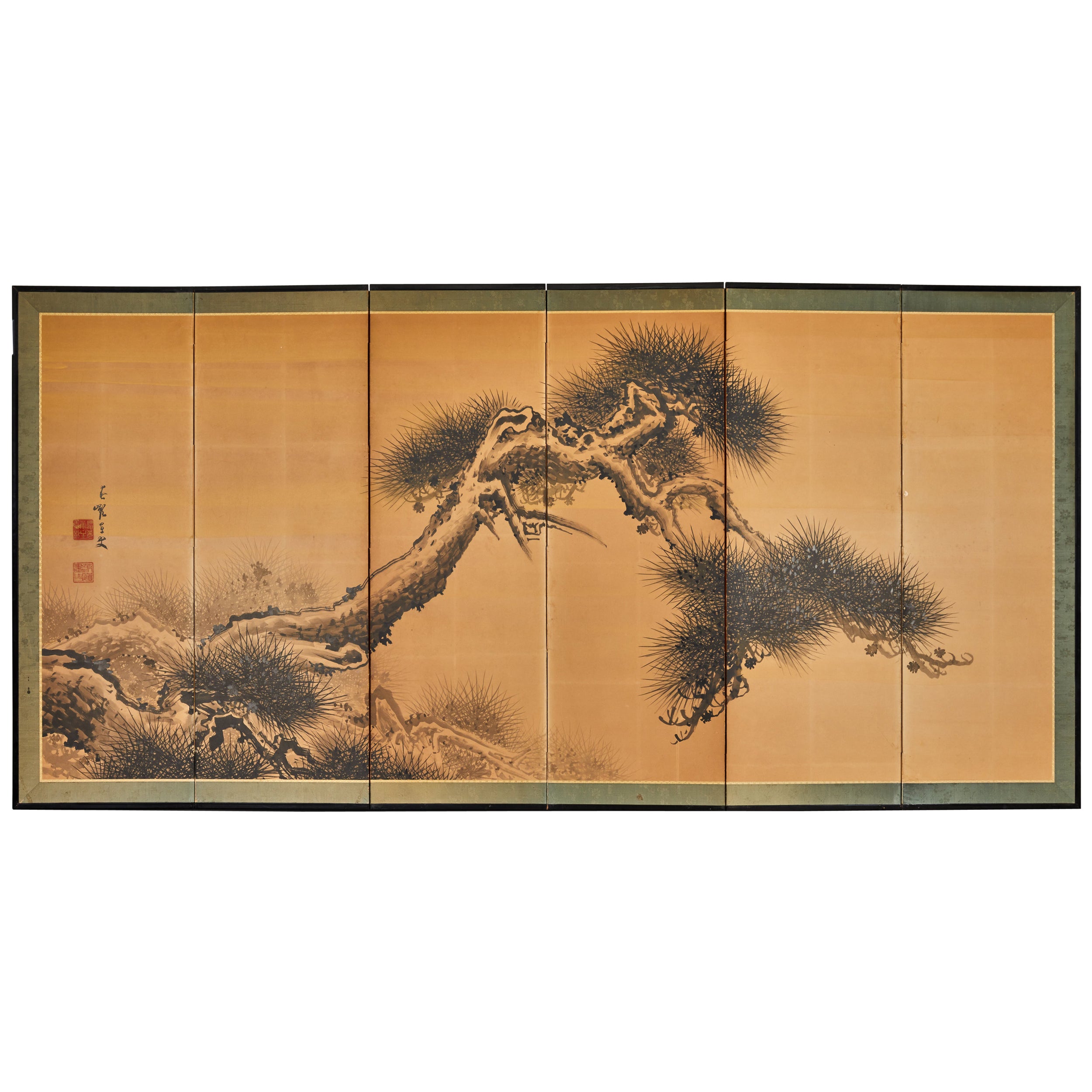
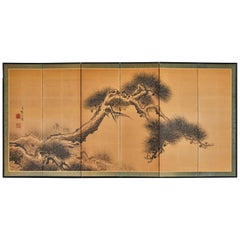
Japanese Six Panel Screen: Ink Painting of a Weathered Pine Tree
Located in Hudson, NY
Meiji period (1868 - 1912) sumi-e (or ink painting) on paper of a venerable pine tree with limbs stretching out over a bluff. Beautiful signature and seal read: Biei. Ink on paper ...
Category
Antique 19th Century Japanese Paintings and Screens
Materials
Brocade, Silk, Paper
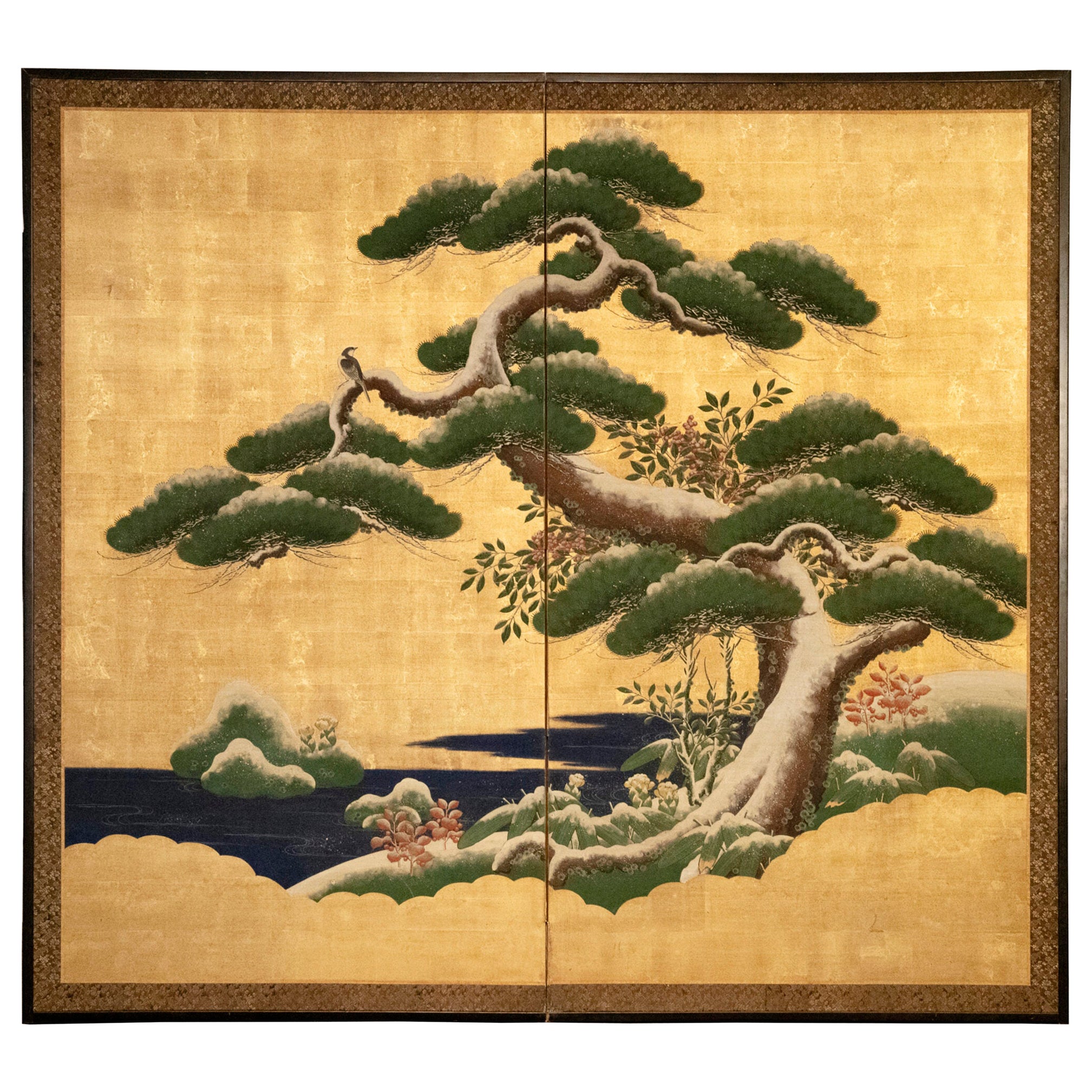
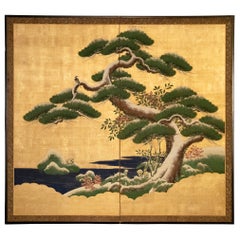
Japanese Two Panel Screen: Pine in Snow
Located in Hudson, NY
Kano School, Mineral pigments on gold leaf with silk brocade border and lacquer wood trim.
Category
Antique Mid-19th Century Japanese Paintings and Screens
Materials
Gold Leaf
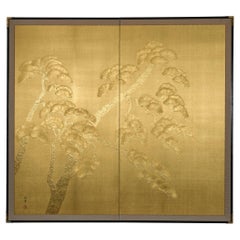
Japanese Two Panel Screen: Gilded Pine
Located in Hudson, NY
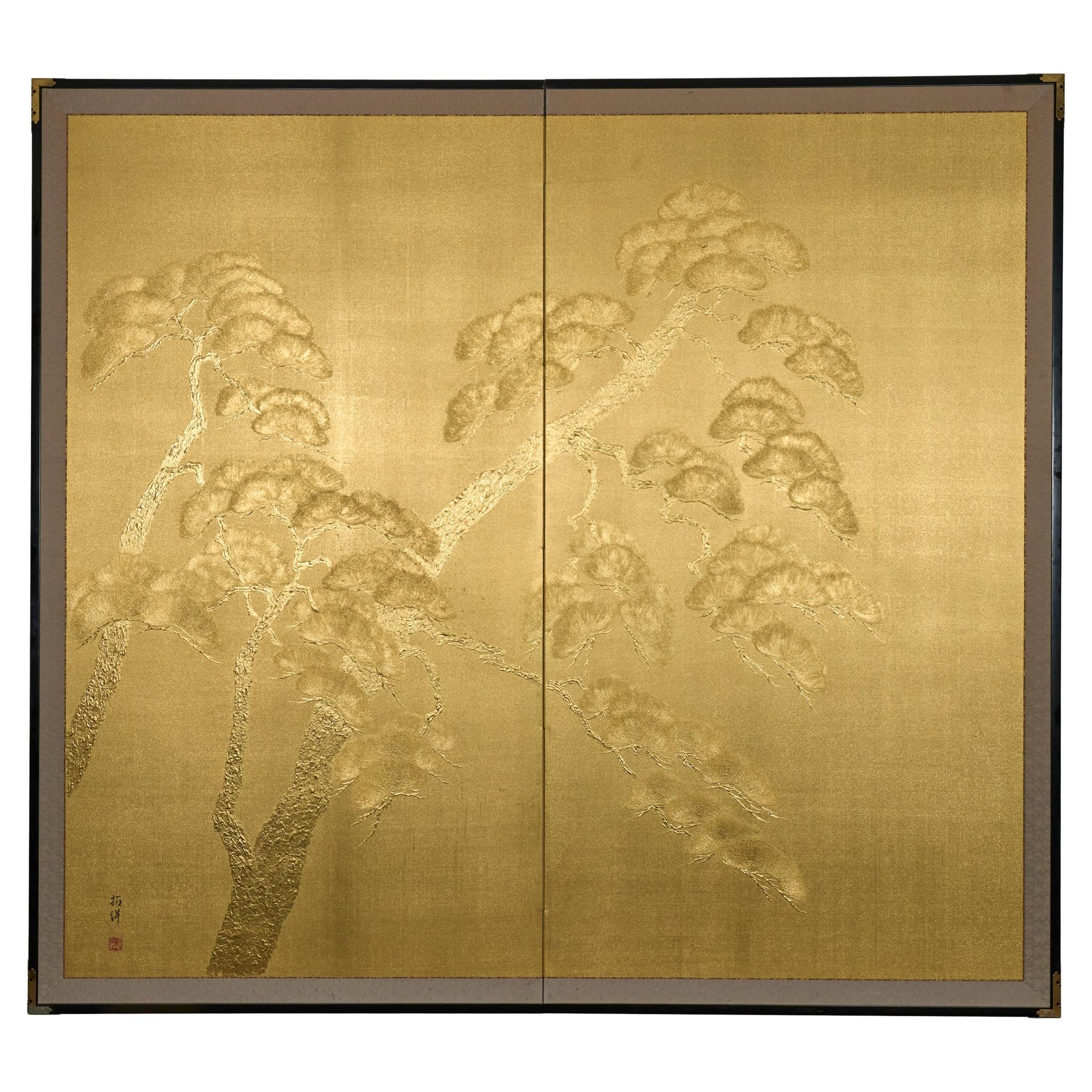
Luxurious golden pine with gold raised relief on gold silk with silk brocade border and black lacquer trim with bronze mounts. Signature and seal read: Takuyo.
Back Label Reads: ...
Category
Mid-20th Century Japanese Paintings and Screens
Materials
Brocade, Silk, Lacquer
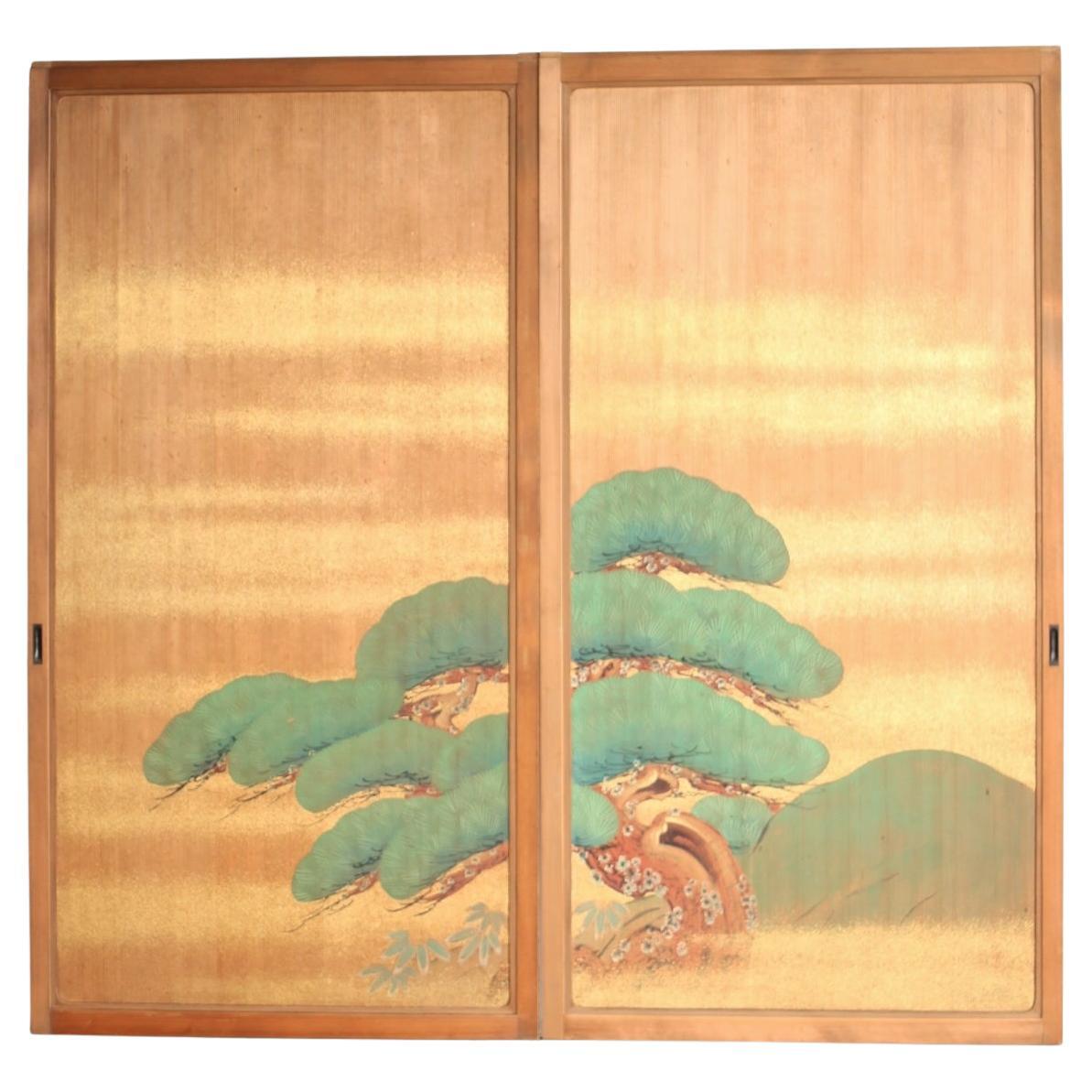
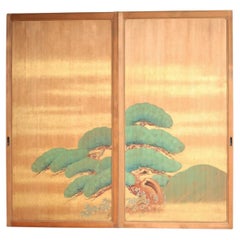
Japanese Antiques Pine Trees, Panel Painting/Sliding Door Painting, 2 Pieces set
Located in Niiza, JP
The material is thought to be cedar or cypress.
925 (W) x 1775 (H) x 30 (D) [mm] *Size of one piece 7㎏/per
Estimate packing size 35kg L18cm W105cm H190cm
The color is well preserve...
Category
20th Century Japanese Paintings and Screens
Materials
Wood
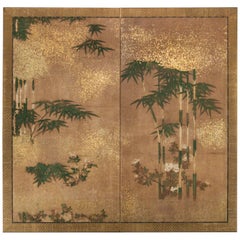
Japanese Two Panel Screen: Bamboo Grove on Mulberry Paper with Gold Dust
Located in Hudson, NY
Kano School painting of a bamboo grove with blooming flowers and gold dust mists. Painted in mineral pigments on mulberry paper with gold dust and a silk brocade border.
Category
Antique Early 19th Century Japanese Edo Paintings and Screens
Materials
Gold
More Ways To Browse
Japanese 20th Century Modern Furniture
Japanese Painting Silk Gold
Japanese Showa Screen
20th Century Japanese Folding Screen
Painting Antique Pine Furniture
Asian Art Painting Pair Wood Panel
Japanese Painting Tree
Pair Of Japanese Screens
Japanese Screens Pines
Japanese Screen Tree
Fusuma Doors
Japanese Silk Painting Ink
Fusuma Sliding Doors
Fusuma Panels
Japanese Crane
Japanese Six Panel Screen
Paper Folded Art
Four Panel Painting