Items Similar to Immortal He Xiangu Painting on Canvas, China, 19th Century Asian Art
Want more images or videos?
Request additional images or videos from the seller
1 of 8
Immortal He Xiangu Painting on Canvas, China, 19th Century Asian Art
$1,115.36
£832.67
€940
CA$1,549.58
A$1,666.79
CHF 890.78
MX$19,646.72
NOK 11,230.67
SEK 10,266.97
DKK 7,163.86
About the Item
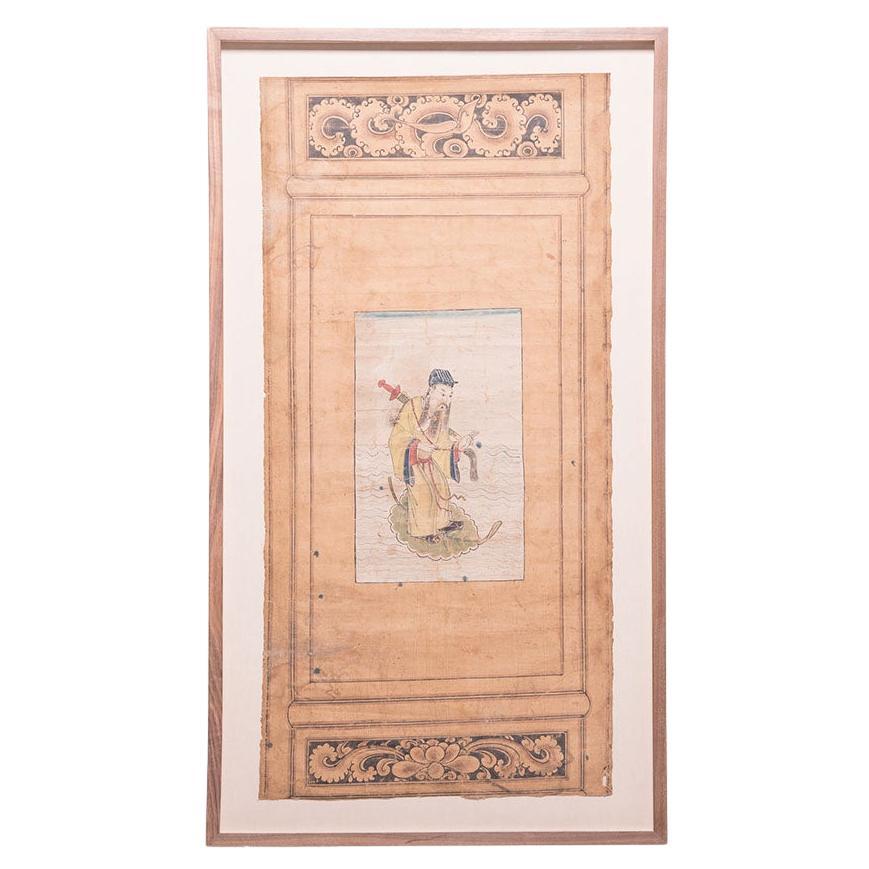
Chinese painting depicting He Xiangu reproduced three times but with a different attribute: up a lotus flower, bottom left a fly hunt and bottom right again the lotus flower, each time surrounded by disciple the one praying right, the one on the left seems to bring him a bowl.
Pigments on linen or hemp,
19th century.
He Xiangu or Ho Hsien-ku, "Immortal Demoiselle He," is an immortal Taoist, a member of the group of Eight Immortals. She is represented holding in her hand a lotus symbolizing spiritual fulfillment, and sometimes also a sheng, a peach of immortality, a wooden ladle or a flyer, accessory of religious. She is sometimes given as a disciple of Lü Dongbin, and Ming theatrical or literary works have imagined a romantic plot between the two. Tradition has made it a woman of the Tang Dynasty who has devoted herself to celibacy to devote herself to Dao. She would have lived under the reigns of Wu Zetian and Zhongzong. . Wu Zetian would have asked to meet her, which she would have accepted or not according to the versions. A "Song" book makes it a contemporary of General Di Qing (1008-1057) to whom she predicts a victory.
- Dimensions:Height: 27.56 in (70 cm)Width: 20.87 in (53 cm)Depth: 0.4 in (1 cm)
- Style:Qing (Of the Period)
- Materials and Techniques:
- Place of Origin:
- Period:
- Date of Manufacture:1800
- Condition:Wear consistent with age and use. some lacks.
- Seller Location:Beuzevillette, FR
- Reference Number:1stDibs: LU266337427953
About the Seller
4.9
Gold Seller
Premium sellers maintaining a 4.3+ rating and 24-hour response times
Established in 2010
1stDibs seller since 2017
310 sales on 1stDibs
Typical response time: 2 hours
- ShippingRetrieving quote...Shipping from: Beuzevillette, France
- Return Policy
More From This Seller
View AllA.Bouverat Chinese Inspired Lacquered Panel Hand-Painted 20th Century
By A. Bouverat
Located in Beuzevillette, FR
Very beautiful rare and large lacquer of Chinese inspiration. Representation of a green space with many plants such as cherry trees and magnolia. A bird crosses the lacquer with its ...
Category
20th Century French Chinoiserie Paintings
Materials
Lacquer
$1,139 Sale Price
20% Off
Set of 6 Large Kakemonos Japanese Mythology, 19th Century Japan circa 1800 Edo
Located in Beuzevillette, FR
Beautiful set of 6 large kakemonos from 19th century Japanese mythology.
Paper support with a canvas pasted on the paper
Wonderful set that is part of Japan's history and beliefs
When not hung, the Kakemonos are rolled up.
circa 1800 - Japan - Edo Period
A kakemono translates as "object to hang". In Japan this refers to a painting or calligraphy, most often done on silk or paper framed in a scroll that was intended to be hung on walls or in public lighting. This particular form, which allows them to be in a roll, dates back to the Tang dynasty in China (this would be related to the copying and preservation of ancient Buddhist texts). A Kami is a deity or spirit worshipped in the Shinto religion. A Yokai is a spirit, ghost, demon, or strange apparition from the creatures of Japanese folklore.
Each of these kakemonos represents a unique story:
- A kami, a Japanese deity, is shown painting a rainbow. Indeed, he performs the action with his right hand while his left hand holds a kind of basket with three pots of paint. This kami has a rather closed attitude. He is standing in a dark and tormented sky. Below this figure, 8 villagers are dressed in traditional Japanese clothes. Their faces are softened. They are not afraid of the elements made by the kami above their heads.
- A character with an unreal look is holding a kind of jar with his two hands, which he spills on human figures above. This being is floating in the air, probably a character from mythology, perhaps Susanoo. Underneath, villagers on umbrellas. They are trying to protect themselves as best they can from what is falling on them. One of them is carrying baskets with fish on her shoulders. A character in the background is thrown forward and falls.
- On this kakemono, the god Raijin, dressed in a white and blue outfit, strikes the sky with his two drum hammers to create lightning and its thunderous sound. Surrounded by Tomoe and a long red scarf, Raijin, enraged and with dishevelled hair, creates a dark and violent storm. The villagers seem frightened by this meteorological phenomenon. One of the villagers can be seen fainting in the arms of a man. This scene may seem chaotic, but Japanese legend tells us that once a field is struck by lightning, the harvest is good.
- On this kakemono, we see an unreal-looking figure holding a fan, as if he were sweeping away the bad weather, or simply producing gusts of wind. He is probably the kami of wind and air, Shina tsu-hiko. The figures below him seem surprised by so much wind. An umbrella flies away on the left, the women hold their hair and scarf, the clothes are caught in the power of the wind, there is even a woman on the ground on the bottom left.
- This Kakemono represents a short moment. This Raiju is a yokai (ghost spirit...
Category
Antique 19th Century Japanese Edo Paintings
Materials
Paper
$2,562 Sale Price / set
20% Off
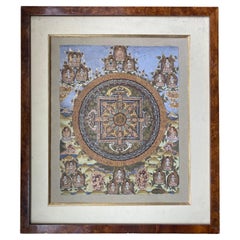
Asian Mandala Tanka circa 1900
Located in Beuzevillette, FR
Very beautiful tanka mandala of the 19th century painted on canvas . Buddha is in the center with the naga on his right arm, surrounded by others arranged like the rays of the sun. T...
Category
Antique 19th Century Asian Paintings and Screens
Materials
Canvas
$455 Sale Price
20% Off
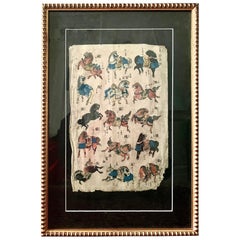
Polychrome woodblock print - nishiki-e - late Edo/early Meiji period, circa 1850
Located in Beuzevillette, FR
Educational sheet illustrating a series of horses depicted in various positions and gaits—walk, trot, gallop, rearing, bucking, lying, etc. Each figure is accompanied by a Japanese c...
Category
Antique Mid-19th Century Chinese Picture Frames
Materials
Paper
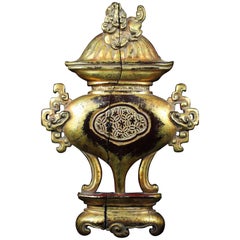
China 18th Century Chinese Decoration Element in Lacquered and Gilded Wood
Located in Beuzevillette, FR
Interesting element probably coming from a lacquered and gilded wood furniture or panel representing a tripod - shaped vase with curved legs with...
Category
Antique 18th Century Chinese Qing Sculptures and Carvings
Materials
Giltwood, Wood, Lacquer
$617 Sale Price
20% Off
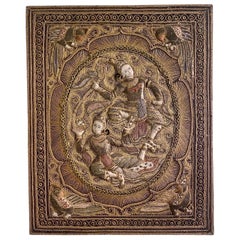
Kalaga Burmese tapestry – dancers and parrots – mid 20th - Burma Myanmar Asia
Located in Beuzevillette, FR
Original Burmese Kalaga-style tapestry, dating from the 20th century.
Tapestry, panel, or wall hanging depicting two dancers and four parrots in relief.
The tapestry is richly embro...
Category
Mid-20th Century Burmese Antiquities
Materials
Tapestry, Velvet, Sequins
You May Also Like
Chinese New Year Painting, c. 1900
Located in Chicago, IL
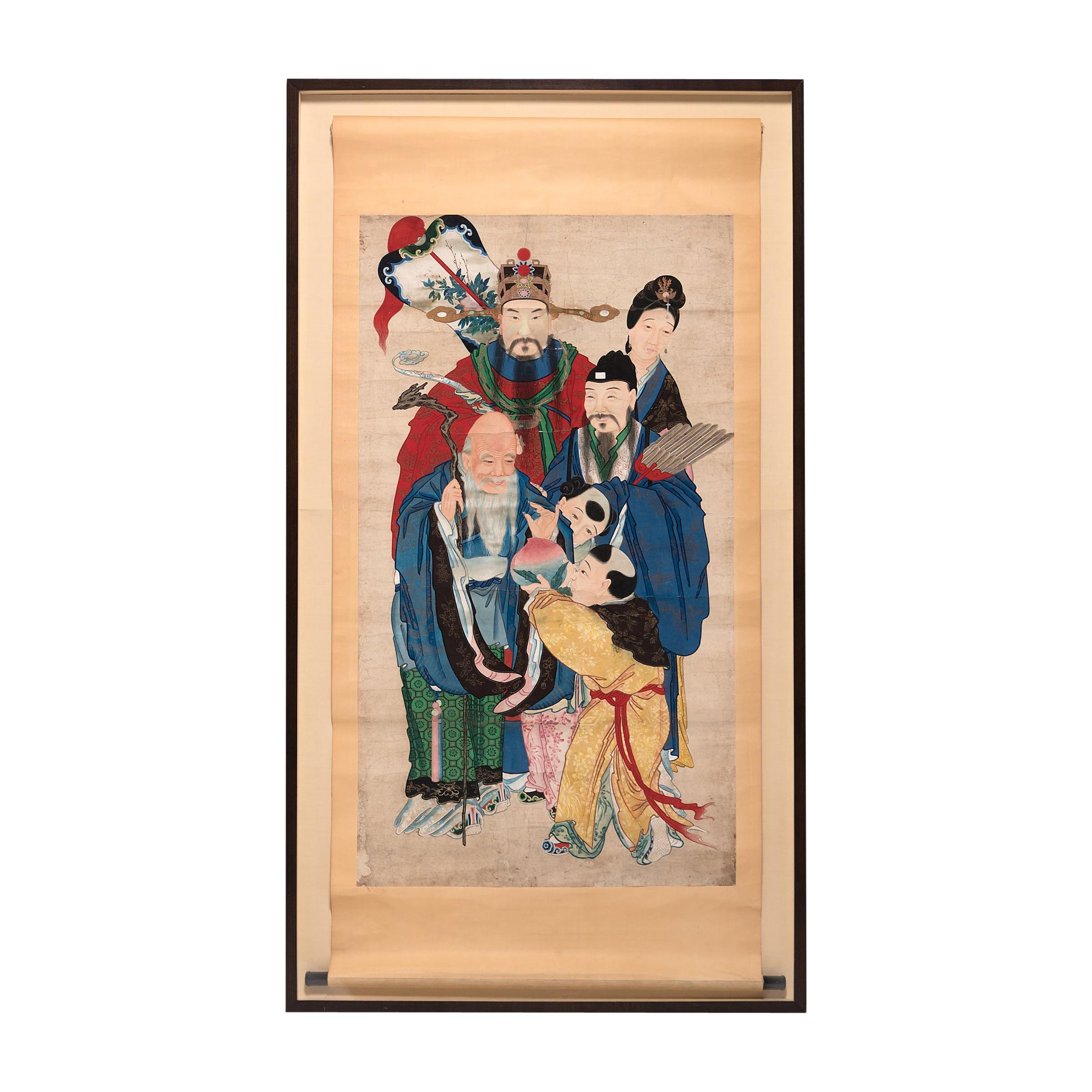
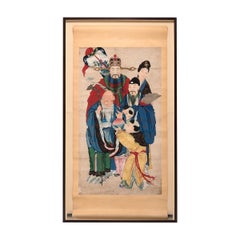
In celebration of the lunar New Year festival, it was traditional all over China to hang special decorations. In a city called Wuqiang, local artists made lacquer scroll paintings laden with symbolism. This framed and finely rendered early 20th century folk painting from Wuqiang features an imperial court official and his family dressed in their best silks. The young boy is dressed in a wonderfully patterned yellow robe to offer Shou Xing...
Category
Early 20th Century Chinese Qing Paintings and Screens
Materials
Paper
19th Century Chinese Painting
Located in Dallas, TX
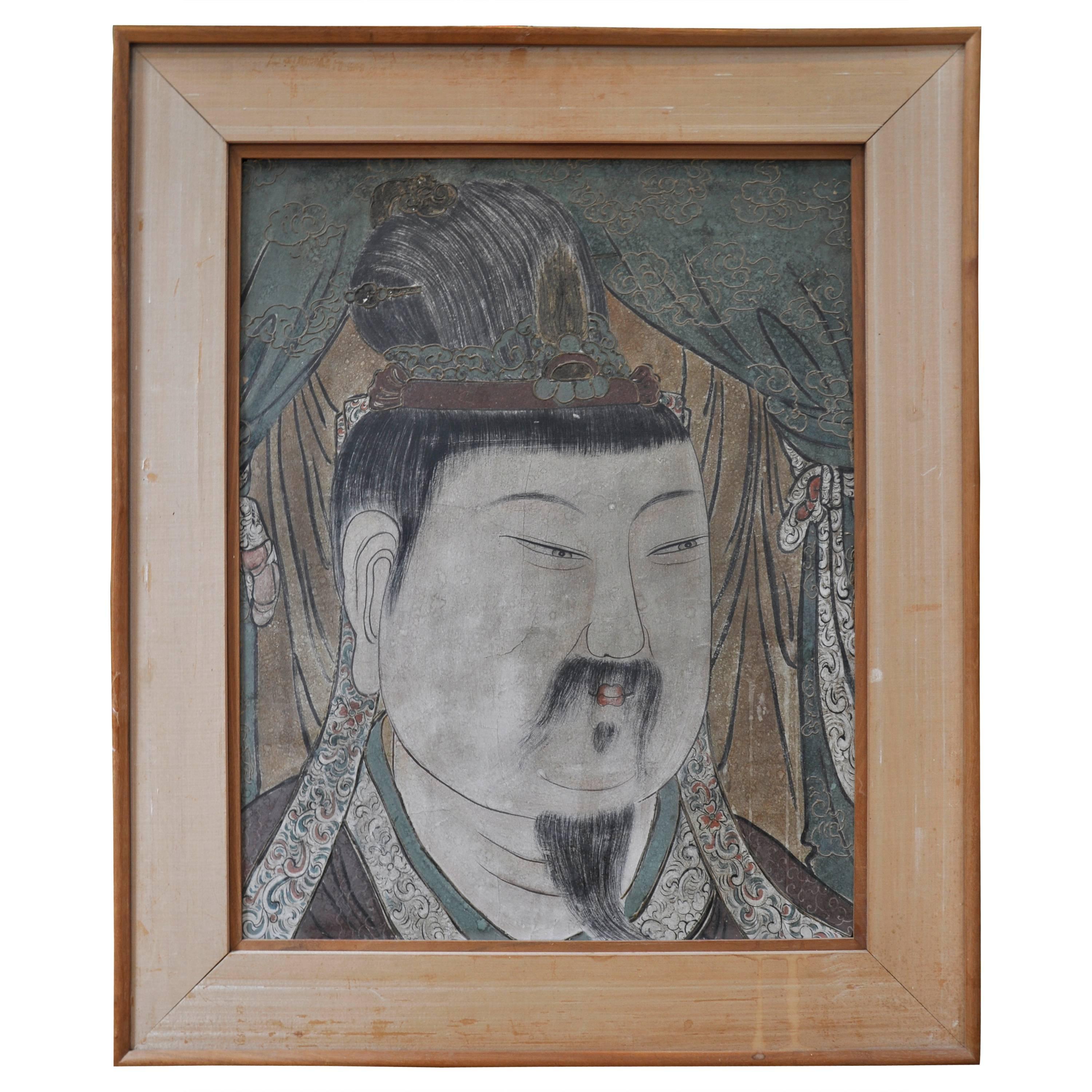
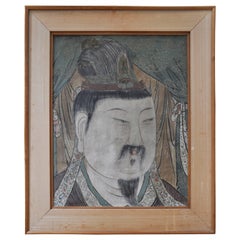
Imperial portrait on paper.
Category
Antique 18th Century Chinese Other Paintings and Screens
Materials
Paint
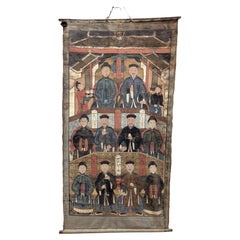
Qing Dynasty 19th Century Ancestral Group Painting on Hand Painted Parchment
Located in Yonkers, NY
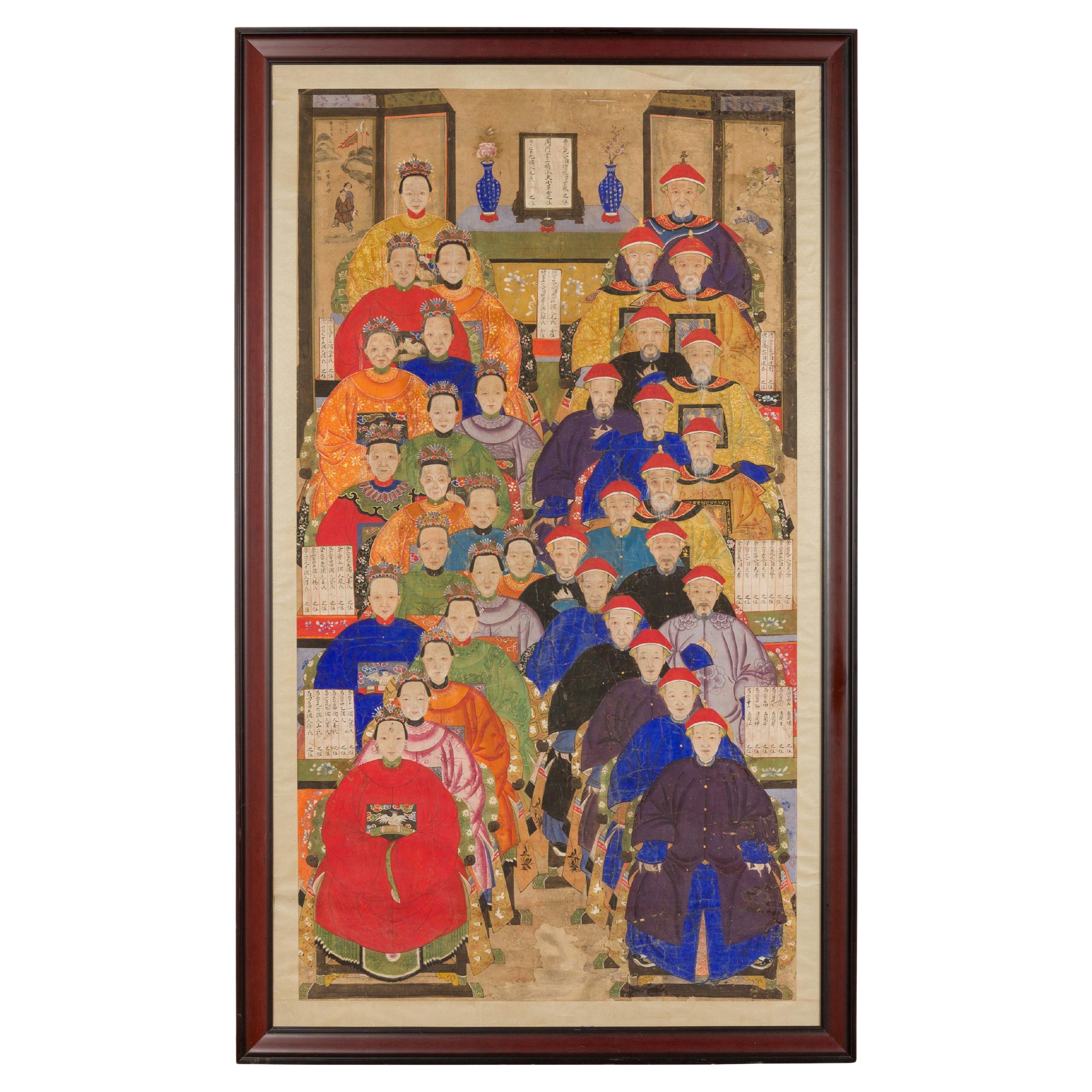
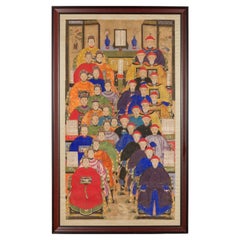
A Chinese Qing Dynasty period painting from the 19th century of an ancestral group portrait in custom frame. Immerse yourself in the rich tapestry of Chinese history with this Qing Dynasty period painting, an ancestral group portrait from the 19th century that masterfully captures the essence of traditional Chinese society and family hierarchy. This vertical painting, housed in a custom composition wood frame with plexiglass, is a testament to the time-honored artistry of Qing Dynasty artists.
Crafted on parchment paper, the painting displays generations of ancestors in a systematic, frontal arrangement. The chromatic spectrum of their robes - blues, reds, greens, golds, blacks, and oranges - adds vibrant depth to the ancestral tribute. Civil officials are distinguished by bird-adorned buzi, an emblem of their rank.
In line with tradition, the portrait hierarchy descends from top to bottom - the older generation presides at the top, followed by subsequent generations. The men are positioned on the right, the women on the left, reflecting the societal norms of the period.
Bordering the parchment, a silk frame contributes an elegant finish. Display this painting above a credenza, console table, or enfilade, and it promises to enhance any interior space with its captivating allure and cultural resonance. This Qing Dynasty painting...
Category
Antique 19th Century Chinese Qing Paintings
Materials
Plexiglass, Wood, Parchment Paper
Antique Chinese Imperial Emperor Ancestral Painting
Located in San Diego, CA
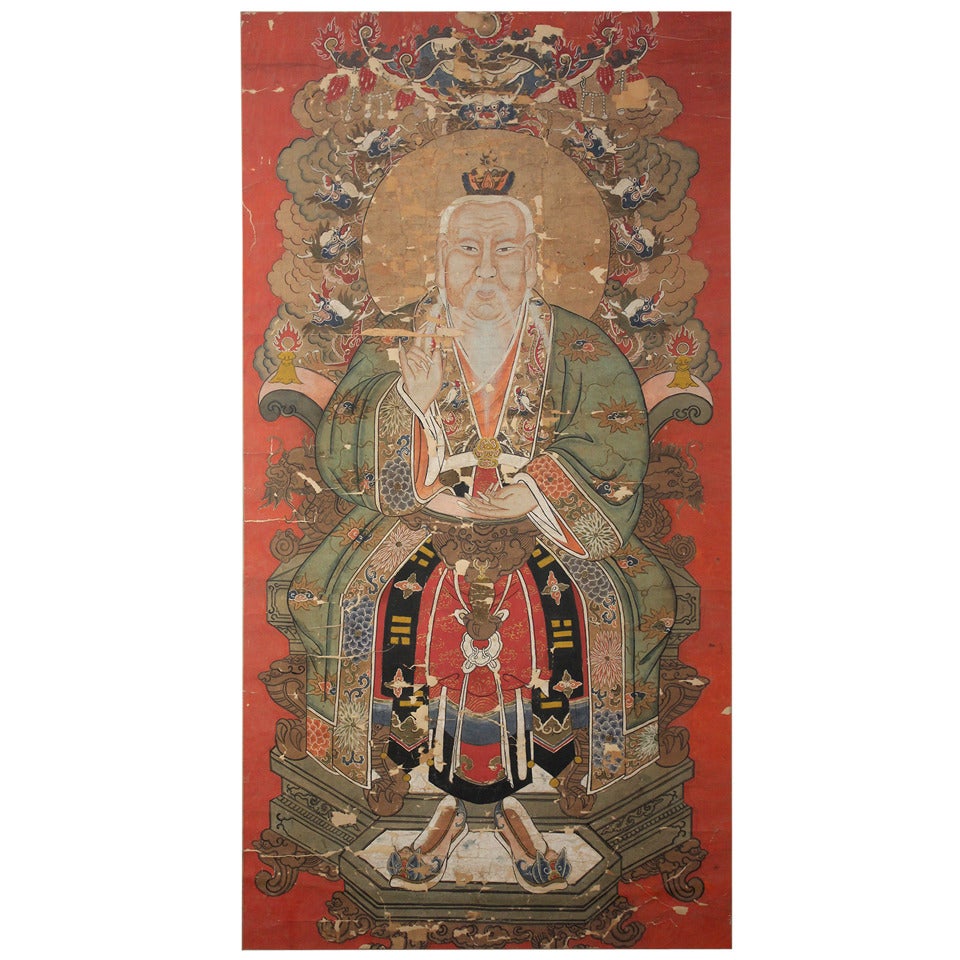
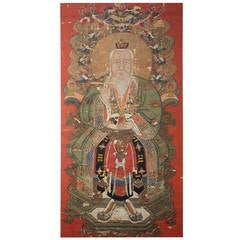
Wonderful large antique Chinese Imperial Emperor ancestral painting. Hand-painted original work on paper with age related wear as pictured. Additional...
Category
Antique 18th Century and Earlier Chinese Paintings
$6,500 Sale Price
45% Off
19th Century Ancestor Painting on Cloth
Located in New York, NY
Original 19th Century Ancestor Painting on canvas. In original condition as pictured. Acquired in northern China outside of Beijing. Each wearing Winter Court Hats. In fair condi...
Category
Antique Late 19th Century Chinese Qing Paintings and Screens
Materials
Canvas
Chinese Mythical Immortal Screen Painting, c. 1850
Located in Chicago, IL
Since the 12th century, people in China have used folding screens and doors to partition and decorate their homes - the vivid scenes backing the screens added life and color to a roo...
Category
Antique Mid-19th Century Chinese Paintings
Materials
Fabric, Paint

More Ways To Browse
Antique Hemp
Chinese Immortal
Japanese Brushes
Window Lattice
18th Century Chinese Painting
Bird Silk Art
Qing Dynasty Painting
Asian Room Divider Screen
Chinese Gilt Wood Panel
Red Lacquer Panels
Chinese Painting On Silk
Japanese Scroll Landscape Painting
Pair Of Japanese Paintings
Antique Japanese Fans
Chinese Ancestral
Folding Screen Gold Leaf
Reverse Glass Painting Asian
Taisho Scroll