Want more images or videos?
Request additional images or videos from the seller
1 of 11
Japanese 2-Panel Furosaki’byôbu 風炉先屏風
Tea-Ceremony Folding Screen
with Dragons
Price:$1,921.44
About the Item
- Dimensions:Height: 31.26 in (79.4 cm)Width: 73.08 in (185.6 cm)Depth: 0.67 in (1.7 cm)
- Materials and Techniques:
- Place of Origin:
- Period:
- Date of Manufacture:1912-1926
- Condition:Repaired: Two small restorations on the back. Wear consistent with age and use. It is in a very good condition with some minor traces of age and wear. Please look at the photos for a condition reference.
- Seller Location:Amsterdam, NL
- Reference Number:Seller: B20061stDibs: LU7165233265642
About the Seller
4.8
Vetted Professional Seller
Every seller passes strict standards for authenticity and reliability
Established in 1996
1stDibs seller since 2022
22 sales on 1stDibs
Authenticity Guarantee
In the unlikely event there’s an issue with an item’s authenticity, contact us within 1 year for a full refund. DetailsMoney-Back Guarantee
If your item is not as described, is damaged in transit, or does not arrive, contact us within 7 days for a full refund. Details24-Hour Cancellation
You have a 24-hour grace period in which to reconsider your purchase, with no questions asked.Vetted Professional Sellers
Our world-class sellers must adhere to strict standards for service and quality, maintaining the integrity of our listings.Price-Match Guarantee
If you find that a seller listed the same item for a lower price elsewhere, we’ll match it.Trusted Global Delivery
Our best-in-class carrier network provides specialized shipping options worldwide, including custom delivery.You May Also Like
Japanese Six-Panel Screen Byobu With Chrysanthemums And Autumn Grass and Flower
Located in Torino, IT
The 19th Century Six-Panel Japanese folding screen "Byōbu" usually used in the most important Japanese house to stop wind and also to separate different space of the same big room de...
Category
Antique Mid-19th Century Japanese Edo Paintings and Screens
Materials
Gold Leaf
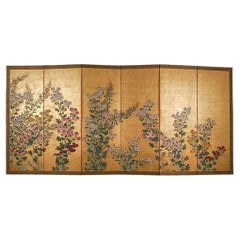
$24,017
H 69.29 in W 143.3 in D 0.5 in
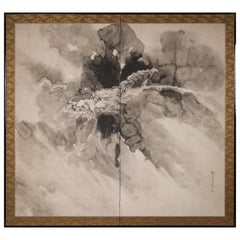
Japanese Two Panel Screen Dragon in the Mist
Located in Hudson, NY
Ink (Sumi) on paper. Signature and Seal read: Kishi Ganku It is backed with paper covered in gold and silver flake. Kishi Ganku (1749 or 1756-1839) was the...
Category
Antique Early 19th Century Japanese Edo Paintings and Screens
Materials
Wood, Paper
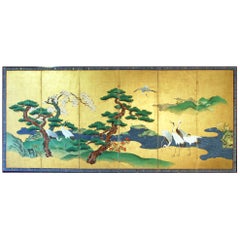
Japanese Folding Screen Six Panels Painted on Gold Leaf
By Japanese Studio
Located in Brescia, IT
Paravento a sei pannelli di scuola giapponese Kano: paesaggio con bellissime ed eleganti gru vicino al fiume, con alberi di pino e sakura.
Dipinto a mano con pigmenti minerali ed inc...
Category
Antique Early 19th Century Japanese Edo Paintings and Screens
Materials
Gold Leaf
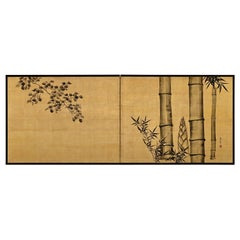
19th Century Japanese Screen for Tea-Ceremony, Ink Bamboo and Plum on Gold Leaf
Located in Kyoto, JP
Three Friends of Winter
Nakajima Raisho (1796-1871)
Late Edo period, circa 1850
Ink and gold leaf on paper.
This is a double-sided Japanese Furosaki or tea-ceremony screen from the mid 19th century; bamboo and plum on the front, young pines the back. It by Nakajima Raisho, a master painter of the Maruyama school in the late Edo and early Meiji periods. In this work Raisho combines exquisite ink brushwork with large open spaces of brilliant gold-leaf to inspire the viewers imagination. Rather than naturalism, he is searching for the phycological impression of the motifs, resulting in abstraction and stylization. His simplification of the motifs the result of looking to capture the inner nature of the objects. This art motif is known as Sho Chiku Bai, or the Three Friends of Winter. Evergreen pine connotes steadfastness, bamboo suggests both strength and flexibility, while plum blossoms unfurling on snow-laden branches imply hardiness. Combined, this trio is emblematic of Japanese new year. Chinese literati were the first to group the three plants together due to their noble characteristics. Like these resilient plants flowering so beautifully in winter, it was expected of the scholar-gentleman to cultivate a strong character with which he would be able to show the same degree of perseverance and steadfastness even during times of adverse conditions.
The screen would have been placed near the hearth of a room used for the Japanese tea ceremony, shielding the fire from draughts and also forming a stimulating and decorative backdrop behind the tea utensils. It would have been used in the Hatsugama, or first tea-ceremony of the new year.
Nakajima Raisho (1796-1871) originally studied under Watanabe Nangaku before entering the school of Maruyama Ozui. He was the highest ranking Maruyama school painter at the end of the Edo period and was known as one of the ‘Four Heian Families’ along with Kishi...
Category
Antique Mid-19th Century Japanese Edo Paintings and Screens
Materials
Gold Leaf
$9,200
H 29 in W 74 in D 0.75 in
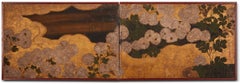
Japanese Two Panel Screen, Chrysanthemums
Located in Hudson, NY
Beautiful white chrysanthemums are emphasized by heavy gold on a soft floral landscape, while gold clouds create a striking and dream-like floral scene. Gold leaf and gofun with min...
Category
Antique Early 18th Century Japanese Paintings and Screens
Materials
Gold, Gold Leaf
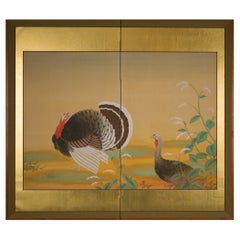
Japanese Two Panel Screen, Turkeys
Located in Hudson, NY
Mineral pigments on silk, mounted on a gold panel, in silk border. Signature and seal read: Yoho.
Category
Early 20th Century Japanese Paintings and Screens
Materials
Silk
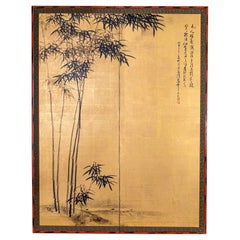
Japanese Two Panel Screen: Bamboo with Calligraphy Poem
Located in Hudson, NY
Moon and bamboo in ink on gold paper with red and black lacquered negoro frame. (Meiji period) Calligraphy reads: Beauty in ink painting with standing woods and branches, like in par...
Category
Antique Early 1900s Japanese Paintings and Screens
Materials
Paper
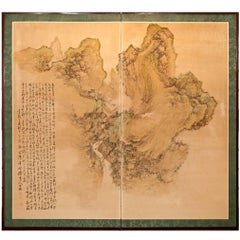
Japanese Two Panel Screen: Mountain Landscape with Calligraphy
Located in Hudson, NY
Japanese Two Panel Screen: Mountain Landscape with Calligraphy. Late Edo (c. 1850) painting of a dramatic mountainside carved by a waterfall with a crane flying in the foreground an...
Category
Antique Mid-19th Century Japanese Edo Paintings and Screens
Materials
Silk, Wood, Paper
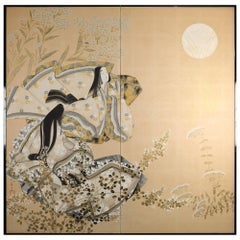
Japanese Two Panel Screen Moon Viewing
Located in Hudson, NY
Japanese two panel screen: Moon Viewing, painting of two noblewomen admiring the full moon outdoors. Extremely sophisticated execution of painting ove...
Category
Vintage 1970s Japanese Showa Paintings and Screens
Materials
Silk, Wood, Paper
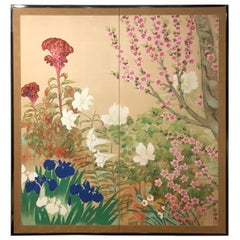
Japanese Two-Panel Screen Spring Flowers
Located in Hudson, NY
A vibrant celebration of spring using a colorful ensemble of coxcomb, irises, lilies, hybiscus, and a blossoming cherry tree. Great examples of "tarashikomi" or "painting-in", a Rim...
Category
Vintage 1930s Japanese Showa Paintings and Screens
Materials
Silk, Paper
More From This Seller
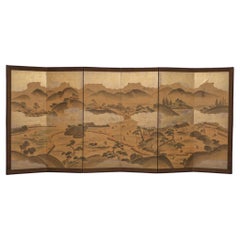
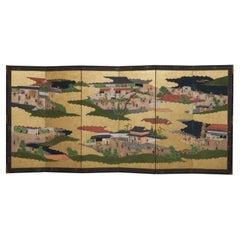
View AllLarge Japanese 6-panel byôbu 屏風 (folding screen) with genre painting
Located in Amsterdam, NL
Fascinating large six-panel byôbu (folding screen) with a detailed genre painting on goldish silver leaf with different scenes of people at work in a rural mountain village during th...
Category
Early 20th Century Japanese Paintings and Screens
Materials
Silver Leaf
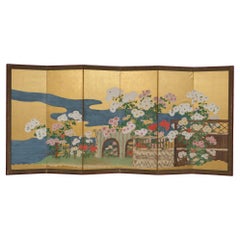
Large Japanese 6-panel byôbu 屏風 (folding screen) with chrysanthemum garden
Located in Amsterdam, NL
A very colourful and captivating large six-panel byôbu (folding screen) with a refined continuous painting of a luscious flower garden filled with many different types of chrysanthemums (kiku), next to a winding river.
This multi-coloured painting is set on a shiny gold-leaf background, and the chrysanthemum flowers are painted by using shell paste (gofun) in low relief.
Several clutches with a great variety of chrysanthemum flowers are in full bloom and they each show their unique form and colour. Varying from white, red, yellow and pink. The flowers bloom all around and on different kinds of bamboo fences and trellises.
In Japan chrysanthemums are believed to represent happiness, love, longevity and joy.
The panels are surrounded by two silk borders, a thin black one, and a wide brown one. The screen is protected by a black and red negoro’nuri...
Category
Antique Late 19th Century Japanese Paintings and Screens
Materials
Gold Leaf
Large Japanese 6-panel byôbu 屏風 (folding screen) with Edo genre painting
Located in Amsterdam, NL
An elaborate, large six-panel byôbu (folding screen) featuring a detailed genre painting on gold leaf, capturing the vibrancy of festive scenes from the Edo period.
Central to the p...
Category
Antique Early 19th Century Japanese Paintings and Screens
Materials
Metal, Gold Leaf
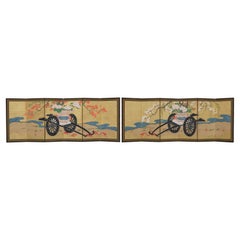
Pair of Japanese hinagata byôbu 雛形屏風 (small folding screens) with flower carts
Located in Amsterdam, NL
An amazing pair of six-panel hinagata byôbu (doll festival folding screens) with a continuous painting on gold leaf showcasing flower carts (hana’guruma) at the edge of a winding river.
Both laden with a large bamboo basket...
Category
Antique Early 19th Century Japanese Paintings and Screens
Materials
Gold Leaf
$4,323 / set
Free Shipping
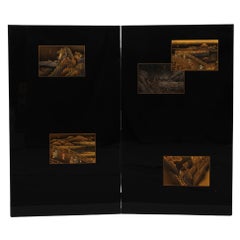
Tall, Japanese lacquer byôbu 屏風 (folding screen) by Mitsuo Takana 高名光夫 (1956)
By Mitsuo Takana
Located in Amsterdam, NL
Refined, tall two-panel byôbu (folding screen) completely adorned with ‘Wajima Ryûsaku’ lacquer by the Nitten award winning artist Mitsuo Takana (1956).
Featuring five refined images inspired by woodblock prints from the famous series ‘Tôkaidô gojûsan tsugi’ (The fifty-three stations of the Tokaido road), like the 1st station Nihonbashi, the 10th station Hakone, and the 21st station Okabe.
The design is executed in hiramaki-e (low-relief lacquer design) in shades of gold, silver, heightened by some multi-coloured details. Set on a shiny black lacquer substrate.
Signed in red lacquer in the lower right corner.
Including original signed & sealed wooden tomobako (storage box). The front with an inscription about the contents as described above. The inside:
‘Friend of the Nitten Exhibition Takana Mitsuo’ - Seal: ‘Hikari’.
‘Lacquer artist Wajima Ryûsaku’ - Seal: ‘Ryûsaku’.
Mitsuo Takana was born 1956 in Wajima, Ishikawa prefecture. He won several awards during exhibitions like: Ishikawa Contemporary Art Exhibition, Japan Artisans' Association Exhibition and the well-known Nitten Exhibition.
Dimensions:
Height 57.48 in/146 cm, Total width 66.92 in/170 cm (2 x 33.46 in/85 cm), Depth 1.10 in/2.8 cm.
Weight 56.21 lb/25.5 kg.
Wajima lacquerware...
Category
Late 20th Century Japanese Paintings and Screens
Materials
Wood, Giltwood, Lacquer
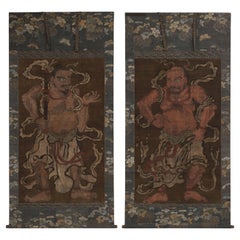
Pair of Japanese kakejiku 掛け軸 (hanging scrolls) depicting Niô guardians 仁王
Located in Amsterdam, NL
Pair of impressive, antique kakejiku (hanging scrolls) showcasing the awe-inspiring Niô guardians, also referred to as heavenly kings.
Each painting cap...
Category
Antique Early 18th Century Japanese Paintings and Screens
Materials
Brocade, Silk, Paint
$16,812 / set
Free Shipping
Still Thinking About These?
All Recently ViewedMore Ways To Browse
2 Panel Screen
Tea Screen
Asian Dragon Paintings
Japanese Dragon Painting
Japanese Dragon Screen
2 Panel Asian Screens
Antique 2 Panel Japanese Screens
Antique Japanese Tea Ceremony Paintings
Japanese Crane
Japanese Six Panel Screen
Paper Folded Art
Four Panel Painting
Japanese Lacquer Panels
Chinese Carved Screen
Kano School
Byobu Screens
Asian Black Screens
Japanese Folding Screen Screen