Want more images or videos?
Request additional images or videos from the seller
1 of 6
Japanese Lacquered Art Deco Screen of Herons
$6,500List Price
About the Item
- Dimensions:Height: 49.75 in (126.37 cm)Width: 38 in (96.52 cm)Depth: 1 in (2.54 cm)
- Style:Art Deco (Of the Period)
- Materials and Techniques:
- Place of Origin:
- Period:
- Date of Manufacture:1920s
- Condition:Condition report upon request.
- Seller Location:Hudson, NY
- Reference Number:Seller: NA7461stDibs: LU85511426422
About the Seller
5.0
Recognized Seller
These prestigious sellers are industry leaders and represent the highest echelon for item quality and design.
Established in 1971
1stDibs seller since 2008
170 sales on 1stDibs
Typical response time: 8 hours
Associations
The Art and Antique Dealers League of AmericaAntiques Associations Members
Authenticity Guarantee
In the unlikely event there’s an issue with an item’s authenticity, contact us within 1 year for a full refund. DetailsMoney-Back Guarantee
If your item is not as described, is damaged in transit, or does not arrive, contact us within 7 days for a full refund. Details24-Hour Cancellation
You have a 24-hour grace period in which to reconsider your purchase, with no questions asked.Vetted Professional Sellers
Our world-class sellers must adhere to strict standards for service and quality, maintaining the integrity of our listings.Price-Match Guarantee
If you find that a seller listed the same item for a lower price elsewhere, we’ll match it.Trusted Global Delivery
Our best-in-class carrier network provides specialized shipping options worldwide, including custom delivery.You May Also Like
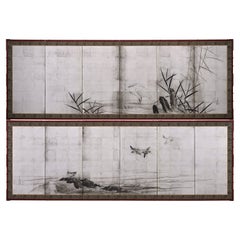
Japanese Silver Screen Pair, Meiji Period, Herons
Plovers, Shijo School
Located in Kyoto, JP
Heron & Plovers
Ink and silver leaf on paper
Maekawa Bunrei (1837-1917)
A pair of low six-panel Japanese screens by Maekawa Bunrei, a later master of the Kyoto based Shijo school of painting. On the right screen a solitary white heron stands motionless in a stream. On the left screen plovers play along a shoreline. The elegant forms are executed employing fluid, minimalistic ink brushstrokes. The soft brushstrokes and the sharp light of the silver leaf lend the scenes a sense of translucence. The sophisticated composition superbly exploits the long, horizontal pictorial surface of the pair of folding screens...
Category
Antique Early 1900s Japanese Meiji Paintings and Screens
Materials
Silver Leaf
$22,500 / set
H 35 in W 98 in D 0.75 in
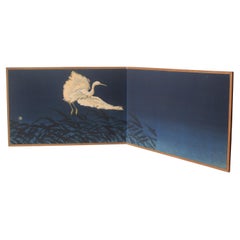
B79 Old Japanese Art a folding screen, Byobu 2panel, White Heron Dyed Fabric
Located in Niiza, JP
Material: fabric on wooden frame
One piece: W870×H580mm×D15mm,
Unfolded size: W1730mm
Folded size: W870×H580×D30mm, 3kg
Estimate packing size: (sandwiched with 5-10mm plywood): 10cm ...
Category
20th Century Japanese Paintings and Screens
Materials
Fabric
$550
H 22.84 in W 68.12 in D 0.79 in
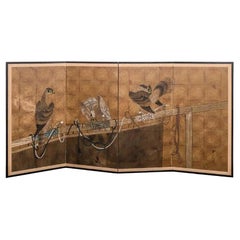
Japanese Art Deco 4-Panel Screen with Falcon, Ca. 1920
Located in New York, NY
Japanese Art Deco 4-Panel Screen with Falcon, Ca. 1920
DIMENSIONS
Height: 36.25 inches
Width: 71.25 inches
Category
Vintage 1920s Japanese Japonisme Paintings and Screens
Materials
Wood
Pair of Japanese Screens
Located in Schellebelle, BE
Exceptional pair of Japanese screens, 20th century
Six parts, six times 45 cm wide
Gold spotted paper with parts of old screens.
Category
Mid-20th Century Japanese Paintings and Screens
Materials
Paper
Chinoiserie Screen Art Deco Style in Colour China Red and Black Lacquer
Located in Hamburg, DE
Chinese Paravent, Art Deco style, China red lacker, main frame in black lacquer, base material wood, can be used as room divider as back side as a dec...
Category
Vintage 1920s Chinese Art Deco Lacquer
Materials
Wood
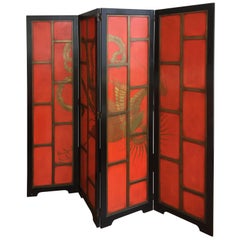
$16,526
H 70.87 in W 20.48 in D 1.19 in
Japanese Asian Signed Four Panel Folding Byobu Screen Herons in the Winter Snow
Located in Studio City, CA
A gorgeous four-panel Showa Period Japanese Byobu folding screen depicting a nature landscape scene with a group of Herons frolicking in the snow covered bare Winter branches of a la...
Category
Mid-20th Century Japanese Showa Paintings and Screens
Materials
Silver Leaf
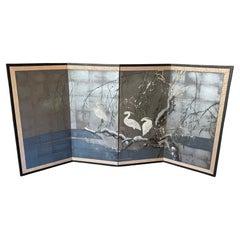
$2,995
H 36 in W 70.5 in D 0.5 in
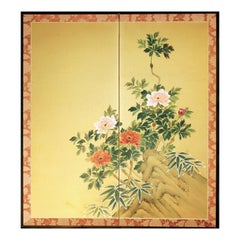
Japanese screen
By Japanese Studio
Located in Brescia, IT
Two-panel screen of Rinpa school painted with mineral pigments on silk and rice paper.
It depicts colorful peony flowers. This is the flower of spring, symbolizing success and pro...
Category
20th Century Japanese Showa Paintings and Screens
Materials
Silk, Paper
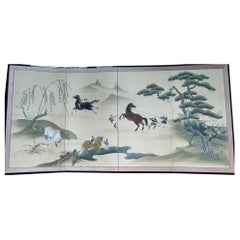
Japanese Art Deco 4-Panel Screen with Riders Taming Horses, Ca. 1960
Located in New York, NY
Japanese Art Deco 4-Panel Screen with Riders Taming Horses, Ca. 1960s
DIMENSIONS
Width: 97 inches
Height: 48 inches
Category
Late 20th Century Japanese Japonisme Paintings and Screens
Materials
Wood
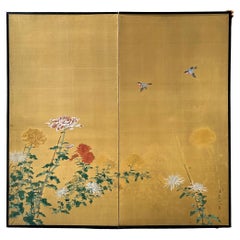
Japanese Screens: Echo of Chrysanthemums
Located in Fukuoka, JP
Echo of Chrysanthemums captures the quiet dialogue between form and reflection. Against a radiant gold-leaf ground, blooming chrysanthemums rise in graceful color harmony — white, cr...
Category
Antique 19th Century Japanese Edo Paintings and Screens
Materials
Gold Leaf
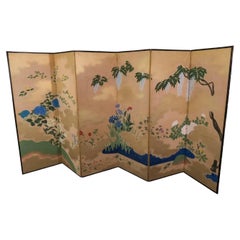
Japanese Meiji Period 6-Panel Screen w/ Blue Lacquered Flowers, Ca. 1900
Located in New York, NY
Japanese Meiji Period 6-Panel Screen w/ Blue Lacquered Flowers, Ca. 1900
Meiji Period (1868-1912)
DIMENSIONS
145” long x 69.5” high
Category
Antique Early 1900s Japanese Japonisme Paintings and Screens
Materials
Wood
$20,000
H 69.5 in W 145 in D 2 in
More From This Seller
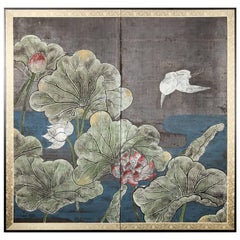
View AllJapanese Two Panel Screen, Lotus and Heron
Located in Hudson, NY
Japanese two panel screen, lotus and heron
Colored mineral pigments on silver leaf on handmade mulberry paper.
Category
Antique Late 19th Century Japanese Paintings and Screens
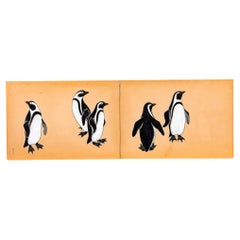
Japanese Two Panel Screen: Lacquer Penguins
Located in Hudson, NY
Beige ground lacquer with black and grey lacquer penguins with small pieces of shell making up white areas. Lacquer on wood. Writing reads: Lacquer Screen By Izumi Atsuhiko. It was ...
Category
Early 20th Century Japanese Paintings and Screens
Materials
Shell, Wood, Lacquer
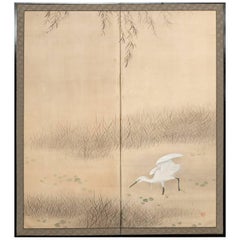
Japanese Two Panel Screen, Heron In Water Lily Pond Under Willow
Located in Hudson, NY
Japanese Screen painted with Heron In Water Lily Pond Under Willow. Meiji period (1868 - 1912) painting of a heron at pond's edge. Painted in min...
Category
Early 20th Century Japanese Meiji Paintings and Screens
Materials
Wood, Paper
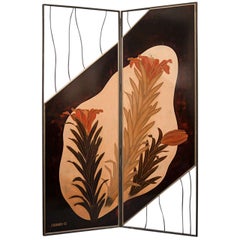
Japanese Lacquer Two-Panel Screen, Lily Flowers
Located in Hudson, NY
Painted lacquer on wood with bronze mounts.
Signature reads: Isawu-O.
Category
Early 20th Century Japanese Paintings and Screens
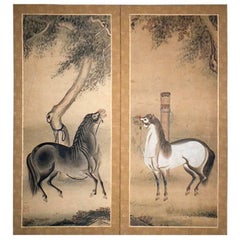
Japanese Screen Painting of Stallions
Located in Hudson, NY
Japanese two panel screen: Painting of stallions.
Kano school of painting.
Mineral pigments on mulberry paper.
Category
Antique 19th Century Japanese Paintings and Screens
Japanese Two Panel Screen Chrysanthemums Through the Mist Obara Art Screen
Located in Hudson, NY
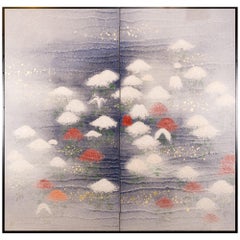
Japanese two panel screen: Chrysanthemums Through the Mist Obara Paper Art Screen. Surreal and masterful rendering of chrysanthemums cloaked in mist that varies in opacity made entirely of carefully arranged mulberry paper fibers in a Japanese art practice called Obara. Accented with gold leaf. Unique in terms of both execution and dreamlike mood. Made by Yamauchi Issei (b. 1929), stamped in the corner. Issei is well known throughout Japan as the leading artist in Obara Paper Art. Starting in 1948, he apprenticed with Fuji Tatsukichi, a leading proponent of the arts and crafts movement in Japan who worked to revive many cultural traditions on the brink of extinction. Issei started exhibiting in the Nitten in 1953, won the gold medal in 1963, and eventually became a juror. His artwork was given as a gift to the Showa Emperor of Japan, as well as dignitaries such as General Douglas MacArthur...
Category
Mid-20th Century Japanese Showa Paintings and Screens
Materials
Wood, Paper