Want more images or videos?
Request additional images or videos from the seller
1 of 7
Japanese Screen with Landscape in Gold Leaf
$17,999.36List Price
About the Item
- Dimensions:Height: 67.33 in (171 cm)Width: 148.82 in (378 cm)Depth: 0.79 in (2 cm)
- Style:Edo (Of the Period)
- Materials and Techniques:
- Place of Origin:
- Period:
- Date of Manufacture:circa 1860
- Condition:Wear consistent with age and use.
- Seller Location:Brescia, IT
- Reference Number:1stDibs: LU5628228066042
About the Seller
5.0
Recognized Seller
These prestigious sellers are industry leaders and represent the highest echelon for item quality and design.
Established in 1981
1stDibs seller since 2021
20 sales on 1stDibs
Authenticity Guarantee
In the unlikely event there’s an issue with an item’s authenticity, contact us within 1 year for a full refund. DetailsMoney-Back Guarantee
If your item is not as described, is damaged in transit, or does not arrive, contact us within 7 days for a full refund. Details24-Hour Cancellation
You have a 24-hour grace period in which to reconsider your purchase, with no questions asked.Vetted Professional Sellers
Our world-class sellers must adhere to strict standards for service and quality, maintaining the integrity of our listings.Price-Match Guarantee
If you find that a seller listed the same item for a lower price elsewhere, we’ll match it.Trusted Global Delivery
Our best-in-class carrier network provides specialized shipping options worldwide, including custom delivery.You May Also Like
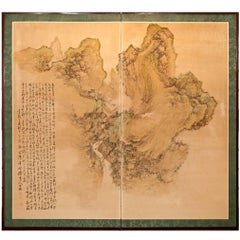
Japanese Two Panel Screen: Mountain Landscape with Calligraphy
Located in Hudson, NY
Japanese Two Panel Screen: Mountain Landscape with Calligraphy. Late Edo (c. 1850) painting of a dramatic mountainside carved by a waterfall with a crane flying in the foreground an...
Category
Antique Mid-19th Century Japanese Edo Paintings and Screens
Materials
Silk, Wood, Paper
Japanese Two Panel Screen: Trees in Floral Landscape
Located in Hudson, NY
Japanese Two Panel Screen: Trees in Floral Landscape, Edo period painting (mid 19th century) of pine and other trees amongst flowers, with bamboo shoots on the right panel, and white...
Category
Antique Mid-19th Century Japanese Paintings and Screens
Materials
Gold Leaf

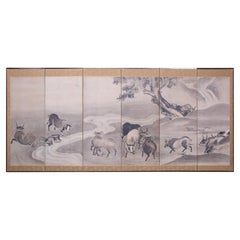
Japanese Six Panel Screen Bulls in a Gentle Landscape
Located in Hudson, NY
Sumi (ink) painting of bulls next to a stream with minimal colors on mulberry paper with silk brocade border.
Category
Antique 19th Century Japanese Paintings and Screens
Materials
Silk, Paper
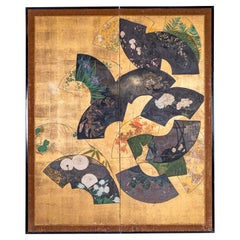
Japanese Two Panel Screen: Painted Fans on Gold Leaf
Located in Hudson, NY
Mineral pigments on gold leaf with brocade border. Calligraphy and sketching on back paper.
Category
Antique Late 19th Century Japanese Paintings and Screens
Materials
Gold Leaf
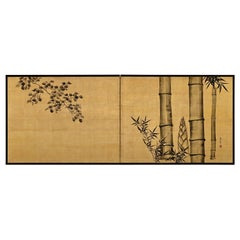
19th Century Japanese Screen for Tea-Ceremony, Ink Bamboo and Plum on Gold Leaf
Located in Kyoto, JP
Three Friends of Winter
Nakajima Raisho (1796-1871)
Late Edo period, circa 1850
Ink and gold leaf on paper.
This is a double-sided Japanese Furosaki or tea-ceremony screen from the mid 19th century; bamboo and plum on the front, young pines the back. It by Nakajima Raisho, a master painter of the Maruyama school in the late Edo and early Meiji periods. In this work Raisho combines exquisite ink brushwork with large open spaces of brilliant gold-leaf to inspire the viewers imagination. Rather than naturalism, he is searching for the phycological impression of the motifs, resulting in abstraction and stylization. His simplification of the motifs the result of looking to capture the inner nature of the objects. This art motif is known as Sho Chiku Bai, or the Three Friends of Winter. Evergreen pine connotes steadfastness, bamboo suggests both strength and flexibility, while plum blossoms unfurling on snow-laden branches imply hardiness. Combined, this trio is emblematic of Japanese new year. Chinese literati were the first to group the three plants together due to their noble characteristics. Like these resilient plants flowering so beautifully in winter, it was expected of the scholar-gentleman to cultivate a strong character with which he would be able to show the same degree of perseverance and steadfastness even during times of adverse conditions.
The screen would have been placed near the hearth of a room used for the Japanese tea ceremony, shielding the fire from draughts and also forming a stimulating and decorative backdrop behind the tea utensils. It would have been used in the Hatsugama, or first tea-ceremony of the new year.
Nakajima Raisho (1796-1871) originally studied under Watanabe Nangaku before entering the school of Maruyama Ozui. He was the highest ranking Maruyama school painter at the end of the Edo period and was known as one of the ‘Four Heian Families’ along with Kishi...
Category
Antique Mid-19th Century Japanese Edo Paintings and Screens
Materials
Gold Leaf
$9,200
H 29 in W 74 in D 0.75 in
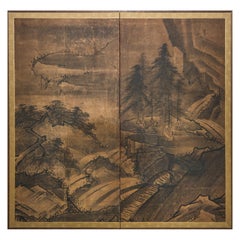
Japanese Two Panel Screen Suiboku Landscape in Sesshu Style
Located in Hudson, NY
Suiboku is a style of ink painting that is reminicent of the way calligraphers paint. Masterfully painted Muromachi Period (1336-1573) painting, unique in style and strength for the period with very bold lines. Sesshu Toyo...
Category
Antique 16th Century Japanese Paintings and Screens
Materials
Silk, Paper
Japanese Two-Panel Screen: Egrets in Japanese Red Pine with Gold Ground
Located in Hudson, NY
Seven graceful Egrets perched upon very vibrant pine. Representing strength, luck, and longevity. A harmonious balance in nature. Mineral pigments on Mulberry paper with dark brown ...
Category
Antique Late 19th Century Japanese Paintings and Screens
Materials
Lacquer, Paper
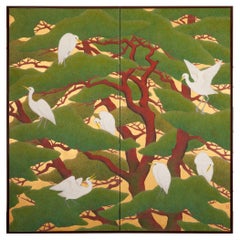
$28,750
H 70 in W 69.5 in D 0.75 in
Japanese Six-Panel Screen, Winter Landscape with Flowering Plum
Located in Hudson, NY
Japanese six-panel screen: Winter landscape with flowering plum, Meiji period (1868-1912) painting of a full moon with wild grasses between river's edge and a snow covered plum tree ...
Category
Early 20th Century Japanese Meiji Paintings and Screens
Materials
Gold Leaf
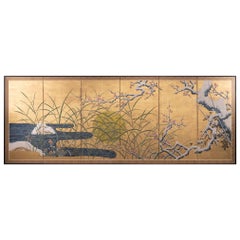
$43,700
H 41.63 in W 108.5 in D 0.75 in
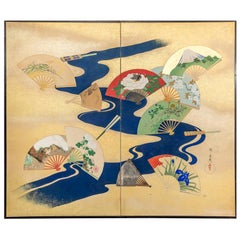
Japanese Two-Panel Screen, Deco Landscape with River Fans
Located in Hudson, NY
Japanese two-panel screen, deco landscape with river fans. Modern scene of a 12th century festival in Kyoto in which fans are sent down the Kamo River and caught downstream. Taisho (...
Category
Early 20th Century Japanese Taisho Paintings and Screens
Materials
Gold Leaf
Japanese Two Panel Screen Dragon in the Mist
Located in Hudson, NY
Ink (Sumi) on paper. Signature and Seal read: Kishi Ganku It is backed with paper covered in gold and silver flake. Kishi Ganku (1749 or 1756-1839) was the...
Category
Antique Early 19th Century Japanese Edo Paintings and Screens
Materials
Wood, Paper
More From This Seller
View AllJapanese Folding Screen Six Panels Painted on Gold Leaf
By Japanese Studio
Located in Brescia, IT
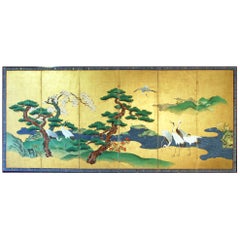
Paravento a sei pannelli di scuola giapponese Kano: paesaggio con bellissime ed eleganti gru vicino al fiume, con alberi di pino e sakura.
Dipinto a mano con pigmenti minerali ed inc...
Category
Antique Early 19th Century Japanese Edo Paintings and Screens
Materials
Gold Leaf
Japanese Screen Landscape on Gold Leaf with Inks
By Japanese Studio
Located in Brescia, IT
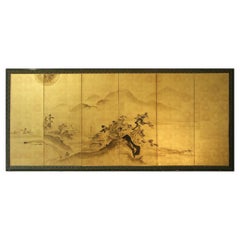
Six-panel screen from the Tosa school painted with ink on gold leaf depicting a relaxing oriental landscape with pagodas, figures on boats and a beautiful sun in the sky.
The screen ...
Category
Antique Late 19th Century Japanese Meiji Paintings and Screens
Materials
Gold Leaf
Japanese Folding Screen Gold Leaf
By Japanese Studio
Located in Brescia, IT
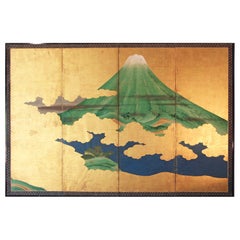
Byobu painted with mineral pigments on gold leaf, the quality of the painting is still excellent, with no color loss or restorations.
A classic four-panel screen depicting Mount Fuji...
Category
Antique Early 19th Century Japanese Edo Paintings and Screens
Materials
Gold Leaf
Japanese Folding Screens Gold Leaf
By Japanese Studio
Located in Brescia, IT
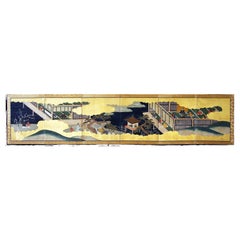
This Japanese six-panel Byobu screen, used for tea ceremonies, is a unique size and depicts scenes from the 11th-century Japanese literary classic "The Tales of Prince Genji."
Painte...
Category
Antique Mid-19th Century Japanese Edo Paintings and Screens
Materials
Gold Leaf
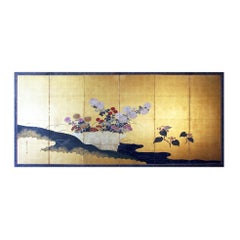
Japanese Byobu - Japanese Folding Screen Gold Leaf
By Japanese Studio
Located in Brescia, IT
Floral scene of a "Rimpa School" garden with polychrome chrysanthemum flowers.
Six-panel screen painted with pigments on golden rice paper of good size and well preserved.
Bold color...
Category
Antique Early 19th Century Japanese Edo Paintings and Screens
Materials
Gold Leaf
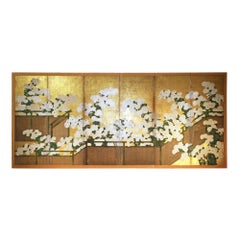
Japanese Screen mid Edo gold leaf
By Japanese Studio
Located in Brescia, IT
This 18th century six-panel screen is truly special. The author is unknown, but his singular genius in portraying dozens of chrysanthemum flowers created with the white of the "gofun...
Category
Antique Mid-18th Century Japanese Edo Paintings and Screens
Materials
Gold Leaf
Still Thinking About These?
All Recently ViewedMore Ways To Browse
Asian Antique Landscape Paintings
Antique Water Stand
Crane Screen
Japanese Silver Leaf Screen
Japanese Crane Screen
Japanese Screen Gold Landscape
Japanese Kano Screen
Kano School Screen
Japanese Screen Kano School
Asian Gold Leaf Panels With Cranes
Japanese Six Panel Screen Cranes
20th Japan Painting On Silk
Chinese Bird And Flowers Painting
Asian Art Scrolls
18th Century Screen
Antique Lacquer Painting
Scroll Painting Silk
Silk Japanese Scrolls