Want more images or videos?
Request additional images or videos from the seller
1 of 7
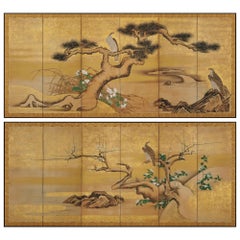
Japanese Screen Painting, Late 17th Century, Crows
Pine by Kano Chikanobu
Price:$17,200
$21,500List Price
About the Item
- Dimensions:Height: 65 in (165.1 cm)Width: 145 in (368.3 cm)Depth: 1 in (2.54 cm)
- Style:Edo (Of the Period)
- Materials and Techniques:
- Place of Origin:
- Period:Late 17th Century
- Date of Manufacture:circa 1700
- Condition:
- Seller Location:Kyoto, JP
- Reference Number:1stDibs: LU2472319346021
About the Seller
5.0
Recognized Seller
These prestigious sellers are industry leaders and represent the highest echelon for item quality and design.
Established in 2001
1stDibs seller since 2016
77 sales on 1stDibs
Typical response time: 5 hours
Authenticity Guarantee
In the unlikely event there’s an issue with an item’s authenticity, contact us within 1 year for a full refund. DetailsMoney-Back Guarantee
If your item is not as described, is damaged in transit, or does not arrive, contact us within 7 days for a full refund. Details24-Hour Cancellation
You have a 24-hour grace period in which to reconsider your purchase, with no questions asked.Vetted Professional Sellers
Our world-class sellers must adhere to strict standards for service and quality, maintaining the integrity of our listings.Price-Match Guarantee
If you find that a seller listed the same item for a lower price elsewhere, we’ll match it.Trusted Global Delivery
Our best-in-class carrier network provides specialized shipping options worldwide, including custom delivery.You May Also Like
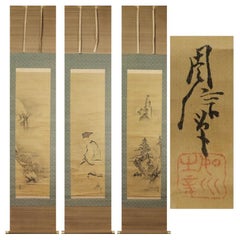
Japanese Painting 17th c Edo Scroll Triptyque Kano Chikanobu Buddhist Painting
Located in Amsterdam, Noord Holland
TheItem below was painted approximately 300 years ago by Kano Chikanobu. In the center is a depiction of a deer hermit, on the right is a landscape of a tower that gives a sense of ...
Category
Antique 17th Century Edo Paintings
Materials
Silk
$3,416 Sale Price
20% Off
H 78.75 in W 16.74 in D 0.04 in
17th Century Japanese Two-Panel Screen, Gibbons of Folklore
Located in Hudson, NY
Japanese two-panel screen: Gibbons of Folklore, Edo period (17th century) Kano School painting of gibbons in Japanese fables. The left panel represents a Japanese fable of a monkey a...
Category
Antique Late 17th Century Japanese Edo Paintings and Screens
Materials
Silk, Wood, Paper

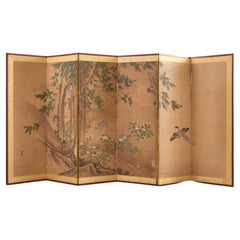
19th Century Japanese Edo Six Panel Kano School Landscape Screen
Located in Rio Vista, CA
Late Edo period 19th century Japanese six-panel landscape screen featuring a cypress tree over a flowering hibiscus with a pair of hototogisu birds. Kano school painted with ink and ...
Category
Antique 19th Century Japanese Edo Paintings and Screens
Materials
Silk, Wood, Paper
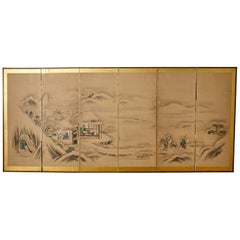
Japanese Six Panel Kano School Winter Landscape Screen
Located in Rio Vista, CA
Large Japanese Meiji period six-panel screen depicting a winter landscape with a Chinese sage visiting friends in a country villa. Ink and vivid color pigments on mulberry paper mounted to a gilt background. Painted in the 19th century Kano school...
Category
Antique 19th Century Japanese Meiji Paintings and Screens
Materials
Metal
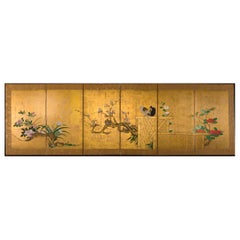
Japanese Six-Panel Screen Late Winter into Early Spring
Located in Hudson, NY
Japanese six-panel screen: Late winter into early spring, Rimpa style painting of a garden scene with doves on a bamboo fence. Flowers in bloom including ...
Category
Antique Early 19th Century Japanese Edo Paintings and Screens
Materials
Gold Leaf
Antique Japanese 17th c Edo Scroll Kano Yosanobu Buddhist Painting
Located in Amsterdam, Noord Holland
Eishin Kano's Ebisu/Great Country Map, double-width/comes with an old box.
The auspicious statues of Ebisu and Daikoku are standing in a double-width hanging scroll with a smiling fa...
Category
Antique 18th Century Edo Paintings
Materials
Silk
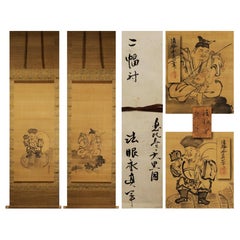
$3,416 Sale Price
20% Off
H 73.23 in W 20.67 in D 0.04 in
18th Century Japanese Two-Panel Screen Collection of Fans on Gold
Located in Hudson, NY
18th century Japanese Screen of a Collection of Fans. Paintings on fans depict famous Japanese painting subjects, this screen was most li...
Category
Antique 18th Century Japanese Edo Paintings and Screens
Materials
Gold Leaf

Japanese Six Panel Screen with Hotei, Edo Period, Early 19th Century
Located in Austin, TX
A delightful Japanese six panel painted paper screen featuring the beloved figure Hotei, Edo Period, early 19th century.
Hotei, called Budai in China, and known as the Laughing Buddha or Fat Buddha in the West, is considered to be an emanation of Maitreya, the Buddha of the Future.
In Japan, he also holds a special place as one of the Seven Lucky Gods, being the god of fortune, and protector of children.
He is always portrayed as a mirthful and corpulent man, dressed in loose robes that show off his round belly. He carries a sack with him, said to be filled with treasure. As the protector of children, he is often portrayed with them playing on or around him, as he is here. The children portrayed in this screen are dressed in Chinese style clothing...
Category
Antique Early 19th Century Japanese Edo Paintings and Screens
Materials
Silk, Paper
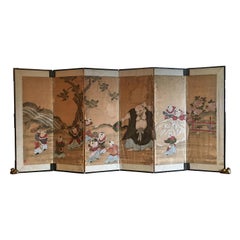
$6,500
H 54.5 in W 111 in D 0.75 in
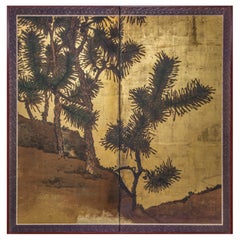
Japanese Two Panel Screen Young Pine and Pine Cones on Gold
Located in Hudson, NY
Mineral pigments on gold leaf on mulberry paper with a silk brocade border.
Category
Antique Early 1800s Japanese Paintings and Screens
Materials
Brocade, Silk, Paper
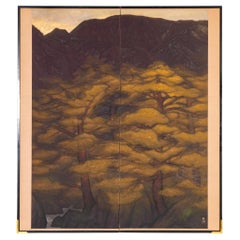
Japanese Two Panel Screen: Pine and Mountain Landscape By Muta Akira
Located in Hudson, NY
By rivers edge at sunrise. By: Muta Akira. Mica paint on canvas. Exhibited in the 1960 Nitten exhibition.
Category
Mid-20th Century Japanese Paintings and Screens
Materials
Canvas
More From This Seller
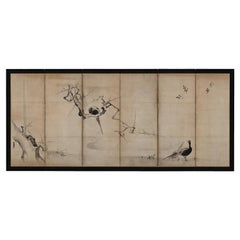
View All17th Century Japanese Screen. Ink Plum Tree
Birds by Kano Naonobu.
Located in Kyoto, JP
Kano Naonobu (1607-1650)
Plum Tree and Birds
Six-fold Japanese Screen. Ink and slight color on paper.
In this evocative ink work spread over a six-panel folding screen, we see the consummation of the elegance and refinement of the Edo Kano school. This 17th century screen is a rare surviving example of a large-scale bird and flower painting by Kano Naonobu, the younger brother of Kano Tanyu...
Category
Antique 17th Century Japanese Edo Paintings and Screens
Materials
Wood, Paper
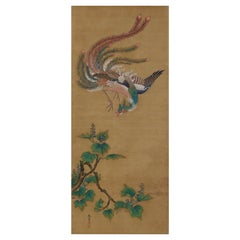
19th Century Japanese Silk Painting by Kano Chikanobu, Phoenix
Paulownia
Located in Kyoto, JP
Birds & Flowers of the seasons
Pheasants & Plum in Snow
Unframed painting. Ink, pigment and gofun on silk
Kano Chikanobu 1819-1888
Signature...
Category
Antique Mid-19th Century Asian Edo Paintings and Screens
Materials
Silk
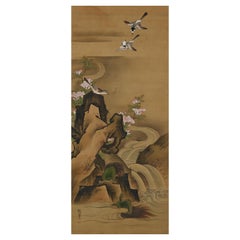
19th Century Japanese Silk Painting by Kano Chikanobu, Turtles
Azalea
Located in Kyoto, JP
Birds & flowers of the seasons
Pheasants & plum in snow
Unframed painting. Ink, pigment and gofun on silk
Kano Chikanobu 1819-1888
Signature...
Category
Antique Mid-19th Century Asian Edo Paintings and Screens
Materials
Silk
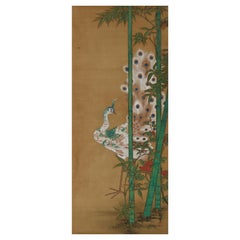
19th Century Japanese Silk Painting by Kano Chikanobu, Peacock
Bamboo
Located in Kyoto, JP
Birds & Flowers of the Seasons
Pheasants & Plum in Snow
Unframed painting. Ink, pigment and gofun on silk
Kano Chikanobu 1819-1888
Signature...
Category
Antique Mid-19th Century Asian Edo Paintings and Screens
Materials
Silk
17th Century Japanese Screen Pair by Soga Nichokuan, Hawks on Pine
Plum Trees
Located in Kyoto, JP
Hawks on plum and pine
Soga Nichokuan (active circa 1625-1660)
Pair of six-fold screens.
Ink, mineral pigments, gofun, gold and speckled gold l...
Category
Antique 1640s Japanese Edo Paintings and Screens
Materials
Wood, Paper
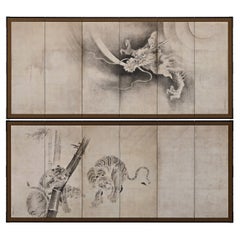
17th Century Japanese Screen Pair. Tiger
Dragon by Kaiho Yusetsu
Located in Kyoto, JP
Kaiho Yusetsu (1598-1677)
Tiger and Dragon
Early Edo Period, Circa 1650
A Pair of Six-fold Japanese Screens. Ink and slight color on paper.
Dimensions:
Each screen: H. 171 cm x W. 380 cm (67.5’’ x 149.5’’)
In this pair of early Edo period Japanese screens a group of tigers prowl in a bamboo grove whipped with fierce wind, while a dragon claws through clouds and mist. The dragon embodies elemental qualities - looming out of the mist, the coils of its body disappearing in the clouds. The dragon is calling for rain, symbolizing spring which is considered the fountain of life. On the other side, the tigers calls for the wind, symbolizing autumn which is considered the end of life. Tigers were familiar motifs within Japanese art from ancient times though the animals were imaginary to the people in the 17th century. While dragons and tigers are usually associated as sacred and ferocious, in this painting, both animals have rather amusing expressions. The tigers appear to glare at the dragon with cat-like eyes, and the look on the swirling dragon’s face appears almost affectionate - lending a playful flair to an otherwise magnificent theme.
The tiger and dragon are cosmological symbols of the balancing forces in the world. Screens such as this were originally meant to express the fluctuating nature of the world. For Japanese in the early Edo period, they likely suggested the powers of the cosmos. In Japan the tiger and dragon motif was originally absorbed into the circles of Zen monasteries before spreading into the secular world. The theme especially appealed to the military classes with the Kano school, the official painters to the Shogun and the samurai, being the leading contributors. The painter of this pair of screens, Kaiho Yusetsu (1598-1677), was closely patronized by the third Shogun Tokugawa Iemitsu. In his later years he worked with Kano school artists...
Category
Antique Mid-17th Century Japanese Edo Paintings and Screens
Materials
Silk, Wood, Paper
Still Thinking About These?
All Recently ViewedMore Ways To Browse
Fabrice Dupre
Ge Ba Textiles
Ge Ba
Japanese Fox Screen
Japanese Herons On Silk
Japanese Rice Paper Art
Kudzu Vine
Scroll Painting Buddha
Wah Cheong
Wabi Sabi Screen
18th C Japanese Screen
Mori Tetsuzan
Rajasthan Painted Screen
Silk Embroidered Byobu
Suzuki Shonen
Tiger Art On Silk
6 Panel Showa Screen
Antique 2 Panel Chinese Screen