Want more images or videos?
Request additional images or videos from the seller
1 of 8
Japanese Two-Panel Screen Chrysanthemums Over a Woven Reed Fence
$15,000List Price
About the Item
- Dimensions:Height: 64.25 in (163.2 cm)Width: 65.5 in (166.37 cm)Depth: 0.75 in (1.91 cm)
- Style:Edo (Of the Period)
- Materials and Techniques:
- Place of Origin:
- Period:
- Date of Manufacture:circa 1850
- Condition:Most items that are 100 years old have been cleaned or polished in their lifetime. More involved restorations are mentioned in the above description. For a detailed condition report and a video of this item please contact us directly. -Naga Antiques.
- Seller Location:Hudson, NY
- Reference Number:Seller: S13961stDibs: LU855120625012
About the Seller
5.0
Recognized Seller
These prestigious sellers are industry leaders and represent the highest echelon for item quality and design.
Established in 1971
1stDibs seller since 2008
170 sales on 1stDibs
Typical response time: 8 hours
Associations
The Art and Antique Dealers League of AmericaAntiques Associations Members
Authenticity Guarantee
In the unlikely event there’s an issue with an item’s authenticity, contact us within 1 year for a full refund. DetailsMoney-Back Guarantee
If your item is not as described, is damaged in transit, or does not arrive, contact us within 7 days for a full refund. Details24-Hour Cancellation
You have a 24-hour grace period in which to reconsider your purchase, with no questions asked.Vetted Professional Sellers
Our world-class sellers must adhere to strict standards for service and quality, maintaining the integrity of our listings.Price-Match Guarantee
If you find that a seller listed the same item for a lower price elsewhere, we’ll match it.Trusted Global Delivery
Our best-in-class carrier network provides specialized shipping options worldwide, including custom delivery.You May Also Like
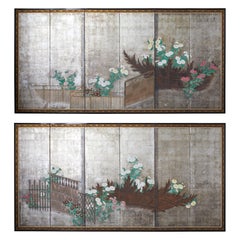
Pair of Six Panel Japanese Edo Screens Chrysanthemums Along Fence
Located in Rio Vista, CA
Remarkable pair of early 19th century Japanese late Edo period screens depicting summer chrysanthemums growing along a brushwood fence. Ink and...
Category
Antique 19th Century Japanese Edo Paintings and Screens
Materials
Silver Leaf
$26,000 / set
H 68.5 in W 138 in D 0.75 in
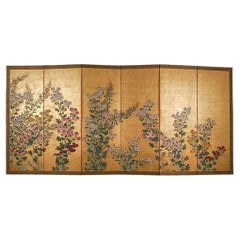
Japanese Six-Panel Screen Byobu With Chrysanthemums And Autumn Grass and Flower
Located in Torino, IT
The 19th Century Six-Panel Japanese folding screen "Byōbu" usually used in the most important Japanese house to stop wind and also to separate different space of the same big room de...
Category
Antique Mid-19th Century Japanese Edo Paintings and Screens
Materials
Gold Leaf
$24,019
H 69.29 in W 143.3 in D 0.5 in
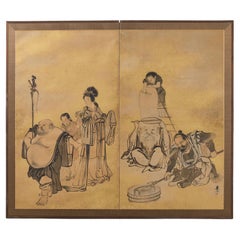
Japanese Edo Two Panel Screen Deities by Yokoyama Kazan
Located in Rio Vista, CA
Whimsical Japanese late Edo period two-panel screen circa 1800 by Yokoyama Kazan (Japanese 1784-1837). The screen depicts four of the seven Gods or deities ...
Category
Antique 19th Century Japanese Edo Paintings and Screens
Materials
Brass, Gold Leaf
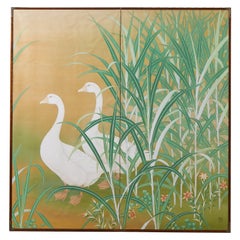
Japanese Meiji Two Panel Screen Geese and Reeds
Located in Rio Vista, CA
Fantastic Japanese late Meiji period two-panel byobu screen by Hashimoto Koshu. The large screen features two white geese amid brightly colored reeds. The symbolism of geese and reeds was introduced to Japan from China in the 13th century. This was a popular subject for Japanese zen artists of the period. Beautifully crafted with exceptional brush strokes and details. Made with natural pigments in dramatic vivid colors of white, pink, and mint green on a silk background of gilt. Circa 1900 with artist seal on bottom right corner. Koshu studied Western art under...
Category
20th Century Japanese Meiji Paintings and Screens
Materials
Silk, Wood, Paper
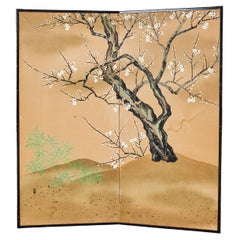
Japanese Showa Two Panel Screen Blossoming Prunus Tree
Located in Rio Vista, CA
Serene Japanese Showa period two-panel folding byobu screen depicting a large spring blossoming prunus tree or plum tree. Beautifully painted with ink and natural color pigments on m...
Category
20th Century Japanese Showa Paintings and Screens
Materials
Brass
Mid-18th Century Japanese Screen Pair, One Hundred Flowers, Chrysanthemums
Located in Kyoto, JP
Omori Soun (b. 1704)
Chrysanthemums - One Hundred Flowers
A Pair of Six-fold Japanese Screens. Ink, color, gofun and gold leaf on paper.
Dating ...
Category
Antique Mid-18th Century Japanese Edo Paintings and Screens
Materials
Gold Leaf
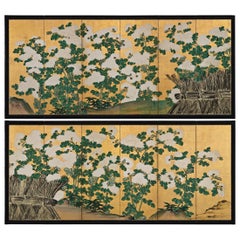
$48,000 / set
H 67.5 in W 149 in D 0.75 in
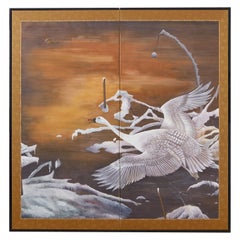
Japanese Style Two-Panel Screen Winter Goose in Flight
Located in Rio Vista, CA
Dramatic Showa period two panel folding byobu screen depicting a large white goose in flight in an evening snow covered winter landscape. Made in the American school style watercolor...
Category
20th Century Showa Paintings and Screens
Materials
Brass
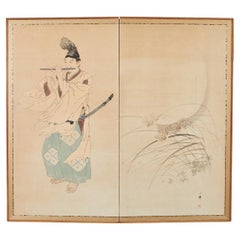
Japanese Taisho Two Panel Screen Heian Period Flute Player
Located in Rio Vista, CA
Extraordinary Japanese Taisho period two panel byobu screen depicting Fujiwara Yasumasa playing the flute in the Ichihara Moor. Fujiwara Yasumasa (958 to 1036) was a famous Heian period...
Category
20th Century Japanese Taisho Paintings and Screens
Materials
Silk, Wood, Paper
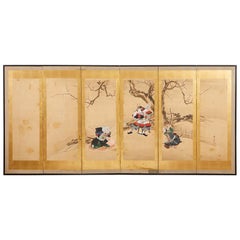
Japanese Edo Six Panel Screen Yoshitsune and Benkei
Located in Rio Vista, CA
Spectacular 19th century Japanese late Edo period six-panel byobu screen depicting Yoshitsune and Benkei, two heroes of Japanese folklore. Crafted in ink and natural color pigments on mulberry paper with thick gold leaf borders on each panel. The character Yoshitsune is seated under a blossoming cherry tree in full armor holding a fan. The warrior priest or monk Benkei is depicted kneeling on a leopard skin...
Category
Antique 19th Century Japanese Edo Paintings and Screens
Materials
Brass, Gold Leaf
$3,400 Sale Price
29% Off
H 66 in W 139.5 in D 0.5 in
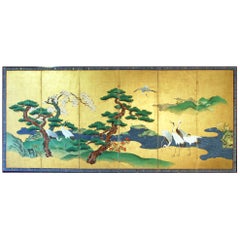
Japanese Folding Screen Six Panels Painted on Gold Leaf
By Japanese Studio
Located in Brescia, IT
Paravento a sei pannelli di scuola giapponese Kano: paesaggio con bellissime ed eleganti gru vicino al fiume, con alberi di pino e sakura.
Dipinto a mano con pigmenti minerali ed inc...
Category
Antique Early 19th Century Japanese Edo Paintings and Screens
Materials
Gold Leaf
More From This Seller
View AllJapanese Two Panel Screen, Chrysanthemums
Located in Hudson, NY
Beautiful white chrysanthemums are emphasized by heavy gold on a soft floral landscape, while gold clouds create a striking and dream-like floral scene. Gold leaf and gofun with min...
Category
Antique Early 18th Century Japanese Paintings and Screens
Materials
Gold, Gold Leaf
Japanese Two Panel Screen: Chrysanthemums Over Twig Fence
Located in Hudson, NY
Mineral pigment and gold dust on mulberry paper. Silk brocade border and black lacquer trim. From the collection of Moke Mokotoff
Category
Antique Late 19th Century Japanese Paintings and Screens
Materials
Gold
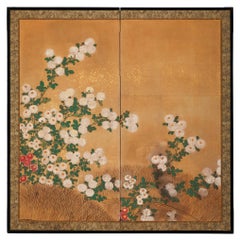
Japanese Two Panel Screen: Simple Chrysanthemums on Gold
Located in Hudson, NY
Mineral pigments on gold leaf. Not signed, by: Baikei Hitsu.
Category
Antique 1880s Japanese Paintings and Screens
Materials
Gold Leaf
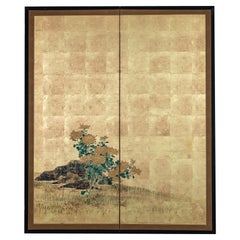
Japanese Two Panel Screen Chrysanthemums Through the Mist Obara Art Screen
Located in Hudson, NY
Japanese two panel screen: Chrysanthemums Through the Mist Obara Paper Art Screen. Surreal and masterful rendering of chrysanthemums cloaked in mist that varies in opacity made entirely of carefully arranged mulberry paper fibers in a Japanese art practice called Obara. Accented with gold leaf. Unique in terms of both execution and dreamlike mood. Made by Yamauchi Issei (b. 1929), stamped in the corner. Issei is well known throughout Japan as the leading artist in Obara Paper Art. Starting in 1948, he apprenticed with Fuji Tatsukichi, a leading proponent of the arts and crafts movement in Japan who worked to revive many cultural traditions on the brink of extinction. Issei started exhibiting in the Nitten in 1953, won the gold medal in 1963, and eventually became a juror. His artwork was given as a gift to the Showa Emperor of Japan, as well as dignitaries such as General Douglas MacArthur...
Category
Mid-20th Century Japanese Showa Paintings and Screens
Materials
Wood, Paper
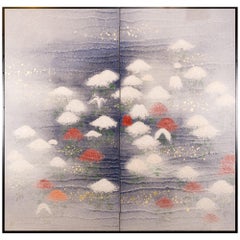
Japanese Two-Panel Screen Peony and Cherry
Located in Hudson, NY
Japanese two-panel screen: Peony and Cherry, Edo period (circa 1800) painting, formerly fusuma (Japanese sliding doors), executed in the Kano school style, featuring a cherry tree in...
Category
Antique Early 1800s Japanese Edo Paintings and Screens
Materials
Gold Leaf
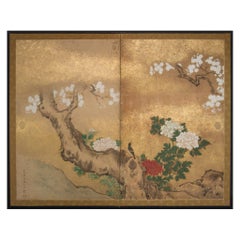
Japanese Two-Panel Screen, Rimpa Style Chrysanthemums on a Twig Fence
Located in Hudson, NY
Detailed painting of varieties of chrysanthemums behind a bound-twig garden fence rendered in silvered, raised gofun. Stylized low-hanging gold mist clouds. Rimpa-style painting in m...
Category
Antique Late 19th Century Japanese Paintings and Screens
Materials
Gold
Still Thinking About These?
All Recently ViewedMore Ways To Browse
Fence Wood
Japanese Silver Leaf Screen
Japanese Screen Chrysanthemums
Antique Fence Panels
Silver Chrysanthemum Japanese
Japanese Reed Screens
Antique Chinese Screens
Asian Silk Paintings Antique
Antique Silk Screen Painting
19th Century Japanese Screen
20th Century Japanese Screens
Hand Painted Japanese Screen
Japanese Gold Leaf
Antique Chinese Panel
Chinese Screen Painted
Japan Gold Painting
Japanese Gold Paintings
Antique Japanese Silk Screen