Want more images or videos?
Request additional images or videos from the seller
1 of 9
Japanese Two Panel Screen: Dragon, Ink on Gold
$28,000List Price
About the Item
- Attributed to:Kanoh Morinori (Artist)
- Dimensions:Height: 64.75 in (164.47 cm)Width: 72.75 in (184.79 cm)Depth: 1.5 in (3.81 cm)
- Style:Edo (Of the Period)
- Materials and Techniques:
- Place of Origin:
- Period:
- Date of Manufacture:18th Century
- Condition:Condition report on request.
- Seller Location:Hudson, NY
- Reference Number:Seller: S11341stDibs: U1003218551294
About the Seller
5.0
Recognized Seller
These prestigious sellers are industry leaders and represent the highest echelon for item quality and design.
Established in 1971
1stDibs seller since 2008
170 sales on 1stDibs
Typical response time: 8 hours
Associations
The Art and Antique Dealers League of AmericaAntiques Associations Members
Authenticity Guarantee
In the unlikely event there’s an issue with an item’s authenticity, contact us within 1 year for a full refund. DetailsMoney-Back Guarantee
If your item is not as described, is damaged in transit, or does not arrive, contact us within 7 days for a full refund. Details24-Hour Cancellation
You have a 24-hour grace period in which to reconsider your purchase, with no questions asked.Vetted Professional Sellers
Our world-class sellers must adhere to strict standards for service and quality, maintaining the integrity of our listings.Price-Match Guarantee
If you find that a seller listed the same item for a lower price elsewhere, we’ll match it.Trusted Global Delivery
Our best-in-class carrier network provides specialized shipping options worldwide, including custom delivery.You May Also Like
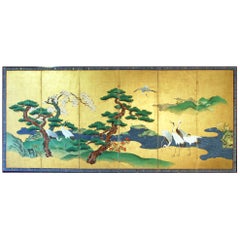
Japanese Folding Screen Six Panels Painted on Gold Leaf
By Japanese Studio
Located in Brescia, IT
Paravento a sei pannelli di scuola giapponese Kano: paesaggio con bellissime ed eleganti gru vicino al fiume, con alberi di pino e sakura.
Dipinto a mano con pigmenti minerali ed inc...
Category
Antique Early 19th Century Japanese Edo Paintings and Screens
Materials
Gold Leaf
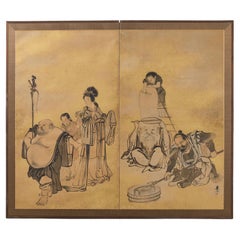
Japanese Edo Two Panel Screen Deities by Yokoyama Kazan
Located in Rio Vista, CA
Whimsical Japanese late Edo period two-panel screen circa 1800 by Yokoyama Kazan (Japanese 1784-1837). The screen depicts four of the seven Gods or deities ...
Category
Antique 19th Century Japanese Edo Paintings and Screens
Materials
Brass, Gold Leaf
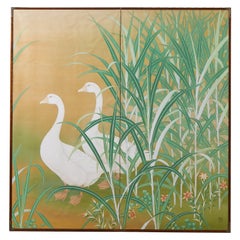
Japanese Meiji Two Panel Screen Geese and Reeds
Located in Rio Vista, CA
Fantastic Japanese late Meiji period two-panel byobu screen by Hashimoto Koshu. The large screen features two white geese amid brightly colored reeds. The symbolism of geese and reeds was introduced to Japan from China in the 13th century. This was a popular subject for Japanese zen artists of the period. Beautifully crafted with exceptional brush strokes and details. Made with natural pigments in dramatic vivid colors of white, pink, and mint green on a silk background of gilt. Circa 1900 with artist seal on bottom right corner. Koshu studied Western art under...
Category
20th Century Japanese Meiji Paintings and Screens
Materials
Silk, Wood, Paper
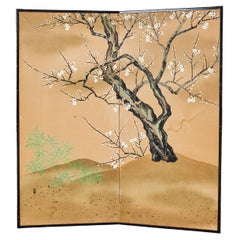
Japanese Showa Two Panel Screen Blossoming Prunus Tree
Located in Rio Vista, CA
Serene Japanese Showa period two-panel folding byobu screen depicting a large spring blossoming prunus tree or plum tree. Beautifully painted with ink and natural color pigments on m...
Category
20th Century Japanese Showa Paintings and Screens
Materials
Brass
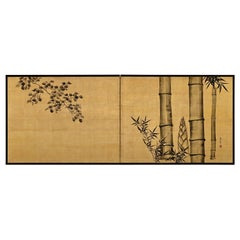
19th Century Japanese Screen for Tea-Ceremony, Ink Bamboo and Plum on Gold Leaf
Located in Kyoto, JP
Three Friends of Winter
Nakajima Raisho (1796-1871)
Late Edo period, circa 1850
Ink and gold leaf on paper.
This is a double-sided Japanese Furosaki or tea-ceremony screen from the mid 19th century; bamboo and plum on the front, young pines the back. It by Nakajima Raisho, a master painter of the Maruyama school in the late Edo and early Meiji periods. In this work Raisho combines exquisite ink brushwork with large open spaces of brilliant gold-leaf to inspire the viewers imagination. Rather than naturalism, he is searching for the phycological impression of the motifs, resulting in abstraction and stylization. His simplification of the motifs the result of looking to capture the inner nature of the objects. This art motif is known as Sho Chiku Bai, or the Three Friends of Winter. Evergreen pine connotes steadfastness, bamboo suggests both strength and flexibility, while plum blossoms unfurling on snow-laden branches imply hardiness. Combined, this trio is emblematic of Japanese new year. Chinese literati were the first to group the three plants together due to their noble characteristics. Like these resilient plants flowering so beautifully in winter, it was expected of the scholar-gentleman to cultivate a strong character with which he would be able to show the same degree of perseverance and steadfastness even during times of adverse conditions.
The screen would have been placed near the hearth of a room used for the Japanese tea ceremony, shielding the fire from draughts and also forming a stimulating and decorative backdrop behind the tea utensils. It would have been used in the Hatsugama, or first tea-ceremony of the new year.
Nakajima Raisho (1796-1871) originally studied under Watanabe Nangaku before entering the school of Maruyama Ozui. He was the highest ranking Maruyama school painter at the end of the Edo period and was known as one of the ‘Four Heian Families’ along with Kishi...
Category
Antique Mid-19th Century Japanese Edo Paintings and Screens
Materials
Gold Leaf
$9,200
H 29 in W 74 in D 0.75 in
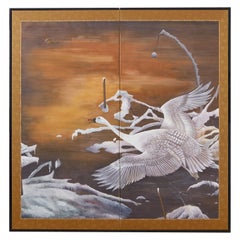
Japanese Style Two-Panel Screen Winter Goose in Flight
Located in Rio Vista, CA
Dramatic Showa period two panel folding byobu screen depicting a large white goose in flight in an evening snow covered winter landscape. Made in the American school style watercolor...
Category
20th Century Showa Paintings and Screens
Materials
Brass
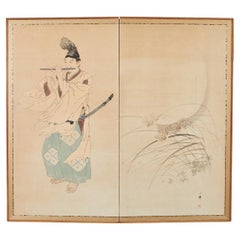
Japanese Taisho Two Panel Screen Heian Period Flute Player
Located in Rio Vista, CA
Extraordinary Japanese Taisho period two panel byobu screen depicting Fujiwara Yasumasa playing the flute in the Ichihara Moor. Fujiwara Yasumasa (958 to 1036) was a famous Heian period...
Category
20th Century Japanese Taisho Paintings and Screens
Materials
Silk, Wood, Paper
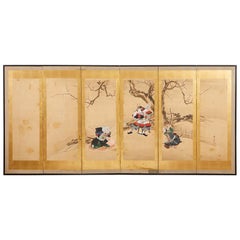
Japanese Edo Six Panel Screen Yoshitsune and Benkei
Located in Rio Vista, CA
Spectacular 19th century Japanese late Edo period six-panel byobu screen depicting Yoshitsune and Benkei, two heroes of Japanese folklore. Crafted in ink and natural color pigments on mulberry paper with thick gold leaf borders on each panel. The character Yoshitsune is seated under a blossoming cherry tree in full armor holding a fan. The warrior priest or monk Benkei is depicted kneeling on a leopard skin...
Category
Antique 19th Century Japanese Edo Paintings and Screens
Materials
Brass, Gold Leaf
$3,400 Sale Price
29% Off
H 66 in W 139.5 in D 0.5 in
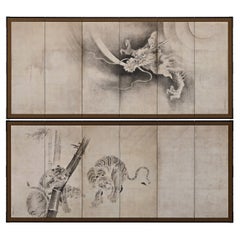
17th Century Japanese Screen Pair. Tiger
Dragon by Kaiho Yusetsu
Located in Kyoto, JP
Kaiho Yusetsu (1598-1677)
Tiger and Dragon
Early Edo Period, Circa 1650
A Pair of Six-fold Japanese Screens. Ink and slight color on paper.
Dimensions:
Each screen: H. 171 cm x W. 380 cm (67.5’’ x 149.5’’)
In this pair of early Edo period Japanese screens a group of tigers prowl in a bamboo grove whipped with fierce wind, while a dragon claws through clouds and mist. The dragon embodies elemental qualities - looming out of the mist, the coils of its body disappearing in the clouds. The dragon is calling for rain, symbolizing spring which is considered the fountain of life. On the other side, the tigers calls for the wind, symbolizing autumn which is considered the end of life. Tigers were familiar motifs within Japanese art from ancient times though the animals were imaginary to the people in the 17th century. While dragons and tigers are usually associated as sacred and ferocious, in this painting, both animals have rather amusing expressions. The tigers appear to glare at the dragon with cat-like eyes, and the look on the swirling dragon’s face appears almost affectionate - lending a playful flair to an otherwise magnificent theme.
The tiger and dragon are cosmological symbols of the balancing forces in the world. Screens such as this were originally meant to express the fluctuating nature of the world. For Japanese in the early Edo period, they likely suggested the powers of the cosmos. In Japan the tiger and dragon motif was originally absorbed into the circles of Zen monasteries before spreading into the secular world. The theme especially appealed to the military classes with the Kano school, the official painters to the Shogun and the samurai, being the leading contributors. The painter of this pair of screens, Kaiho Yusetsu (1598-1677), was closely patronized by the third Shogun Tokugawa Iemitsu. In his later years he worked with Kano school artists...
Category
Antique Mid-17th Century Japanese Edo Paintings and Screens
Materials
Silk, Wood, Paper
$78,000 / set
H 67.5 in W 149.5 in D 0.75 in
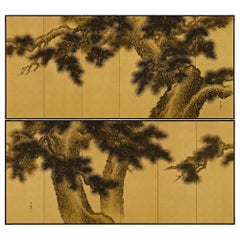
Early 20th Century Japanese Screen Pair - Ink Pine Trees on Gold
Located in Kyoto, JP
Imao Keisho (1902-1993)
Pine Trees
Early 20th Century, Circa 1930
Pair of six-panel Japanese screens. Ink on silk and gold leaf.
Dimensions: Each screen H. 67.5” x 148” (172 cm x 376 cm)
A pair of monumental six-panel Japanese pine screens by the renowned Nihonga artist Imao Keisho. Here Keisho entirely removed the background and brought the pine trees to the surface of the painting. This simplification of the elements makes the scene exceptionally direct and compelling and injects a very modern...
Category
Early 20th Century Japanese Showa Paintings and Screens
Materials
Gold Leaf
More From This Seller
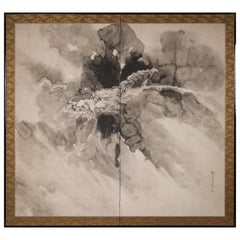
View AllJapanese Two Panel Screen Dragon in the Mist
Located in Hudson, NY
Ink (Sumi) on paper. Signature and Seal read: Kishi Ganku It is backed with paper covered in gold and silver flake. Kishi Ganku (1749 or 1756-1839) was the...
Category
Antique Early 19th Century Japanese Edo Paintings and Screens
Materials
Wood, Paper
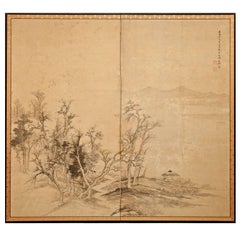
Japanese Two-Panel Screen: Ink Landscape on Silk
By Shunyu
Located in Hudson, NY
Japanese Two Panel Screen: Ink Landscape on Silk, Meiji period (1868 - 1912) painting of a man riding a mule on a pathway through the Kurotani mountains with a thatched roof shelter ...
Category
Antique 19th Century Japanese Meiji Paintings and Screens
Materials
Silk, Wood
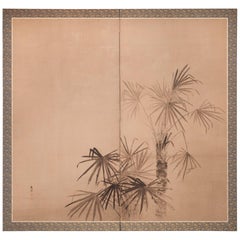
Japanese Two-Panel Screen Ink Painting of Palm Trees on Paper
Located in Hudson, NY
Japanese two-panel screen: ink painting of Palm Trees on paper, Edo period (1787) beautiful painting of Japanese windmill palm trees. Ink paint...
Category
Antique 18th Century Japanese Edo Paintings and Screens
Materials
Silk, Wood, Paper
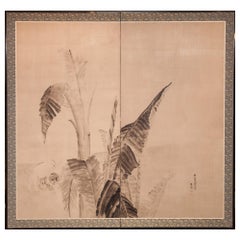
Japanese Two Panel Screen Ink Painting of Banana Leaves on Mulberry Paper
Located in Hudson, NY
Edo period (dated 1787) beautiful painting of unfurling palm leaves with romping puppies in the background. Ink painting (sumi-e) on mulberry paper. Signature reads: Okyo. Calligraph...
Category
Antique Late 18th Century Japanese Edo Paintings and Screens
Materials
Paper
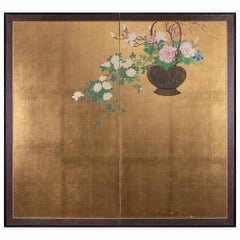
Japanese Two-Panel Screen Ikebana on Gold
Located in Hudson, NY
Japanese two-panel screen: Ikebana on gold. Meiji period (1868-1912) painting of a basket with beautifully arranged spring flowers in the style of ikebana (Japanese traditional flowe...
Category
Antique Late 19th Century Japanese Meiji Paintings and Screens
Materials
Gold Leaf
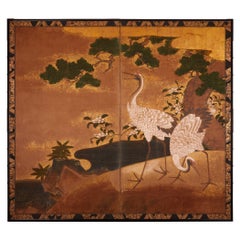
Japanese Two-Panel Screen: Cranes on Gold
Located in Hudson, NY
Early Kano School painting of pine trees overlooking two beautifully painted cranes and floral design in a natural setting by water’s edge. Mineral pig...
Category
Antique Late 18th Century Japanese Paintings and Screens
Materials
Gold, Gold Leaf
Still Thinking About These?
All Recently ViewedMore Ways To Browse
18th Century Japanese Silk Painting
Asian Dragon Paintings
Gold Leaf Dragon
Japanese Dragon Painting
Japanese Dragon Screen
Used Lattice Panels
Antique Japanese Lacquer Screens
Japanese Meiji Panel
Coromandel Lacquer
18th Century Japanese Screens
Calligraphy
Mineral Pigments On Silk
Chinese Silk Screen
Japanese Silver Leaf
Antique Brass Painting
Vintage Asian Painting
Coromandel Panel
Asian Painted Scrolls