Items Similar to Japanese Two Panel Screen Dragon in the Mist


Want more images or videos?
Request additional images or videos from the seller
1 of 12
Japanese Two Panel Screen Dragon in the Mist
$43,700
£33,032.14
€37,889.24
CA$60,919.60
A$66,315.95
CHF 35,200.53
MX$797,923.63
NOK 446,038.65
SEK 408,697.45
DKK 282,954.55
About the Item
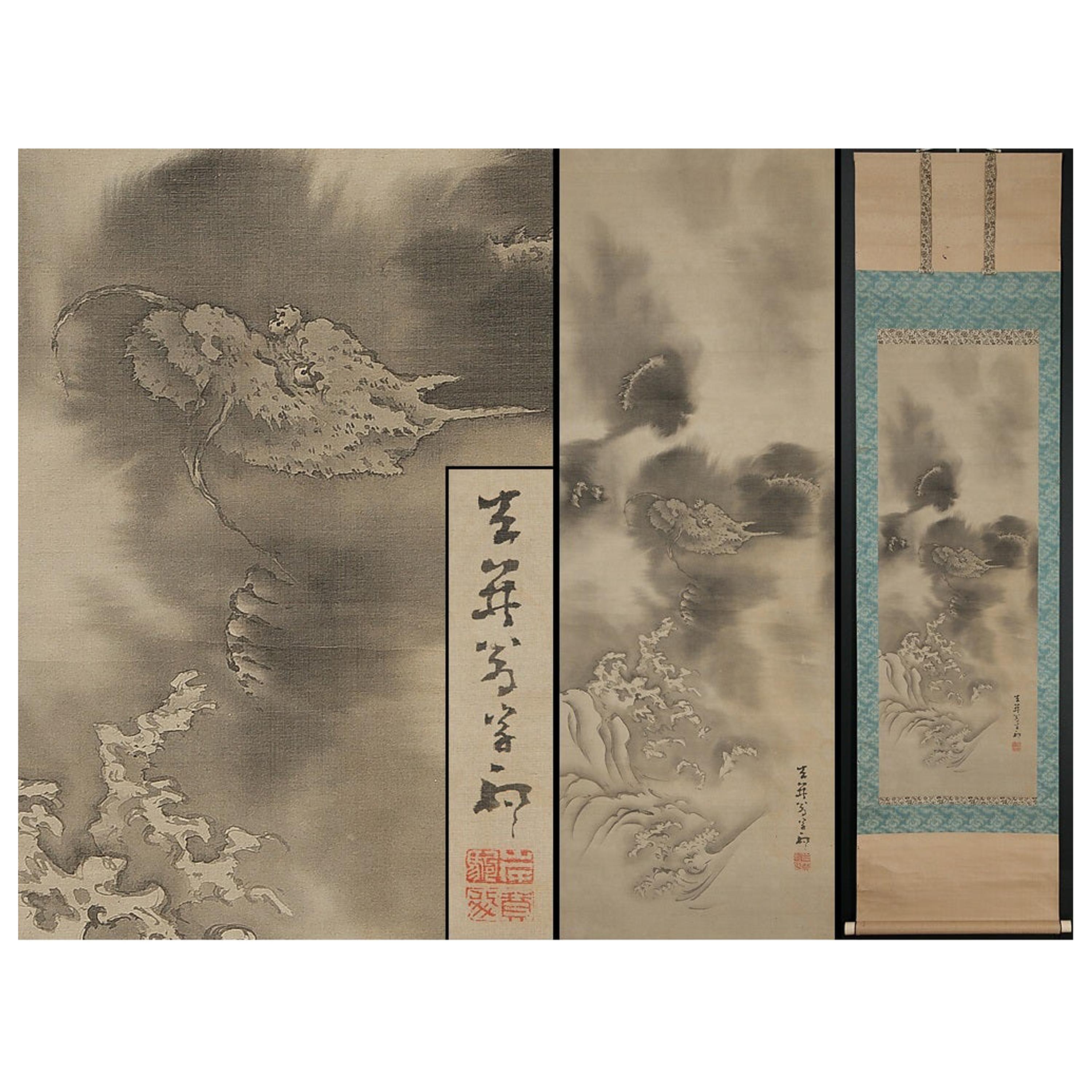
Ink (Sumi) on paper. Signature and Seal read: Kishi Ganku It is backed with paper covered in gold and silver flake. Kishi Ganku (1749 or 1756-1839) was the Edo period founder of the popular Kishi school of painting. Born in Kanazawa, Ishikawa prefecture, the former Kaga domain, little is known of his early career, but he came to Kyoto around 1773 where he quickly established a name for himself as a top painter, receiving Imperial commissions and patrons from the ruling classes, Samurai families and important business men. He was granted an imperial court position in 1804. He returned to Kanazawa in 1809, where he was made honorary governor of Echizen (Echizen no kami). However his longing for the stimulation of the capitol saw him return to Kyoto in 1813, where he would remain for most of the rest of his long life. He passed the torch to son Gantai (1782–1865), son-in-law Ganryo (1797–1852) and adopted son Renzan(1804–1859). He is held in the collection of the V&A, Ashmolean, New York Metropolitan, Chicago, the Walters, Boston Museum of Fine Arts and Freer among many many others.
- Dimensions:Height: 69 in (175.26 cm)Width: 74.25 in (188.6 cm)Depth: 1 in (2.54 cm)
- Style:Edo (Of the Period)
- Materials and Techniques:
- Place of Origin:
- Period:
- Date of Manufacture:circa 1800
- Condition:Condition report upon request.
- Seller Location:Hudson, NY
- Reference Number:Seller: S17721stDibs: LU855124678292
About the Seller
5.0
Recognized Seller
These prestigious sellers are industry leaders and represent the highest echelon for item quality and design.
Established in 1971
1stDibs seller since 2008
170 sales on 1stDibs
Typical response time: 8 hours
Associations
The Art and Antique Dealers League of AmericaAntiques Associations Members
- ShippingRetrieving quote...Shipping from: Hudson, NY
- Return Policy
More From This Seller
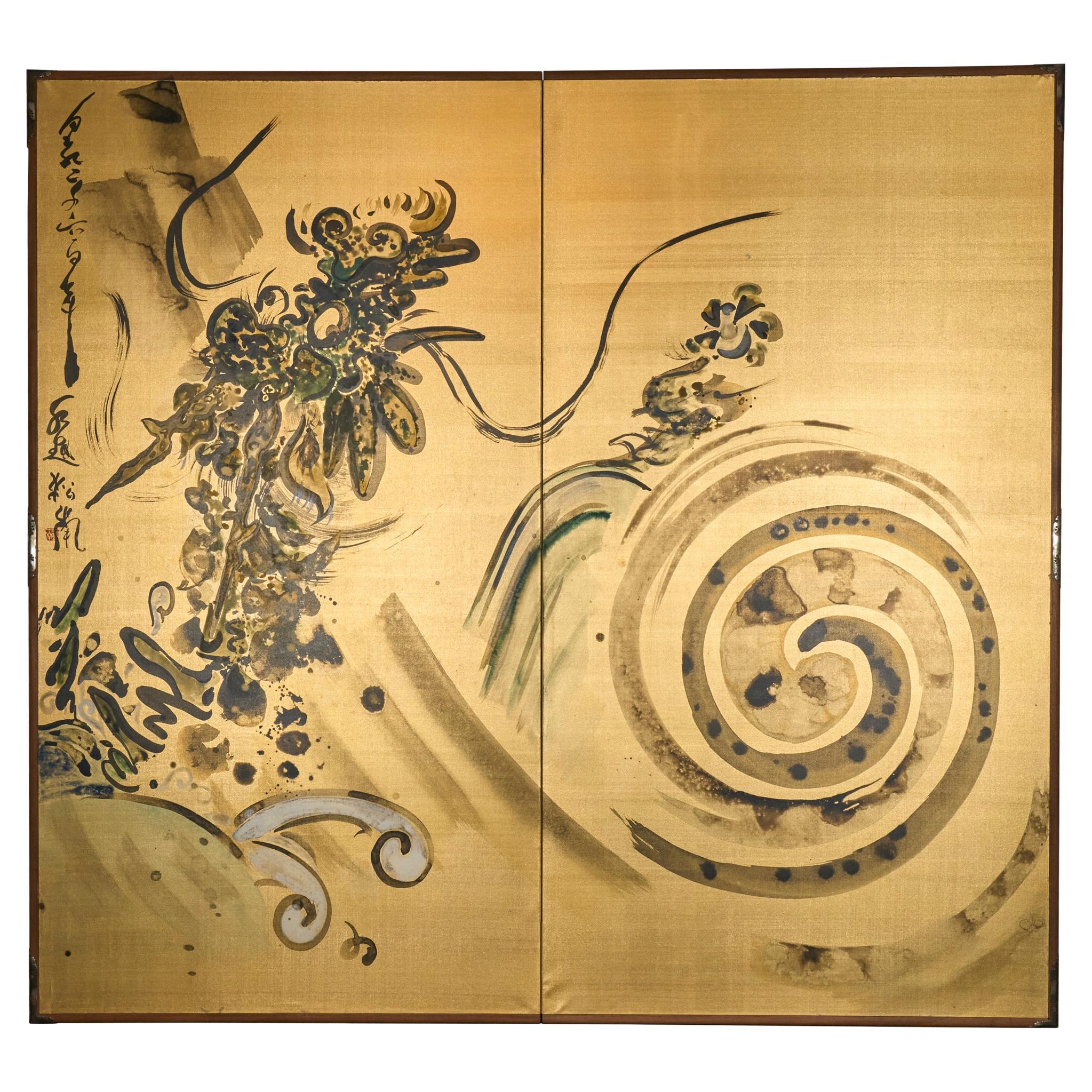
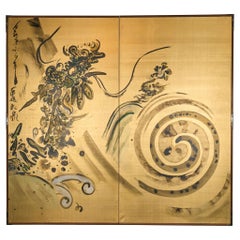
View AllJapanese Two Panel Screen: Whimsical Dragon
Located in Hudson, NY
Extremely dramatic painting of a dragon in sumi-e ink and mineral pigments on gold silk in a dark brown lacquer trim. Signature and seal read: Shonan.
Category
Antique Early 1900s Japanese Paintings and Screens
Materials
Silk, Wood, Lacquer
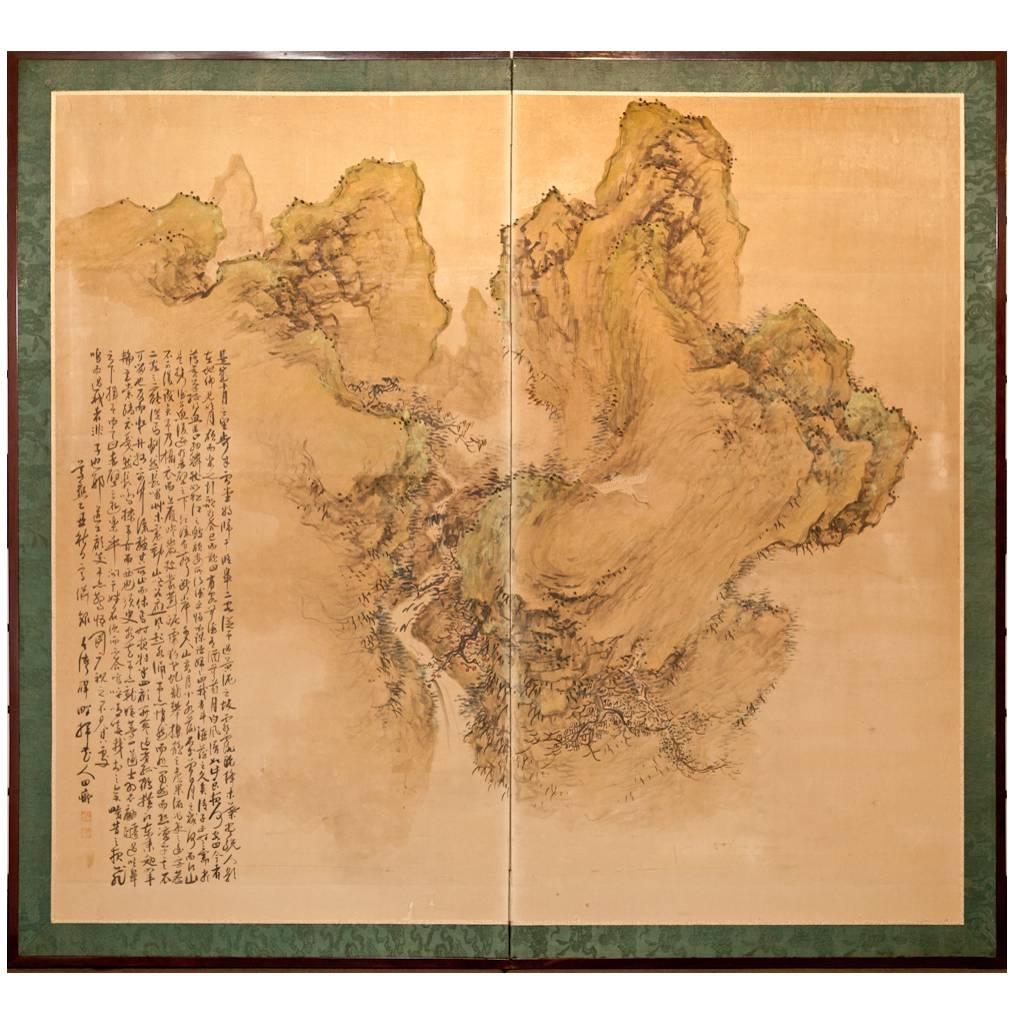
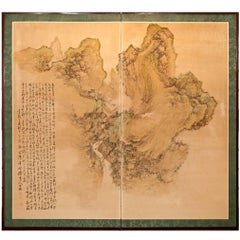
Japanese Two Panel Screen: Mountain Landscape with Calligraphy
Located in Hudson, NY
Japanese Two Panel Screen: Mountain Landscape with Calligraphy. Late Edo (c. 1850) painting of a dramatic mountainside carved by a waterfall with a crane flying in the foreground an...
Category
Antique Mid-19th Century Japanese Edo Paintings and Screens
Materials
Silk, Wood, Paper
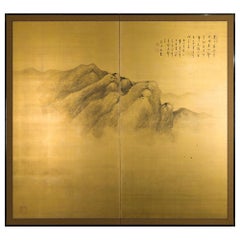
Japanese Two Panel Screen: Mountains in the Mist
Located in Hudson, NY
Chinese School landscape ink painting on gilded silk by Yukimatsu Shunpo, signed and dated 1924. Yukimatsu Shunpo was born in Oita in 1897 and studied under Himejima Chikugai in Osak...
Category
Early 20th Century Japanese Taisho Paintings and Screens
Materials
Silk
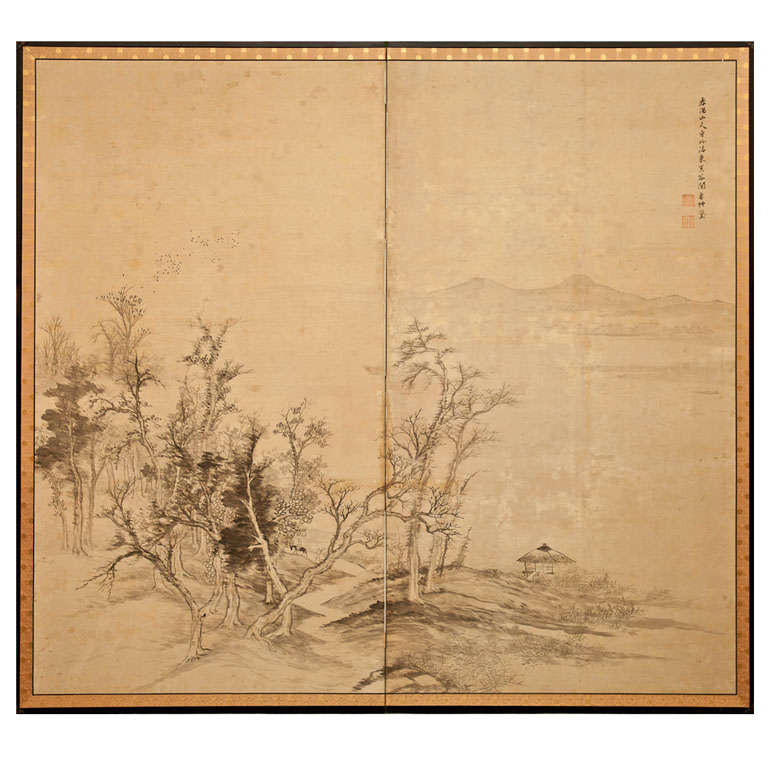
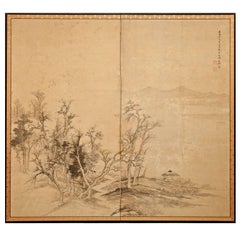
Japanese Two-Panel Screen: Ink Landscape on Silk
By Shunyu
Located in Hudson, NY
Japanese Two Panel Screen: Ink Landscape on Silk, Meiji period (1868 - 1912) painting of a man riding a mule on a pathway through the Kurotani mountains with a thatched roof shelter ...
Category
Antique 19th Century Japanese Meiji Paintings and Screens
Materials
Silk, Wood
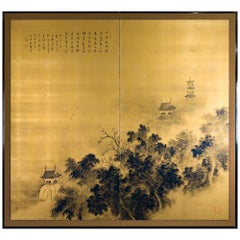
Japanese Two-Panel Screen Temples Through Misty Forest
Located in Hudson, NY
Japanese two-panel screen: Temples Through Misty Forest. Chinese School landscape ink painting on gilded silk by Yukimatsu Shunpo, signed and dated 1924. Yukimatsu Shunpo was born in...
Category
Vintage 1920s Japanese Taisho Paintings and Screens
Materials
Silk, Wood
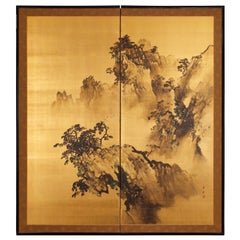
Japanese Two Panel Screen: Craggy Landscape on Gold Sil
Located in Hudson, NY
Dramatic Mountain landscape with gnarled pines. Signature reads: Shunsen. Ink painting on gold silk with silk brocade border.
Category
Early 20th Century Japanese Paintings and Screens
Materials
Brocade, Silk
You May Also Like
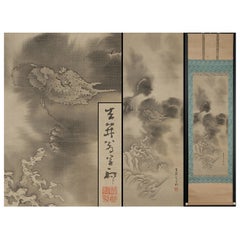
Lovely Edo Period Scroll Paintings Japan Artist Saeki Kishi Ganku Dragon Clouds
Located in Amsterdam, Noord Holland
Saeki Kishi Ganku "NoboriRyuzu" silk painting hanging scroll with box
Size Axis ... vertical 163.5cm horizontal 43cm
picture ... vertical 96cm horizont...
Category
Antique 19th Century Japanese Edo Paintings and Screens
Materials
Silk
$1,304 Sale Price
25% Off
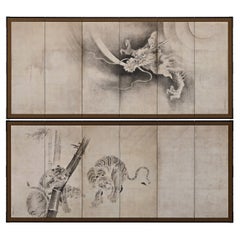
17th Century Japanese Screen Pair. Tiger
Dragon by Kaiho Yusetsu
Located in Kyoto, JP
Kaiho Yusetsu (1598-1677)
Tiger and Dragon
Early Edo Period, Circa 1650
A Pair of Six-fold Japanese Screens. Ink and slight color on paper.
Dimensions:
Each screen: H. 171 cm x W. 380 cm (67.5’’ x 149.5’’)
In this pair of early Edo period Japanese screens a group of tigers prowl in a bamboo grove whipped with fierce wind, while a dragon claws through clouds and mist. The dragon embodies elemental qualities - looming out of the mist, the coils of its body disappearing in the clouds. The dragon is calling for rain, symbolizing spring which is considered the fountain of life. On the other side, the tigers calls for the wind, symbolizing autumn which is considered the end of life. Tigers were familiar motifs within Japanese art from ancient times though the animals were imaginary to the people in the 17th century. While dragons and tigers are usually associated as sacred and ferocious, in this painting, both animals have rather amusing expressions. The tigers appear to glare at the dragon with cat-like eyes, and the look on the swirling dragon’s face appears almost affectionate - lending a playful flair to an otherwise magnificent theme.
The tiger and dragon are cosmological symbols of the balancing forces in the world. Screens such as this were originally meant to express the fluctuating nature of the world. For Japanese in the early Edo period, they likely suggested the powers of the cosmos. In Japan the tiger and dragon motif was originally absorbed into the circles of Zen monasteries before spreading into the secular world. The theme especially appealed to the military classes with the Kano school, the official painters to the Shogun and the samurai, being the leading contributors. The painter of this pair of screens, Kaiho Yusetsu (1598-1677), was closely patronized by the third Shogun Tokugawa Iemitsu. In his later years he worked with Kano school artists...
Category
Antique Mid-17th Century Japanese Edo Paintings and Screens
Materials
Silk, Wood, Paper
Lovely Japanese 18/19th c Edo Scroll Kano Osanobu Nihonga Painting Mountain
Located in Amsterdam, Noord Holland
Kano Osanobu (狩野養信)
Osanobu Kano (born August 18, 1796; died June 12, 1846) was the ninth painter of the Kobikicho Kano School in the Edo period. His common name was Shozaburo. His father was Naganobu KANO, and Tadanobu KANO was his son. His Go (pen name) was Osanobu Seisenin, Kaishinsai, and Gyokusen.
Brief Personal History
He was born the eldest son of Naganobu ISENIN during the Edo period. He was first sent to serve at Edo Castle at the age of 15, and it appears that he was apparently pushed by his father to perform various public tasks for the Kanon School. He kept a diary for 36 years, starting from the day before he first went into service at Edo Castle until the day before he died. The diary is entitles "Official Service Diary" (it consists of 52 volumes that are maintained at the Tokyo National Museum, and 4 volumes that are separately maintained at the different families), and have become the focus of a lot of attention in recent years for the detailed information they present on the daily life and work of a prestigious official painter. The reading of the characters of his name was originally "Takenobu"; however, with the birth of the first son of the Shongun Ieyoshi TOKUGAWA in 1813, whose name was Takechiyo, having a sylable with the same pronunciation of "Take"was deemed to be inappropriate, and was therefore changed to "Osanobu". Because Takenobu died the following year, after which he was referred to as Gyokujuin, Osanobu changed his pen name Gyokusen he had used until that point to Seisenin, in order to avoid using the same Chinese charcter pronounced alike. In 1819, he attained the second highest rank for a Buddhist priest, Hogen, and assumed the role of head of the family after his father passed away in 1828. In 1834 he attained the highest rank for a Buddhist priest, Hoin. He oversaw the rennovation of the wall paintings of Nishinomaru Palace of Edo Castle from 1838 to 1839, and Honmaru Palace of it from 1844 to 1846. It is thought that Osanobu later died due to the fatigue...
Category
Antique 18th Century Edo Paintings
Materials
Silk
$1,726 Sale Price
20% Off
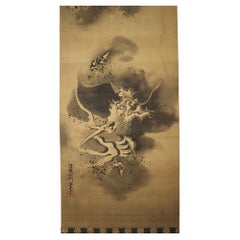
K23 Japanese Antiques A hanging scroll, Dragon
Clouds Ink on Silk painted
Located in Niiza, JP
Ink on Silk, Scroll head: wood
Image size: 310(W) x 920(H) [mm]
Scroll mounting: 420(W) x 1750(H) [mm]
Box size: 70(W) x 70(H) x 520(D) [mm] 600g
Estimated packing size: 130(W) x 130...
Category
Antique 19th Century Japanese Paintings and Screens
Materials
Fabric, Silk, Wood
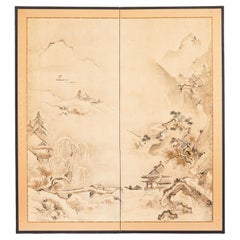
Japanese Meiji Two-Panel Screen Chinese Country Winter Landscape
Located in Rio Vista, CA
Late 19th / early 20th century Japanese Meiji period two-panel folding byobu screen featuring a winter landscape with a Chinese country villa and distant village. Kano School screen ...
Category
Antique 19th Century Japanese Meiji Paintings and Screens
Materials
Brass
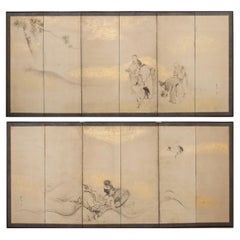
Pair of 18th Century Japanese Edo Screens of Chinese Immortals
Located in Rio Vista, CA
Mesmerizing pair of late 18th/early 19th century Japanese Edo period byobu screens by Shibata Gito (Japanese 1780-1819). The paintings depict Chinese immortals in a dreamy landscape....
Category
Antique 18th Century Japanese Edo Paintings and Screens
Materials
Silk, Wood, Paper
More Ways To Browse
Japanese Dragon
Antique Japanese Dragon
Wood Dragon
Asian Dragon Paintings
Japanese Dragon Painting
Japanese Dragon Screen
Kishi Ganku
Asian Wood Screen Panels
Gold Leaf Screen
Chinese Wood Screen
Japanese Gold Screen
Asian Gold Leaf Art
Chinese Art Panel
Japanese Silk Painting 20th Century
Japanese Gold Leaf Panel Paintings
Hand Painted Chinese Screen
Chinese Wood Painting
Japanese Silk Panel