Items Similar to Kano School Japan Byôbu Screen “Wild Horses”, Kano School, Edo period
Video Loading
Want more images or videos?
Request additional images or videos from the seller
1 of 22
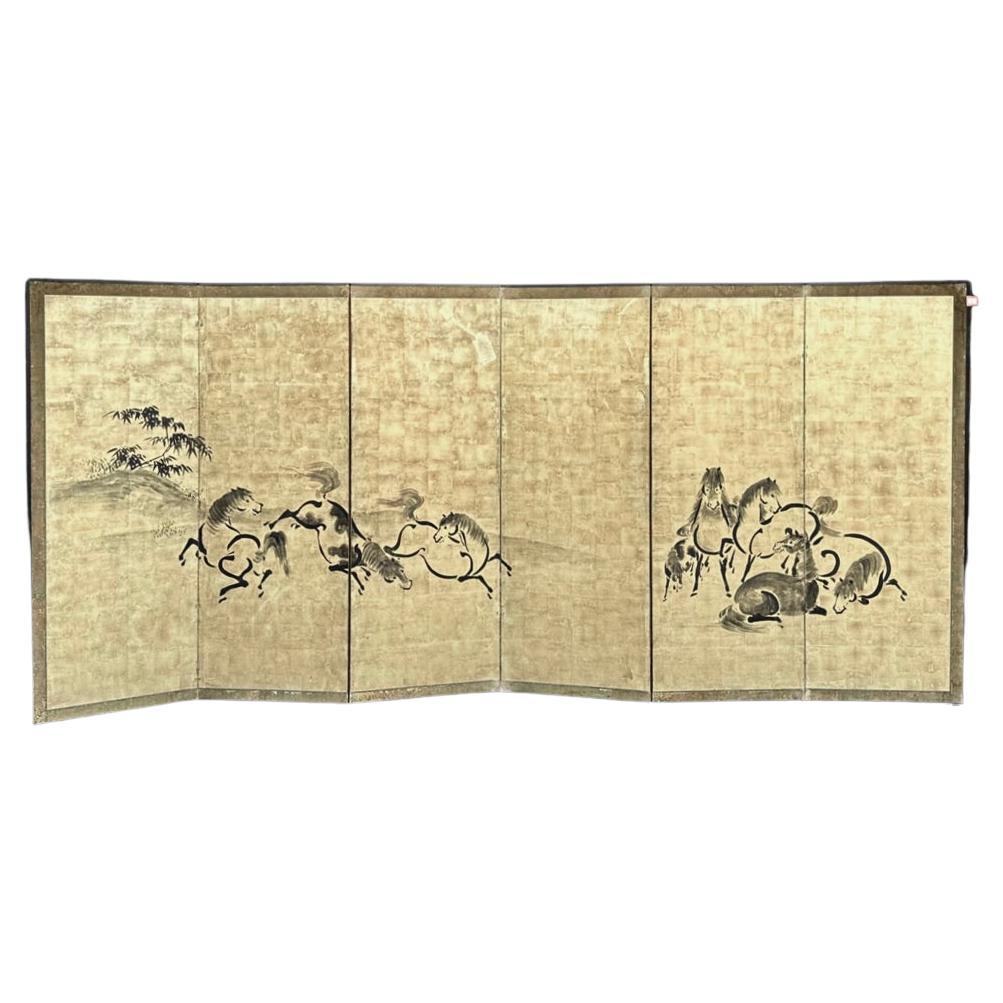
Kano School Japan Byôbu Screen “Wild Horses”, Kano School, Edo period
$13,611.08
£10,130.66
€11,450
CA$18,877.21
A$20,323.03
CHF 10,883.38
MX$244,885.27
NOK 137,318.07
SEK 125,668.21
DKK 87,270.16
About the Item
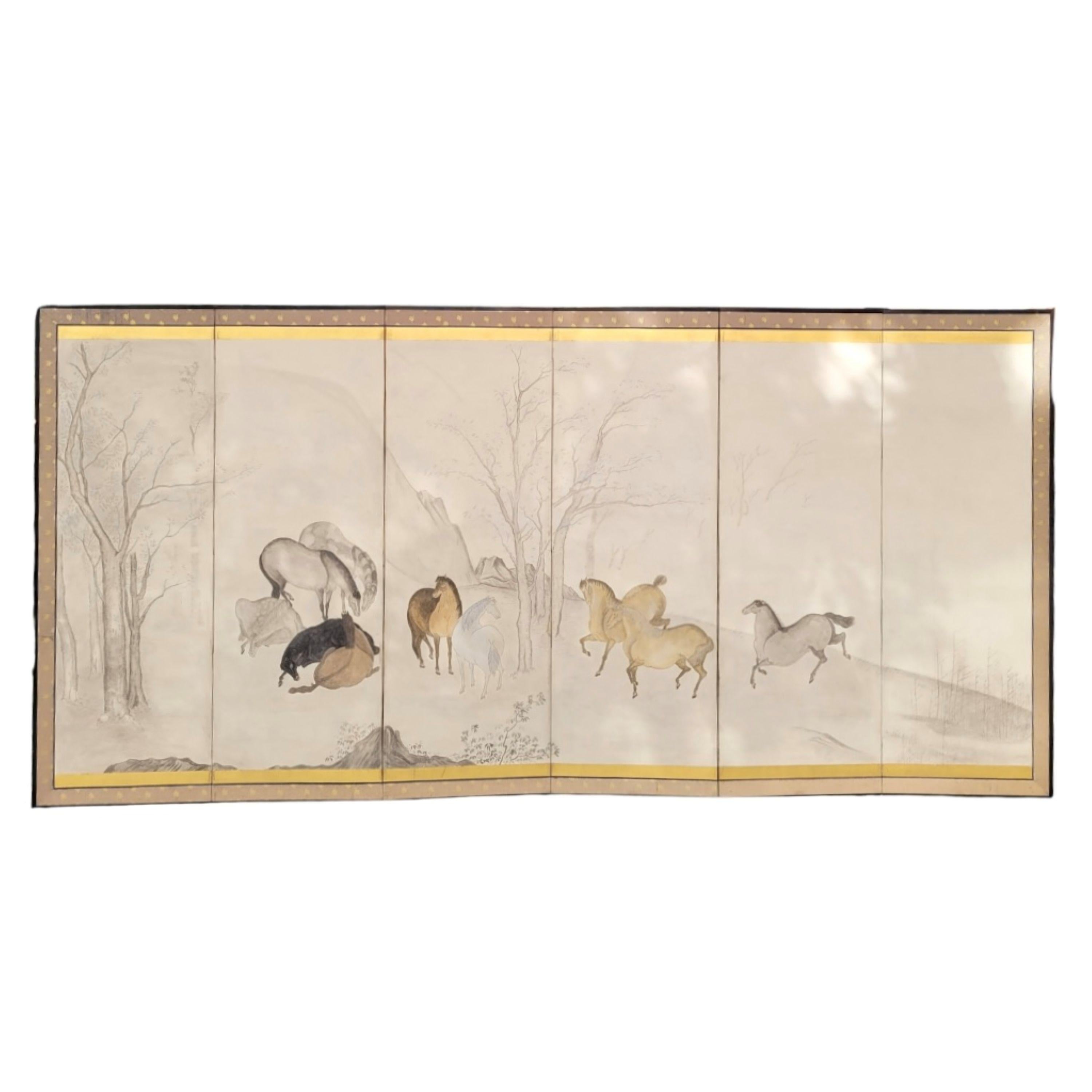
One of a kind Japanese folding screen, or byōbu, with six panels depicting a delicate and graceful scene of wild horses in a natural setting. Masterfully painted with ink and watercolor on mulberry paper, it is protected and supported by a fine lacquered wooden frame with metal fittings. A beige silk brocade frame adorned with small gold flowers and gold trim at the top and bottom adds presence and luminosity to the piece. Dated to the late Edo period (1603-1868), this beautiful byōbu is a serene painting in the style of the Kano School. The brushstrokes, soft colors, and tranquil atmosphere, combined with the influence of natural elements, are characteristic of traditional schools like Kano, known for its refined depiction of nature. Ten wild horses are presented in a winter landscape, complete with leafless trees, small bushes, and large rocks. Some animals graze, others gallop, and still others gather to rest.
In Japanese culture, horses are a popular figure in art, especially in the context of landscape painting and animal portraiture. They hold a deep symbolism that extends throughout history and across various artistic traditions. Their representation not only evokes beauty and elegance but is also linked to spiritual, cultural, and social meanings.
These animals are traditionally considered symbols of power, nobility, and status. In the samurai context, especially during the feudal period, horses were fundamental to warriors, representing not only mobility and agility on the battlefield but also the prestige of a samurai who owned a high-quality horse. They were often depicted in paintings and screens related to the nobility or the samurai elite, and the ability to ride a horse was a sign of skill and honor.
They are also associated with speed, energy, and agility. Horses are often depicted in dynamic motion, conveying the idea of speed and momentum.
In Japanese mythology, horses have a special connection to the divine. They are believed to be vehicles of the gods and spiritual messengers. They also symbolize protection, possessing the power to shield people from evil spirits. In Shintoism, they are sacred animals, used as mounts by kami (gods) and associated with good fortune and business.
In landscape painting, horses are often presented as part of a natural environment, symbolizing the relationship between humans, animals, and nature. This connection reflects the Japanese aesthetic sensibility toward nature and the harmony among all life forms. In this context, they also symbolize freedom and natural beauty, highlighting the serene coexistence between nature and living beings.
It stands out as an excellent example of the Kano school of art (加納派, Kano-ha), due to the delicate depiction of the horses and the use of a restrained color scheme that creates a serene atmosphere. The Kano school was one of the most influential and longest-lasting artistic traditions in Japan, active primarily from the Muromachi period (1336–1573) to the early Edo period (1603–1868). Founded by Kano Masanobu (1434–1530), it remained one of Japan's major schools of painting until the 19th century. Its style and technique dominated much of the painting produced by the imperial court and the samurai class.
The painting style of this school is heavily influenced by the tradition of Chinese painting, particularly in its use of ink, known as suiboku-ga in Japanese. This technique uses only ink and water, with a very restricted palette that emphasizes texture and shadows, creating a sober and majestic style. Its main subjects were landscape painting, historical scenes, floral motifs, and animals.
During the Edo period, members of the Kano school were highly valued by the Tokugawa shoguns and the imperial court. Artists of the school received commissions to create large-scale works, including folding screens, door panels, and paintings on the walls of palaces and temples. This solidified their status as official court painters. Although the school is associated with monochromatic ink painting, it is also known for its use of other mediums.
The use of gold was common, especially in screens, lampshades, and other decorative works featuring gold backgrounds and colored details.
In terms of composition, they emphasized balance and symmetry. However, over time, some members of the school began to experiment with a freer approach, while always respecting the rules of traditional Japanese aesthetics.
Technical Data
Technique on support: Watercolor and ink on mulberry paper
Title of the work: “Wild Horses”
Period: Circa 1850, late Edo period (1615-1868)
Style / School: Kano School
Country of origin: Japan
Provenance: Important French private collection
Good condition considering its age and use
Overall dimensions: 176 x 365 x 10 cm.
- Creator:Japanese Studio (Artist)
- Dimensions:Height: 69.3 in (176 cm)Width: 143.71 in (365 cm)Depth: 3.94 in (10 cm)
- Style:Japonisme (Of the Period)
- Materials and Techniques:
- Place of Origin:
- Period:
- Date of Manufacture:1850
- Condition:Wear consistent with age and use.
- Seller Location:Valladolid, ES
- Reference Number:1stDibs: LU2943347429512
About the Seller
4.7
Platinum Seller
Premium sellers with a 4.7+ rating and 24-hour response times
Established in 1990
1stDibs seller since 2017
170 sales on 1stDibs
Typical response time: <1 hour
- ShippingRetrieving quote...Shipping from: Valladolid, Spain
- Return Policy
More From This Seller
View AllChinese Qing Reverse-Painted Mirror from the Qing Dynasty
By Chow
s Oriental Furniture Co.
Located in Valladolid, ES
Stunning reverse-painted mirror from the 19th-century Qing Dynasty, depicting different scenes in a vertical narrative.
Different scenes with symbolic and auspicious elements frame r...
Category
Antique 1870s Chinese Qing Paintings and Screens
Materials
Crystal
Qing Dynasty Blue White Brown Gouache Scrall Geishas
Located in Valladolid, ES
Amazing and Exquisite vertical Chinese scroll, 18th century Qing Dynasty, blue, white, and brown, "Geisha Pair" (Gouache on paper, hanging vertically, possibly a vertical scroll, fra...
Category
Antique 1780s Chinese Qing Paintings and Screens
Materials
Giltwood, Paint, Paper
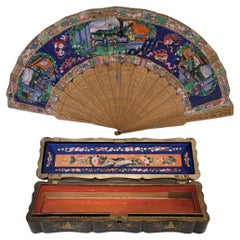
Chinese fan with a thousand faces, Sandalwood box and gouache
Located in Valladolid, ES
One of a kind Thousand-Faced Fan with Box, Bamboo and Gouache, Late 19th Century - China
Type: Thousand-Faced Fan
Materials: Paper, gouache, bone chinoiserie wood
Period: 1890s
...
Category
Antique 1890s Antiquities
Materials
Bone, Wood, Giltwood, Lacquer, Sandalwood
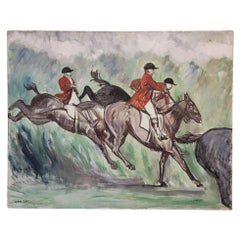
France Acrylic on canvas “Horse Race”, León Lafourcade
By Napoléon III
Located in Valladolid, ES
Amazing painting by Léolaf, the artistic name of León Lafourcade, a French-born artist active between the 19th and 20th centuries. He participated in various exhibitions, including at the Salon des Artistes Indépendants. It depicts an equestrian scene of jockeys racing, capturing the energy and dynamism of the moment. An expressive use of brushwork is evident, with loose, fluid strokes suggesting movement and speed, especially in the background, with a diffuse or ethereal finish. The hazy atmosphere contributes to this feeling. The jockeys wear the characteristic red equestrian jacket...
Category
Antique 1890s French Other Paintings
Materials
Canvas, Acrylic
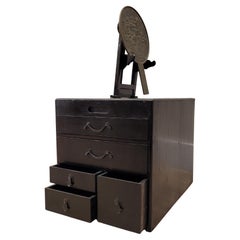
Japanese Meiji Dressing Stand with Mirror Black Lacquer
By Vintage Japanese Monochrome
Located in Valladolid, ES
Elegant and beautiful Dressing Table or it could be suitable for a jewellery box , Meiji Period ( 1868 - 1912 ).
Executed with black lacquer, holding a bronze hand mirror ( ekagami)
Configured with five smooth-running drawers of different Size. Two are equipped with slender "hirute"-shaped bail handles and three with decorative pull-rings.
The front-and backside featuring oval grips for easy transport.
Surmounted by a mirror frame in a shape reminiscent of a Shintô shrine torii-gate-
a twin-posted framework with a triangular crossbar flared in upswept Chinese-style gable ( Karahafu) endings.
Resting of the frame is the Japanese traditional handheld mirror with auspicious embossed design of wisteria ( fuji) and lovely patina.
Inscription on the right.
Considering its age the set is in a very good condition with some traces of usage and wear conform age.
Dimensions:
Dressing stand...
Category
Antique 1880s Dutch Meiji Antiquities
Materials
Bronze
$1,654 Sale Price
30% Off
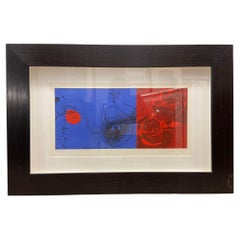
Korea Etching by Deok Sung Kang, numbered 75/75
By Duck Shin
Located in Valladolid, ES
Gorgeous Etching, with aquatint and color matrix by the South Korean artist Deok Sung Kang, made around 1990. The works of this artist, although they tend towards abstraction, are really inspired by nature. They illustrate a very personal vision of everyday objects and phenomena. The creative brilliance of this artist is widely recognized.
In this case, the work is divided into two areas, the first of which is dominated by a red color, which represents a pair of red roses using a rather realistic technique. However, in contrast, a larger area of intense blue inspired by natural motifs and splashed with a red spot.
About the artist
Deok Sung Kang is a painter and printmaker of South Korean origin. He studied Fine Arts in his native country, although he later attended the École de Beaux Arts in Paris and, later, in 1989, he settled in Madrid, where he continued his studies at the Complutense University of Madrid. The highlight of his facet as a painter are his prints, often using rice paper as a support.
Most of his works have been exhibited at fairs and exhibitions in Spain, but he has also done some in his country, such as at the Art Museum in Seoul.
About the technique
The origin of prints in Asian art has its foundations in the knowledge of printing texts on woodblocks, around the 8th century. Over time, it evolved and this new art became accessible to the majority of the public, opening the doors to the enjoyment of art and collecting, which until then was limited only to merchants, rich warriors...
Gprgeous Etching is a type of engraving, which is made using a metal plate (iron, zinc or copper) as a base, which is covered with a light layer of a protective varnish or acid-resistant wax. The engraver draws with a stylus on the layer of varnish, reaching just up to the metal plate. Later, the plate is dipped in etching, hence its name, a solution based on water and nitric acid, which corrodes the copper in the areas where it was not protected by the varnish. The immersion time is what determines the depth of the line.
Metal plates engraved with this technique can be printed with the desired ink colour, prepared by combining various pigments and binders.
Beautiful work of art by the contemporary Korean artist Duck Sung Kang...
Category
1990s Korean Mid-Century Modern Paintings
Materials
Paper
$741 Sale Price
20% Off
You May Also Like
Hasegawa School Edo Folding Screen with Horses Byobu Horses Japan
Located in Valladolid, ES
One of a kind and incredible six-panel Hasegawa school folding screen, featuring horses, is an exceptional piece.
"Scene with Wild Horses" (Kōgen Bashu-zu in Japanese) is in the styl...
Category
1850s Edo Animal Drawings and Watercolors
Materials
Paper
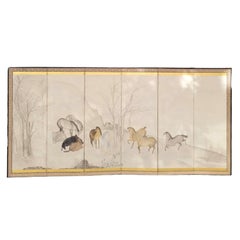
Japanese Taisho/Showa Period Six - Panel Screen with Galloping Horses, Ca. 1920
Located in New York, NY
Japanese Taisho/Showa Period Six - Panel Screen with Galloping Horses, Ca. 1920
ABOUT
Taisho/Showa Period (1912 – 1926)
DIMENSIONS
Width: 70 inches
Height: 35 inches
Category
Vintage 1920s Japanese Japonisme Paintings and Screens
Materials
Wood
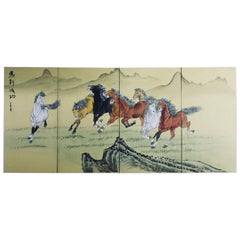
Japanese Art Deco 4-Panel Screen with Riders Taming Horses, Ca. 1960
Located in New York, NY
Japanese Art Deco 4-Panel Screen with Riders Taming Horses, Ca. 1960s
DIMENSIONS
Width: 97 inches
Height: 48 inches
Category
Late 20th Century Japanese Japonisme Paintings and Screens
Materials
Wood
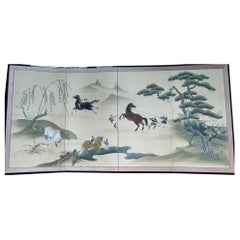
Japanese Two Panel Screen: Horse Roundup
Located in Hudson, NY
Interesting and unusual subject matter, Tosa School painting in mineral pigments on gold leaf with silk brocade border.
Category
Antique Late 17th Century Japanese Paintings and Screens
Materials
Gold Leaf
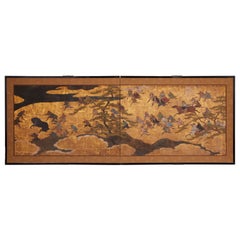
Japanese Inspired Six-Panel Screen with Horses in Stable with Bamboo Backdrop
Located in Yonkers, NY
This six-panel Chinese folding screen showcases a vibrant painted scene of six individually depicted horses, each rendered in expressive motion within their stables. Likely inspired ...
Category
Late 20th Century Chinese Screens and Room Dividers
Materials
Fabric, Wood, Paper
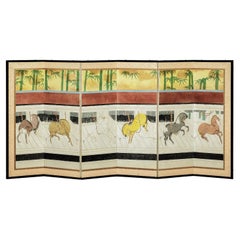
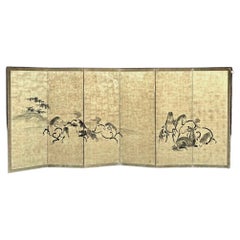
Elegant Horse Screen. In style of Kano Tanshin
By Kano Tanshin
Located in Fukuoka, JP
Ink on gold.
This continuation of equine grace unfolds across a stunning gold-leaf backdrop, capturing the essence of nobility that horses represent in Japanese lore.
The screen de...
Category
Antique Late 18th Century Japanese Edo Paintings and Screens
Materials
Gold Leaf
$8,500 Sale Price
38% Off