Items Similar to Large Japanese 6-panel byôbu 屏風 (folding screen) with genre painting
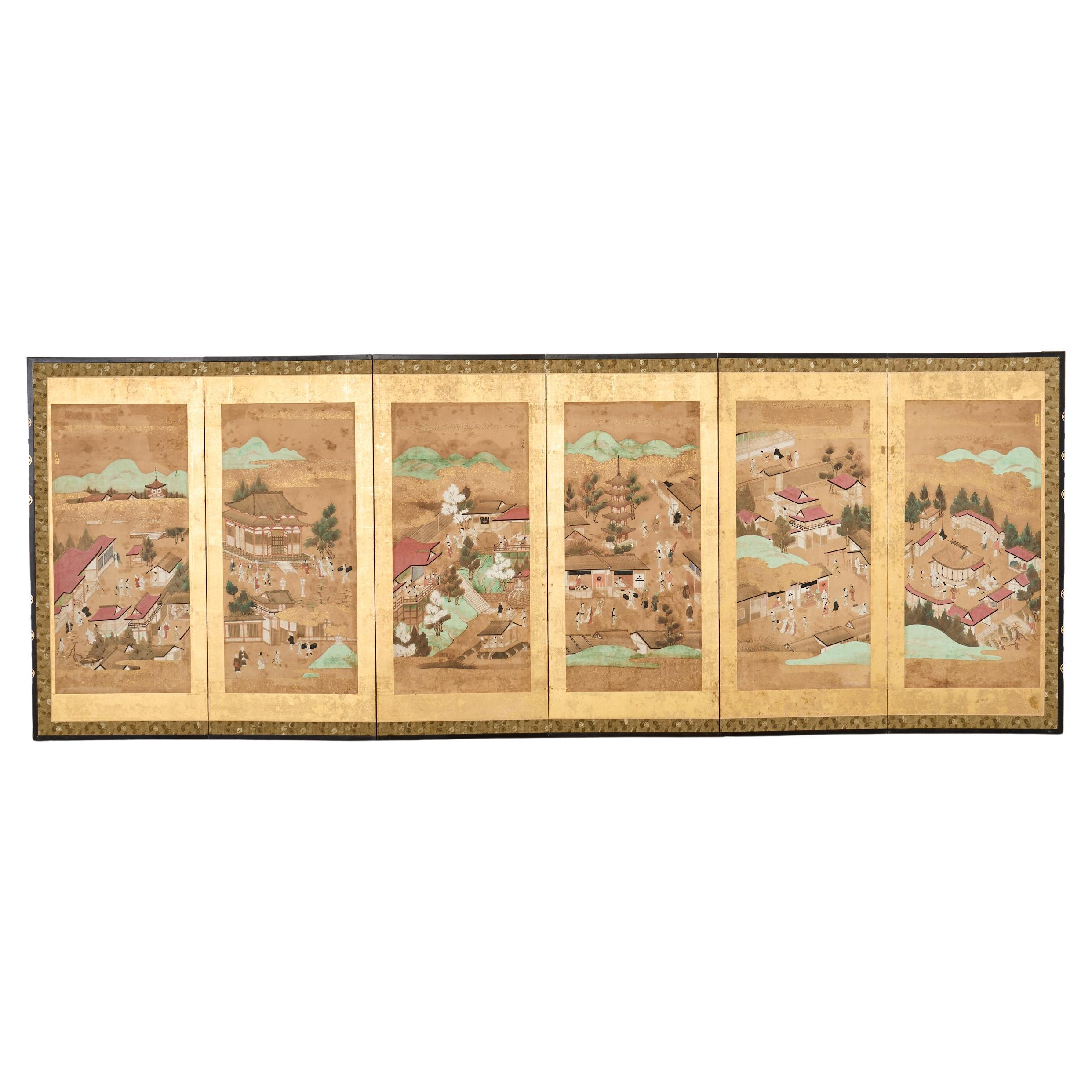
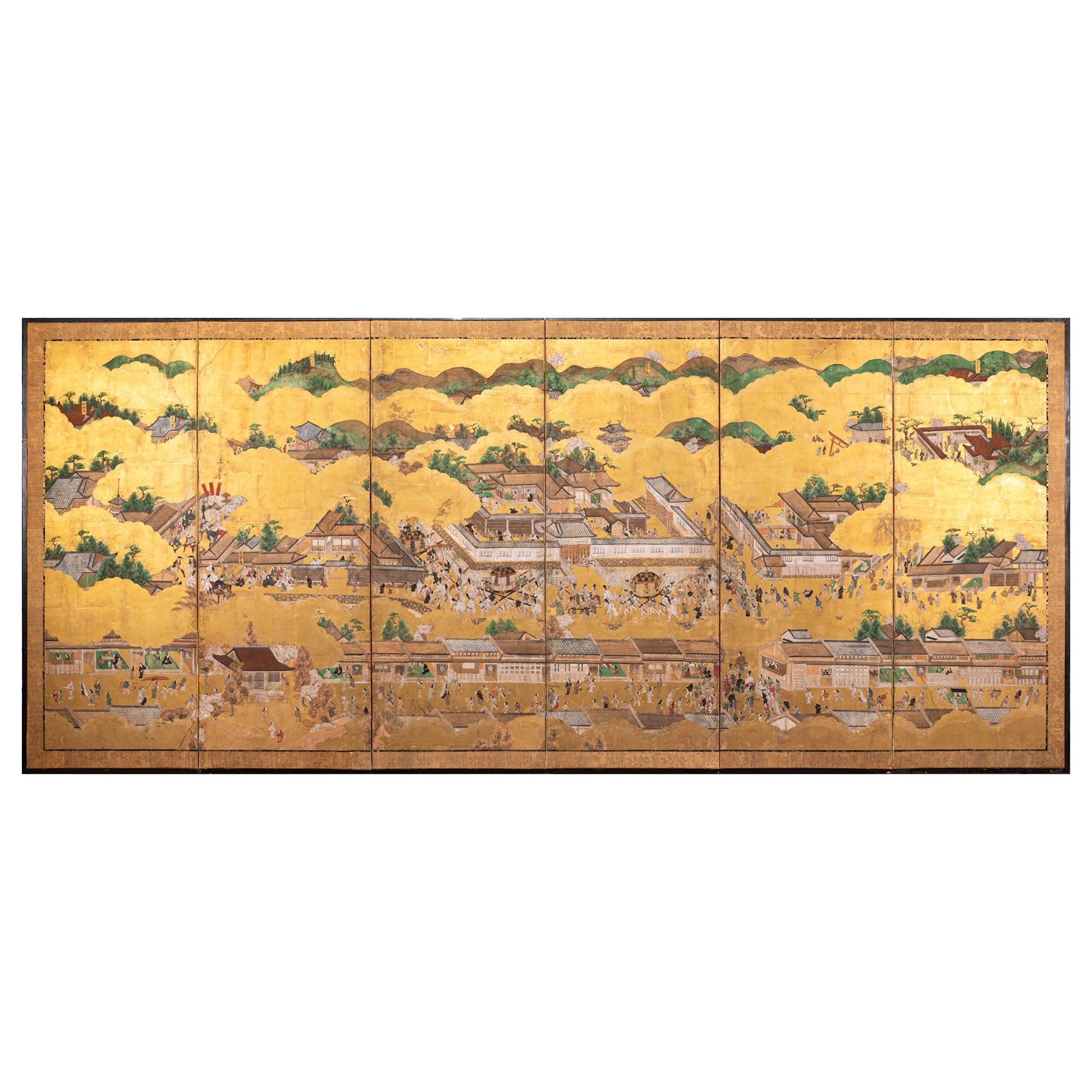
Want more images or videos?
Request additional images or videos from the seller
1 of 21
Large Japanese 6-panel byôbu 屏風 (folding screen) with genre painting
$4,547.52
£3,381.65
€3,800
CA$6,241.58
A$6,817.72
CHF 3,608.82
MX$81,959.62
NOK 45,873.30
SEK 41,958.50
DKK 28,950.43
About the Item
Fascinating large six-panel byôbu (folding screen) with a detailed genre painting on goldish silver leaf with different scenes of people at work in a rural mountain village during the Edo period.
Farmers are hard at work in the large rice paddies. On the left they are tending the growing plants, in the foreground they are ploughing the field by using the help of an ox, while more on the right they are doing it by hand. In the middle they are planting new rice plants. Next to a small, almost hidden, Shintô shrine with a torii (gate) at the entrance. Another man with baskets is on his way to the fields, coming from the village behind him, carrying filled baskets using a shoulder yoke.
The different scenes are surrounded by dense silver leaf clouds with a translucent golden finish. Silver leaf continuously undergoes the process of oxidation, which creates a beautiful aged patina. The panels are mounted by two silk borders, a thin navy blue brocade one, and a broad brown brocade one. Protected by a red lacquer wooden frame with its original hardware.
It is in a good condition with some traces of wear conform age and old restorations, like in the top of the most right panel. Restoration of the mounting on the upper left side. Some repapering of the back. Please look at the photos for a condition reference.
Dimensions:
Total width: 147.16 in/373.8 cm (2 x 25.07 in/63.7 cm, 4 x 24.25 in/61.6 cm); Height: 67.83 in/172.3 cm.
The folding screen is ideal for mounting flat on a wall and presenting as a single work of art.
When shipped we will add a certificate of authenticity.
Price including insured shipping.
- Dimensions:Height: 67.84 in (172.3 cm)Width: 147.17 in (373.8 cm)Depth: 0.75 in (1.9 cm)
- Materials and Techniques:
- Place of Origin:
- Period:
- Date of Manufacture:Late Meiji period/Taishô period (First quarter 20th century)
- Condition:Repaired: It is in a good condition with some traces of wear conform age and old restorations, like in the top of the most right panel. Restoration of the mounting on the upper left side. Some repapering of the back. Wear consistent with age and use. Please look at the photos for a condition reference.
- Seller Location:Amsterdam, NL
- Reference Number:Seller: B30091stDibs: LU7165236595752
About the Seller
4.8
Vetted Professional Seller
Every seller passes strict standards for authenticity and reliability
Established in 1996
1stDibs seller since 2022
22 sales on 1stDibs
- ShippingRetrieving quote...Shipping from: Zwanenburg, Netherlands
- Return Policy
More From This Seller
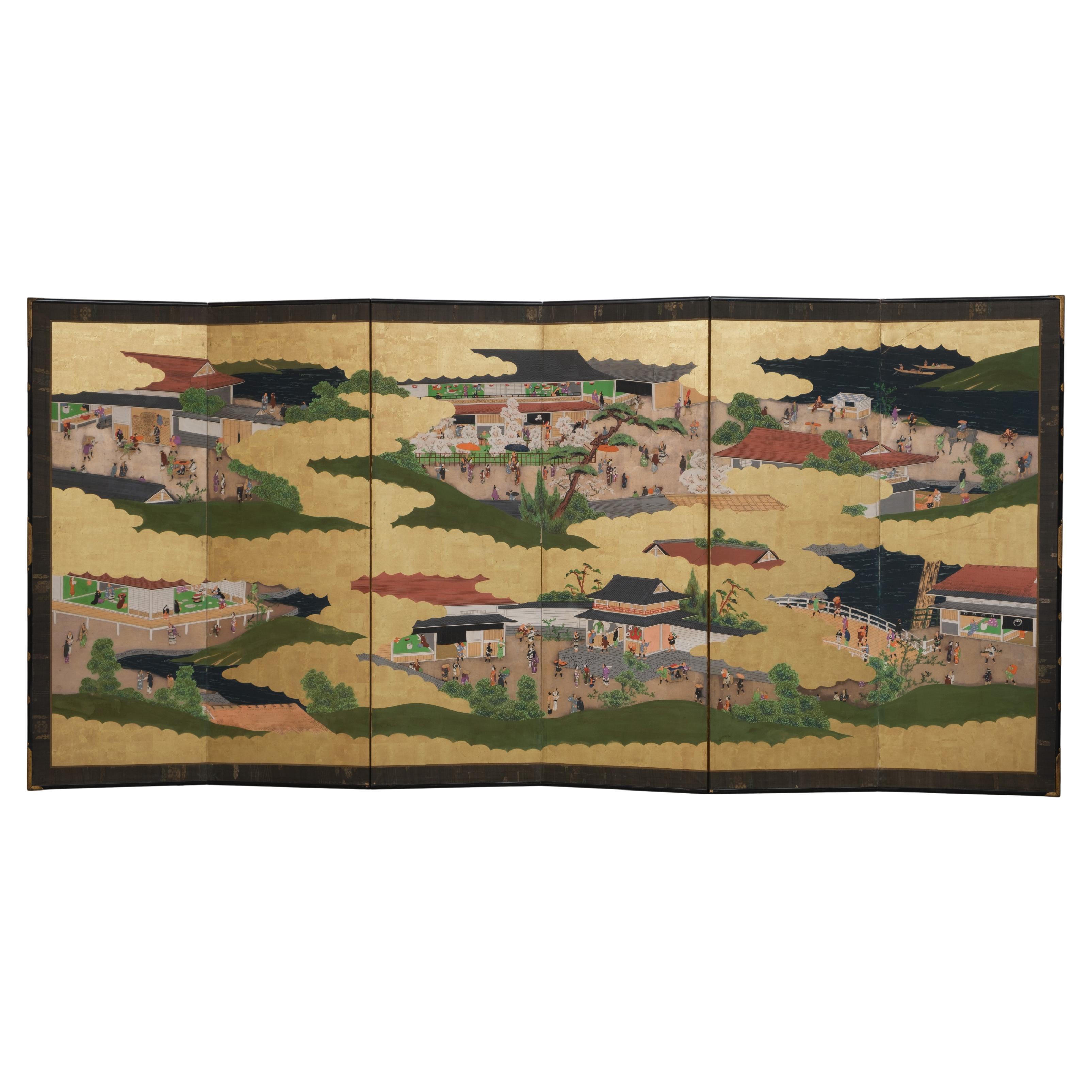
View AllLarge Japanese 6-panel byôbu 屏風 (folding screen) with Edo genre painting
Located in Amsterdam, NL
An elaborate, large six-panel byôbu (folding screen) featuring a detailed genre painting on gold leaf, capturing the vibrancy of festive scenes from the Edo period.
Central to the p...
Category
Antique Early 19th Century Japanese Paintings and Screens
Materials
Metal, Gold Leaf
Large Japanese 6-panel byôbu 屏風 (folding screen) with chrysanthemum garden
Located in Amsterdam, NL
A very colourful and captivating large six-panel byôbu (folding screen) with a refined continuous painting of a luscious flower garden filled with many different types of chrysanthemums (kiku), next to a winding river.
This multi-coloured painting is set on a shiny gold-leaf background, and the chrysanthemum flowers are painted by using shell paste (gofun) in low relief.
Several clutches with a great variety of chrysanthemum flowers are in full bloom and they each show their unique form and colour. Varying from white, red, yellow and pink. The flowers bloom all around and on different kinds of bamboo fences and trellises.
In Japan chrysanthemums are believed to represent happiness, love, longevity and joy.
The panels are surrounded by two silk borders, a thin black one, and a wide brown one. The screen is protected by a black and red negoro’nuri...
Category
Antique Late 19th Century Japanese Paintings and Screens
Materials
Gold Leaf
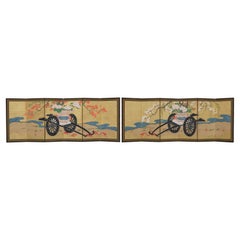
Pair of Japanese hinagata byôbu 雛形屏風 (small folding screens) with flower carts
Located in Amsterdam, NL
An amazing pair of six-panel hinagata byôbu (doll festival folding screens) with a continuous painting on gold leaf showcasing flower carts (hana’guruma) at the edge of a winding river.
Both laden with a large bamboo basket...
Category
Antique Early 19th Century Japanese Paintings and Screens
Materials
Gold Leaf
$4,308 / set
Free Shipping
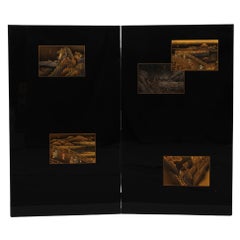
Tall, Japanese lacquer byôbu 屏風 (folding screen) by Mitsuo Takana 高名光夫 (1956)
By Mitsuo Takana
Located in Amsterdam, NL
Refined, tall two-panel byôbu (folding screen) completely adorned with ‘Wajima Ryûsaku’ lacquer by the Nitten award winning artist Mitsuo Takana (1956).
Featuring five refined images inspired by woodblock prints from the famous series ‘Tôkaidô gojûsan tsugi’ (The fifty-three stations of the Tokaido road), like the 1st station Nihonbashi, the 10th station Hakone, and the 21st station Okabe.
The design is executed in hiramaki-e (low-relief lacquer design) in shades of gold, silver, heightened by some multi-coloured details. Set on a shiny black lacquer substrate.
Signed in red lacquer in the lower right corner.
Including original signed & sealed wooden tomobako (storage box). The front with an inscription about the contents as described above. The inside:
‘Friend of the Nitten Exhibition Takana Mitsuo’ - Seal: ‘Hikari’.
‘Lacquer artist Wajima Ryûsaku’ - Seal: ‘Ryûsaku’.
Mitsuo Takana was born 1956 in Wajima, Ishikawa prefecture. He won several awards during exhibitions like: Ishikawa Contemporary Art Exhibition, Japan Artisans' Association Exhibition and the well-known Nitten Exhibition.
Dimensions:
Height 57.48 in/146 cm, Total width 66.92 in/170 cm (2 x 33.46 in/85 cm), Depth 1.10 in/2.8 cm.
Weight 56.21 lb/25.5 kg.
Wajima lacquerware...
Category
Late 20th Century Japanese Paintings and Screens
Materials
Wood, Giltwood, Lacquer
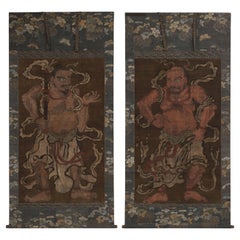
Pair of Japanese kakejiku 掛け軸 (hanging scrolls) depicting Niô guardians 仁王
Located in Amsterdam, NL
Pair of impressive, antique kakejiku (hanging scrolls) showcasing the awe-inspiring Niô guardians, also referred to as heavenly kings.
Each painting cap...
Category
Antique Early 18th Century Japanese Paintings and Screens
Materials
Brocade, Silk, Paint
$16,754 / set
Free Shipping
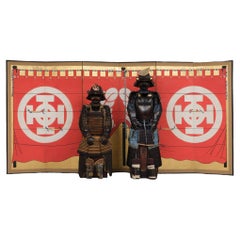
Rare set of 2 Japanese suits-of-armour, complete with 2 matching folding screens
Located in Amsterdam, NL
Important unique set of two suits-of-armour (yoroi), complete with two high six-panel screens, that belong together as is indicated by the used family crests (mon). Two crests are used, both belonging to the Nakagawa family of Oka Castle, Ôita prefecture on Kyûshû.
They are:
– the Nakagawa-kurusu, a circle depicting a Celtic-like cross through a ring.
The cross was originally a Christian symbol but after the ban on Christianity in Japan the use of a hidden cross in family crests could continue.
– the Nakagawa-kashiwa, two leaves of the Japanese Emperor Oak turned to each other (dakikashiwa mon).
The remarkable aspect of this ensemble is the presence of matching crests on both the yoroi and the accompanying folding screens. The kurusu and kashiwa crests adorning the yoroi are elegantly replicated on the screens, providing compelling evidence that these pieces form a harmonious and unified set. This exceptional cohesion between the armour and screens further enhances their artistic and historical value.
After the warlord Toyotomi Hideyoshi (1537-1598) had interfered in the battle between the Lord of Bungo Province Ôtomo Yoshi-mune (1558-1605) and the Shimazu of Hyûga Province, he split the Bungo Province in a number of small fiefs and transferred in 1594 Nakagawa Hideshige (1570-1612) from Miki Castle
in the Harima Fief to Oka Castle in Kyûshû.
The Nakagawa family stayed in possession of Oka Castle till the abolishment of the military use of castles in 1873. In 1884 the Nakagawa family received the title of Count (a title in use till the abolishment of aristocracy in 1947).
After the Nakagawa’s left, the castle and the building soon dilapidated and is now known as Oka Castle Ruins. The castle is located in Taketa Village part of Taketa Town in Ôita Province on Kyûshû.
> Set of two tall byôbu (folding screens),
painted with large red jinmaku (camp enclosure curtain) on a gold leaf ground. The curtains show both crests of the Nakagawa family: one screen depicts two Nakagawa-kurusu crests next to a Nakagawa-kashi crest in the middle, and the other shows the symbols the other way round.
Dimensions:
Total width 148.66 in/377.6 cm (2 x 25.35 in/64.4 cm, 4 x 24.48 in/62.2 cm); Height 72.63 in/184.5 cm.
Period: Japan – Late Edo period (First half 19th century), and maybe even older.
> Yoroi with Nakagawa-kashiwa crest:
A Japanese black lacquered suit-of-armour (yoroi) completely laced with orange cords (kuro’urushinuri hi’ito odoshi nimai’dô’maru).
A thirty-two plate suji’bachi kabuto (helmet with raised ridges) with in front a maedate (fore crest) -with traces of gilding- in the shape of flames, resembling a mythical flaming bird flying down. The fukikaeshi (face guards) and the mabizashi (visor) have the Nakagawa-kashiwa crest in gold maki-e lacquer.
Five curved ‘itazane’-plate neck guards (shikoro) laced with orange cords.
Together with an ‘angry man...
Category
Antique 18th Century Japanese Antiquities
Materials
Gold Leaf, Iron, Metal
You May Also Like
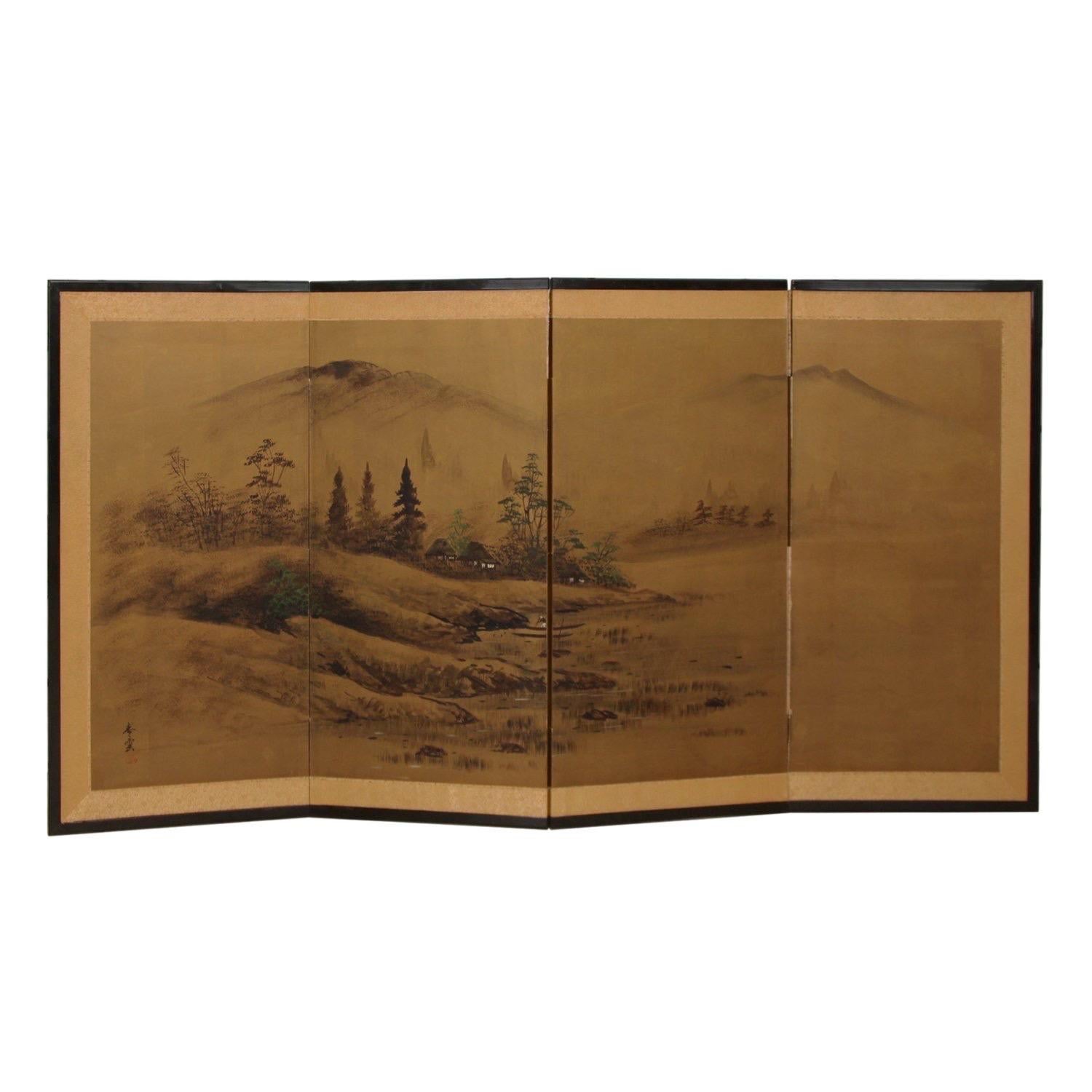
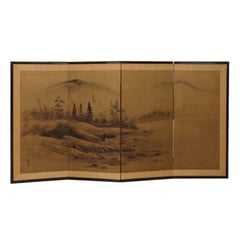
Antique Japanese Taisho Period Byobu Four Panel Folding Screen
Located in New York, NY
Antique Byobu Four Panel Screen.
Japan, late 19th to early 20th century. Taisho period.
Category
Antique Late 19th Century Japanese Paintings and Screens
Materials
Paper
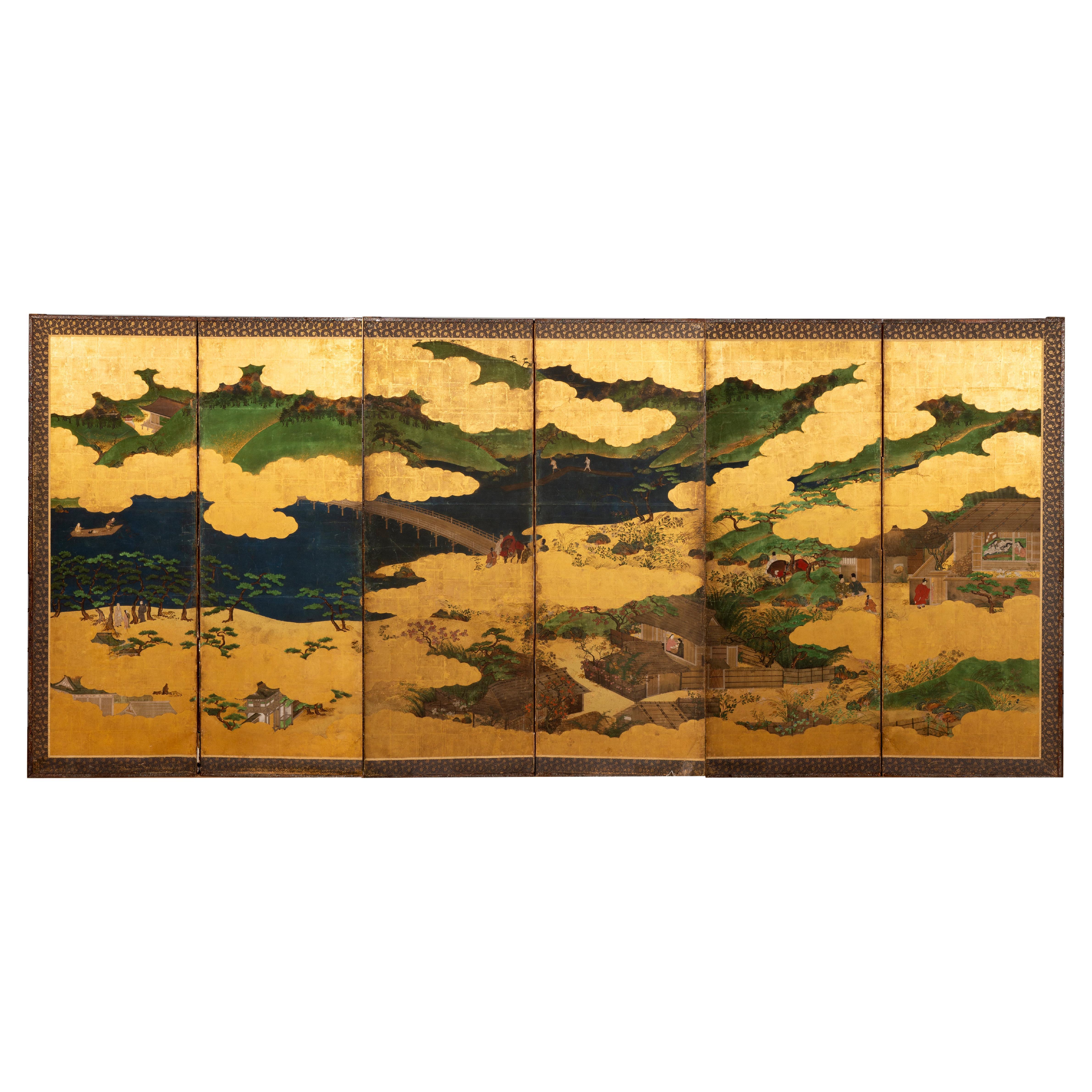
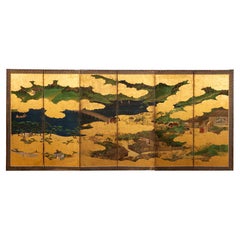
Japanese Six Panel Paper Screen
Located in Essex, MA
Six panel Tosa school with rich colors depicting a river and bridge. Featuring people in various pursuits. Descended in the Thayer family of Massachusetts.
Category
Antique 1750s Japanese Paintings and Screens
Materials
Paper
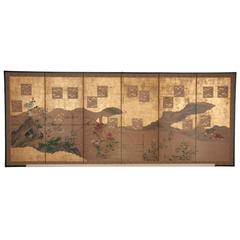
Japanese Six-Panel Screen
Located in Stamford, CT
A six-panel Japanese paper screen with poems, autumn flowers, bamboo fence and Mandarin ducks. Poems are believed to be earlier but were probably...
Category
Antique Mid-19th Century Japanese Edo Paintings and Screens
Materials
Paper
$19,900
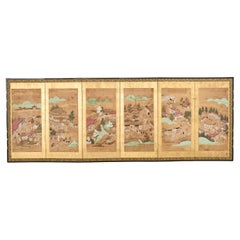
19th Century Japanese Edo Six Panel Screen Scenes of Kyoto
Located in Rio Vista, CA
Fascinating Japanese 19th century Edo period six-panel Rakuchu Rakugai folding byobu screen featuring scenes in and around the capitol Kyoto, Japan. This type of non-commissioned scr...
Category
Antique 19th Century Japanese Edo Paintings and Screens
Materials
Brass, Gold Leaf
Japanese Six Panel Screen: Scenes in and Around Kyoto,
Rakuchu Rakugai-Zu
Located in Hudson, NY
The left two panels is the intersection of the Tokaido (an important and historical road that connects Kyoto with Tokyo) at Sanjo (Sanjo translates to "Third Street" and is the main ...
Category
Antique 18th Century Japanese Paintings and Screens
Materials
Gold Leaf
20th Century Japanese Six Panel River Screen
Located in Locust Valley, NY
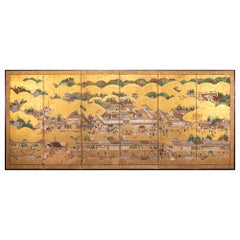
This 20th Century Japanese Six-Panel River Screen is a beautiful example of traditional Japanese screen art, featuring a serene river scene. These ...
Category
20th Century Unknown Anglo-Japanese Paintings and Screens
Materials
Wood, Paper
More Ways To Browse
Antique Folding Screen
20th Century Folding Screen
Antique Yoke
Antique Yokes
20th Century Japanese Folding Screen
Japanese Folding Screen Art
Byobu Panel
Japanese Lacquer Panel Screen
Japanese Byobu
Antique Japanese Lacquer Screens
Japanese Silver Leaf
Lacquered Folding Screen
Hand Painted 4 Panel Screen
Silver Japanese Painting
Antique Asian Folding Screen
Hand Painted Silk Panels
Japanese Screens Byobu
Japanese Screen Silver