Items Similar to Late 17th Century Japanese Screen. Puppy and Kittens on Gold Leaf.
Want more images or videos?
Request additional images or videos from the seller
1 of 10
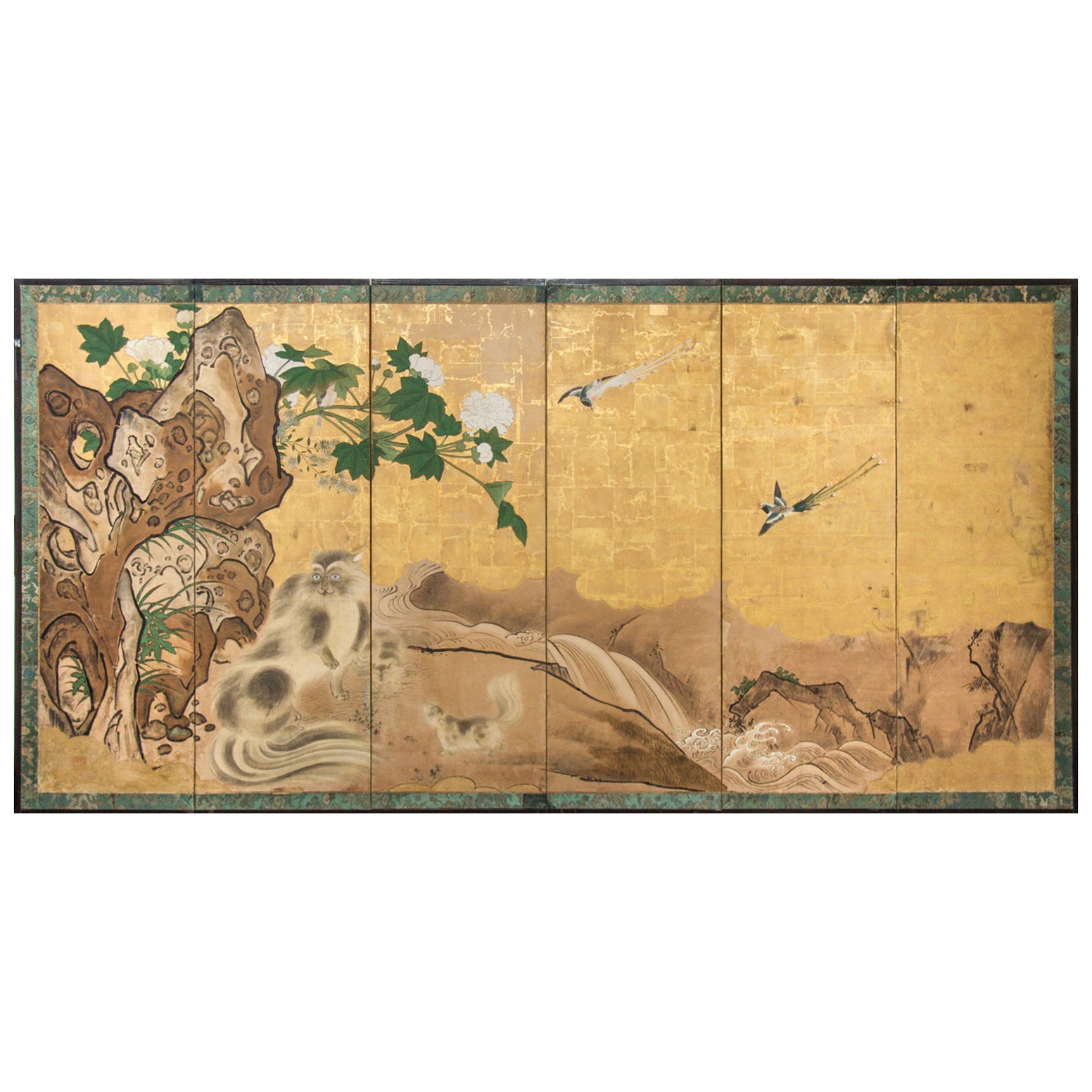
Late 17th Century Japanese Screen. Puppy and Kittens on Gold Leaf.
$32,500
£24,788.74
€28,228.39
CA$45,672.41
A$49,812.18
CHF 26,387.13
MX$597,177.36
NOK 336,054.81
SEK 307,297.19
DKK 210,893.67
About the Item
Anonymous
Late 17th century
Puppy
Kittens
A six-panel Japanese screen. Ink, color, gofun, gold-leaf and gold-fleck on paper.
A medium sized late 17th century Japanese screen featuring a playful narrative scene with a puppy and four kittens. The puppy, adorned with a red ribbon and medallion, is pictured prancing toward the nonchalant group of kittens. The exuberance and movement of the puppy is contrasted against the stillness and nonchalance of the kittens. The distortion and exaggeration of the spotted and speckled kittens resembles the art of caricature; producing animated characters with a comical effect. Blooming in the field are Japanese violets (sumire), Dandelions (Tanpopo) and Japanese field horsertail (Tsukushi). These small flowers denote the season of spring, allowing us further insight into the mood of the scene. The strong and simplified geometric plain is delineated with gold leaf in the upper field and tsunago or gold flecks in the lower field.
Far from the modern age with its more precise awareness of realistic sketching, these cats and dogs were inspired by Chinese paintings from the 12th century Song dynasty. These were kept in Japan with the Shogunate and in temples and circulated amongst the heads of the Kano schools of painting. Given the age of the screen and its likely Kano school origins the imagery would have held strong auspicious meaning. As a painting subject, although not as common as other auspicious animal imagery, dogs generally conveyed ideas of prosperity, family harmony, and fertility; thus they were often portrayed in familial groups or as puppies playing. Dogs were also featured as the animals with the closest relationship to humans, hence the ribbon on the puppy. Cats, as well as being depicted as charming and cute creatures, have also been associated with fertility and family well-being.
The screen bears a signature which reads Douo hitsu, which simply means painted by Douo. It is quite unusual that it is without any seals of the artist and may well be a later, spurious addition to the screen.
- Dimensions:Height: 44 in (111.76 cm)Width: 119 in (302.26 cm)Depth: 0.75 in (1.91 cm)
- Style:Edo (Of the Period)
- Materials and Techniques:
- Place of Origin:
- Period:Late 17th Century
- Date of Manufacture:Circa 1680
- Condition:Refinished. Wear consistent with age and use. The screen has recently been completely remounted in Kyoto utilizing traditional craftsmen and techniques.
- Seller Location:Kyoto, JP
- Reference Number:1stDibs: LU2472336574172
About the Seller
5.0
Recognized Seller
These prestigious sellers are industry leaders and represent the highest echelon for item quality and design.
Gold Seller
Premium sellers maintaining a 4.3+ rating and 24-hour response times
Established in 2001
1stDibs seller since 2016
75 sales on 1stDibs
Typical response time: 6 hours
- ShippingRetrieving quote...Shipping from: Kyoto, Japan
- Return Policy
More From This Seller
View AllJapanese Screen Painting, Circa 1700
Tales of Ise
by Tosa Mitsusuke
By Tosa Mitsusuke 1
Located in Kyoto, JP
A six-fold Japanese screen by Tosa Mitsusuke (1675-1710), Japan 17th-18th century, Edo period.
The signature reads Shoroku-i ge Tosa sa Konoe Shogen Mit...
Category
Antique Late 17th Century Japanese Edo Paintings and Screens
Materials
Gold Leaf
Japanese Screen Painting, Early 19th Century, Autumn Flowers by Sakai Hoitsu
Located in Kyoto, JP
A two-fold Japanese screen by the Rimpa school artist Sakai Hoitsu (1761-1828), Japan, 19th century, Edo period.
This small Japanese folding screen pai...
Category
Antique Early 19th Century Japanese Edo Paintings and Screens
Materials
Wood, Silk
Circa 1920 Japanese Screen. Cat
Mouse Harvest Scene on Gold Silk.
Located in Kyoto, JP
The narrative playfulness of the scene depicted on this Japanese screen sets alight what is at its core a celebration of a bountiful harvest. The screen offers a visual representatio...
Category
Early 20th Century Japanese Taisho Paintings and Screens
Materials
Gold
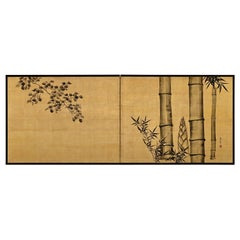
19th Century Japanese Screen for Tea-Ceremony, Ink Bamboo and Plum on Gold Leaf
Located in Kyoto, JP
Three Friends of Winter
Nakajima Raisho (1796-1871)
Late Edo period, circa 1850
Ink and gold leaf on paper.
This is a double-sided Japanese Furosaki or tea-ceremony screen from the mid 19th century; bamboo and plum on the front, young pines the back. It by Nakajima Raisho, a master painter of the Maruyama school in the late Edo and early Meiji periods. In this work Raisho combines exquisite ink brushwork with large open spaces of brilliant gold-leaf to inspire the viewers imagination. Rather than naturalism, he is searching for the phycological impression of the motifs, resulting in abstraction and stylization. His simplification of the motifs the result of looking to capture the inner nature of the objects. This art motif is known as Sho Chiku Bai, or the Three Friends of Winter. Evergreen pine connotes steadfastness, bamboo suggests both strength and flexibility, while plum blossoms unfurling on snow-laden branches imply hardiness. Combined, this trio is emblematic of Japanese new year. Chinese literati were the first to group the three plants together due to their noble characteristics. Like these resilient plants flowering so beautifully in winter, it was expected of the scholar-gentleman to cultivate a strong character with which he would be able to show the same degree of perseverance and steadfastness even during times of adverse conditions.
The screen would have been placed near the hearth of a room used for the Japanese tea ceremony, shielding the fire from draughts and also forming a stimulating and decorative backdrop behind the tea utensils. It would have been used in the Hatsugama, or first tea-ceremony of the new year.
Nakajima Raisho (1796-1871) originally studied under Watanabe Nangaku before entering the school of Maruyama Ozui. He was the highest ranking Maruyama school painter at the end of the Edo period and was known as one of the ‘Four Heian Families’ along with Kishi...
Category
Antique Mid-19th Century Japanese Edo Paintings and Screens
Materials
Gold Leaf
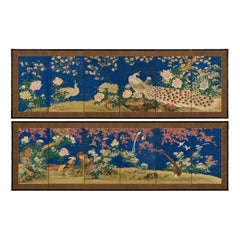
Mid 19th Century Japanese Screen Pair. Flowers
Birds of the Four Seasons.
Located in Kyoto, JP
Shioka Sorin (1781-1850)
Flowers & Birds of the Four Seasons
Pair of six-panel Japanese Screens. Ink, gofun and pigments on silk.
Dimensions (each screen): H. 91.5cm x W. 285cm (3...
Category
Antique Mid-19th Century Japanese Edo Paintings and Screens
Materials
Silk
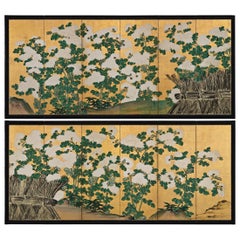
Mid-18th Century Japanese Screen Pair, One Hundred Flowers, Chrysanthemums
Located in Kyoto, JP
Omori Soun (b. 1704)
Chrysanthemums - One Hundred Flowers
A Pair of Six-fold Japanese Screens. Ink, color, gofun and gold leaf on paper.
Dating ...
Category
Antique Mid-18th Century Japanese Edo Paintings and Screens
Materials
Gold Leaf
You May Also Like
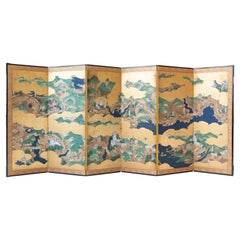
Early 19th century Japanese Screen with Village Scenes, on Gold Leaf
Located in New York, NY
A striking antique six-fold Japanese screen. This is one of a pair. See other listing.
The subject is "Tokaido", which features famous locations between Tokyo and Kyoto. The desig...
Category
Antique Early 19th Century Japanese Paintings and Screens
Materials
Gold Leaf
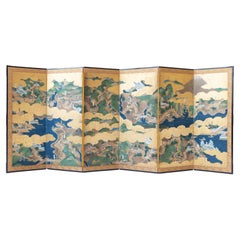
Early 19th century Japanese Screen with Village Scenes on Gold Leaf
Located in New York, NY
A striking antique six-fold Japanese screen. This is one of a pair.
The subject is "Tokaido", which features famous locations between Tokyo and Kyoto. The design is beautifully det...
Category
Antique Early 19th Century Japanese Paintings and Screens
Materials
Gold Leaf
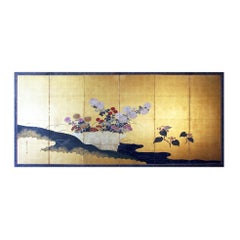
Japanese Byobu - Japanese Folding Screen Gold Leaf
By Japanese Studio
Located in Brescia, IT
Floral scene of a "Rimpa School" garden with polychrome chrysanthemum flowers.
Six-panel screen painted with pigments on golden rice paper of good size and well preserved.
Bold color...
Category
Antique Early 19th Century Japanese Edo Paintings and Screens
Materials
Gold Leaf
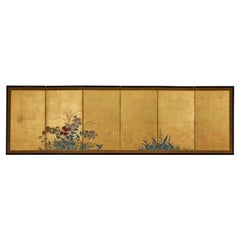
Japanese Six Panel Screen: Rimpa Style Summer Flowers on Gold
Located in Hudson, NY
Red and yellow chrysanthemums and pampass grasses. Meiji period (1868 - 1912), Rimpa style painting in mineral pigments on mulberry paper with a silk brocade border.
Category
Antique Late 19th Century Japanese Paintings and Screens
Materials
Brocade, Silk, Paper
Japanese Screen Landscape on Gold Leaf with Inks
By Japanese Studio
Located in Brescia, IT
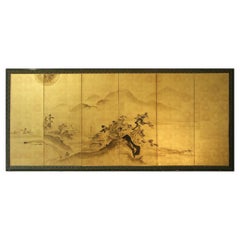
Six-panel screen from the Tosa school painted with ink on gold leaf depicting a relaxing oriental landscape with pagodas, figures on boats and a beautiful sun in the sky.
The screen ...
Category
Antique Late 19th Century Japanese Meiji Paintings and Screens
Materials
Gold Leaf
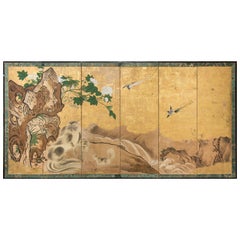
Japanese Six Panel Screen Mother Cat and Kittens Near Rushing Stream
Located in Hudson, NY
Kano School painting, in mineral pigments and gold leaf on mulberry paper with a silk brocade border. Artist seal reads: Hokkyo Unsen.
Category
Antique Early 19th Century Japanese Paintings and Screens
Materials
Gold Leaf
More Ways To Browse
Edo Screen Gold
17th Century Japanese Paintings
17th Century Japanese Screens
Japanese Puppies
Japanese Showa Screen
20th Century Japanese Folding Screen
Japanese Folding Screen Art
19th Century Chinese Painting On Silk
Byobu Panel
Four Panel Asian Art
Gold Folding Screen
China Silk Panels
Chinese Silk Panel
Japanese Lacquer Panel Screen
Flower And Bird Painting
19th Century Japanese Scroll
Lattice Panel
Vintage Japanese Flower Art