Items Similar to Meiji Era, Circa 1900 Japanese Screen Pair, Flowers
Birds of Spring
Autumn
Want more images or videos?
Request additional images or videos from the seller
1 of 12
Meiji Era, Circa 1900 Japanese Screen Pair, Flowers
Birds of Spring
Autumn
$32,000per set
£24,174.82per set
€27,723.27per set
CA$44,649.89per set
A$48,592.80per set
CHF 25,759per set
MX$584,608.51per set
NOK 326,706.82per set
SEK 298,913.86per set
DKK 207,113.86per set
About the Item
Flowers
Birds of Spring and Autumn
Unknown artist.
Japan. Meiji period, circa 1900.
A pair of six-fold screens. Ink, color, gofun and gold leaf on paper.
Signed: Gaga Sha
Top Seal: Minamoto Shoji In
Bottom Seal: Meiryu
Dimensions:
Each screen H. 68” x W. 148” (173cm x 376cm)
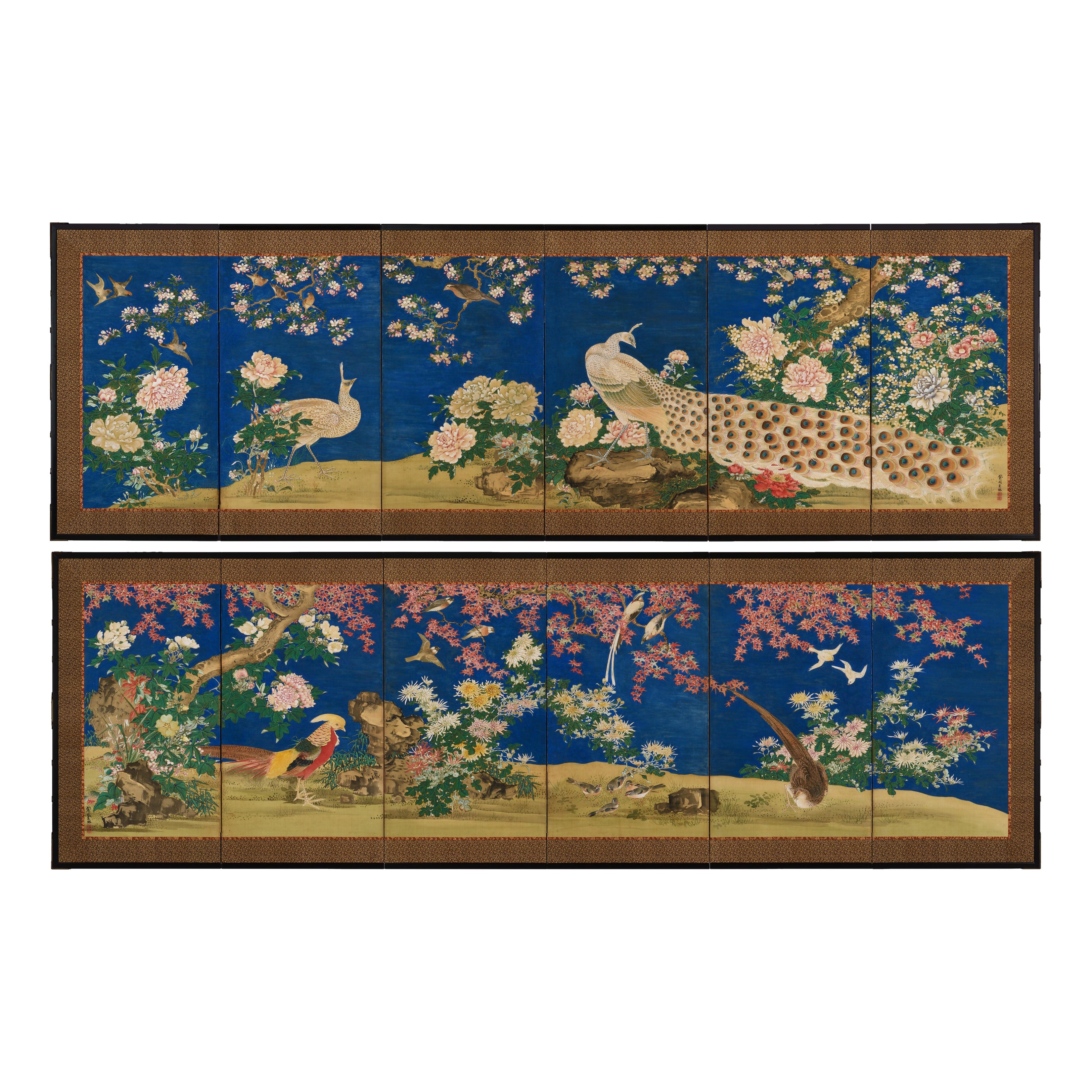
A pair of six-fold Japanese flower and bird screens from the late Meiji period. The cherry blossom tree on the right screen paired with sparrows represents spring, and on the left screen, the maple tree with its turning leaves and the flock of Japanese tits symbolizes autumn. Painted at the turn of the 20th century the artist was clearly caught up in the wave of modernization which stimulated young Japanese painters at the time. Rather than the modest coloring of the then dominant Maruyama/Shijo schools of painting the artist used saturated colors to create a vivid and dramatic effect. Similarly the daring composition has moved away from the typically lyrical qualities found in earlier compositions. Here, the artist depicts a scene of life at the top of the trees, a realm where humans are rarely able to enter. The ancient trees are contrasted strongly against the youthful exuberance of the birds and their song, color and excitement resonate across the screens. The fleeting beauty of the cherry blossoms and autumn foliage illustrates all too perfectly that nothing in this world is permanent, everything passes away at some point. A sad but beautiful admiration for this impermanence has been an important part of the Japanese mindset since ancient times. In Japanese, it's called "mono no aware." Another highlight of this expansive bird-and-flower painting is the artist’s ability to capture movement. Like a piece of animation, with each bird, we can imagine the series of moments before and after the painted scene.
- Dimensions:Height: 68 in (172.72 cm)Width: 148 in (375.92 cm)Depth: 0.75 in (1.91 cm)
- Sold As:Set of 2
- Style:Meiji (Of the Period)
- Materials and Techniques:
- Place of Origin:
- Period:
- Date of Manufacture:circa 1900
- Condition:Wear consistent with age and use. The screens are in good, original condition.
- Seller Location:Kyoto, JP
- Reference Number:1stDibs: LU2472325540322
About the Seller
5.0
Recognized Seller
These prestigious sellers are industry leaders and represent the highest echelon for item quality and design.
Gold Seller
Premium sellers maintaining a 4.3+ rating and 24-hour response times
Established in 2001
1stDibs seller since 2016
75 sales on 1stDibs
Typical response time: 6 hours
- ShippingRetrieving quote...Shipping from: Kyoto, Japan
- Return Policy
More From This Seller
View AllMid 19th Century Japanese Screen Pair. Flowers
Birds of the Four Seasons.
Located in Kyoto, JP
Shioka Sorin (1781-1850)
Flowers & Birds of the Four Seasons
Pair of six-panel Japanese Screens. Ink, gofun and pigments on silk.
Dimensions (each screen): H. 91.5cm x W. 285cm (3...
Category
Antique Mid-19th Century Japanese Edo Paintings and Screens
Materials
Silk
Meiji era Japanese Screen Pair, Two-panel. Spring
Autumn Birds
Flowers.
Located in Kyoto, JP
Spring and Autumn Birds & Flowers
Hasegawa Gyokujun (1863-1921)
Meiji period, circa 1900.
Ink, color and gofun on silk.
Dimensions of each screen:
H. 172 cm x W. 188 cm (68’’ x 7...
Category
Early 20th Century Japanese Meiji Paintings and Screens
Materials
Gold Leaf
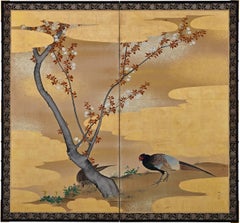
Early 19th Century Japanese Screen. Cherry Blossom
Pheasants by Mori Tetsuzan
Located in Kyoto, JP
Mori Tetsuzan (1775-1841)
Pheasants and Cherry Blossoms
Two-fold Japanese screen. Ink, color, gofun, gold and silver on paper.
A two-fold Japanese bir...
Category
Antique Early 19th Century Japanese Edo Paintings and Screens
Materials
Gold Leaf
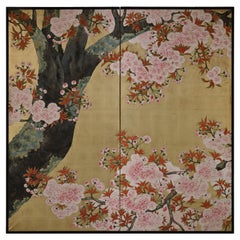
Early 20th Century Japanese Cherry Blossom Screen by Kano Sanrakuki
Located in Kyoto, JP
Cherry Blossoms
Kano Sanrakuki (1898-1981)
Showa period, circa 1930
2-panel Japanese Screen
Color, gofun and gold leaf on paper
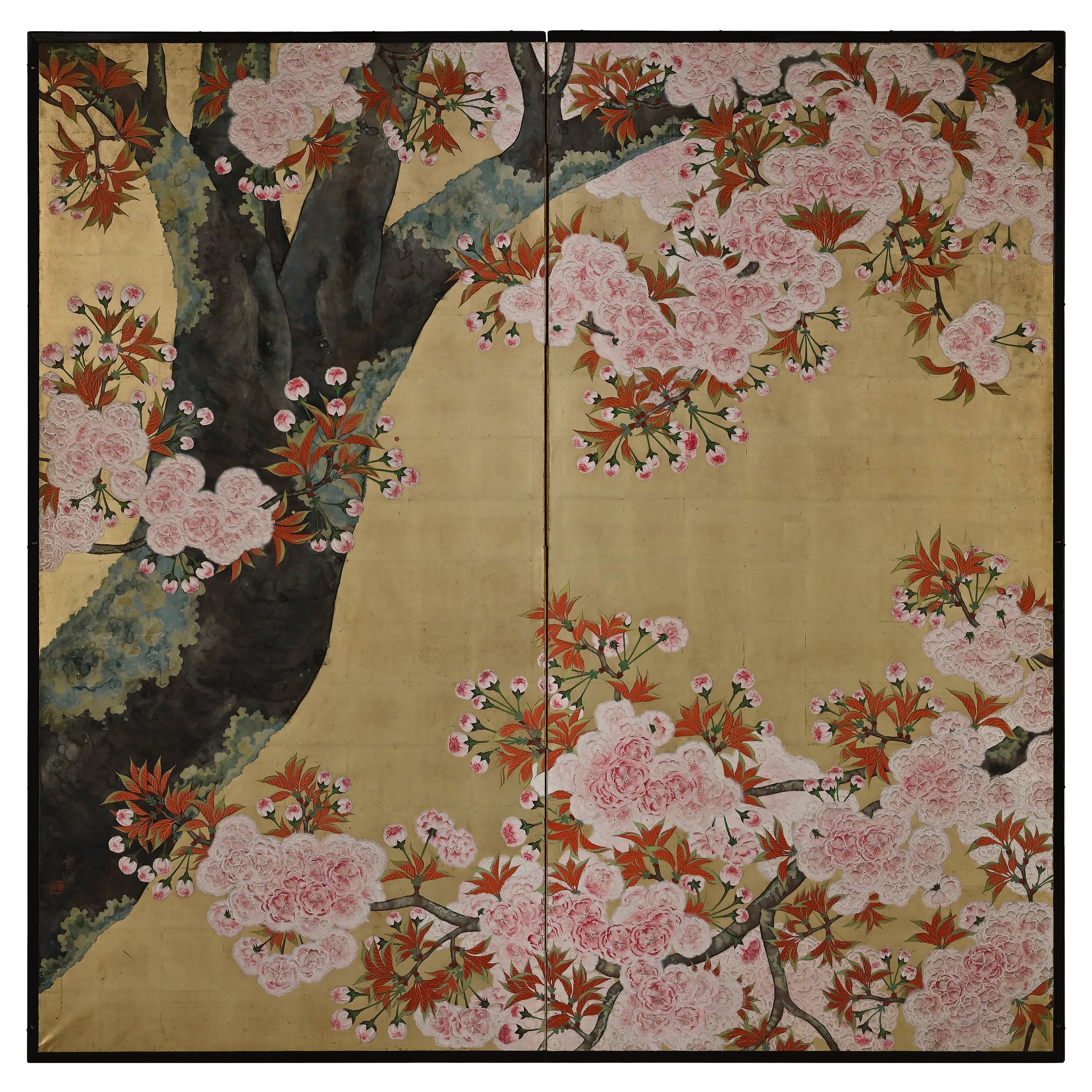
Against a backdrop of gold-leafed ground, the lichen covered trunk and branches of the life-sized cherry blossom tree reach out and beyond the confines of the pictorial surface. The overall composition has a feeling of flatness which draws emphasis to the surface and the three-dimensionality of the cherry blossoms. Painstakingly built-up layers of thickly applied shell-white gofun detail the voluminous blossoms and cover large areas of this tour-de-force of Japanese Nihonga painting. By simplifying the background, minimizing the number of colors and depicting the blossoms with such heavy relief, the artist has emphasized the stunning presence of the cherry tree. The type of tree depicted is the Yae-Zakura; a double-layered type of cherry blossom famed for its beauty and strength. When we think of Japanese cherry blossoms, the first thing that comes to mind is Somei Yoshino variety, which has a single flower with five almost white petals. This type is fragile and easily blown away by strong wind or rain. Most of the double-flowered cherry blossoms begin to bloom when the Somei-Yoshino falls, and the flowering period lasts longer than that of the Somei-Yoshino.
Kano Sanrakuki originally studied painting at the Kyoto City Arts and Crafts School under the tutelage of Yamamoto Shunkyo...
Category
Early 20th Century Japanese Showa Paintings and Screens
Materials
Gold Leaf
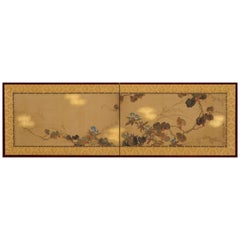
Japanese Screen Painting, Early 19th Century, Autumn Flowers by Sakai Hoitsu
Located in Kyoto, JP
A two-fold Japanese screen by the Rimpa school artist Sakai Hoitsu (1761-1828), Japan, 19th century, Edo period.
This small Japanese folding screen pai...
Category
Antique Early 19th Century Japanese Edo Paintings and Screens
Materials
Wood, Silk
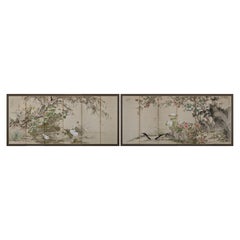
19th Century Japanese Screen Pair - Birds
Flowers of the Four Seasons
Located in Kyoto, JP
Birds & Flowers of the Four Seasons
Yamamoto Baiitsu (1783-1856)
Late Edo period, Dated 1850
A magnificent pair of six-panel Japanese folding screens by Yamamoto Baitsu, representin...
Category
Antique Mid-19th Century Japanese Edo Paintings and Screens
Materials
Wood, Paper
You May Also Like
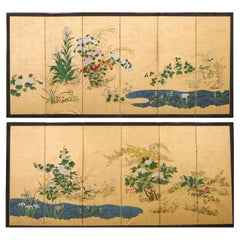
Pair of Japanese Meiji Screens Blossoms of Spring, Summer and Autumn
Located in Rio Vista, CA
Amazing pair of late 19th/early 20th century Japanese Meiji period byobu screens depicting flowering plants and blossoms of the spring, summer, and autumn. Painted in the Nihonga sch...
Category
Antique 19th Century Japanese Meiji Paintings and Screens
Materials
Brass, Gold Leaf
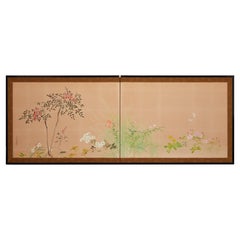
Japanese Two Panel Screen: Winter into Spring Floral Landscape
Located in Hudson, NY
With nandin, narcissus and chrysanthemums. Signature and seal read: Koun. Mineral pigments on mulberry paper with a silk brocade border.
Category
Early 20th Century Japanese Paintings and Screens
Materials
Brocade, Silk, Paper
Japanese Two Panel Screen: Summer Flowers
Located in Hudson, NY
Screen depicts Summer flowers and birds on gilded silk. Signature reads: Konishi Fukunen. Notes about Artist: Konishi Fukunen (1887-1959) was born the second son of the Paper mounting specialist Konishi Uhei in Takeo, Fukui prefecture in the mid Meiji period. In 1902 he was sent to Kyoto to study painting under Suzuki Shonen...
Category
Mid-20th Century Japanese Paintings and Screens
Materials
Silk
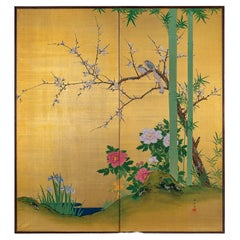
Japanese "Magpie and Peony" Two Panel Screen, Edo Period, 18th/19th century
Located in Austin, TX
A sublime Japanese two panel "Magpie and Peony" screen, ink and color on paper, Edo Period, late 18th or early 19th century, circa 1800, Japan.
The two panel screen features a wond...
Category
Antique Early 19th Century Japanese Edo Paintings and Screens
Materials
Copper
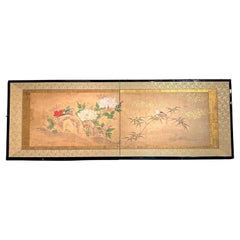
Japanese Four Panel Screen, Autumn Flowers
Located in Hudson, NY
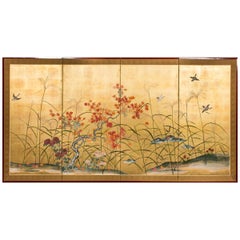
Taisho period painting (1912-1926) of a fall landscape with wild grasses, red maple, and dahlias. Mineral pigments on gold with a silk brocade border and beautiful metal mounts.
Category
Vintage 1920s Japanese Taisho Paintings and Screens
Materials
Silk, Wood, Paper
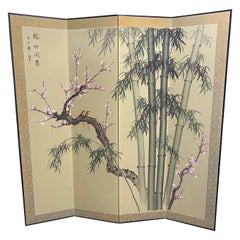
Japanese Asian Signed Large Four-Panel Byobu Screen Bamboo Cherry Blossoms Birds
Located in Studio City, CA
A gorgeous large/tall four-panel Japanese Byobu folding screen depicting a nature scene/landscape with playful yellow and orange birds frolicking in nature among the branches of a bl...
Category
20th Century Japanese Showa Paintings and Screens
Materials
Silk
More Ways To Browse
Flower Paintings
Cherry Blossom Trees
Circa 1900 Paintings
Japanese Bird Art
Antique Furniture Springs
Japanese Flower Painting
20th Century Japanese Folding Screen
Flower And Bird Painting
Asian Bird Paintings
Japanese Screens Flowers
Circa 1890 Paintings
Japanese Paper Flowers
Pair Of Japanese Screens
Pair Of Japanese Paintings
Folding Screen Gold Leaf
Cherry Blossom Screen
Japanese Autumn Screen
Meiji Era Screen