Items Similar to Mid 19th Century Japanese Screen Pair. Flowers
Birds of the Four Seasons.

Want more images or videos?
Request additional images or videos from the seller
1 of 14
Mid 19th Century Japanese Screen Pair. Flowers
Birds of the Four Seasons.
$68,000per set
£51,400.13per set
€58,958.08per set
CA$94,794.80per set
A$103,191.87per set
CHF 54,774.29per set
MX$1,241,620.30per set
NOK 694,064.71per set
SEK 635,959.41per set
DKK 440,295.41per set
About the Item
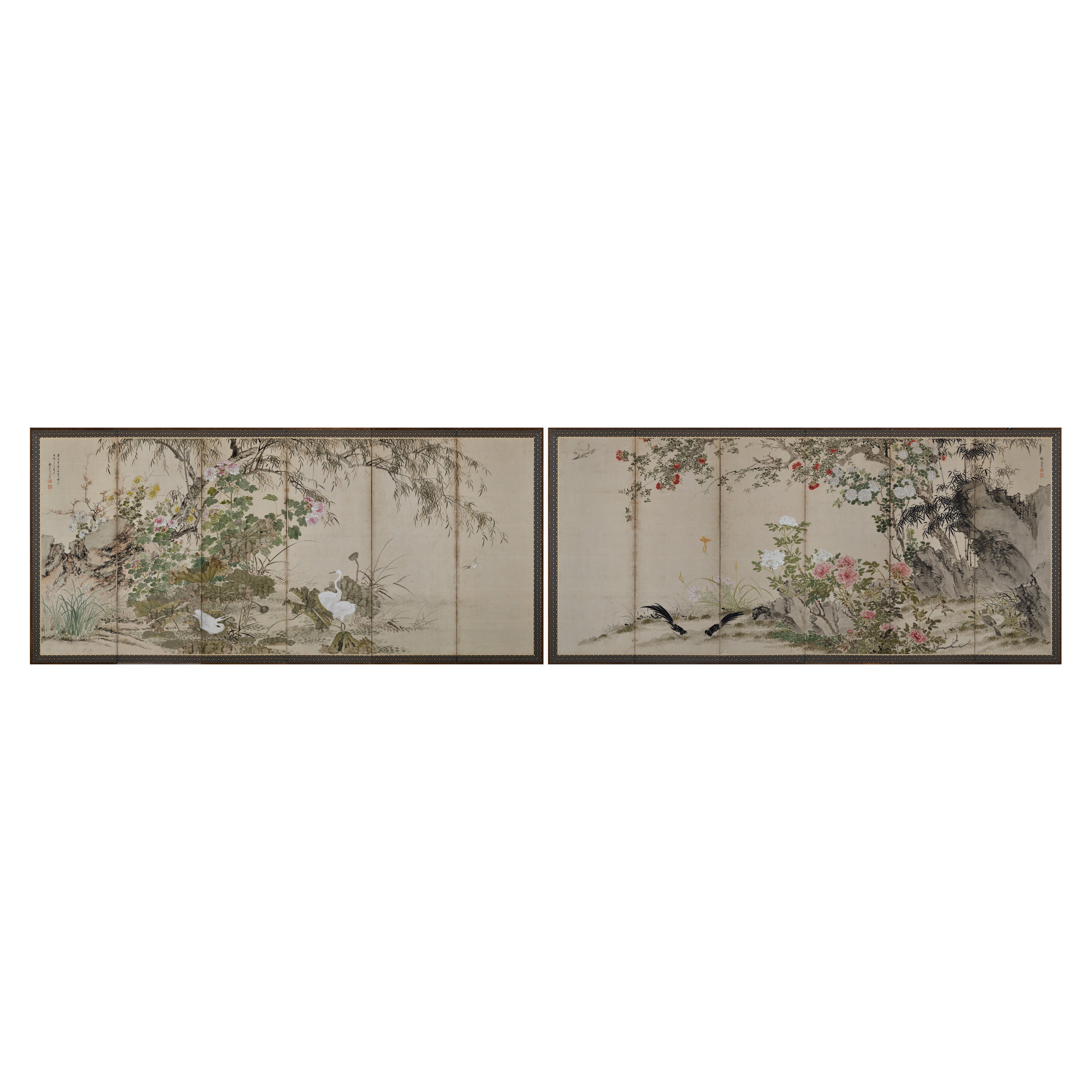
Shioka Sorin (1781-1850)
Flowers
Birds of the Four Seasons
Pair of six-panel Japanese Screens. Ink, gofun and pigments on silk.
Dimensions (each screen): H. 91.5cm x W. 285cm (36” x 112”)
A pair of smaller Japanese six-fold screens by the Nanpin school artist Shioka Sorin (1781-1850). The highly decorative flowers of these Japanese screens evoke the passage of the seasons from Spring through to Winter. Flowering crabapple and peonies denote spring and summer on the right screen. On the left screen ornamental chrysanthemums, maple and hibiscus represent autumn and the red berries at the extreme left lead us in to winter. The white peacocks and Chinese pheasants are depicted for their extraordinary plumage and colors, with the flowers and birds combining to create a brilliant patterned effect. Almost the entire surface of the silk panels are covered in mineral pigments which contributes greatly to the tactile richness of the surface.
Colorful Chinese flower and bird paintings were created by court painters during the Ming dynasty (1368–1644) to decorate the grand halls of imperial palaces, where they could also serve as metaphors for the emperor and his court. However, Japanese artists transformed the courtly Chinese painting tradition into more exquisite, decorative and distinctive 'Japanese' style. From the 17th century on, patrons of the arts came from more than just the ruling classes. As the buying power of the traditional elites of the aristocracy and samurai dwindled, wealth increased among merchants, who were long considered at the bottom of the social scale. The merchant class patronized newly formed groups of artists who better represented their aesthetics and interests. Paintings from the Nanpin school in a naturalistic manner reflected a fascination with the exotic and a burgeoning interest in empirical science. This new style introduced through Nagasaki spread to the art world in Kamigata (Kyōto and Ōsaka) and Edo, giving rise to a new style of painting which had a significant impact on the future direction of Japanese art. Their work, mostly of flower and bird subjects, derives from a blend of realism with a brightly colored decorative manner. The Chinese artist Shen Nanpin (Shen Quan) is credited as being the originator of the style, arriving in Japan in 1731. He was a relatively unknown painter of the Ming academic style though quickly gained great fame in Japan.
Shiokawa Sorin (1781-1850) was the son of So Shizan (1733-1805) and the grandson of So Shiseki (1715-1786). A native of Edo, he inherited and continued the family painting traditions and passed on their Nanpin style. His grandfather, So Shiseki, was a very influential artist in Japanese painting history. He took the Nanpin school beyond its origins in Nagasaki and beyond its basis in bird and flower subjects. Among his most famous students were Shiba Kokan and Sakai Hoitsu.
- Dimensions:Height: 36 in (91.44 cm)Width: 112 in (284.48 cm)Depth: 0.75 in (1.91 cm)
- Sold As:Set of 2
- Style:Edo (Of the Period)
- Materials and Techniques:
- Place of Origin:
- Period:
- Date of Manufacture:Circa 1830
- Condition:Refinished. Wear consistent with age and use. The screens have been completely restored and remounted in Kyoto utilizing traditional craftsmen and techniques.
- Seller Location:Kyoto, JP
- Reference Number:1stDibs: LU2472341985232
About the Seller
5.0
Recognized Seller
These prestigious sellers are industry leaders and represent the highest echelon for item quality and design.
Gold Seller
Premium sellers maintaining a 4.3+ rating and 24-hour response times
Established in 2001
1stDibs seller since 2016
75 sales on 1stDibs
Typical response time: 6 hours
- ShippingRetrieving quote...Shipping from: Kyoto, Japan
- Return Policy
More From This Seller
View AllMeiji Era, Circa 1900 Japanese Screen Pair, Flowers
Birds of Spring
Autumn
Located in Kyoto, JP
Flowers & Birds of Spring and Autumn
Unknown artist.
Japan. Meiji period, circa 1900.
A pair of six-fold screens. Ink, color, gofun and gold leaf on paper.
Signed: Gaga S...
Category
Antique 1890s Japanese Meiji Paintings and Screens
Materials
Gold Leaf
19th Century Japanese Screen Pair - Birds
Flowers of the Four Seasons
Located in Kyoto, JP
Birds & Flowers of the Four Seasons
Yamamoto Baiitsu (1783-1856)
Late Edo period, Dated 1850
A magnificent pair of six-panel Japanese folding screens by Yamamoto Baitsu, representin...
Category
Antique Mid-19th Century Japanese Edo Paintings and Screens
Materials
Wood, Paper
Early 19th Century Japanese Screen. Cherry Blossom
Pheasants by Mori Tetsuzan
Located in Kyoto, JP
Mori Tetsuzan (1775-1841)
Pheasants and Cherry Blossoms
Two-fold Japanese screen. Ink, color, gofun, gold and silver on paper.
A two-fold Japanese bir...
Category
Antique Early 19th Century Japanese Edo Paintings and Screens
Materials
Gold Leaf
17th Century Japanese Screen Pair by Soga Nichokuan, Hawks on Pine
Plum Trees
Located in Kyoto, JP
Hawks on plum and pine
Soga Nichokuan (active circa 1625-1660)
Pair of six-fold screens.
Ink, mineral pigments, gofun, gold and speckled gold l...
Category
Antique 1640s Japanese Edo Paintings and Screens
Materials
Wood, Paper
Meiji era Japanese Screen Pair, Two-panel. Spring
Autumn Birds
Flowers.
Located in Kyoto, JP
Spring and Autumn Birds & Flowers
Hasegawa Gyokujun (1863-1921)
Meiji period, circa 1900.
Ink, color and gofun on silk.
Dimensions of each screen:
H. 172 cm x W. 188 cm (68’’ x 7...
Category
Early 20th Century Japanese Meiji Paintings and Screens
Materials
Gold Leaf
Japanese Screen Painting, Early 19th Century, Autumn Flowers by Sakai Hoitsu
Located in Kyoto, JP
A two-fold Japanese screen by the Rimpa school artist Sakai Hoitsu (1761-1828), Japan, 19th century, Edo period.
This small Japanese folding screen pai...
Category
Antique Early 19th Century Japanese Edo Paintings and Screens
Materials
Wood, Silk
You May Also Like
Japanese "Magpie and Peony" Two Panel Screen, Edo Period, 18th/19th century
Located in Austin, TX
A sublime Japanese two panel "Magpie and Peony" screen, ink and color on paper, Edo Period, late 18th or early 19th century, circa 1800, Japan.
The two panel screen features a wond...
Category
Antique Early 19th Century Japanese Edo Paintings and Screens
Materials
Copper
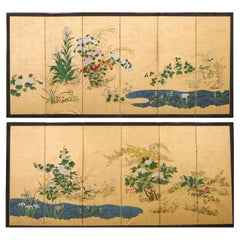
Pair of Japanese Meiji Screens Blossoms of Spring, Summer and Autumn
Located in Rio Vista, CA
Amazing pair of late 19th/early 20th century Japanese Meiji period byobu screens depicting flowering plants and blossoms of the spring, summer, and autumn. Painted in the Nihonga sch...
Category
Antique 19th Century Japanese Meiji Paintings and Screens
Materials
Brass, Gold Leaf
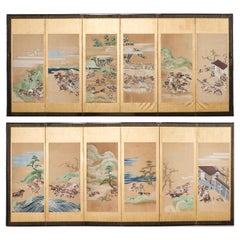
Pair of Japanese Edo/Tokugawa Screens Tale of Heiki
Located in Rio Vista, CA
Monumental pair of late 18th century Japanese Edo/Tokugawa period byobu screens depicting the battles between Taira and Minamoto. The screens have six panels each with individual sce...
Category
Antique 19th Century Japanese Edo Paintings and Screens
Materials
Brass, Gold Leaf
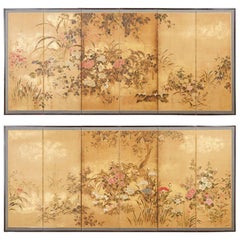
Pair of Japanese Edo Rimpa School Screens after Tawaraya Sōtatsu
Located in Rio Vista, CA
Impressive pair of 17th century Japanese Edo period Rinpa school screens made in the manner and style of Autumn Grasses by Tawaraya Sōtatsu (1570-1640). Beautifully decorated with wi...
Category
Antique 17th Century Japanese Edo Paintings and Screens
Materials
Gold Leaf
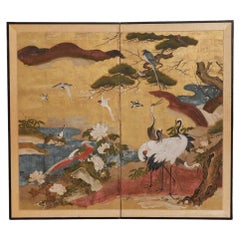
Antique Japanese Kachoga Kano School 2-Panel Screen, Edo Period
Located in Point Richmond, CA
Antique Japanese 2-panel Screen of Birds
Flowers in a Landscape Setting, Kano School, Edo Period. This Kachoga subject of birds and flowers contains a brilliant mix of a variet...
Category
Antique 18th Century Japanese Edo Paintings and Screens
Materials
Gold Leaf
Pair of Japanese Edo Six Panel Screens the Seven Sages
Located in Rio Vista, CA
Fantastic pair of 19th century Japanese late Edo/early Meiji period six-panel screens titled The seven sages of the bamboo grove. The Kano school screens...
Category
Antique 19th Century Japanese Edo Paintings and Screens
Materials
Brass, Gold Leaf

More Ways To Browse
Mid Century Screen
Emperor Japan
Antique Bird Painting
19th Century Flower Paintings
The Four Seasons 19th Century
White Peacock
Bird Paintings 19th Century
Mid Century Bird Paintings
Asian Bird Paintings
Japanese Screens Flowers
Peacock China
Japanese Birds Painted On Silk
Japanese Screen Black
Japanese Four Panel Silk Screen
Pair Of Japanese Screens
Four Panel Japanese Folding Screen
Bird Silk Art
Pair Of Japanese Paintings