18th Century and Earlier Paintings and Screens
to
14
88
28
162
1
1
162
689
954
148
303
213
115
40
3
30
16
13
24
35
28
29
9
107
70
62
60
57
152
142
110
28
6
162
162
162
4
2
1
1
1
Period: 18th Century and Earlier
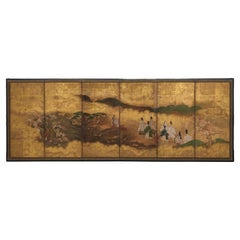
Mid-size 6-panel byôbu 屏風 with a scene from The Tale of Genji
Located in Amsterdam, NL
A refined medium-sized six-panel byôbu (folding screen) showcasing a classical autumn court scene from chapter 7 of The Tale of Genji (Genji Monogatari), titled Momiji no Ga (The Aut...
Category
Japanese Antique 18th Century and Earlier Paintings and Screens
Materials
Metal, Gold Leaf
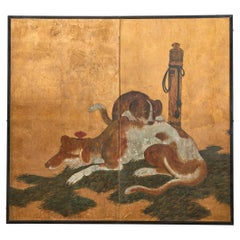
Japanese Two Panel Screen: European Hounds
Located in Hudson, NY
18th century painting of European hound and her pup. Mineral pigments on gold leaf with black lacquer trim.
Category
Japanese Antique 18th Century and Earlier Paintings and Screens
Materials
Gold Leaf
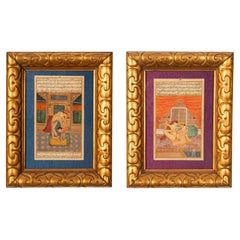
Antique 18th Century Pair Indian Hindu Erotic Kamasutra Miniature Paintings 1750
Located in Portland, OR
A fine quality pair of antique 18th century Indian erotic Kamasutra paintings, circa 1750.
The paintings most likely North-East India or possibly Nepal, are very finely painted with ...
Category
Indian Anglo-Indian Antique 18th Century and Earlier Paintings and Screens
Materials
Paint
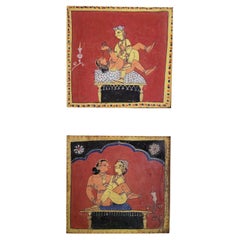
Pair of Indian Erotic Paintings from a Kama Sutra Series
Located in Dallas, TX
Presenting a stunning piece of Indian antiquity from the 17th century, namely, a pair of indian erotic paintings from a kama sutra series.
India, Orissa, 17th century.
Hand-painted on cloth canvas.
These have impeccable Provenance!
They were purchased by a Private Dallas Collector at Christie’s New York Auction on 19th September 2002. Sale Number 1115, Lot No. 251.
Christie’s operate a twice yearly auction of Southeast Asian Art & Antiquities in New York in the months of March and September.
The Lot was described as: “Two Erotic Paintings from a Karma Sutra...
Category
Indian Archaistic Antique 18th Century and Earlier Paintings and Screens
Materials
Canvas
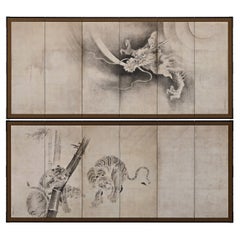
17th Century Japanese Screen Pair. Tiger
Dragon by Kaiho Yusetsu
Located in Kyoto, JP
Kaiho Yusetsu (1598-1677)
Tiger and Dragon
Early Edo Period, Circa 1650
A Pair of Six-fold Japanese Screens. Ink and slight color on paper.
Dimensions:
Each screen: H. 171 cm x W. 380 cm (67.5’’ x 149.5’’)
In this pair of early Edo period Japanese screens a group of tigers prowl in a bamboo grove whipped with fierce wind, while a dragon claws through clouds and mist. The dragon embodies elemental qualities - looming out of the mist, the coils of its body disappearing in the clouds. The dragon is calling for rain, symbolizing spring which is considered the fountain of life. On the other side, the tigers calls for the wind, symbolizing autumn which is considered the end of life. Tigers were familiar motifs within Japanese art from ancient times though the animals were imaginary to the people in the 17th century. While dragons and tigers are usually associated as sacred and ferocious, in this painting, both animals have rather amusing expressions. The tigers appear to glare at the dragon with cat-like eyes, and the look on the swirling dragon’s face appears almost affectionate - lending a playful flair to an otherwise magnificent theme.
The tiger and dragon are cosmological symbols of the balancing forces in the world. Screens such as this were originally meant to express the fluctuating nature of the world. For Japanese in the early Edo period, they likely suggested the powers of the cosmos. In Japan the tiger and dragon motif was originally absorbed into the circles of Zen monasteries before spreading into the secular world. The theme especially appealed to the military classes with the Kano school, the official painters to the Shogun and the samurai, being the leading contributors. The painter of this pair of screens, Kaiho Yusetsu (1598-1677), was closely patronized by the third Shogun Tokugawa Iemitsu. In his later years he worked with Kano school artists...
Category
Japanese Edo Antique 18th Century and Earlier Paintings and Screens
Materials
Silk, Wood, Paper
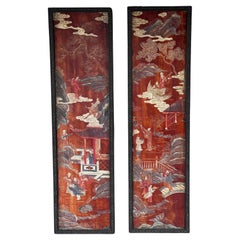
Pair of 18th Century Coromandel Panels with Chinese Chippendale Frames
Located in Bradenton, FL
Pair of 18th century Coromandel panels with Chinese Chippendale Frames. with a scene depicting figures with pavilions and having Chinese Chippendale ebonized fretwork carved frames.
Category
Chinese Chinese Chippendale Antique 18th Century and Earlier Paintings and Screens
Materials
Lacquer
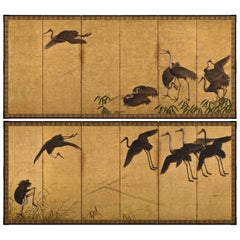
17th Century Japanese Screen Pair. Flock of Cranes. Ink and color on gold leaf.
Located in Kyoto, JP
A pair of six-fold Japanese screens from the 17th century depicting a flock of cranes arriving at their wintering grounds. The expansive scene is heavily atmospheric. The cranes are...
Category
Japanese Edo Antique 18th Century and Earlier Paintings and Screens
Materials
Gold Leaf
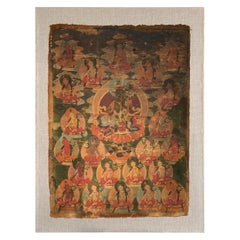
18th Century Tibetan Thangka Painting
Located in Chicago, IL
A rare striking 18th century Tibetan Thangka depicting the Green Tara seated on a lotus throne ready to step down to offer comfort and pro...
Category
Tibetan Tibetan Antique 18th Century and Earlier Paintings and Screens
Materials
Linen, Paint
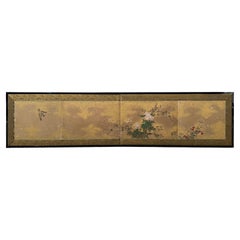
Japanese Screen: Spring Offering
Located in Fukuoka, JP
Spring Offering is a small yet exquisitely refined Edo-period screen originally created as a backdrop for a Girls’ Day altar. Against a softly shimmering gold-leaf background, delica...
Category
Japanese Edo Antique 18th Century and Earlier Paintings and Screens
Materials
Paper, Wood

$1,250 Sale Price
56% Off
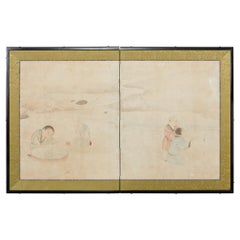
Japanese Edo Two Panel Screen Children Playing Catching Fish
Located in Rio Vista, CA
Delightful late 18th century/early 19th century Japanese Edo period two panel byobu screen depicting children at play near a riverbank and catching fish. Painted in the Maruyama-Shij...
Category
Japanese Edo Antique 18th Century and Earlier Paintings and Screens
Materials
Silk, Wood, Paper
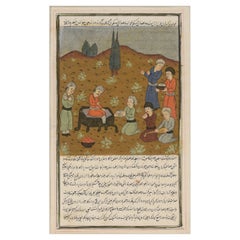
Persian Manuscript Page - Garden Scene
Located in Soquel, CA
Persian Manuscript Page depicting a garden scene. Circa 18th century.
Hand painted scene depicts a hilly outdoor landscape where people are congre...
Category
Persian Islamic Antique 18th Century and Earlier Paintings and Screens
Materials
Gold Leaf
$600 / item
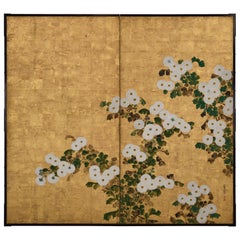
18th Century Japanese Rinpa Screen. White Chrysanthemums. School of Korin.
Located in Kyoto, JP
School of Ogata Korin
White Chrysanthemums
18th Century, Edo period.
A two-panel Japanese screen. Ink, color, gofun and gold leaf on paper.
Dimensions: H. 171 cm x W. 188 cm (67.5” x 74”)
On this two-panel Japanese screen we see blooming chrysanthemums, a flower which embodies the essence of autumn in Japan. Here the traditional floral theme has been simplified and stylized. The bright colors and asymmetrical composition against the delicate gold leaf create a luxurious and ornate work of art. Its background, a strikingly patinated grid of gold leaf, denies any sense of place or time and imbues everything with an ethereal glow. The leaves and stems of the plants are nothing more than pools of mottled color and ink without any outline whatsoever. These are typical Rinpa adaptations of traditional ink painting methods; tarashikomi, or diluted washes of color blended while very wet, and mokkotsu, or “bonelessness,” which creates forms without exterior outlines. The relief work of the rounded flower petals has been obtained by the moriage process (a mixture based on ground shells modeled on the surface of the paper).
On the lower right of the screen, the siganture “Hokyo Korin Jakumyo” and the “Hoshuku” seal can be read. Korin is Ogata Korin, famed for the Irises (Nezu Museum) and Red and White Plum Blossom (MOA Museum of Art) folding screens, both National Treasures. Korin worked in both Kyoto and Edo in the mid-Edo period. Korin was using the art name “Jakumyo” just after he received the Hokyo level, which was in 1701.
This particular screen was published in May of 1961 in the Japanese Sansai Fine Art Magazine*. An in depth article accompanies the photograph of the screen and and a photograph of the signature and seal. This article devotes much of its body to discussing the moriage technique, how it enlivens the chrysanthemum flowers and Korin’s specific skill in using the technique. The article goes on to discuss the most famous works of Korin, utilizing this technique, which were known at the time. Specifically a two-panel screen held in the Honolulu Museum which was discovered in the store-house of Takahashi Soan. A two-panel screen pair which the Nakano family own. A two-panel screen pair with chrysanthemums in moriage in fan designs owned by the Nomura family. Also a small folding screen featuring chrysanthemums held in the Yamato Bunkakan. The article goes on to say that this particular two-fold screen came from the Nijo family. Korin is known to have had a strong connection with the aristocratic Nijo family. The article explains that Korin received a lot of favors from the Nijo family and that this screen would have been gifted to them.
Since that time the Honolulu screen has been amended to ‘attributed to Ogata Korin’ and I do not know further details of the other 3 screens. Other Chrysanthemum screens...
Category
Japanese Edo Antique 18th Century and Earlier Paintings and Screens
Materials
Gold Leaf
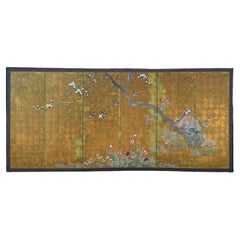
Japanese screen: Melody of Magnolia Blossoms
Located in Fukuoka, JP
Bathed in radiant gold, Melody of Magnolia Blossoms captures the fleeting harmony of nature in bloom. A graceful magnolia branch arcs across the shimmering surface, its petals unfold...
Category
Japanese Edo Antique 18th Century and Earlier Paintings and Screens
Materials
Paper, Wood
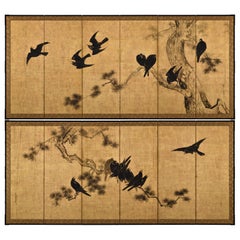
Mid 18th Century Japanese Screen Pair. Crows
Pines by Unkoku Toshuku.
Located in Kyoto, JP
Unkoku Toshuku (1722-1779)
Crows and Pines
A pair of six-panel Japanese Screens. Ink and gold leaf on paper.
Dimensions: Each Screen: H. 170.5 cm x W. 375 cm
Haha-cho or mynah birds, whose forms resemble crows in artwork, were commonly depicted in Japanese art. These types of paintings were originally modeled on paintings attributed to the 13th century Chinese painter Muqi (Mokkei), whose art was enormously influential in Japan. Crows only became a theme among Japanese artists from the later 1500s onward. They likely were inspired by these imported Chinese paintings of myna birds, which are not native to Japan, substituting the native species of crow instead.
The best known early examples of the depiction of Japanese crows are two Momoyama screen...
Category
Japanese Edo Antique 18th Century and Earlier Paintings and Screens
Materials
Gold Leaf
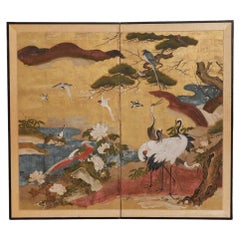
Antique Japanese Kachoga Kano School 2-Panel Screen, Edo Period
Located in Point Richmond, CA
Antique Japanese 2-panel Screen of Birds
Flowers in a Landscape Setting, Kano School, Edo Period. This Kachoga subject of birds and flowers contains a brilliant mix of a variet...
Category
Japanese Edo Antique 18th Century and Earlier Paintings and Screens
Materials
Gold Leaf
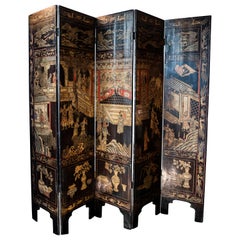
18th Century Five-Panel Chinese Coromandel Screel
Located in CABA, AR
Transport yourself back to the opulent splendor of the 18th century with this magnificent Chinese five-panel black Coromandel screen, a true m...
Category
Chinese Chinese Export Antique 18th Century and Earlier Paintings and Screens
Materials
Gold Leaf
$10,500 Sale Price
30% Off
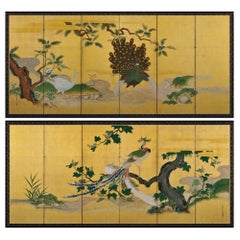
Japanese Screen Pair, circa 1730, Peacocks and Phoenix, Kano School
Located in Kyoto, JP
Phoenix and Peacocks.
A pair of six-panel Japanese folding screens by Tsunetake Yotei (n.d.)
First half of the 18th century.
The signature reads 67 year old Tsunetake.
The seals read:
-Tsunetake no in,
-Yotei,
-Seishin
Dimensions:
Each screen – H. 69” x W. 149” (176 cm x 378 cm)
A pair of Kano Grand Picture (Waga) screens depicting phoenix and peacocks rich with symbolic meaning. Dating to the first half of the 18th century, from the Kobikicho Kano school in Edo, this pair of folding...
Category
Asian Edo Antique 18th Century and Earlier Paintings and Screens
Materials
Gold Leaf
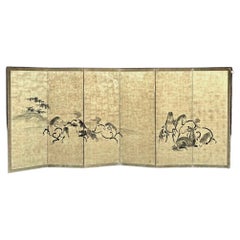
Elegant Horse Screen. In style of Kano Tanshin
By Kano Tanshin
Located in Fukuoka, JP
Ink on gold.
This continuation of equine grace unfolds across a stunning gold-leaf backdrop, capturing the essence of nobility that horses represent in Japanese lore.
The screen de...
Category
Japanese Edo Antique 18th Century and Earlier Paintings and Screens
Materials
Gold Leaf
$8,500 Sale Price
38% Off
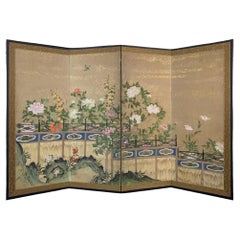
Peony Blossoms Screen
Located in Fukuoka, JP
Peony Blossoms Screen
Period: Edo period 18-19th century
Size: 212 x 138 cm (83.5 x 54.3 inches)
SKU: PJ105
Experience a rare gem from Japan's heritage – an Edo period peony blosso...
Category
Japanese Edo Antique 18th Century and Earlier Paintings and Screens
Materials
Paper, Silk
$5,760
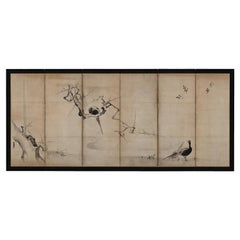
17th Century Japanese Screen. Ink Plum Tree
Birds by Kano Naonobu.
Located in Kyoto, JP
Kano Naonobu (1607-1650)
Plum Tree and Birds
Six-fold Japanese Screen. Ink and slight color on paper.
In this evocative ink work spread over a six-panel folding screen, we see the consummation of the elegance and refinement of the Edo Kano school. This 17th century screen is a rare surviving example of a large-scale bird and flower painting by Kano Naonobu, the younger brother of Kano Tanyu...
Category
Japanese Edo Antique 18th Century and Earlier Paintings and Screens
Materials
Wood, Paper
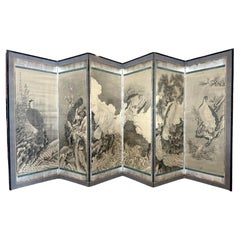
Rare Japanese Floor Screen of Perched Eagles Soga Shohaku Edo period
Located in Atlanta, GA
A rare six-panel Japanese folding floor screen (Byōbu) by Soga Shōhaku (1730-1781) from Edo period. The screen depicts six perched hawk-eagles in various poses positioned in a litera...
Category
Japanese Edo Antique 18th Century and Earlier Paintings and Screens
Materials
Brocade, Wood, Paper
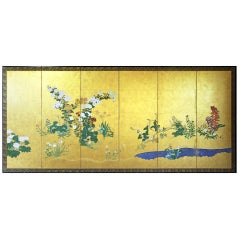
Edo Landscape Japanese Folding Screen
Located in Brescia, IT
Refined work by a painter from the first half of the 19th century, from the landscape of the "Rinpa" school by a painter from the end of the 18th century, the Rinpa school.
Six panels painted in ink on gold leaf and "gofun" on vegetable paper.
The flowers are made with the "gofun" technique, natural or pigmented white oyster powder.
Rinpa is one of the major historical schools of Japanese painting. The style was consolidated by the brothers Ogata Korin (1658–1716) and Ogata Kenzan (1663–1743).
This folding screen has a very clean design that leaves plenty of room for the beautiful golden landscape.
It comes flat and you can easily hang it with our hooks.
Lucio Morini...
Category
Japanese Edo Antique 18th Century and Earlier Paintings and Screens
Materials
Gold Leaf
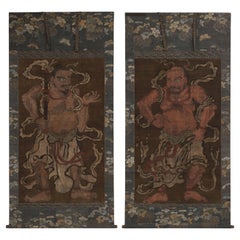
Pair of Japanese kakejiku 掛け軸 (hanging scrolls) depicting Niô guardians 仁王
Located in Amsterdam, NL
Pair of impressive, antique kakejiku (hanging scrolls) showcasing the awe-inspiring Niô guardians, also referred to as heavenly kings.
Each painting cap...
Category
Japanese Antique 18th Century and Earlier Paintings and Screens
Materials
Brocade, Silk, Paint
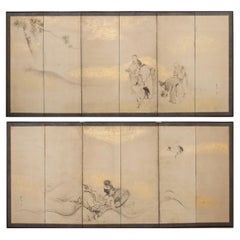
Pair of 18th Century Japanese Edo Screens of Chinese Immortals
Located in Rio Vista, CA
Mesmerizing pair of late 18th/early 19th century Japanese Edo period byobu screens by Shibata Gito (Japanese 1780-1819). The paintings depict Chinese immortals in a dreamy landscape....
Category
Japanese Edo Antique 18th Century and Earlier Paintings and Screens
Materials
Silk, Wood, Paper
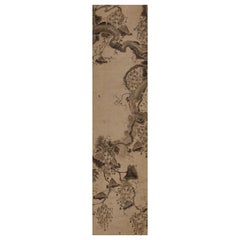
17th Century Korean Grapevine and Squirrel Scroll Painting, Mid Joseon Period
Located in Kyoto, JP
Anonymous. Korean, 17th century. Joseon period.
Hanging scroll. Ink on paper.
Seal: Shinso
Dimensions:
Scroll: H. 200 cm x W. 31 cm (79” x 12”)
Image: H. 122 cm x W. 29.5 cm (48” x 11.5”)
The grapevine came to China and then Korea from western Asia via the silk road trade routes. By the mid-Joseon period, it was one of the most popular subjects for Korean literati painters. Grapevines were painted as a singular subject or, less commonly, in combination with squirrels, which are associated with children due to their playful nature. Together, grapevines and squirrels embody wishes for abundant offspring and wealth.
For the Korean literati artist the twisting vines, curling tendrils and round, plump grapes provided ample opportunity for expressive "brush play”. In this painting the artist has abstracted the scene and is seemingly unconcerned with discontinuities and proportion. Vines spring up from nowhere, grapes hang in random clusters and the squirrel’s head appears as if twisted backwards. For the vines and leaves we can feel a sense of speed in the brushstrokes, imparting a dynamic feel which is at once intense and animated. This contrasts dramatically with the countless tiny strokes of ink which realistically capture the texture of the squirrel’s fur...
Category
Korean Other Antique 18th Century and Earlier Paintings and Screens
Materials
Paper
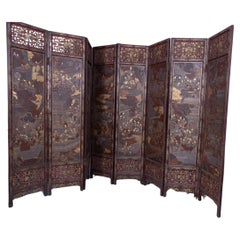
18th Century Chinese Heavily Detailed 8-Panel Coromandel Screen
Located in New Orleans, LA
18th century Chinese heavily detailed 8-panel Coromandel screen, decorated on either side, with carved open work at top and bottom of each panel, heavily gold-leafed. On the front ar...
Category
Chinese Antique 18th Century and Earlier Paintings and Screens
Materials
Giltwood
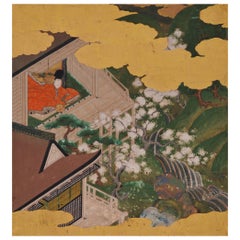
Japanese Painting, 17th Century, Tale of Genji, Tosa School
Located in Kyoto, JP
Illustration to an unidentified chapter of the Tale of Genji (Genji Monogatari)
Tosa School (second half of the 17th Century)
Ink, pigment, gofun and...
Category
Japanese Edo Antique 18th Century and Earlier Paintings and Screens
Materials
Gold Leaf
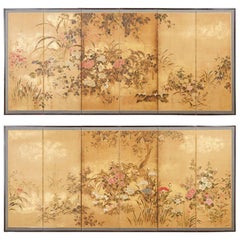
Pair of Japanese Edo Rimpa School Screens after Tawaraya Sōtatsu
Located in Rio Vista, CA
Impressive pair of 17th century Japanese Edo period Rinpa school screens made in the manner and style of Autumn Grasses by Tawaraya Sōtatsu (1570-1640). Beautifully decorated with wi...
Category
Japanese Edo Antique 18th Century and Earlier Paintings and Screens
Materials
Gold Leaf
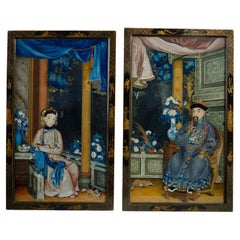
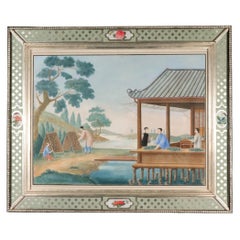
Pair Of Chinese Export Mirror Paintings
Located in London, GB
A FINE PAIR OF CHINESE EXPORT MIRROR PAINTINGS, LATE 18TH CENTURY.
Depicting a man and a woman seated on a terrace. Each in a Japanned frame.
Category
Antique 18th Century and Earlier Paintings and Screens
Materials
Mirror, Lacquer
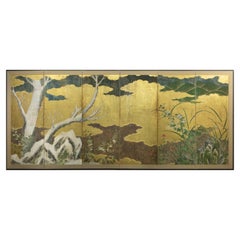
Japanese Six-Panel Screen Winter Into Spring
Located in Hudson, NY
With snow-covered willow tree, garden stone and winter berries. Right panels have spring flowers and a view of hills in the distance (likely the Higashiyama Hills painted in Kyoto by...
Category
Japanese Edo Antique 18th Century and Earlier Paintings and Screens
Materials
Gold Leaf
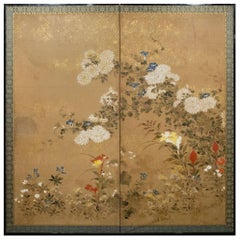
Japanese Two-Panel Screen, Flower Garden
Located in Hudson, NY
Rimpa School painting featuring cascading chrysanthemums as well as cockscombs, summer wild flowers, and a climbing morning glory vine. Beautifully executed, fine painting in mineral...
Category
Japanese Edo Antique 18th Century and Earlier Paintings and Screens
Materials
Gold Leaf
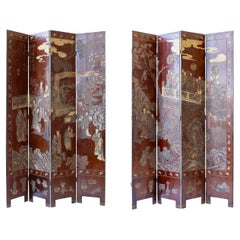
Late 18th/Early 19th Century Eight Panel Coromandel Screen, with Inscription
Located in New York, NY
A late 18th century Chinese carved Coromandel screen with beautiful warm brown background. On one side is a landscape and figure design with pavilions and figures in a rocky landsca...
Category
Chinese Antique 18th Century and Earlier Paintings and Screens
Materials
Wood, Lacquer
Korean Painting, Wall Panel, 17th Century Ink Grapevine
Located in Kyoto, JP
Grapevine
Anonymous. Korean, 17th century.
Wall panel, ink on paper.
Upper seal:
Kou Kinun in
Lower seal:
Kaigen
Dimensions:
Measures: 98.5 cm x 29.5 cm (39” ...
Category
Korean Other Antique 18th Century and Earlier Paintings and Screens
Materials
Wood, Paper
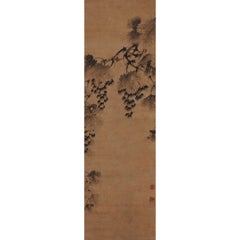
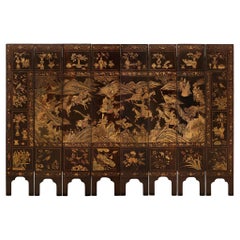
A spectacular Chinese 18th century Coromandel Lacquered 8-panel floor screen
Located in West Palm Beach, FL
A spectacular and most impressive Chinese 18th century Coromandel Lacquered screen. Each of the eight panels are raised by two feet formed from an urn shaped arch below a foliate decorated band. The center of each panel joins together to depict various scenes executed in the Kuan Cai or "incised colors" technique. The front side of the screen features bottom panels showing various birds on/near a variety of blooming trees, while the central panel depicts a battle scene on horseback through hills and forests. The tops show a variety of vases holding floral branches, and bowls of fruit mirroring...
Category
Chinese Chinese Export Antique 18th Century and Earlier Paintings and Screens
Materials
Wood
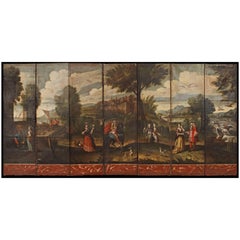
Spanish Colonial Screen
Located in Mexico, DF
Fantastic Spanish Colonial school screen. Probably from Peru. This screen, with a kind of European landscape, give us an idea of the influence ...
Category
Peruvian Spanish Colonial Antique 18th Century and Earlier Paintings and Screens
$380,000
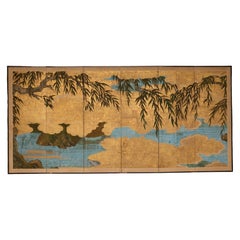
Japanese antique screen - EDO period - Willow over a stream
Located in Prahran, Victoria
Antique Japanese 6 panel screen from the early Edo period (C1650). One of a pair (both available). This magnificent golden screen shows...
Category
Japanese Edo Antique 18th Century and Earlier Paintings and Screens
Materials
Gold Leaf
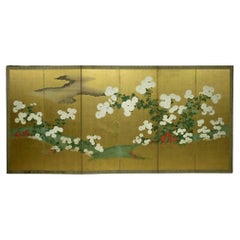
Late Edo Period Rinpa School Chrysanthemum Blossom Screen
By Rimpa School
Located in Fukuoka, JP
Late Edo Period Rinpa School Chrysanthemum Blossom Screen
Period: late Edo, early 19th century
Size: 364 x 172 cm (143 x 67 inches)
This exquisite late Edo period Rinpa school scr...
Category
Japanese Edo Antique 18th Century and Earlier Paintings and Screens
Materials
Paper
$7,660 Sale Price
20% Off
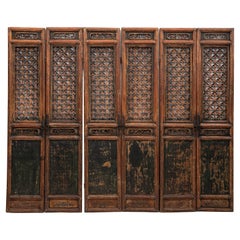
Set of 6 Antique Chinese Lattice Panels
Located in Kastrup, DK
Set of six wood carved Chinese 17-18th century Qing dynasty panels or room divider.
Each panel features an main section with an open fretwork design lattice panel window, comprised by a pattern of a connecting cherry blossoms. Relief foliate lattice design on the top and bottom of the window.
The bottom panels are designed with solid wood panels adorned with a hand painted flower motif at the bottom.
Panels such as these were used to easily divid- or open up a room. These Qing panels...
Category
Chinese Qing Antique 18th Century and Earlier Paintings and Screens
Materials
Wood
$6,957 / set
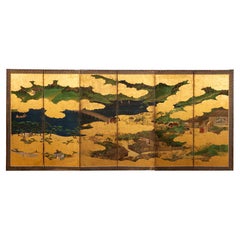
Japanese Six Panel Paper Screen
Located in Essex, MA
Six panel Tosa school with rich colors depicting a river and bridge. Featuring people in various pursuits. Descended in the Thayer family of Massachusetts.
Category
Japanese Antique 18th Century and Earlier Paintings and Screens
Materials
Paper
Japanese Two Panel Screen: Sudare on Gold Leaf
Located in Hudson, NY
This elegant Japanese two-panel screen masterfully combines traditional materials with striking minimalist composition. The screen features a dazzling and luminous background of gold...
Category
Japanese Antique 18th Century and Earlier Paintings and Screens
Materials
Brocade, Silk, Wood, Lacquer, Paper

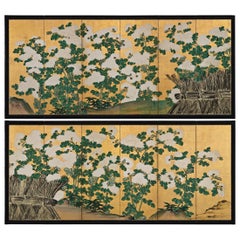
Mid-18th Century Japanese Screen Pair, One Hundred Flowers, Chrysanthemums
Located in Kyoto, JP
Omori Soun (b. 1704)
Chrysanthemums - One Hundred Flowers
A Pair of Six-fold Japanese Screens. Ink, color, gofun and gold leaf on paper.
Dating ...
Category
Japanese Edo Antique 18th Century and Earlier Paintings and Screens
Materials
Gold Leaf
China Trade Painting on Paper depicting the Feeding of Silkworms
Located in Downingtown, PA
China Trade Painting on Paper depicting Feeding of Silkworms,
Circa 1780-1800
This painting is a superb example of the artwork created by Chinese artists for the Western market, off...
Category
Chinese Chinese Export Antique 18th Century and Earlier Paintings and Screens
Materials
Paper
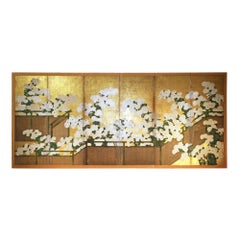
Japanese Screen mid Edo gold leaf
Located in Brescia, IT
This 18th century six-panel screen is truly special. The author is unknown, but his singular genius in portraying dozens of chrysanthemum flowers created with the white of the "gofun...
Category
Japanese Edo Antique 18th Century and Earlier Paintings and Screens
Materials
Gold Leaf
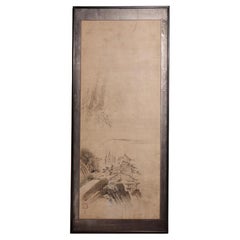
Antique Japanese Suibokuga Landscape by Kano Tokinobu, 17th century.
Located in Point Richmond, CA
Antique Japanese Suibokuga Landscape by Kano Tokinobu, 17th century. A sumi-e ink on paper painting illustrating a rocky seaside landscape containing buildings, vegetation and ship masts. The painting with 3 vermillion seals of the artist in the lower left corner. Japanese dry mount paper on a wood frame with thin brocade border silver leafed surround and lacquered wood outer frame.
Condition: Lighter discoloration near the bottom of the painting, various paper restorations, other minor signs of age, wear, stains, otherwise fine condition.
Age: Painting Edo Period, circa 1670. Mounting circa 1985.
Image: 51-1/2 in. x 20-1/2 in. (131cm x 52cm)
Frame: 59-1/4 in. x 25-1/4 in. (150cm x 64cm)
Weight: 6 lbs.
Provenance:
with Honeychurch Antiques...
Category
Japanese Edo Antique 18th Century and Earlier Paintings and Screens
Materials
Paper
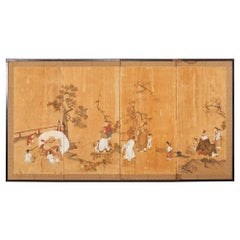
17th Century Japanese Edo Four Panel Screen Hotei with Chinese Sages
Located in Rio Vista, CA
Beautifully weathered late 17th/early 18th century Japanese edo period four panel byobu screen depicting hotei (fat monk) in a treed landscape with Chinese sages engaged in leisurely...
Category
Japanese Edo Antique 18th Century and Earlier Paintings and Screens
Materials
Brass
A Chinese mid 18th century Laquered Coromandel screen
Located in West Palm Beach, FL
A monumentally scaled and most important Chinese mid 18th century Laquered Coromandel screen. This finely detailed ten panel screen, with its original tempera paint, showcases a collection of continuous scenes depicting a landscape with pagodas, pavilions, a court of noblemen, women, and musicians. Each panel displays tones of rose, green, cafe brown, and gold on a dark rose ground within a border of wandering mischievous dragons and Greek key designs. The rear is tastefully decorated in the center with Chinese calligraphy relating to the story of the front with a border of flowers in vases, animals, and various figures.
This wonderful screen was formerly in the Collections of Viscount Furness and Lady Musker, as well as being sold by Mallet Antiques...
Category
Chinese Antique 18th Century and Earlier Paintings and Screens
Materials
Wood, Lacquer
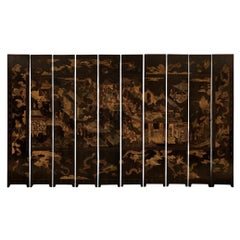
Evolving Elegance: An Oxidized Silver Screen from the Meiji Period
Located in Fukuoka, JP
This anodized 6-panel screen captures the serene and minimalistic beauty of a bamboo grove, embodying the aesthetic principles of the Edo period. The screen features subtle and delic...
Category
Japanese Edo Antique 18th Century and Earlier Paintings and Screens
Materials
Silver Leaf
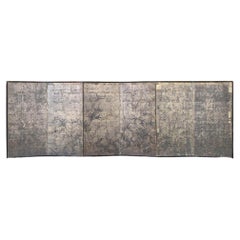
Japanese Asian Pair of Large Six-Panel Folding Byobu Screens Mythical Landscape
Located in Studio City, CA
A beautiful, alluring, wonderfully composed and engaging hand-painted large pair of six-panel Japanese/Asian Byobu folding screens depicting an almost magical/ mythical village scene...
Category
Japanese Meiji Antique 18th Century and Earlier Paintings and Screens
Materials
Gold Leaf
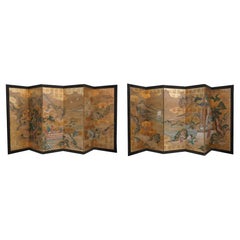
17th Century
Late 1600s
, Japanese Edo Period 12-Panel Folding Screen Painted
Located in North Miami, FL
A pair of 17th Century (Late 1600s) Japanese Edo screens made of 12-panels. This folding silk screen is painted on a gold leaf background. It has a...
Category
Japanese Edo Antique 18th Century and Earlier Paintings and Screens
Materials
Silk, Wood, Paint, Paper
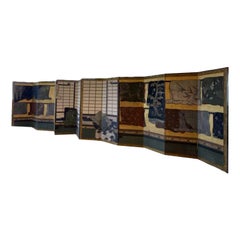
Rare Antique Japanese Folding Screen by Kano Tanshin
By Kano Tanshin
Located in Atlanta, GA
An exquisite Japanese folding screen painted and signed by Kano Tanshin (Morimasa) (1658-1719), circa early Edo Period. An important member of the Kano painter family, the son of Kano Tanyu...
Category
Japanese Japonisme Antique 18th Century and Earlier Paintings and Screens
Materials
Brass
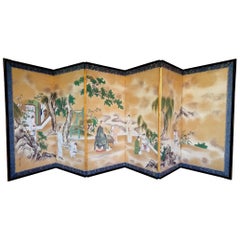
Japanese Six Panel Screen: Scenes in and Around Kyoto,
Rakuchu Rakugai-Zu
Located in Hudson, NY
The left two panels is the intersection of the Tokaido (an important and historical road that connects Kyoto with Tokyo) at Sanjo (Sanjo translates to "Third Street" and is the main ...
Category
Japanese Antique 18th Century and Earlier Paintings and Screens
Materials
Gold Leaf
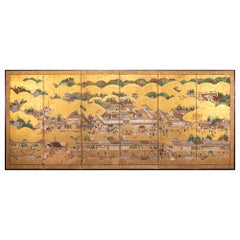
Late 17th Century Japanese Screen Pair. Battle of Ichi-no-tani and Yashima.
Located in Kyoto, JP
Anonymous
Late 17th Century
Battle of Ichi-no-tani & Yashima
Dimensions: Each Screen: H. 175 cm x W. 385 cm (69” x 151.5”)
This pair of Japanese screens depict two significant battles from the Genpei War (1180–85), as recounted in the Tale of the Heike, a semi-historical epic chronicling the conflict between rival clans for control of Japan, written in the early 1200s.
Each screen portrays a single battle through a series of small episodes, framed by gold clouds, landscape elements, and architectural features. True to the style of many screens inspired by The Tale of the Heike, the scenes are rendered in lavish colors and gold, downplaying the brutality of the warfare. Although based on real events, these narratives often glorified and romanticized the heroic feats of the warriors. Viewers at the time would have been familiar with the story’s details, leading to a proliferation of paintings on folding screens inspired by this theme from the late Muromachi to the early Edo periods.
On the right screen, we see the Minamoto’s attack on the Taira, who have retreated from the capital, Kyoto, toward the sea. The central building represents the temporary Taira headquarters, where Taira soldiers are holding the young Emperor Antoku. The Minamoto plan to launch a surprise attack from the rear after descending the steep cliff known as Ichi-no-tani, depicted at the top center. This scene highlights the tactical brilliance of Minamoto commander Yoshitsune and the courage of his men.
The left screen captures moments from the Battle of Yashima...
Category
Japanese Edo Antique 18th Century and Earlier Paintings and Screens
Materials
Gold Leaf
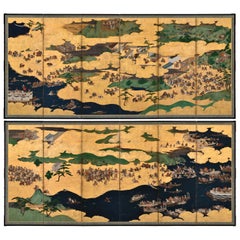
18th Century Six Panel japanese Screen with Samurai on Horses
Located in New York, NY
A spectacular six-panel Japanese screen dating to the 18th century. The screen depicts samurai warriors from the Tairo and Minamoto clans, who fought for control of Japan in the 12t...
Category
Japanese Antique 18th Century and Earlier Paintings and Screens
Materials
Gold Leaf
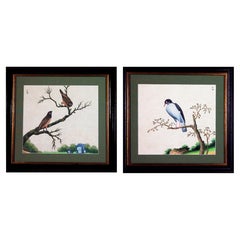
Chinese Export Watercolor Exotic Bird Paintings on Paper
Located in Downingtown, PA
Natural History of the East: Pair of Fine Chinese Export Bird Watercolors
(c. 1800–1820)
A superb pair of early 19th-century Chinese Export ...
Category
Chinese Chinese Export Antique 18th Century and Earlier Paintings and Screens
Materials
Paper
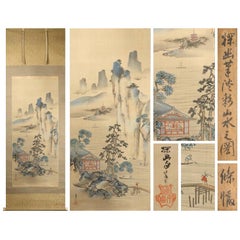
Lovely 17th-18th Century Scroll Painting Japan Artist Kano Soyu Painted
Located in Amsterdam, Noord Holland
It is a work that is said to have been drawn by Kano Soyu as you can see.
It is a picture of the light-colored Sansui map carefully drawn to the smallest detail, and the
towering m...
Category
Japanese Edo Antique 18th Century and Earlier Paintings and Screens
Materials
Silk
$3,015 Sale Price
20% Off
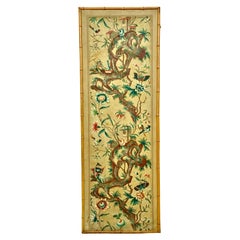
18th Century French or Italian Hand-Painted Chinoiserie Panel
Located in Bradenton, FL
Elegant 18th / 19th century hand-painted French or Italian Chinoiserie panel. Panel features colorful branches filled with exotic birds, flowers, butterflies, and Asian characters an...
Category
French Chinoiserie Antique 18th Century and Earlier Paintings and Screens
Materials
Silk, Giltwood
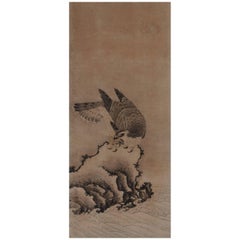
17th century Japanese Falcon Painting, Mitani Toshuku, Unkoku School
Located in Kyoto, JP
Mitani Toshuku (1577-1654)
“Falcon”
Wall panel, ink and light color on paper.
Upper Seal: Mitani
Lower Seal: Toshuku
Dimensions:
Each 118.5 cm x 51 cm x 2 cm (46.5” x 20” x .75”)
Individual falcon paintings by Mitani Toshuku (1577-1654), an early artist of the Unkoku School. Founded by Unkoku Togan (1547–1618), a master of the Momoyama period, the Unkoku school enjoyed long lasting patronage in southern Japan. Togan was a retainer of the Mori family in present day Yamaguchi prefecture. Members of the school considered themselves to be in the artistic lineage of Sesshu Toyo...
Category
Japanese Edo Antique 18th Century and Earlier Paintings and Screens
Materials
Paper
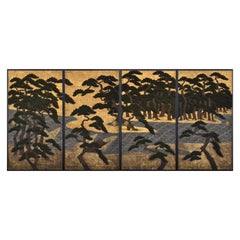
Circa 1700 Japanese Sliding Door (Fusuma) Set. Pine Trees on the Seashore.
Located in Kyoto, JP
"Pine Trees on the Seashore"
A set of four sliding doors (Japanese fusuma). Ink, color, gold-leaf and gold-fleck on paper.
Dimensions (total display si...
Category
Japanese Edo Antique 18th Century and Earlier Paintings and Screens
Materials
Gold Leaf
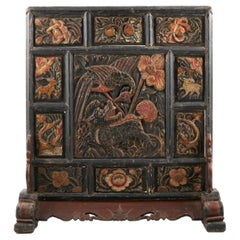
Chinese Ming Dynasty Carved Table Screen
Located in Kastrup, DK
A rare 16-17th cenury Ming Dynasty standing table screen. Untoched original condition.
Hand carved wood, the panel is carved with relief details depicting a dragon, cranes, mythical...
Category
Chinese Ming Antique 18th Century and Earlier Paintings and Screens
Materials
Wood
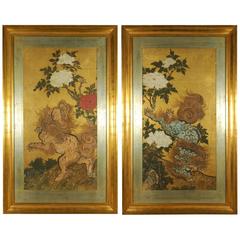
Pair of Antique Japanese Paintings of Karashishi, Edo Period, 18th Century
Located in Prahran, Victoria
A rare pair of antique Japanese Karashishi paintings in a landscape of rocks and peony flowers on gold leaf ground in fine handmade frames, Edo period, early 18th century. The Karash...
Category
Japanese Edo Antique 18th Century and Earlier Paintings and Screens
Materials
Gold Leaf
Still Thinking About These?
All Recently ViewedMore Ways To Browse
Ogata Korin
Painted Panel Screen Birds
Antique Chinese Black Lacquer Screen
Antique Falconry
Carved Stone Panel
Chinese Carved Hardwood Screen
Chinese Folding Silk Screen Art
Chinese Paint Brushes
Chinese Pearl And Lacquer Screen
Gold Screen Crane
Japanese 4 Panel Screen
Japanese Autumn Screen
Japanese Calligraphy Screen
Japanese Cherry Blossom Screen
Japanese Snow Painting
Kimono Rack
Korean Painted Screen
Rinpa School