Late 17th Century Paintings and Screens
to
7
12
157
675
956
151
297
222
112
40
3
29
16
14
25
37
27
29
8
10
6
6
6
4
12
12
12
12
12
12
1
Period: Late 17th Century
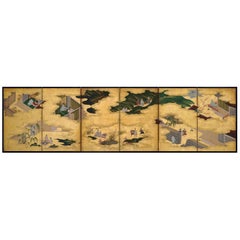
Japanese Screen Painting, Circa 1700
Tales of Ise
by Tosa Mitsusuke
By Tosa Mitsusuke 1
Located in Kyoto, JP
A six-fold Japanese screen by Tosa Mitsusuke (1675-1710), Japan 17th-18th century, Edo period.
The signature reads Shoroku-i ge Tosa sa Konoe Shogen Mit...
Category
Japanese Edo Antique Late 17th Century Paintings and Screens
Materials
Gold Leaf
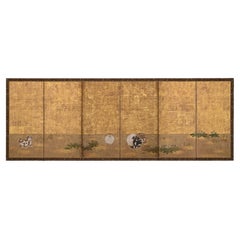
Late 17th Century Japanese Screen. Puppy and Kittens on Gold Leaf.
Located in Kyoto, JP
Anonymous
Late 17th century
Puppy & Kittens
A six-panel Japanese screen. Ink, color, gofun, gold-leaf and gold-fleck on paper.
A medium sized late 17th century Japanese screen fe...
Category
Japanese Edo Antique Late 17th Century Paintings and Screens
Materials
Gold Leaf
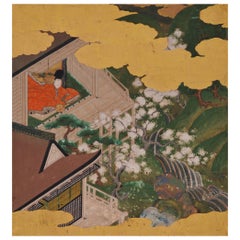
Japanese Painting, 17th Century, Tale of Genji, Tosa School
Located in Kyoto, JP
Illustration to an unidentified chapter of the Tale of Genji (Genji Monogatari)
Tosa School (second half of the 17th Century)
Ink, pigment, gofun and...
Category
Japanese Edo Antique Late 17th Century Paintings and Screens
Materials
Gold Leaf
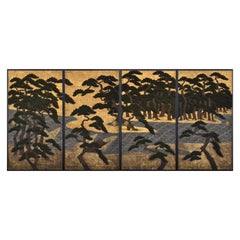
Circa 1700 Japanese Sliding Door (Fusuma) Set. Pine Trees on the Seashore.
Located in Kyoto, JP
"Pine Trees on the Seashore"
A set of four sliding doors (Japanese fusuma). Ink, color, gold-leaf and gold-fleck on paper.
Dimensions (total display si...
Category
Japanese Edo Antique Late 17th Century Paintings and Screens
Materials
Gold Leaf
Late 17th Century Japanese Screen Pair. Battle of Ichi-no-tani and Yashima.
Located in Kyoto, JP
Anonymous
Late 17th Century
Battle of Ichi-no-tani & Yashima
Dimensions: Each Screen: H. 175 cm x W. 385 cm (69” x 151.5”)
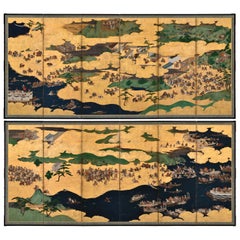
This pair of Japanese screens depict two significant battles from the Genpei War (1180–85), as recounted in the Tale of the Heike, a semi-historical epic chronicling the conflict between rival clans for control of Japan, written in the early 1200s.
Each screen portrays a single battle through a series of small episodes, framed by gold clouds, landscape elements, and architectural features. True to the style of many screens inspired by The Tale of the Heike, the scenes are rendered in lavish colors and gold, downplaying the brutality of the warfare. Although based on real events, these narratives often glorified and romanticized the heroic feats of the warriors. Viewers at the time would have been familiar with the story’s details, leading to a proliferation of paintings on folding screens inspired by this theme from the late Muromachi to the early Edo periods.
On the right screen, we see the Minamoto’s attack on the Taira, who have retreated from the capital, Kyoto, toward the sea. The central building represents the temporary Taira headquarters, where Taira soldiers are holding the young Emperor Antoku. The Minamoto plan to launch a surprise attack from the rear after descending the steep cliff known as Ichi-no-tani, depicted at the top center. This scene highlights the tactical brilliance of Minamoto commander Yoshitsune and the courage of his men.
The left screen captures moments from the Battle of Yashima...
Category
Japanese Edo Antique Late 17th Century Paintings and Screens
Materials
Gold Leaf
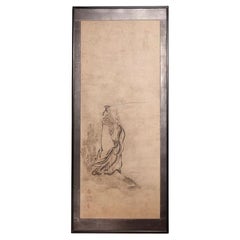
Antique Japanese Suibokuga Sage by Kano Tokinobu, 17th century.
Located in Point Richmond, CA
Antique Japanese Suibokuga Sage Painting by Kano Tokinobu, 17th century. A sumi-e ink on paper painting illustrating an acolyte at a riverbank. The image of the standing Chinese figure with elongated earlobes (a symbol of enlightenment), hair tied back in a kerchief and long beard, holds a large fan in his left hand to his right shoulder. The long robes are windswept with water curls about the figures feet. The painting with 3 vermillion seals of the artist in the lower left corner. Japanese dry mount paper on a wood frame with thin brocade border silver leafed surround and lacquered wood outer frame.
Condition: Paper restoration on center, a quarter of an inch of the left edge of the painting is added, other minor signs of age, wear, stains and repairs overall fine condition.
Age: Painting Edo Period, circa 1670. Mounting circa 1985.
Image: 51-1/2 in. x 20-1/2 in. (131cm x 52cm)
Frame: 59-1/4 in. x 25-1/4 in. (150cm x 64cm)
Weight: 6lbs.
Provenance:
with Honeychurch Antiques...
Category
Japanese Edo Antique Late 17th Century Paintings and Screens
Materials
Paper
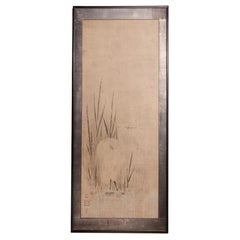
Antique Japanese Suibokuga Egrets by Kano Tokinobu, 17th century.
Located in Point Richmond, CA
Antique Japanese Suibokuga Egrets by Kano Tokinobu, 17th century.
A sumi-e ink on paper painting illustrating two egrets in reserve with no outlines contrasting with the reeds from the marsh in the background. The painting with 3 vermillion seals of the artist in the lower left corner. Japanese dry mount paper on a wood frame with thin brocade border silver leafed surround and lacquered wood outer frame.
Condition: Lighter discoloration on the lower portion of the painting, other minor signs of age, wear, stains and repairs otherwise fine condition.
Age: Painting Edo Period, circa 1670. Mounting circa 1985.
Image: 51-1/2 in. x 20-1/2 in. (131cm x 52cm)
Frame 59-1/4 in. x 25-1/4 in. (150cm x 64cm)
Weight: 6 lbs.
Provenance:
with Honeychurch Antiques...
Category
Japanese Edo Antique Late 17th Century Paintings and Screens
Materials
Paper
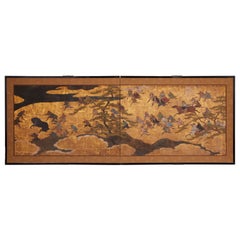
Japanese Two Panel Screen: Horse Roundup
Located in Hudson, NY
Interesting and unusual subject matter, Tosa School painting in mineral pigments on gold leaf with silk brocade border.
Category
Japanese Antique Late 17th Century Paintings and Screens
Materials
Gold Leaf
Antique Japanese Suibokuga Landscape by Kano Tokinobu, 17th century.
Located in Point Richmond, CA
Antique Japanese Suibokuga Landscape by Kano Tokinobu. 17th century.
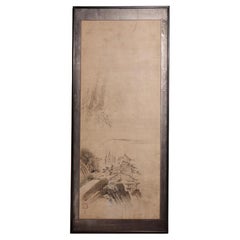
A sumi-e ink on paper painting illustrating an ethereal mountainous landscape at the seashore containing buildings, trees, birds and ship masts. 3 vermillion seals of the artist in the lower right hand corner. Japanese dry mount paper on a wood frame with thin brocade border silver leafed surround and lacquered wood outer frame.
Condition: Minor signs of age, wear, otherwise fine condition.
Age: Painting Edo Period, circa 1670. Mounting circa 1985.
Image: 51-1/2 in. x 20-1/2 in. (131cm x 52cm)
Frame: 59-1/4 in. x 25-1/4 in. (150cm x 64cm)
Weight: 6 lbs.
Provenance:
with Honeychurch Antiques...
Category
Japanese Edo Antique Late 17th Century Paintings and Screens
Materials
Paper
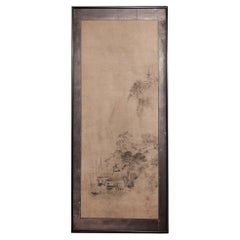
Antique Japanese Suibokuga Landscape by Kano Tokinobu, 17th century.
Located in Point Richmond, CA
Antique Japanese Suibokuga Landscape by Kano Tokinobu, 17th century. A sumi-e ink on paper painting illustrating a rocky seaside landscape containing buildings, vegetation and ship masts. The painting with 3 vermillion seals of the artist in the lower left corner. Japanese dry mount paper on a wood frame with thin brocade border silver leafed surround and lacquered wood outer frame.
Condition: Lighter discoloration near the bottom of the painting, various paper restorations, other minor signs of age, wear, stains, otherwise fine condition.
Age: Painting Edo Period, circa 1670. Mounting circa 1985.
Image: 51-1/2 in. x 20-1/2 in. (131cm x 52cm)
Frame: 59-1/4 in. x 25-1/4 in. (150cm x 64cm)
Weight: 6 lbs.
Provenance:
with Honeychurch Antiques...
Category
Japanese Edo Antique Late 17th Century Paintings and Screens
Materials
Paper
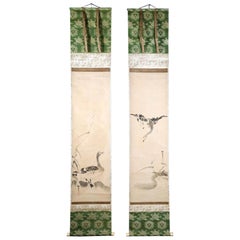
Pair of Japanese Ink Hanging Scrolls Kano Tanyu
By Kano Tan
yu 1
Located in Atlanta, GA
A fine matching pair of hanging scrolls ink on paper mounted in green brocade borders circa Edo period (17-18th century). The Kano school painting depicts wild geese in the reeds by the margin of water, a popular subject borrowed from the Chinese tradition. Both painting were signed as Tanyu with a red seal of Morinobu, his birth name. The storage box is also present and was inscribed with the title Painting of Geese and Reeds and Kano Tanyu...
Category
Japanese Japonisme Antique Late 17th Century Paintings and Screens
Materials
Wood, Paper

$6,000 / set
17th Century Japanese Two-Panel Screen, Gibbons of Folklore
Located in Hudson, NY
Japanese two-panel screen: Gibbons of Folklore, Edo period (17th century) Kano School painting of gibbons in Japanese fables. The left panel represents a Japanese fable of a monkey a...
Category
Japanese Edo Antique Late 17th Century Paintings and Screens
Materials
Silk, Wood, Paper

Related Items
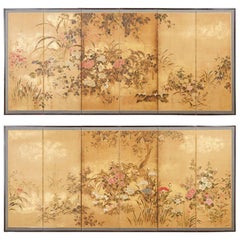
Pair of Japanese Edo Rimpa School Screens after Tawaraya Sōtatsu
Located in Rio Vista, CA
Impressive pair of 17th century Japanese Edo period Rinpa school screens made in the manner and style of Autumn Grasses by Tawaraya Sōtatsu (1570-1640). Beautifully decorated with wi...
Category
Japanese Edo Antique Late 17th Century Paintings and Screens
Materials
Gold Leaf
$26,000 / set
H 60.5 in W 131 in D 0.75 in
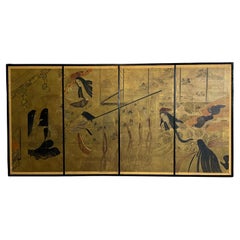
Large Painting of a Japanese Scene After the Tale of Genji
Located in Pasadena, CA
This painting is an illustration of the classic Japanese novel, "The Tale of Genji," written by Murasaki Shikibu. It captures the aristocratic atmosp...
Category
Japanese Han Antique Late 17th Century Paintings and Screens
Materials
Paper, Paint
$2,200 Sale Price
31% Off
H 35.75 in W 71 in D 1.25 in
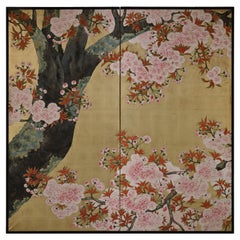
Early 20th Century Japanese Cherry Blossom Screen by Kano Sanrakuki
Located in Kyoto, JP
Cherry Blossoms
Kano Sanrakuki (1898-1981)
Showa period, circa 1930
2-panel Japanese Screen
Color, gofun and gold leaf on paper
Against a backdrop of gold-leafed ground, the lichen covered trunk and branches of the life-sized cherry blossom tree reach out and beyond the confines of the pictorial surface. The overall composition has a feeling of flatness which draws emphasis to the surface and the three-dimensionality of the cherry blossoms. Painstakingly built-up layers of thickly applied shell-white gofun detail the voluminous blossoms and cover large areas of this tour-de-force of Japanese Nihonga painting. By simplifying the background, minimizing the number of colors and depicting the blossoms with such heavy relief, the artist has emphasized the stunning presence of the cherry tree. The type of tree depicted is the Yae-Zakura; a double-layered type of cherry blossom famed for its beauty and strength. When we think of Japanese cherry blossoms, the first thing that comes to mind is Somei Yoshino variety, which has a single flower with five almost white petals. This type is fragile and easily blown away by strong wind or rain. Most of the double-flowered cherry blossoms begin to bloom when the Somei-Yoshino falls, and the flowering period lasts longer than that of the Somei-Yoshino.
Kano Sanrakuki originally studied painting at the Kyoto City Arts and Crafts School under the tutelage of Yamamoto Shunkyo...
Category
Japanese Showa Late 17th Century Paintings and Screens
Materials
Gold Leaf
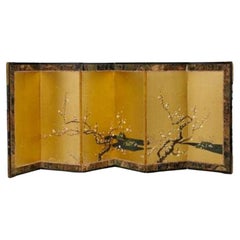
Early 20th Century Japanese 6-Panel Gouache and Gold Leaf Painted Table Screen
Located in Morristown, NJ
20th c., Showa period gouache and gold leaf Japanese screen. Depicting plum tree blossoms on a riverbank across 6 panels. Plum blossoms are often mentioned in Japanese poetry as a symbol of spring...
Category
Japanese Showa Late 17th Century Paintings and Screens
Materials
Gold Leaf
$2,950
H 11 in W 30 in D 0.75 in
Pair of Japanese Screens
Located in Schellebelle, BE
Exceptional pair of Japanese screens, 20th century
Six parts, six times 45 cm wide
Gold spotted paper with parts of old screens.
Category
Japanese Late 17th Century Paintings and Screens
Materials
Paper
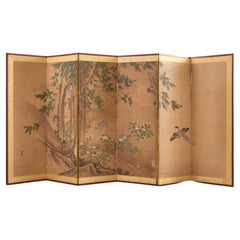
19th Century Japanese Edo Six Panel Kano School Landscape Screen
Located in Rio Vista, CA
Late Edo period 19th century Japanese six-panel landscape screen featuring a cypress tree over a flowering hibiscus with a pair of hototogisu birds. Kano school painted with ink and ...
Category
Japanese Edo Antique Late 17th Century Paintings and Screens
Materials
Silk, Wood, Paper
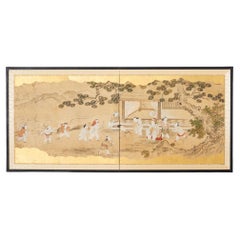
19th Century Japanese Edo Screen Kano School Garden Terrace
Located in Rio Vista, CA
Fantastic 19th century Japanese Edo/Tokugawa period two-panel byobu screen featuring Chinese children frolicking on a garden terrace with a pavilion and large pine tree. Made in the ...
Category
Japanese Edo Antique Late 17th Century Paintings and Screens
Materials
Brass, Gold Leaf
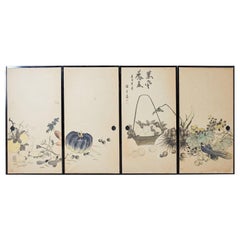
Set of Four Japanese Fusuma Painted Door Panels
Located in Rio Vista, CA
Rare set of four Japanese Showa period door panels known as Fusuma in Japanese architecture. Similar to a Shoji room divider but made of an opaque materia...
Category
Japanese Showa Late 17th Century Paintings and Screens
Materials
Brass
$2,400 Sale Price / set
20% Off
H 69.5 in W 36 in D 1 in
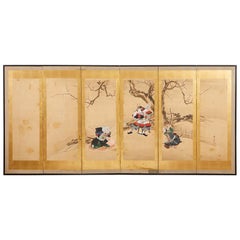
Japanese Edo Six Panel Screen Yoshitsune and Benkei
Located in Rio Vista, CA
Spectacular 19th century Japanese late Edo period six-panel byobu screen depicting Yoshitsune and Benkei, two heroes of Japanese folklore. Crafted in ink and natural color pigments on mulberry paper with thick gold leaf borders on each panel. The character Yoshitsune is seated under a blossoming cherry tree in full armor holding a fan. The warrior priest or monk Benkei is depicted kneeling on a leopard skin...
Category
Japanese Edo Antique Late 17th Century Paintings and Screens
Materials
Brass, Gold Leaf
$3,400 Sale Price
29% Off
H 66 in W 139.5 in D 0.5 in
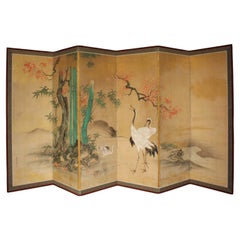
B1 Japanese Antiques Kano School, 6panel folding screen, crane&plants
Located in Niiza, JP
Material: Paper, Wooden Frame
Single: W600×H1760mm
Unfolded Size: W3640mm 12kg
Folded Size: W620×H1760×D100mm
Estimated packaging (sandwiched with 5-10mm plywood):
21cm x 72cm x 18...
Category
Japanese Antique Late 17th Century Paintings and Screens
Materials
Paper
$3,600
H 69.3 in W 143.31 in D 0.79 in
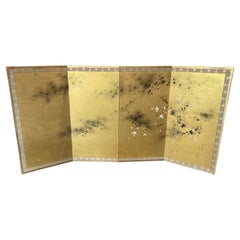
Japanese Asian Signed Four Panel Folding Byobu Cherry Blossom
Pine Tree Screen
Located in Studio City, CA
A gorgeous four-panel Showa Period Japanese Byobu folding screen featuring luminous cherry blossoms amongst the branches of a venerable pine tree. A very serene, tranquil, and peace...
Category
Japanese Showa Late 17th Century Paintings and Screens
Materials
Silk, Paint
$1,595
H 36 in W 72.5 in D 0.75 in
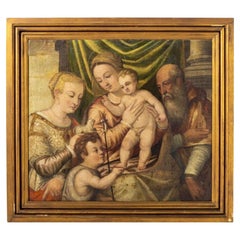
Flemish School 17th Century
Located in Madrid, ES
Flemish school 17th century
"Our Lady with the Child Jesus, St. John, St. Elizabeth and Zacarias".
Oil on canvas Relined.
Dimensions: 74 x 84 cm
good conditions.
Category
Dutch Baroque Antique Late 17th Century Paintings and Screens
Materials
Paint
Previously Available Items
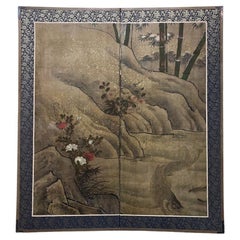
17-18 th century, zTwo panel with fish17th-18th Century Rinpa School Two-Panel S
Located in Fukuoka, JP
17-18 th century, zTwo panel with fish17th-18th Century Rinpa School Two-Panel Screen
Period: 17th-18th century
Size: 140 x 125 cm (55 x 49 inches)
SKU: PTA43
This beautiful two-pa...
Category
Japanese Edo Antique Late 17th Century Paintings and Screens
Materials
Wood, Paper
H 55.12 in W 0.79 in D 49.22 in
Edo Japanese Folding Screen Hand Painted on Gold Leaf
Located in Brescia, IT
Six-panel screen of the Kano school, painted with mineral pigments on gold leaf and rice paper.
Painting before the middle of the Edo period.
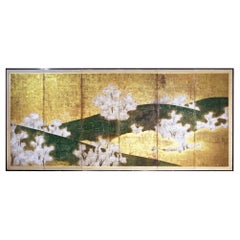
Landscape representing a simple large" "Sakura" forest in bloom, almost suspended over a uniform green grass. Very old screen with beautiful oxidized gold, some color sagging, but very well kept considering the age.
It can lay flat and can be hung on the wall, paper hinges are sturdy.
Lucio Morini...
Category
Japanese Edo Antique Late 17th Century Paintings and Screens
Materials
Gold Leaf
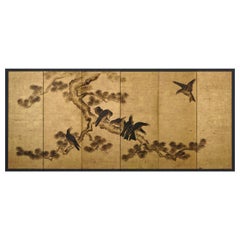
Japanese Screen Painting, Late 17th Century, Crows
Pine by Kano Chikanobu
Located in Kyoto, JP
Kano Shushin Chikanobu (1660-1728)
'Crows and Pine’
Six-fold screen, ink and gold leaf on paper.
Haha-cho or mynah birds, whose forms resemble crows in artwork, were commonly depicted in Japanese art. These types of paintings were originally modeled on paintings attributed to the 13th century Chinese painter Muqi (Mokkei), whose art was enormously influential in Japan. For his crows and pine tree, kano Chikanobu owes a debt of gratitude to Muqi, not only regarding his forms but also his brushwork. At the same time, Chikanobu clearly depicts large, native Japanese jungle crows with thick, arched upper bills and a tuft of hair above their bills. Rarely, if ever, had such birds been so clearly defined in Japanese painting. Chikanobu represented the birds and their close grouping with realism, yet entirely without the use of outlines. Similarly, the pine tree’s low-hanging branch was rendered with spontaneous ink washes and strokes, the brush flowing fluently and unerringly across the expansive gold background. The composition is almost entirely committed to the foreground; the soft gradation of ink tones through the pine branch is the only indication of depth. The hand-beaten gold leaf background has acquired a lustrous patina over its 300-year life and contrasts brilliantly against the rich black ink.
The screen has been quite recently re-mounted. Unlike traditionally mounted Japanese screen panels...
Category
Japanese Edo Antique Late 17th Century Paintings and Screens
Materials
Gold Leaf
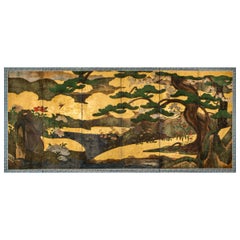
Japanese Six-Panel Screen Garden Landscape by River
s Edge
Located in Hudson, NY
Kano School painting showing ancient pine, exotic birds, peonies, azalea and cherry tree in bloom on far right. Early Edo period painting, (1614 -...
Category
Japanese Edo Antique Late 17th Century Paintings and Screens
Materials
Gold Leaf
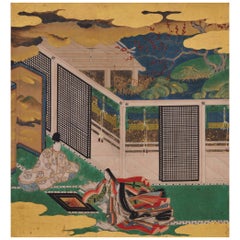
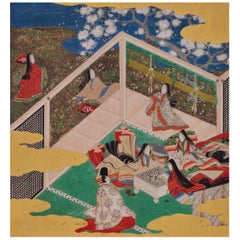
17th Century Japanese Tale of Genji Painting, Maboroshi, Tosa School
Located in Kyoto, JP
The Seer (Maboroshi), Illustration to Chapter 41 of the Tale of Genji (Genji Monogatari)
Tosa School (second half of the 17th century)
Ink, pigment, gofun and gold on paper. Un...
Category
Japanese Edo Antique Late 17th Century Paintings and Screens
Materials
Gold Leaf
17th Century Japanese Tale of Genji Painting, Takekawa, Tosa School
Located in Kyoto, JP
Bamboo River (Takekawa), Illustration to Chapter 44 of the Tale of Genji (Genji Monogatari)
Tosa School (second half of the 17th Century)
Ink, pigmen...
Category
Japanese Edo Antique Late 17th Century Paintings and Screens
Materials
Paper
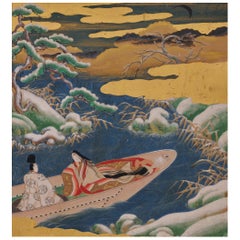
17th Century Japanese Tale of Genji Painting, Ukifune, Tosa School
Located in Kyoto, JP
A boat upon the water (Ukifune), Illustration to Chapter 51 of the Tale of Genji (Genji monogatari)
Tosa School (second half of the 17th Century)
Ink, ...
Category
Japanese Edo Antique Late 17th Century Paintings and Screens
Materials
Paper
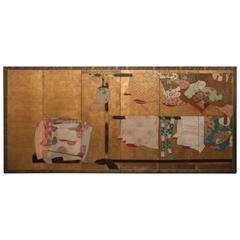
Japanese Screen: Whose Sleeves?
Located in Hudson, NY
(Tagasode)
Category
Japanese Antique Late 17th Century Paintings and Screens
Materials
Gold Leaf
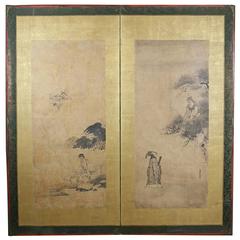
Framed Japanese Kano School Two Panel Screen Signed Kusumi Morikage
Located in Essex, MA
Appears to be two scrolls that were mounted on screen panels. Signed lower right. Lots of old restoration. Provenance Mrs Bayard Thayer; sold by Yamanaka & Co, Boston, Sept 1st 1914 ...
Category
Japanese Antique Late 17th Century Paintings and Screens
More Ways To Browse
Ogata Korin
Painted Panel Screen Birds
Antique Chinese Black Lacquer Screen
Antique Falconry
Carved Stone Panel
Chinese Carved Hardwood Screen
Chinese Folding Silk Screen Art
Chinese Paint Brushes
Chinese Pearl And Lacquer Screen
Gold Screen Crane
Japanese 4 Panel Screen
Japanese Autumn Screen
Japanese Calligraphy Screen
Japanese Cherry Blossom Screen
Japanese Snow Painting
Kimono Rack
Korean Painted Screen
Rinpa School