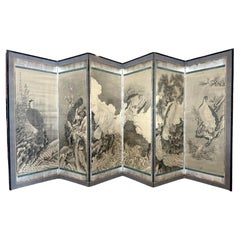
Items Similar to Rare Japanese Folding Screen, Kayo Zu, Falcons on a Perch, Soga School, Edo
Want more images or videos?
Request additional images or videos from the seller
1 of 17
Rare Japanese Folding Screen, Kayo Zu, Falcons on a Perch, Soga School, Edo
$19,062.28
£14,161.94
€16,000
CA$26,430.71
A$28,424.01
CHF 15,198.38
MX$342,785.54
NOK 192,193.86
SEK 175,113.35
DKK 121,946.58
About the Item
Six-Panel Folding Screen, Kayo Zu, Falcons on a Perch, Soga School, Edo Period, 18th Century
This six-panel folding screen, of the oshi-e hari type (paintings mounted on screens), is painted with pigments on paper. It is assembled using strips of paper and silk, along with black lacquered slats adorned with protective brass fittings.
The technical term kayo zu, meaning “falcon on a perch,” depicts immobile falcons. These birds are tied to the perch with a cord. The word kay? is composed of the characters ka (perch) and yo (falcon).
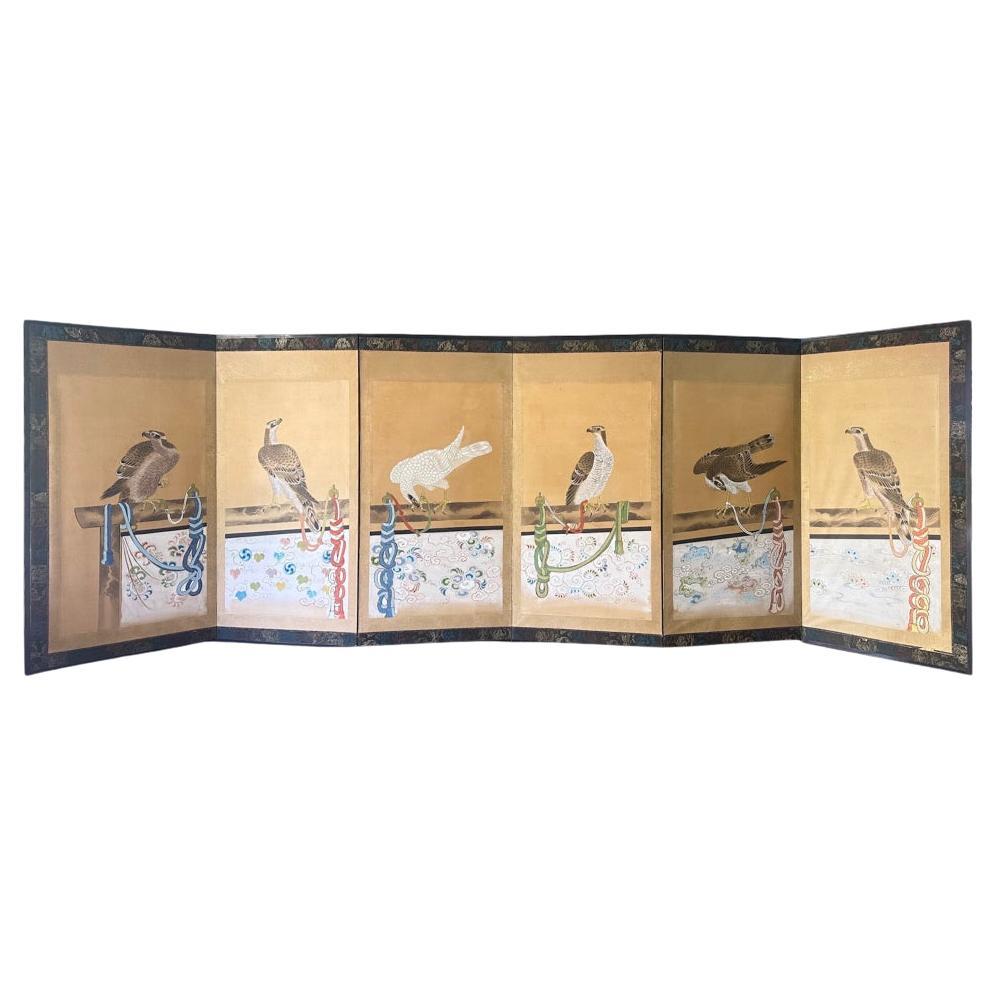
Each panel features a falcon, a striking image of a bird of prey, perched on an interior perch whose silk veil allows the plumage to appear in transparency (the exterior perches have straw protections). The existence of interior perches highlights the importance accorded to these birds.
Each bird of prey is depicted in a different position, attached to a finely drawn cordon, demonstrating remarkable attention to detail and imparting a strong sense of realism to the entire piece.
This folding screen is part of an artistic tradition fueled by the nobility’s passion for falconry, particularly popular during the 17th and 18th centuries, though its origins date back to the Middle Ages. Many artists, such as Hashimoto Senkei, a pupil of Kano Tanyu, distinguished themselves in this genre by working for the Obama clan of Wakasa in the Echizen province, now known as Fukui. Coming from a lineage of specialized artists, Senkei perpetuated an art form passed down from his father, Hashimoto Ch?bei, who was known as the “Falcon of Tsuruga.”
The daimyo of Tsuruga (Echizen province) employed a group of painters specialized in depicting falcons. These artists were heavily influenced by Soga Chokuan and Soga Nichokuan, 17th-century artists whose approach involved infusing falcons with vibrant character and liveliness through meticulous observation.

Through meticulous representation of the details of the plumage, beak, and the lively gaze of the birds, each panel offers subtle variations in the falcons’ posture, plumage color, and the manner in which the cordon is tied. These birds of prey, as hunters, are depicted as alert and ready to move with great speed.
This perceptible diversity from one panel to another enriches the overall composition, inviting the viewer to contemplate the artist’s rigor and freedom in the study of nature.
During the Edo period, these screens were primarily used by the nobility and kept in castles, which explains why some of them remain in excellent condition to this day.
Folding screens with falcon motifs can be found, among others, at the Musée Guimet in Paris, the Museum für Ostasiatische Kunst in Berlin, and Tsukuba University in Japan.
- Dimensions:Height: 68.51 in (174 cm)Width: 146.46 in (372 cm)Depth: 0.79 in (2 cm)
- Style:Edo (Of the Period)
- Materials and Techniques:
- Place of Origin:
- Period:
- Date of Manufacture:1750 1780
- Condition:Wear consistent with age and use.
- Seller Location:PARIS, FR
- Reference Number:1stDibs: LU6491246561932
About the Seller
5.0
Recognized Seller
These prestigious sellers are industry leaders and represent the highest echelon for item quality and design.
Established in 1982
1stDibs seller since 2022
7 sales on 1stDibs
- ShippingRetrieving quote...Shipping from: PARIS, France
- Return Policy
More From This Seller
View AllTwo-panel folding screen, Nihonga, Hirai Baisen (1889–1969), early Shōwa era (19
Located in PARIS, FR
Two-panel folding screen, Nihonga, Hirai Baisen (1889–1969), early Shōwa era (1940s)
This two-panel screen is signed by Hirai Baisen (1889–1969), a major Nihonga painter who is only...
Category
20th Century Japanese Paintings and Screens
Materials
Paper
Rare Japanese painting, Skeletons Studying, Shaku Kaiyin, Japan Meiji Period
Located in PARIS, FR
Skeletons Studying, Shaku Kaiyin, Japan Meiji Period
This ink-on-paper painting, mounted as a scroll with colored paper borders, is titled Skeletons Studying. It portrays a circle of...
Category
Antique Late 19th Century Japanese Paintings and Screens
Materials
Paper
$1,810 Sale Price
20% Off
Scroll paintingJapan, Woman jumping from the balcony of Kiyomizu-dera Edo period
Located in PARIS, FR
Japan, Woman jumping from the balcony of Kiyomizu-dera Edo period
Japanese scroll painting – Woman jumping from the balcony of Kiyomizu-dera temple, Edo period
Ink and pigments on pa...
Category
Antique 1790s Japanese Paintings
Materials
Paper
Box signed Katsutoshi Koku, Japan, Meiji period (1868-1912)
Located in PARIS, FR
Box signed Katsutoshi Koku, Japan, Meiji period (1868-1912)
Rectangular silver box bearing the Japanese junjin hallmark, signifying pure silver, made during the Meiji period (1868-1...
Category
Antique Late 19th Century Japanese Decorative Boxes
Materials
Silver
Screen Calligraphy, Risking One’s Life Here and There – Sakae Umezu (1926-2013)
Located in PARIS, FR
Screen Calligraphy, Risking One’s Life Here and There – Sakae Umezu (1926-2013)
This two-panel folding screen, created by Sakae Umezu, is a powerful and expressive calligraphic work....
Category
Late 20th Century Japanese Screens and Room Dividers
Materials
Paper
Wunderkammer, The Dance of the Skeletons, by Tanomura Chokunyu (1814-1909)
Located in PARIS, FR
The Dance of the Skeletons, by Tanomura Chokunyu (1814-1909)
This Japanese ink and pigment painting on paper, mounted on a scroll with silk borders, depicts the macabre and captivati...
Category
Antique Late 19th Century Art Nouveau Paintings
Materials
Paper
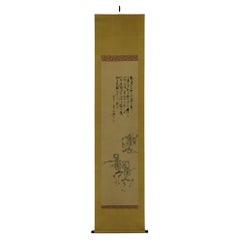
$1,715 Sale Price
20% Off
You May Also Like
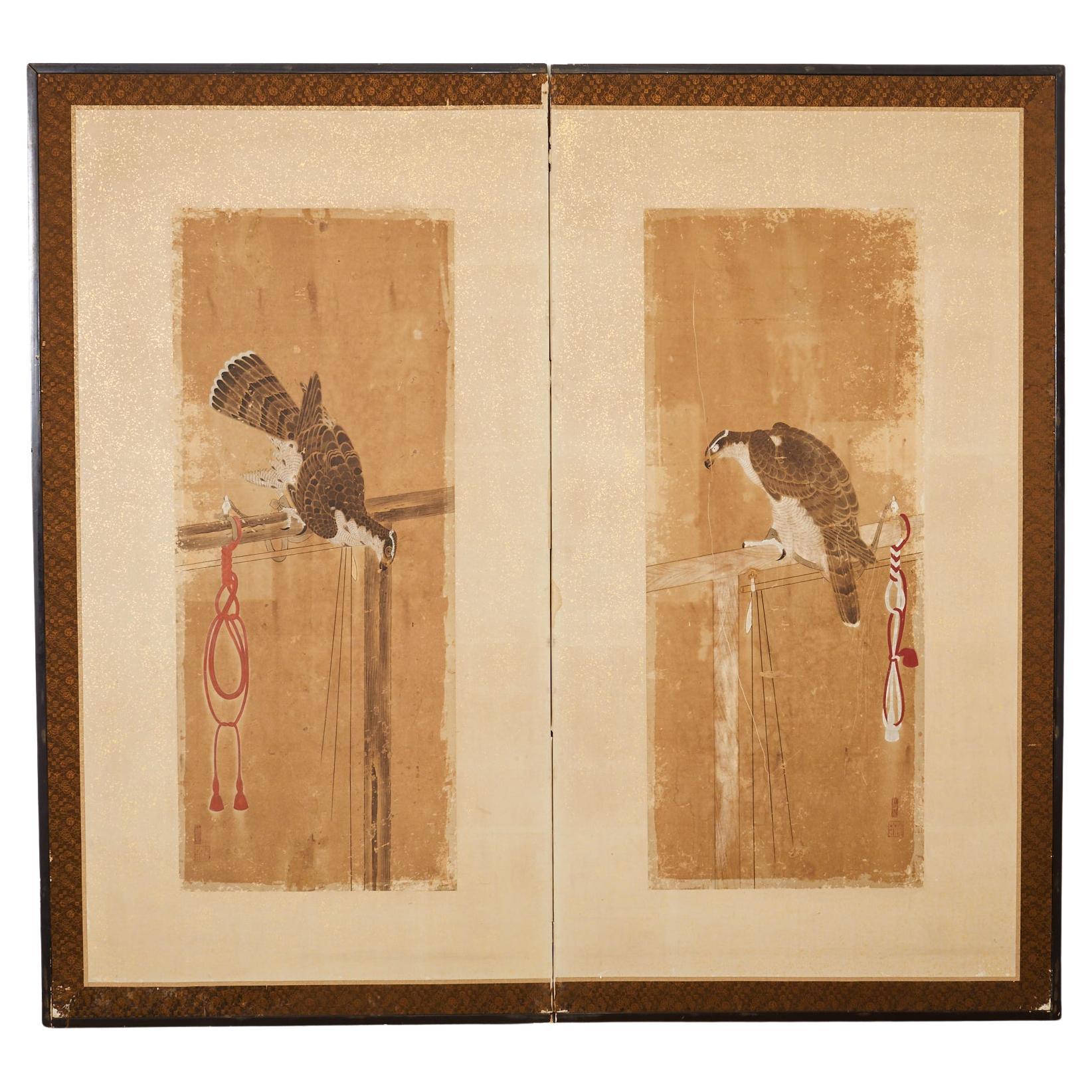
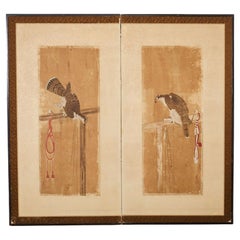
Japanese Edo Two Panel Screen Birds of Prey Hawks
Located in Rio Vista, CA
Fascinating Japanese 19th century Edo period two-panel screen depicting two perched birds of prey. Painted in the manner of Chokuan Soga (17th century). Large size byobu screen with ...
Category
Antique 19th Century Japanese Edo Paintings and Screens
Materials
Silk, Wood, Paper
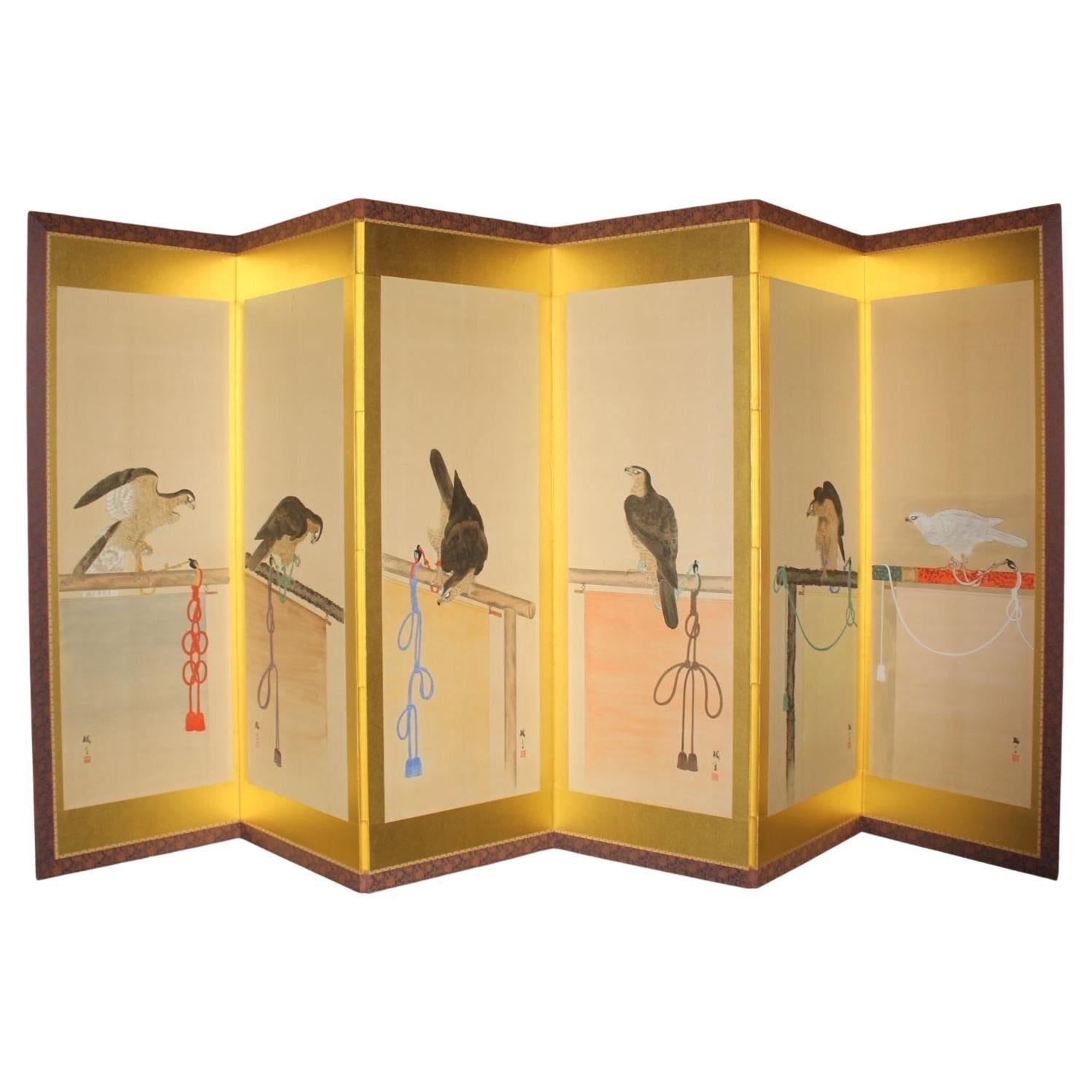
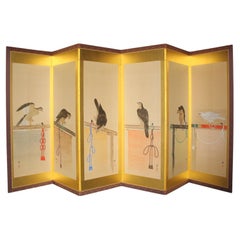
B77 Old Japanese 6panels folding Screen, Hawk Falconer
Located in Niiza, JP
Material: Paper on wooden frame
One piece: W580×H1740mm×D15mm,
Unfolded size: W3520mm
Folded size: W600×H1740×D100mm, 12kg
Estimate packing size: (sandwiched with 5-10mm plywood): 17...
Category
20th Century Japanese Paintings and Screens
Materials
Paper
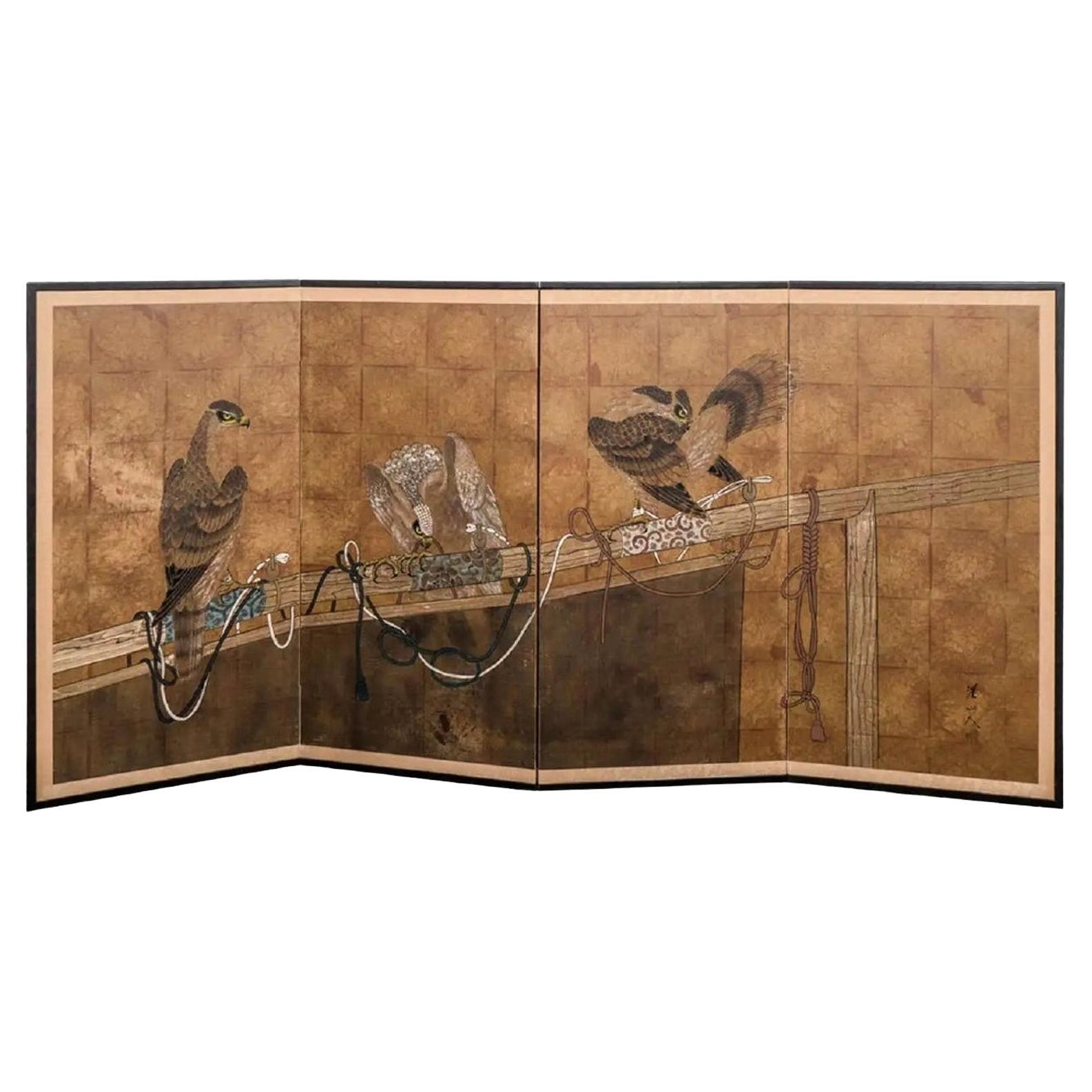
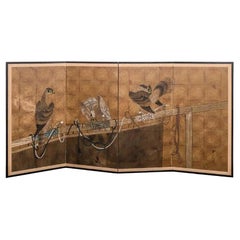
Japanese Art Deco 4-Panel Screen with Falcon, Ca. 1920
Located in New York, NY
Japanese Art Deco 4-Panel Screen with Falcon, Ca. 1920
DIMENSIONS
Height: 36.25 inches
Width: 71.25 inches
Category
Vintage 1920s Japanese Japonisme Paintings and Screens
Materials
Wood
Pair Antique Japanese Edo Falcon Hawk Birds of Prey Handpainted Screens 1860
By Soga Nichokuan 1
Located in Portland, OR
A very fine pair of antique Edo period four paneled screens (Takagari), hand-painted with tethered birds of prey, in the manner of Soga Nichokuan, circa 1860.
Wonderful pair of...
Category
Antique Late 19th Century Japanese Edo Paintings and Screens
Materials
Paper, Wood
Late 18th to Early 19th Century Hawk Screen
Located in Fukuoka, JP
Late 18th to Early 19th Century Hawk Screen
Period: Late Edo
Size: 372 x 125 cm (146.4 x 49.2 inches)
Behold the grandeur of the late Edo period encaps...
Category
Antique 18th Century Japanese Edo Paintings and Screens
Materials
Paper, Wood
$5,800 Sale Price
32% Off
Rare Japanese Floor Screen of Perched Eagles Soga Shohaku Edo period
Located in Atlanta, GA
A rare six-panel Japanese folding floor screen (Byōbu) by Soga Shōhaku (1730-1781) from Edo period. The screen depicts six perched hawk-eagles in various poses positioned in a litera...
Category
Antique 18th Century Japanese Edo Paintings and Screens
Materials
Brocade, Wood, Paper