Want more images or videos?
Request additional images or videos from the seller
1 of 11
Vintage kimono textile art "View from the Window ~Maple&Plum~" by ikasu, Japan
Price:$410
$490List Price
About the Item
- Creator:Kimono ikasu (Artist)
- Dimensions:Height: 0.79 in (2 cm)Diameter: 13 in (33 cm)
- Style:Japonisme (In the Style Of)
- Materials and Techniques:
- Place of Origin:
- Period:
- Date of Manufacture:1930
- Condition:
- Seller Location:Setagaya City, JP
- Reference Number:1stDibs: LU10079243379112
About the Seller
No Reviews Yet
Vetted Professional Seller
Every seller passes strict standards for authenticity and reliability
1stDibs seller since 2024
Authenticity Guarantee
In the unlikely event there’s an issue with an item’s authenticity, contact us within 1 year for a full refund. DetailsMoney-Back Guarantee
If your item is not as described, is damaged in transit, or does not arrive, contact us within 7 days for a full refund. Details24-Hour Cancellation
You have a 24-hour grace period in which to reconsider your purchase, with no questions asked.Vetted Professional Sellers
Our world-class sellers must adhere to strict standards for service and quality, maintaining the integrity of our listings.Price-Match Guarantee
If you find that a seller listed the same item for a lower price elsewhere, we’ll match it.Trusted Global Delivery
Our best-in-class carrier network provides specialized shipping options worldwide, including custom delivery.You May Also Like
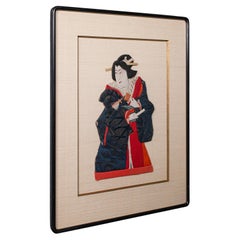
Vintage Geisha Portrait, Japanese Textile Relief Costume Picture, Art Deco, 1940
Located in Hele, Devon, GB
This is a vintage Geisha portrait. A Japanese, padded textile relief costume study in silk cotton, dating to the Art Deco period, circa 1940. A fascinating and decorative study, rich...
Category
Vintage 1940s Japanese Art Deco Paintings and Screens
Materials
Textile, Glass
$1,718
H 20.87 in W 15.95 in D 0.79 in
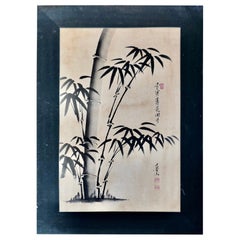
Vintage Bamboo Japanese Art, Wall Art 5 excellent pieces
Located in Godshill, Isle of Wight
Vintage Bamboo Japanese Art, Wall Art
5 excellent pieces, on cartridge paper set on Black Silk
Wonderful Vintage pieces, from 1980, 21.5” high, 15.5” wide
ZX281
Category
Vintage 1980s Japonisme Paintings and Screens
Materials
Paper
Japanese Two Panel Screen: Plum Blossom in the Mist
Located in Hudson, NY
Plum blossom, baby pine and bamboo painted in mineral pigments on heavy gold leaf on paper. Silk brocade border with black lacquer trim and bronze hardware.
Category
Antique Early 1800s Japanese Paintings and Screens
Materials
Bronze, Gold Leaf

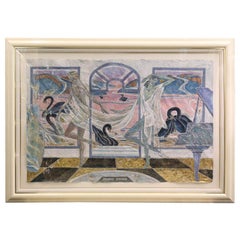
"View from the Terrace, " Mixed-Media by Yamin Young
By Yamin Young
Located in Houston, TX
Well listed Chinese Artist Yamin Young. "View from the Terrace". Mixed-media on handmade rice paper, mounted to the fabric base, protected by the plexiglas...
Category
Late 20th Century Chinese Other Paintings
Materials
Gold Leaf
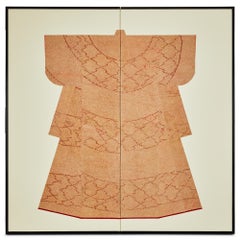
Japanese Two Panel Screen: Kimono
Located in Hudson, NY
Beautiful 19th century shibori (pin dyed) fabric in kimono form mounted on a simple ground of mulberry paper. Black lacquer trim with beautifully designed bronze mounts. The fabric ...
Category
Early 20th Century Paintings and Screens
Materials
Fabric, Wood, Lacquer, Paper
Japanese Contemporary Red Black Cream Folding Screen Silk Brocade Kimono Art, 3
Located in Takarazuka, JP
Exceptional Japanese contemporary two panel "byobu" or folding screen featuring genryoku style handcrafted silk raised kimono Japanese decorative art in crimson red, black and gold o...
Category
21st Century and Contemporary Japanese Meiji Paintings and Screens
Materials
Gold
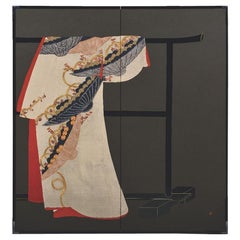
$9,250
H 60 in W 57 in D 2.5 in
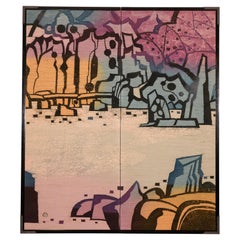
Japanese Two Panel Screen: Textile Landscape
Located in Hudson, NY
"The Garden of Tenryu-ji Temple" Mineral pigments on fabric in a black lacquer trim with bronze mounts. signature and seal read: Minagawa Taizo. ...
Category
20th Century Japanese Paintings and Screens
Materials
Fabric, Lacquer
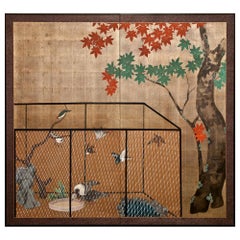
Japanese Two Panel Screen Aviary Shaded by A Maple Tree
Located in Hudson, NY
Japanese Two Panel Screen: Aviary Shaded By A Maple Tree, Showa period (1926 - 1989) painting of an outdoor bird enclosure under a maple tree. Painted in ...
Category
Mid-20th Century Japanese Showa Paintings and Screens
Materials
Silk, Wood, Paper
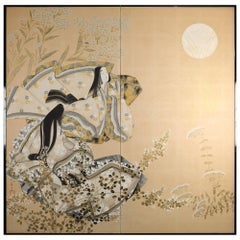
Japanese Two Panel Screen Moon Viewing
Located in Hudson, NY
Japanese two panel screen: Moon Viewing, painting of two noblewomen admiring the full moon outdoors. Extremely sophisticated execution of painting ove...
Category
Vintage 1970s Japanese Showa Paintings and Screens
Materials
Silk, Wood, Paper
17th Century Japanese Screen. Ink Plum Tree
Birds by Kano Naonobu.
Located in Kyoto, JP
Kano Naonobu (1607-1650)
Plum Tree and Birds
Six-fold Japanese Screen. Ink and slight color on paper.
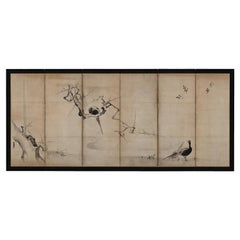
In this evocative ink work spread over a six-panel folding screen, we see the consummation of the elegance and refinement of the Edo Kano school. This 17th century screen is a rare surviving example of a large-scale bird and flower painting by Kano Naonobu, the younger brother of Kano Tanyu...
Category
Antique 17th Century Japanese Edo Paintings and Screens
Materials
Wood, Paper
More From This Seller
View AllVintage kimono textile art " Plum Gradation " by ikasu Pink White Japan
By Kimono ikasu
Located in Setagaya City, JP
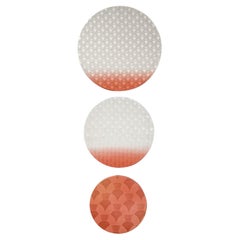
This canvas featuring a plum color gradient kimono showcases a unique decorative variation of the popular seigaiha (青海波) sea waves pattern.
The artwork got a Mr.
Mrs. Abe Arts ...
Category
Vintage 1980s Japanese Japonisme Paintings and Screens
Materials
Canvas, Silk
Antique kimono textile art " Plum Blossom Night ~ Resilience ~ " by ikasu Japan
By Kimono ikasu
Located in Setagaya City, JP
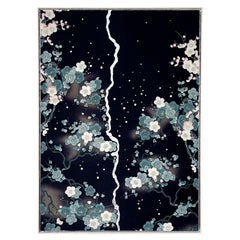
This artwork uses antique fabric from Taisho era (early 1920ies) kimono and paulownia wood taken from antique kiritansu - chest-of-drawers used initially to keep kimonos.
It is el...
Category
Vintage 1920s Japanese Japonisme Paintings and Screens
Materials
Silver Leaf
VIntage kimono textile art " Geometry ~ Chrysanthemums ~" by ikasu White Japan
By Kimono ikasu
Located in Setagaya City, JP
<
This work is inspired by traditional Japanese natural symbolism, and is framed in paulownia wood originally used for a kimono chest-of-drawers.
It is elegantly framed with...
Category
Vintage 1960s Japanese Japonisme Paintings and Screens
Materials
Silk, Wood

Vintage kimono textile art " Marble Story ~ Healing ~" by ikasu Grey Japan
By Kimono ikasu
Located in Setagaya City, JP
<
This work uses a vintage kimono fabric with marble pattern, that makes it look like a real piece of marble.
The line in the middle symbolizes “kintsugi” - concept of wabi-sabi, which values imperfection, impermanence, and the beauty of aging.
It is elegantly framed with paulownia wood originally used for kimono chest-of-drawers, and is filled with storytelling and sense of luxury.
I used pieces of kimono that could no longer be used as clothing and kiritansu chest-of-drawers that would normally be discarded to create the ultimate upcycled piece.
<< Explanation and meaning of pattern and colors
Kintsugi (金継ぎ), which translates to "golden joinery" or "golden repair," is a traditional Japanese art form of repairing broken pottery with lacquer mixed with powdered gold, silver, or platinum. I used this tecnique here to "repair" antique kimono by transforming it into art work. Beyond its literal meaning of mending broken ceramics, kintsugi carries profound philosophical and cultural significance in Japanese tradition:
・Embracing Imperfection: Kintsugi celebrates imperfection and impermanence. Rather than disguising or concealing flaws, it highlights them, treating the breakage as part of the object's history. This philosophy encourages acceptance of imperfection as an essential aspect of life, beauty, and human experience.
・Wabi-Sabi Aesthetic: Kintsugi embodies the principles of wabi-sabi, an aesthetic worldview centered on the acceptance of transience and imperfection. Wabi-sabi values simplicity, authenticity, and the beauty of things that are imperfect, impermanent, and incomplete. Kintsugi exemplifies these principles by turning what might be considered flaws into features that enhance the object's beauty and character.
・Resilience and Transformation: The act of repairing broken things with precious metals symbolizes resilience and transformation. Instead of discarding or replacing the broken object, kintsugi honors its history and transforms it into something new and valuable. This reflects broader philosophical themes of overcoming adversity, finding beauty in imperfection, and embracing change.
・Honoring the Past: Kintsugi preserves and honors the history of the object. Rather than erasing or ignoring its past, it acknowledges and celebrates it. This aspect of kintsugi can be seen as a metaphor for honoring our own personal histories, including the challenges and setbacks we have faced, and recognizing how they have shaped us into who we are today.
・Spiritual and Philosophical Symbolism: Kintsugi has spiritual and philosophical implications, reflecting concepts such as the interconnectedness of all things, the cycle of life and death, and the pursuit of harmony and balance. The process of repairing broken objects with precious metals is seen as a metaphor for spiritual growth, enlightenment, and the journey towards wholeness.
Overall, kintsugi represents not only a practical technique for repairing ceramics but also a profound philosophical and cultural perspective on life, beauty, and the human experience. It embodies values such as resilience, acceptance, and the transformative power of embracing imperfection.
<< Characteristics of the fabric
This vintage textile is hand-painted with a traditional painting technique where the colors are added on wet surface, which creates an effect of marble.
<< About the frame
Kiritansu - chest-of-drawers for kimono, is traditionally made from paulownia wood, a uniquely Japanese material closely tied to the world of kimonos.
Paulownia wood is known as the lightest wood in Japan, prased for its natural luster, resistance to moisture, and resilience against cracking. Since ancient times, it has been used in crafting furniture, chests, and musical instruments.
During the Edo period, it became customary to store cherished kimonos in paulownia chests...
Category
Vintage 1960s Japanese Japonisme Paintings and Screens
Materials
Gold Leaf
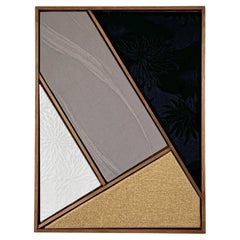
Vintage kimono textile art " Monochrome Geometry " by ikasu Gold Grey Japan
By Kimono ikasu
Located in Setagaya City, JP
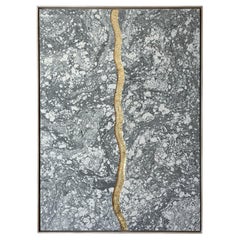
This work is inspired by traditional Japanese nature colors symbolism, and is framed in paulownia wood originally used for a kimono chest-of-drawers.
It is filled with storytelling ...
Category
Vintage 1960s Japanese Japonisme Paintings and Screens
Materials
Silk, Wood
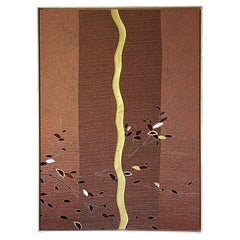
Vintage kimono textile art " Autumn branches ~ Kintsugi ~" by ikasu Brown Japan
By Kimono ikasu
Located in Setagaya City, JP
<
The frame for this work is made of paulownia wood taken from antique Kiritansu - chest-of-drawers for kimono.
I use antique kiritansu that can’t be used as furniture anymo...
Category
Vintage 1960s Japanese Japonisme Paintings and Screens
Materials
Gold Leaf
Still Thinking About These?
All Recently ViewedMore Ways To Browse
Reverse Painted Glass Insurance Sign
Qing Dynasty Room Divider
Silk Fish Art
Burmese Wood Screens
Chinese Pillow Book
Gumps Screen
Japanese Screen Owl
Vintage Byobu
Antique Japanese Calligraphy Brush
Carved Wood Screen Doors
Chinese Screen Gold Gods
Chinese Screen Round
Chinoiserie Four Panel Gold Leaf Room Divider
Copper Plate Moroccan
Early Ming Fresco Painting
Japanese Fox Screen
Japanese Herons On Silk
Japanese Rice Paper Art