Items Similar to 19th Century Indian Print with Guanyin the Bodhisattva of Compassion on Elephant
Want more images or videos?
Request additional images or videos from the seller
1 of 19
19th Century Indian Print with Guanyin the Bodhisattva of Compassion on Elephant
$4,000
£3,022.22
€3,465.12
CA$5,582.46
A$6,074.14
CHF 3,216.18
MX$73,076.06
NOK 40,838.35
SEK 37,364.23
DKK 25,889.23
About the Item
An antique Indian print from the 19th century depicting Guanyin the Bodhisattva of Compassion. Created in India during the 19th century, this large print features Guanyin the Bodhisattva of Compassion, sitting on a noble elephant. Holding a lotus flower in the left hand, Guanyin wears an ornate headdress and elegant clothes. The print itself measures 26.5 x 51.5 H and has been set inside a custom frame. With its vivid colors and serne subject, this 19th century Indian print in custom frame will enliven any wall beautifully, perhaps hung above a credenza, console table or enfilade!
- Dimensions:Height: 59.25 in (150.5 cm)Width: 34 in (86.36 cm)Depth: 1.75 in (4.45 cm)
- Materials and Techniques:
- Place of Origin:
- Period:
- Date of Manufacture:19th Century
- Condition:Additions or alterations made to the original: Custom frame. Wear consistent with age and use. Please refer to the various additional photos for further condition detail and contact us with any questions!
- Seller Location:Yonkers, NY
- Reference Number:Seller: YN7459 / FEA Home1stDibs: LU863928299452
About the Seller
5.0
Platinum Seller
Premium sellers with a 4.7+ rating and 24-hour response times
Established in 1964
1stDibs seller since 2009
1,237 sales on 1stDibs
Typical response time: <1 hour
- ShippingRetrieving quote...Shipping from: Yonkers, NY
- Return Policy
More From This Seller
View AllLarge Framed Indian 19th Century Painting of Guanyin Sitting on a Dragon
Located in Yonkers, NY
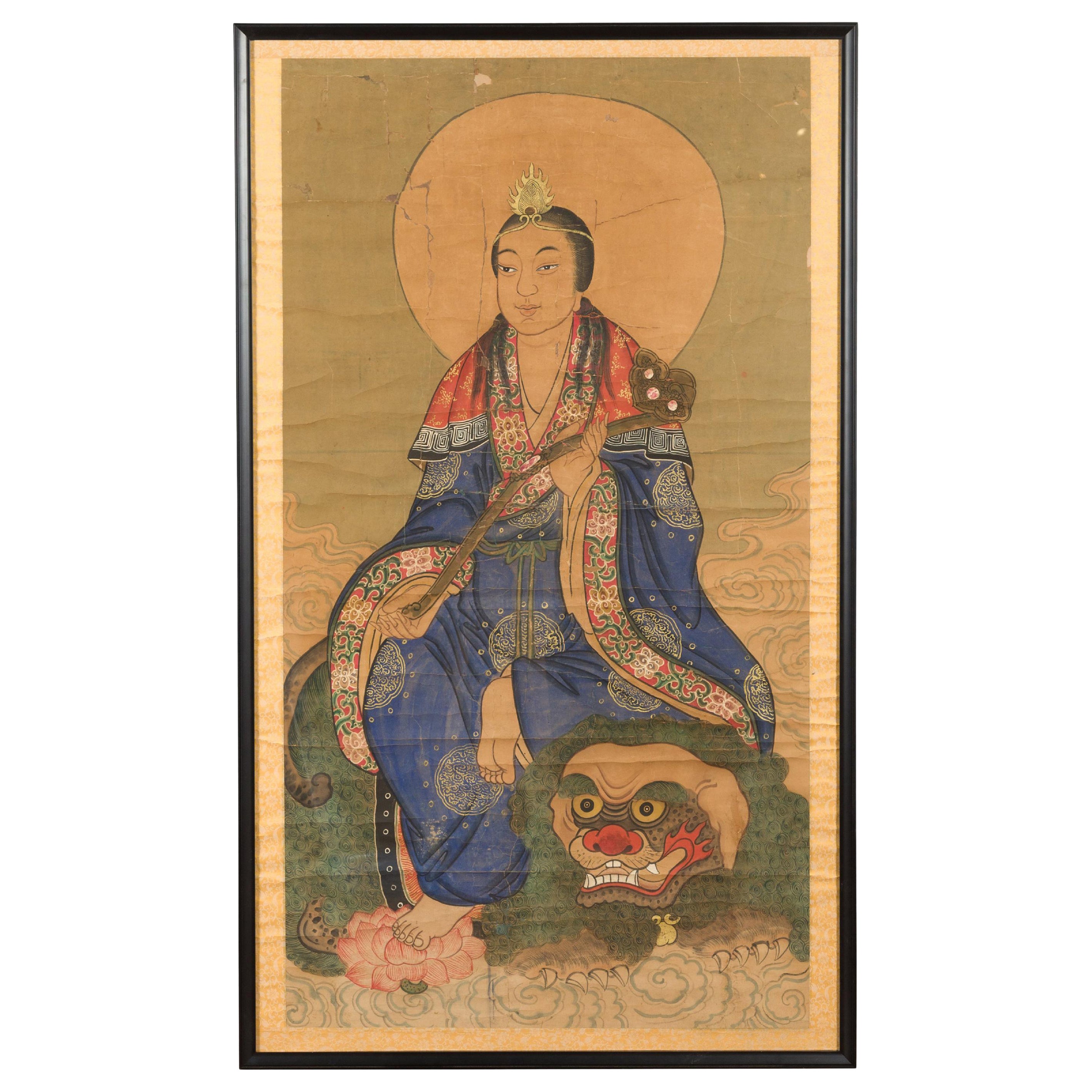
An antique Indian painting from the 19th century depicting Guanyin the Bodhisattva of Compassion sitting on a dragon. Created in India during the 19th century, this large painting features Guanyin the Bodhisattva of Compassion, sitting on the head of a dragon, fluffy clouds adorning the painting's lower section. Her right foot on a lotus flower, Guanyin wears an ornate headdress and elegant clothes. The painting itself measures 30.5"W x 53.5" H and has been set inside a custom frame. Its peaceful subject will make this 19th century Indian painting...
Category
Antique 19th Century Indian Paintings
Materials
Fabric, Plexiglass, Paper
Antique Framed Buddhist Painting
Located in Yonkers, NY
A Tibetan Thangka Buddhist painting hand-painted on canvas, created for the veneration of the Three Great Bodhisattvas. Embrace the rich tradition of Tibetan Buddhism with this vibra...
Category
Antique 19th Century Tibetan Paintings and Screens
Materials
Canvas, Glass, Wood
Mandarin Taoist Ceremonial Chinese Scroll Portrait Painting in Custom Frame
Located in Yonkers, NY
Mandarin Taoist Chinese ceremonial scroll portrait painting in custom plexiglass frame. Exuding an air of spiritual significance and artistic mastery, this Mandarin Taoist Chinese ce...
Category
Antique 19th Century Chinese Prints
Materials
Plexiglass, Paper
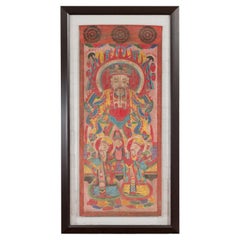
Framed Hand-Painted Parchment Painting of a Celestial Warrior with Silk Matting
Located in Yonkers, NY
A Qing Dynasty period hand-painted Celestial warrior on parchment with silk matting in custom frame. This Qing Dynasty period hand-painted depiction of a Celestial warrior is rich in...
Category
Antique 19th Century Chinese Qing Paintings
Materials
Composition
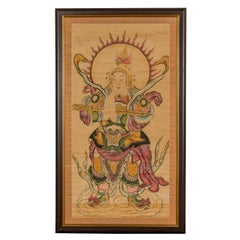
Chinese Qing Dynasty 19th Century Official
s Wife Painting on Linen Canvas
Located in Yonkers, NY
A Chinese Qing Dynasty period framed painting from the 19th century of an official's wife with bird-adorned buzi, painted on a linen canvas. Created in the North-Eastern province of Shanxi during the Qing dynasty, this 19th century painting showcases a frontal depiction of an official's wife recognizable thanks to the bird-themed rank badge sitting on an elegant armchair with scrolling arms and carved apron. Wearing a red robe and topped with an ornate headdress, the figure is highlighted with gold foil accents and stands out beautifully on a linen canvas. The print size is 17.5"W x 41.5"H. These paintings traditionally come from Shanxi province which was home to many of the wealthy merchant families associated with the imperial court during the Qing dynasty. Set inside a custom made frame, this 19th century Qing Dynasty official's wife painting...
Category
Antique 19th Century Chinese Paintings
Materials
Canvas, Plexiglass, Wood
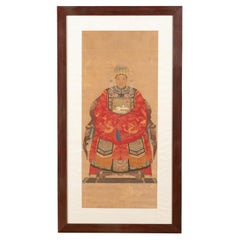
Taoist Hand-Painted Portrait on Parchment Paper in Custom Frame
Located in Yonkers, NY
A large antique hand-painted Taoist portrait on parchment paper with silk matting, in custom frame. This large antique hand-painted Taoist portrait is a mesmerizing work of art that ...
Category
Antique 19th Century Chinese Qing Paintings
Materials
Composition
You May Also Like
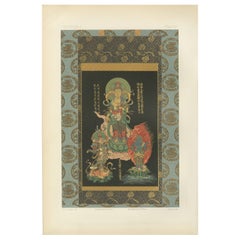
Antique Japanese Buddhist Deity Print with Guardians, 19th Century
Located in Langweer, NL
Antique Japanese Buddhist Deity Print with Guardians, 19th Century
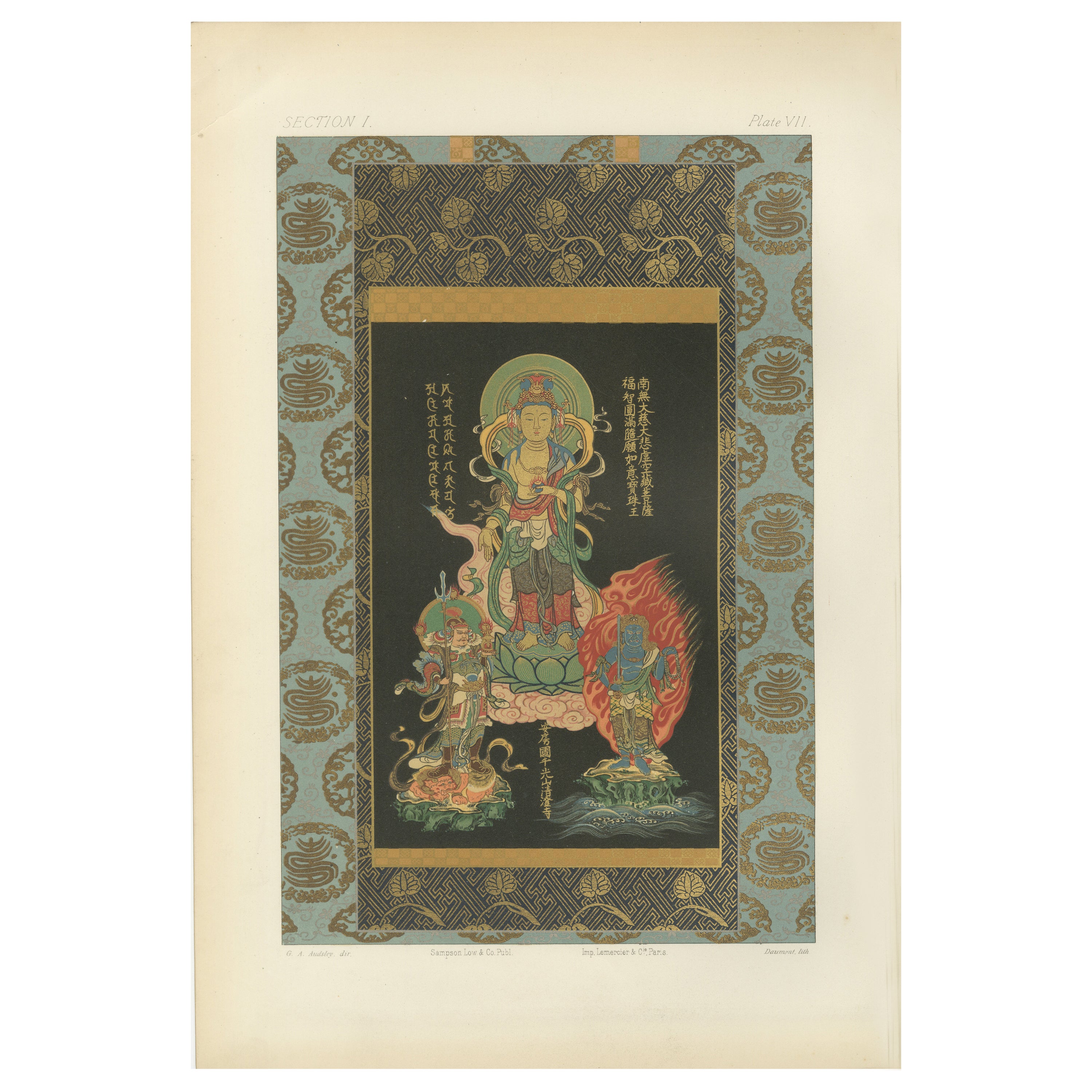
This captivating 19th-century Japanese print presents a vibrant depiction of a Buddhist deity surrounded by fierce...
Category
Antique 1880s Prints
Materials
Paper
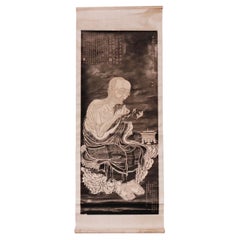
Antique Chinese Printed Ink Rubbing of Panthaka Arhat, (scroll mounted)
Located in Point Richmond, CA
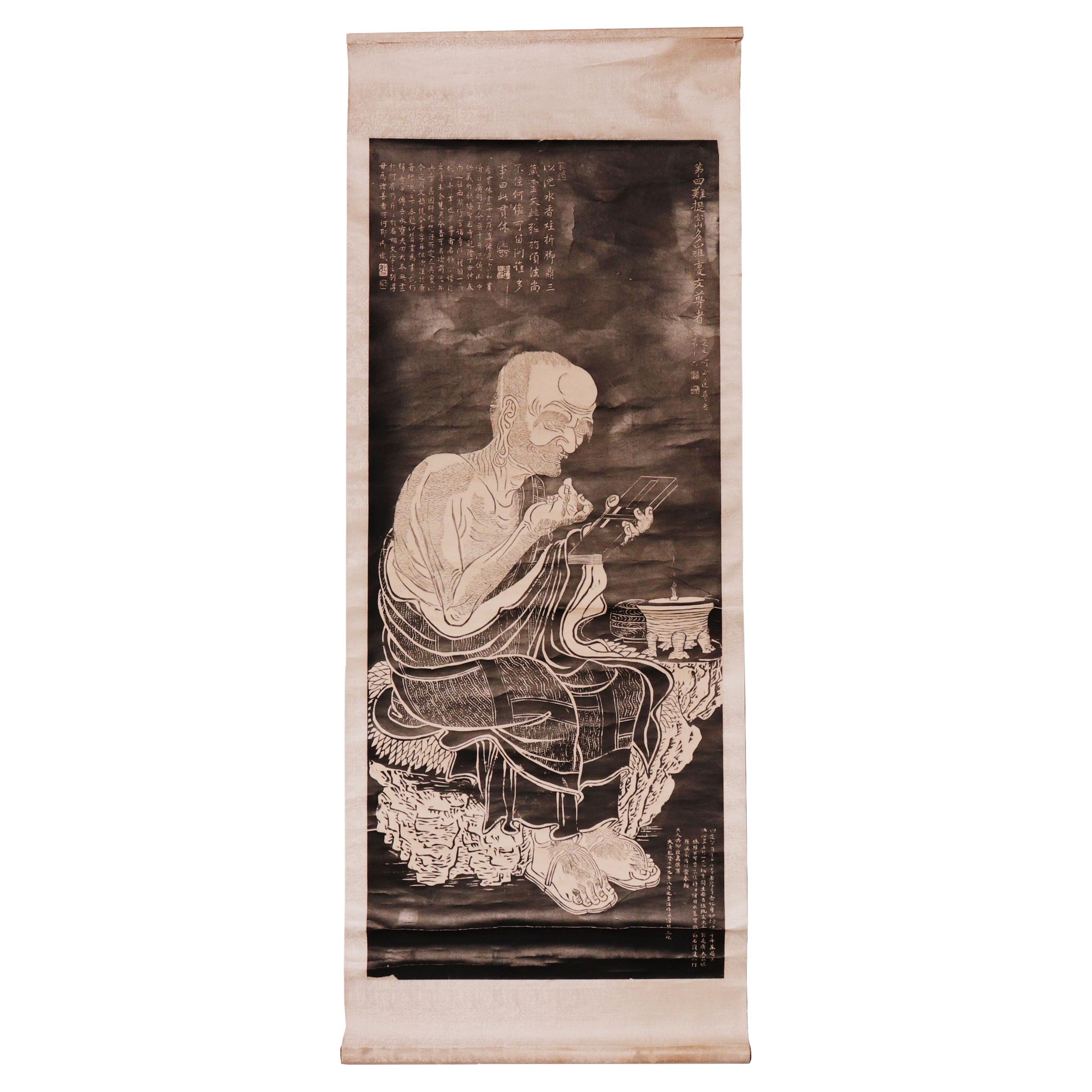
Chinese ink rubbing printing depicting Panthaka Arhat, no.4 of the 16 arhat images immortalized in stone at the former stupa at Shengyin Temple. Depicted here sitting on a rock with a book in his left hand and snapping his fingers in his right hand, symbolic of the speed at which he obtained enlightenment, accompanied by a beggar’s bowl and an incense burner, complete with colophons and silk scroll mounting. The Emperor Qianlong ordered the stone stele to be carved in 1764 after the arhat designs painted by the famed artist Guanxiu (832-912). Even though the temple was destroyed in the Taiping rebellion, the steles remain and have been reinstalled at the Hangzhou Stele Forest. Condition: Creases from rolling, otherwise fine condition. Mounting: 58” x 22”. 19th Century. Ex Collection: Frank “Till” & Peggy Durdin, San Diego.
For other rubbings of this stele see:
Penn Museum, object number 2010-26-4
The Metropolitan Museum of Art AN#: 59.195.15
Fine Arts Library of Harvard University, record id: W280021_urn-3:FHCL:478850
For another example of this image rendered in jade and lacquer see: “Screen Paintings of Guanxiu’s Sixteen Arhats in the Collection of the Palace Museum” Luo Wehhua translated by Bruce Doar, Orientations, September 2010, p. 104. In this article the image is identified as the sixteenth arhat Abheda, It is explained in this article that Qianlong re-identified the arhats, thus the 16th Arhat attribution for this image. Also in this article the identical colophon by Qianlong above the image is translated as: “These accurate portraits of the Sixteen Arhats were created by the Tang Dynasty painter Guanxiu, as recorded in Xuanhe Huapu (Record of paintings in the Xuanhe Reign), and during the millennium from the Guangming reign period to the present day, the original works were to be found in Zhejiang, where they were housed in the collection of Shengyin Temple in Qiantang (Huangzhou). In spring of the dingchou year (1757) of his reign, the Qianlong emperor undertook a southern tour of inspection and stayed at an imperial lodge on the West Lake. He went to the temple to pay his respects and there he saw the arhats on display and wrote a description of these marvels. The sequence of the arhats and their names had been passed down since ancient times, but they did not correspond to their Sanskrit titles; the sequence of the arhat names conformed instead to the interpretation of the Sanskrit classics by the Zhangjia State Preceptor. The emperor penned the original names and positions in the sequence below each of the figures in accordance with the readings supplied in Tongwen Yuntong (Unified Rhymes), and below each he penned an encomium, which he signed. Then the images were returned to the collection, to be passed down as a perpetual treasure. Now, the fourth great arhat had long gone missing and we did not know where his painting was. But it was merely a trifling matter of matching the images with the names, and now surely we have found him! This I, the emperor, believe.”
All 16 of these rubbings can be found in the Rubel Chinese Rubbings Collection at the Fine Arts Library of Harvard University with the following descriptive historical note: “Rubbing from stele depicting No. 4 of 16 arhats (Lohans, Buddhist saints) -- Nan ti mi duo luo qing you, Panthaka Arhat. Original painting attributed to Guanxiu, 832-912. Inscriptions written by Hongli, Emperor Qianlong (Gaozong, 1711-1799) of Qing Dynasty. 7 seals of Qianlong follow the inscriptions. Script style: in xing shu. Shi liu zun zhe -- "The 16 noble ones" are 16 lohans. Lohans are also called "a-lo-han" based on the transliteration of the Sanskrit term "arhat." (Japanese: Rakan; Chinese: Lohan; Tibetan: Gnas-brtan). Arhats or Arahants are saints or sages said to have renounced nirvana (freedom from the cycle of suffering and rebirth), vowed to remain in the world to protect the Dharma and propagate the Law of the Buddha in order to devote themselves more effectively to the relief of human misery, like the Bodhisattvas. These 16 Arhats, personal disciples distinguished by the Buddha, formed part of the 500 claimed by tradition to have attended the First Council in Rajagrha. The names and abodes of these 16 arhats are given in a work entitled "Record on the Duration of the Law, spoken by the Great arhat Nadimitra," which was translated into Chinese by the famous pilgrim Xuanzang (596-664) in 654. 16 lohans are quite often represented, especially in China and Japan, in sculpture and painting, in poses and with attributes. Every lohan can be easily with special icongraphic characteristics. Guanxiu (Jiang Deyin or Deyuan, a Buddhist monk also named Master Chan Yue, 832-912) -- painter during late Tang to Five Dynasties, specialized in painting lohan figures. Legend has it that the first portraits of the 18 Lohans...
Category
Antique 19th Century Chinese Qing Prints
Materials
Paper
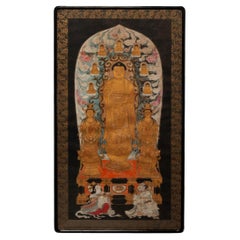
Antique Japanese Buddhist Ink
Color On Silk Painting Amida Triad Buddha
Located in Forney, TX
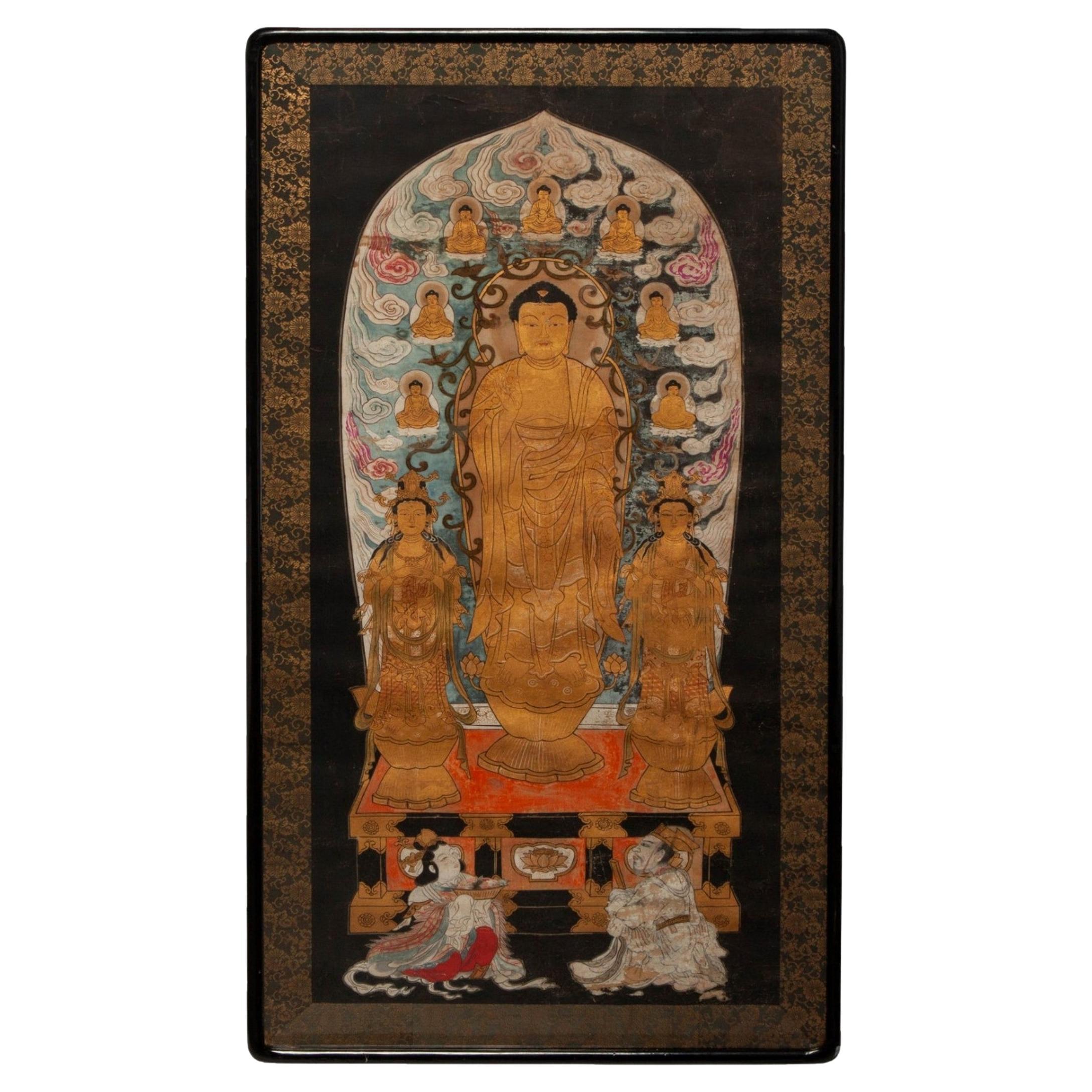
A beautiful framed antique Japanese School ink and color painting on silk, 19th century, finely detailed and richly colored, depicting Amida Triad, with two Bodhisattva attendants worshipping Buddha, on a gilt arabesque mat, in a black frame.
Provenance / Acquisition:
A Private Dallas Collector
Acquired from the highly reputable auction house Dallas Auction Gallery, Dallas, Texas. Summer Fine Arts and Antiques catalog.
Owned and curated by Reyne Hirsch, a notable media personality and expert in 20th century decorative arts. She's was a top appraiser for Antiques Roadshow...
Category
Antique 19th Century Japanese Edo Paintings and Screens
Materials
Metallic Thread
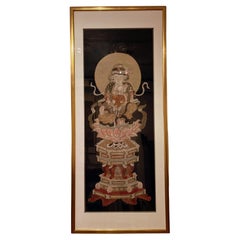
Framed Japanese or Chinese Brush Painting of Buddhistattva, Conservation Framed
Located in Greenwich, CT
Chinese or Japanese brush painting of Bodhisattva of Mercy sitting on lotus throne, Painting itself is in very good condition. Conservation framed is the quality of using by museum ...
Category
Antique Early 1900s Chinese Paintings and Screens
Materials
Silk
$2,500 Sale Price
34% Off
Framed Shakyamuni Buddha Thangka Painting
Located in Miami, FL
Offered is a vibrant and intricate Tibetan Buddhist "thangka" (also known as "tangka", "thanka", or "tanka"), which is what a painting that serves as a visual representation of spiri...
Category
Vintage 1960s Tibetan Tibetan Paintings and Screens
Materials
Bronze, Gold Leaf
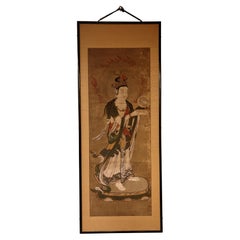
Japanese Brush Painting of a Standing Bodhisattva of Mercy
Located in Greenwich, CT
Japanese brush painting of a standing Bodhisattva of Mercy, beautiful colors and brush work, 19th century, original brocade mount
I am planning to reti...
Category
Antique 19th Century Japanese Meiji Paintings and Screens
Materials
Paper
$2,200 Sale Price
38% Off
More Ways To Browse
Asian Elephants
Antique Indian Prints
Asian Art On Paper
Antique Guanyin
Antique Elephant Print
Indian Art Elephants
Wood Guanyin
Bodhisattva Wood
Japanese Mid Century Woodblock
Antique Accordion
Kiyoshi Saito
Meiji Woodblock
Tamil Nadu
17th Century Horse
Japanese Triptych
Paul Jacoulet Woodblock Prints
The Eye By Kiyoshi Saito
Woodblock Prints Paul