1910s Scholar s Objects
to
2
3
58
172
252
25
87
38
45
11
3
2
1
1
4
4
5
17
4
1
1
1
1
1
2
2
1
1
3
3
3
Period: 1910s
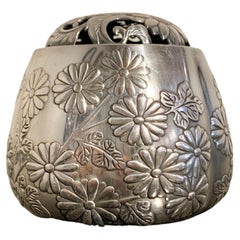
Japanese Silver Incense Burner, Akoda Koro, by Nomura, Meiji Period, Japan
Located in Austin, TX
A lovely and luxurious Japanese silver incense burner of lobed melon form, akoda koro, marked jungin and signed Nomura, Meiji Period, circa 1900, Japan.
The silver koro...
Category
Japanese Meiji Vintage 1910s Scholar s Objects
Materials
Silver, Sterling Silver
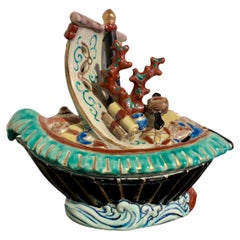
Japanese Kutani Treasure Boat
Takarabune
Censer, Taisho Period, Japan
Located in Austin, TX
A wonderful Japanese Kutani porcelain incense burner, koro, in the form of a treasure ship, Takarabune, Taisho Period (1912 - 1926), Japan.
The censer boldly modeled as the legendary Takarabune, or Treasure Ship, a mythical ship said to carry the shichifukujin, the Seven Lucky Gods, around the heavens during the first days of the New Year, visiting lucky humans to bring blessings and prosperity.
The black bodied, single mast ship sails on the water, its sail full of wind and decorated with the character "takara", meaning treasure. The pierced top of the ship serving as the cover for the censer. It is loaded with magical items and treasure, most prominently, a large coral branch...
Category
Vintage 1910s Scholar s Objects
Materials
Porcelain
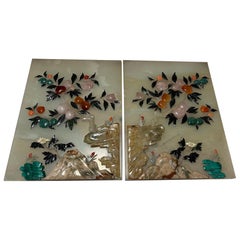
Pair Of Antique Chinese Finely Carved Jade Scholar Screens With Fine Floral Work
Located in Vancouver, British Columbia
Exquisitely hand carved early Republic period Chinese pair of Scholar's screens. Beautiful variety of finely carved plaques displaying blossoming fruit set against a mottled backgrou...
Category
Chinese Chinese Export Vintage 1910s Scholar s Objects
Materials
Jade
Related Items
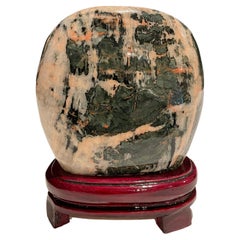
Quality Chinese Scholar Rock
Located in Norwood, NJ
Chinese Scholar stone, Meditation stone, Appreciation stone or Dream stone. All names for this beautiful natural stone that when studied evokes and por...
Category
Chinese 1910s Scholar s Objects
Materials
Stone

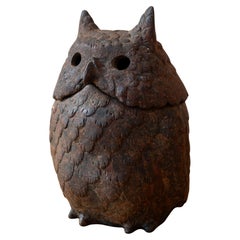
Japanese Iron Owl Incense Burner Lantern
Located in San Diego, CA
Iron owl sculpture with a nice patina. Removable head with vented ears and eyes. For burning incense, small lantern, or candle holder. Japan. 1960s.
Category
Japanese Mid-Century Modern Vintage 1910s Scholar s Objects
Materials
Iron
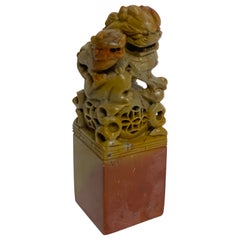
Large Chinese Export Carved Soapstone Foo Dog Scholars Seal
Located in West Palm Beach, FL
Large Chinese export carved soapstone foo dog scholars seal, nicely carved, in two color soapstone, with large seal at base.
The inscription reads:
...
Category
Chinese Chinese Export 1910s Scholar s Objects
Materials
Soapstone
$380 Sale Price
20% Off
H 4.5 in W 1.5 in D 1.5 in
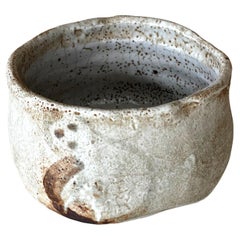
Antique Japanese Shino Ware Chawan Tea Bowl
Located in Atlanta, GA
On offer is a Japanese ceramic tea bowl (chawan) used in the traditional chado ceremony. The bowl was potted in clog form with a ring foot shaved extremely low. Its size and harmonious proportion make it perfect to be held in both hands during chado. Classified as shino ware...
Category
Japanese Edo Antique 1910s Scholar s Objects
Materials
Ceramic
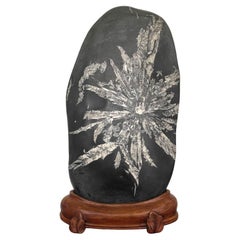
Chinese Scholar Rock Chrysanthemum Stone
Located in Atlanta, GA
An extraordinary specimen created by nature millions of years ago, this large and stunning Chinese black chrysanthemum stone features white crystalline mineral (calcite and chalcedon...
Category
Chinese Chinese Export Antique 1910s Scholar s Objects
Materials
Stone
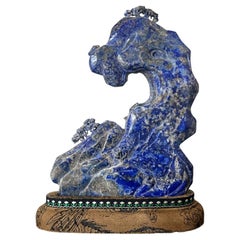
Chinese Carved Lapis Lazuli Scholar Stone
Located in Atlanta, GA
A Chinese scholar rock carved from a natural lapis stone and displayed on a brocade wrapped stand circa late 19th century Qing Dynasty. The brightly blue lapis was considered as am exotic gemstone in China and mostly imported from Persia through the silk road. While not a conventional rock types of materials for scholar stones, it is occasionally carved and polished into smaller Gongshi to be displayed and meditated upon in the scholar's study. Similar approaches were also done with jade, malachite and turquoise, even petrified wood, Chenxiang Agarwood, roots in spirited form, porcelain and even bronze in rock forms.
The lapis was carved into a mountain form with stacked rocks...
Category
Chinese Chinese Export Antique 1910s Scholar s Objects
Materials
Stone
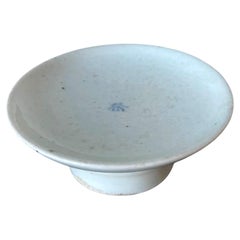
Korean Ceramic Ritual Offering Stemmed Dish with Inscription Joseon Dynasty
Located in Atlanta, GA
A small ceramic stemmed dish with high cylindrical foot in white glaze with a cobalt blue underglaze inscription in the center from Korea, circa 18-19th cent...
Category
Korean Archaistic Antique 1910s Scholar s Objects
Materials
Ceramic
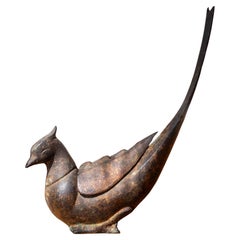
Mid Century Japanese Iron Bird Incense Burner
Located in San Diego, CA
Antique iron bird sculpture with a nice patina. Removable vented piece, for burning incense, 1960s.
Category
Japanese Mid-Century Modern Vintage 1910s Scholar s Objects
Materials
Iron
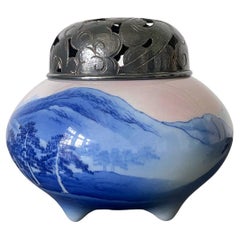
Japanese Glazed Ceramic and Silver Koro Incense Burner Makuzu Kozan
By Makuzu Kozan
Located in Atlanta, GA
A tri-pod ceramic incense burner (koro) by Japanese Imperial potter Makuzu Kozan (1842-1916) circa late Meiji to the start of Taisho period (1890-1910s). A fine example of the artist's work belonging to the late part of his underglaze paint phase (started around 1887 until his death), the surface of the koro was painted in beautiful shades of blue to depict a continuous landscape not unlike a traditional ink and watercolor hand scroll. The rise and fall mountains recede and fade into the horizon and are dotted with groves of pines. The sky is painted with a beautiful subtle shade of pink, suggesting a time of sunrise or sunset. The koro is fitted with an ensuite reticulated sterling silver hoya (incense cover), pierced with swirling cloud and marked with "pure silver' in Kanji. The base is signed in underglaze blue "Makuzu Kozan Sei" within a double ring. The piece is beautifully potted in form and the decoration was done with expertise using the novel technique developed by Kozan called Fuki-e (the blow painting), in order to achieve the striking landscape known as "Mountain and Water" with sense of dimensions and gradient, the poetic effects normally conveyed only by sumi ink staining on paper. The piece comes with an unsigned tomobako (wood storage box) of a recent age.
Also known as Miyagawa Kozan (1842–1916), Makuzu Kozan was one of the most established and collected ceramist from Meiji Period. Born as Miyagawa Toranosuke, Kozan established his pottery studio in Yokohama around 1870s and later became one of the appointed artists to the Japanese Imperial household. His work was exhibited in many international fairs that the Meiji government participated at the turn of the century and won many grand prizes. Being one of the most creative ceramists, Kozan started experimenting with new chemical colors from the West in the format of his porcelain glaze around 1880s. New colors allowed him to create underglaze designs that appeared bright, smooth and glossy. He even invented his own receipt of cobalt blue to achieve a much brighter yet softer shade, as evident on this vase. To create landscape that is realistic and dimensional, more common in the western paintings, he was inspired by the native Japanese ink painting technique developed around 1900 by Yokoyama...
Category
Japanese Japonisme Antique 1910s Scholar s Objects
Materials
Silver
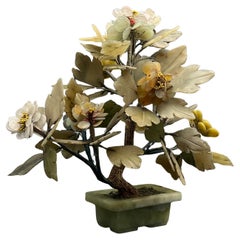
No.2 of 2, Chinese Jade Bonsai Tree with Jade Pot
Located in Skien, NO
One of a pair No. 2– Stunning Chinese handcrafted Bonsai Tree/Flower in white and green / gray white and green jade (for the leaves) and agate/hardstone (for the pink and yellow flow...
Category
Chinese Qing 1910s Scholar s Objects
Materials
Jade
$1,480 Sale Price
20% Off
H 12.21 in W 12.21 in D 7.88 in
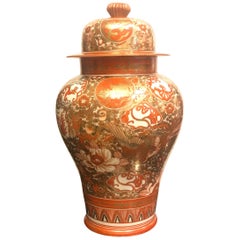
Antique Meiji Period Kutani Japanese Porcelain Temple Jar
Located in Lambertville, NJ
Antique Meiji period Japanese porcelain temple jar with intricate hand painted decoration and gilt. The jar in Classic Kutani colors with floral and phoenix birds all over the top an...
Category
Japanese Meiji Antique 1910s Scholar s Objects
Materials
Porcelain
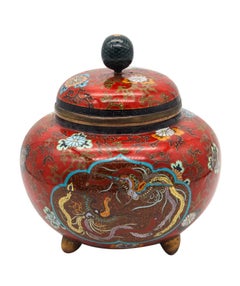
JAPAN IMPERIAL 1900 Meiji Period Tripode Koro Censer In Cloisonné Enamel With
Located in Miami, FL
Japanese tripod Koro from the Meiji Period (1868-1912).
This is a rare and beautiful antique koro censer, created in the imperial Japan during the Meiji period (1868-1912), circa 1900. It was carefully crafted in solid bronze and copper with silver wires and embellished with applications of polychromatic Cloisonné enamels and aventurine. The designs depict organics and natural motifs such mythological animals and flowers.
The Chrysanthemum Symbol
In Imperial Japan, the chrysanthemum (Kiku) was a potent symbol of the imperial family and the emperor himself, representing longevity, royalty, and divine power. The 16-petaled chrysanthemum is the Imperial Seal and crest, found on passports, coins, and the Chrysanthemum Throne. This association dates back to the Kamakura period (1185–1333), particularly with Emperor Go-Toba's fondness for the flower, establishing its link to imperial authority and lineage. The connection between the chrysanthemum and the imperial family began when Emperor Go-Toba adopted it as a personal emblem, aligning it with the strength and refinement of the emperor's rule. During the Meiji Period, the 16-petaled chrysanthemum crest, solidifying the association with the imperial family, was established during this time.
The Meiji Imperial Period
This is an era of Japanese history that extended from October 23, 1868 to July 30, 1912.The Meiji era was the first half of the Empire of Japan, when the Japanese people moved from being an isolated feudal society at risk of colonization by Western powers to the new paradigm of a modern, industrialized nation state and emergent great power, influenced by Western scientific, technological, philosophical, political, legal, and aesthetic ideas. As a result of such wholesale adoption of radically different ideas, the changes to Japan were profound, and affected its social structure, internal politics, economy, military, and foreign relations. The period corresponded to the reign of Emperor Meiji. It was preceded by the Keiō era and was succeeded by the Taishō era, upon the accession of Emperor Taishō.
Country: Imperial Japan.
Period: Meiji, 1890-1910.
Technique: Silver Wire Cloisonné over copper and bronze.
Weight: 416.80 Grams, (0.417 Kg).
Measurements:118 mm by 115 mm (4.65 x 4.52 Inches).
Koro
This term refers to a Japanese censer, incense burner, perfume burner or pastille burner is a vessel made for burning incense or perfume in some solid form. They vary greatly in size, form, and material of construction, and have been in use since ancient times throughout the world. They may consist of simple earthenware bowls or fire pots to intricately carved silver or gold vessels, small tabletop objects a few centimeters tall to as many as several meters high. Many designs use openwork to allow a flow of air. In many cultures, burning incense has spiritual and religious connotations, and this influences the design and decoration of the censer.
Cloisonné
This is an enameling technique in which the pattern is formed by wires soldered to the surface of the object to be decorated, which is usually made from copper, forming cells or cloisons, each of which holds a single colour of enamel paste which is then fired, and ground and polished. The champleve technique also uses an enameling technique, but the cells are formed by carving into the surface of the object, or in the casting. The cloisonne technique has been in use since the 12th century BC in the west, but the technique did not reach China until the 13th or 14th century. It became popular in China in the 18th century. Initially bronze or brass bodies were used, and in the 19th century copper, at which time the quality of the items produced began to decline. Chinese cloisonné is the best-known enamel cloisonné, though the Japanese produced large quantities from the mid-19th century, of very high technical quality. In the west the cloisonne technique was revived in the mid-19th century following imports from China, and its use continued in the Art Nouveau and Art Deco periods.
Condition: Basically, is in great antique condition, near mint, with insignificant and minimal usage, in great condition. All parts are secured in the settings. This Japanese Meiji Koro...
Category
Japanese Meiji Antique 1910s Scholar s Objects
Materials
Silver, Bronze, Copper, Enamel
$1,598 Sale Price
20% Off
H 4.65 in Dm 4.52 in
Previously Available Items
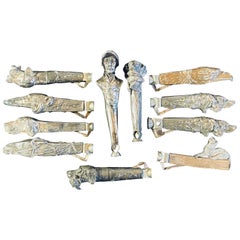
Collection 11 Antique Silvered Metal Cigar Cutters Dog Jockey Horse Eagle Cat
Located in Manhasset, NY
Fine Collection of 11 antique silvered metal cigar cutters including 7 dogs, jockey, horse, eagle, and a cat from The Jerry Terranova Estate. My p...
Category
Arts and Crafts Vintage 1910s Scholar s Objects
Materials
Metal, Silver Plate
H 6.75 in W 2 in D 1.75 in
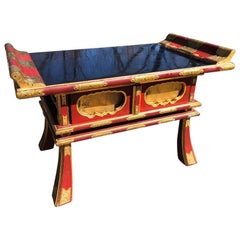
Japanese Antique Red Lacquer and Gold Gilt Display Altar Table
Located in South Burlington, VT
Japanese handcrafted rich red lacquer and gold gilt bronze embellished wooden altar or display table. A beautiful antique work from an old southern Japan collection.
Measurements:...
Category
Japanese Taisho Vintage 1910s Scholar s Objects
Materials
Bronze
Still Thinking About These?
All Recently ViewedMore Ways To Browse
Antique Chinese Carved Bamboo Brush Pot
Lingbi Scholar Stones
Chinese Brush Holder
Asian Green Marble
Carved Jade Bonsai Tree
Chinese Calligraphy Brush And Stand
Chinese Jade Brush
Chinese Scholar Seal
Carved Calligraphy Brush
Chinese Red Jade
Taihu Stone
Antique Chinese Brush Holder
Antique Chinese Calligraphy Brush
Chinese Amber Snuff Bottle
Amber Snuff Bottle Antique
Calligraphy Brush Stand
Fish Snuff Bottle
Foo Dog Seal