Want more images or videos?
Request additional images or videos from the seller
1 of 6
Shipwreck Salvaged Medieval Blue and White Peony Vase
$300List Price
About the Item
- Dimensions:Height: 2.5 in (6.35 cm)Diameter: 2.75 in (6.99 cm)
- Period:
- Date of Manufacture:1450 AD
- Condition:
- Seller Location:London, GB
- Reference Number:1stDibs: LU105223416482
About the Seller
5.0
Recognized Seller
These prestigious sellers are industry leaders and represent the highest echelon for item quality and design.
Gold Seller
Premium sellers maintaining a 4.3+ rating and 24-hour response times
Established in 2007
1stDibs seller since 2014
106 sales on 1stDibs
Typical response time: 1 hour
Associations
LAPADA - The Association of Arts
Antiques DealersInternational Confederation of Art and Antique Dealers
AssociationsThe British Antique Dealers
Association
Authenticity Guarantee
In the unlikely event there’s an issue with an item’s authenticity, contact us within 1 year for a full refund. DetailsMoney-Back Guarantee
If your item is not as described, is damaged in transit, or does not arrive, contact us within 7 days for a full refund. Details24-Hour Cancellation
You have a 24-hour grace period in which to reconsider your purchase, with no questions asked.Vetted Professional Sellers
Our world-class sellers must adhere to strict standards for service and quality, maintaining the integrity of our listings.Price-Match Guarantee
If you find that a seller listed the same item for a lower price elsewhere, we’ll match it.Trusted Global Delivery
Our best-in-class carrier network provides specialized shipping options worldwide, including custom delivery.You May Also Like
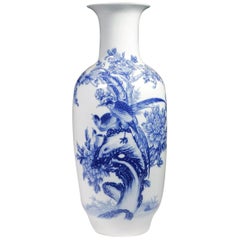
Chinese Blue and White Porcelain Vase from Modern Official Kiln
Located in Atlanta, GA
Dubbed as production of the "Chinese Modern Official Kiln", a small group of porcelains of the highest standard were produced in Jingdezhen from 1962-1967, The production was aimed as a revival of the Chinese porcelain after the foundation of the Republic in 1949 in order to serve the purpose of decorating the meeting halls for the newly renewed diplomatic relations around the globe. The best available materials and artists, including the painters and potters, were employed to achieve a high quality that rivaled the pieces produced during the pinnacle years in the porcelain production in the previous Qing dynasty. Due to the breakout of the Cultural Revolution, most of the pieces failed to be used as intended. Most if not all signatures, such as found on this vase, were added later as a hallmark to distinguish them. "Zhong Nai Hai Huai Ren Tang Treasures Porcelain Research Bureau year of 1962". Zhong Nai Hai is the residential and working compound for Chinese political elites in Beijing and Huai Ren Hall being an important meeting hall.
The pieces from "Modern Official Kiln" ubiquitously showcase perfectly balanced forms with precision in symmetry. The use of very high quality Gaolin clay resulted in a semi translucent body, often quite thinly potted. The superbly underglaze paint were sandwiched between a pre-applied glaze and then an overglaze, and the elaborate designs were drawn by master painters. Often, there is a hidden red Chinese National Emblem on the interior wall. These features were all well reflected in this piece. The decoration of the blue paint on the vase is of a classic regal composition and the cobalt blue is of a vivid radiating color. Blooming peonies, an old laurel tree with blossom and scholar rocks provide the background and anchor for a pair of pheasants. One raises its head to crow while the other one looks down. These motifs are commonly found in classic Chinese scroll paintings, a genre called "Flower and Bird Painting". On the back of the vase, there are Chairman Mao's head portrait watermarked in the glaze as well as a cursive poem with a collection number as shown.
For a pair of blue and white vase of the same production, see sale by Singapore International Auction PTE ltd on July 21st, 2019 lot 2014.
For a pair of blue and white urns...
Category
Vintage 1960s Chinese Modern Ceramics
Materials
Porcelain
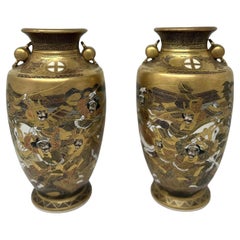
Antique Pair Japanese Satsuma Hand Painted Vase Urns Meiji Period 1868-1912
Located in Dublin, Ireland
Stunning Pair of early Meiji period Satsuma heavy gauge earthenware Rouleau Japanese Vases of Museum quality and generous proportions. These beautiful Satsuma-ware vases were made du...
Category
Antique 19th Century Japanese Anglo-Japanese Ceramics
Materials
Ceramic, Porcelain
$1,521 / set
H 9.75 in W 5.25 in D 5.25 in
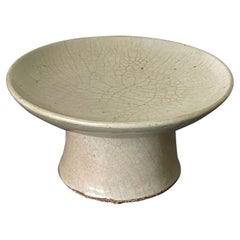
Korean White Ceramic Stem Dish Joseon Dynasty
Located in Atlanta, GA
A ceramic dish with high cylindrical foot in white glaze from Korea, circa 19th century Joseon Dynasty. By shape, this piece is most likely a ceremonial vessel that was used to make offerings on the altar. Although without inscription, we can't rule out that it could be a household item for occasions that were less formal. Such as a private shrine in the household. During Joseon dynasty, the social morals were largely centered on the principles of Confucianism that originated from China. Many ritual ceramic wares were produced for rituals and worships on all level of the society. The ware were often modeled after the archaic bronze ware that elevated them from the aesthetic of daily use pieces. High foot dish like this were made in both round and square shape to suite different use but they were all distinguished with the inscription for their exclusive ceremonial purpose.
Of elegant form and harmonious proportion, this stem dish...
Category
Antique 19th Century Korean Archaistic Ceramics
Materials
Ceramic
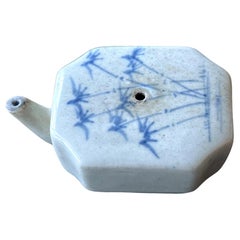
Korean Ceramic White Porcelain Water Dropper Joseon Dynasty
Located in Atlanta, GA
A small Korean water dropper in rectangular form with beveled edges, circa early 19th century of the Joseon Dynasty. The milky white porcelain pie...
Category
Antique 19th Century Korean Other Ceramics
Materials
Ceramic
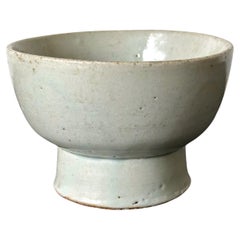
Small Korean White Ceramic Stem Bowl Joseon Dynasty
Located in Atlanta, GA
A ceramic stem bowl with high cylindrical pedestal foot in white glaze from Korea, circa 18 centuries of late Joseon Dynasty. By shape, this piece appears to be a ceremonial vessel t...
Category
Antique 18th Century Korean Archaistic Ceramics
Materials
Ceramic
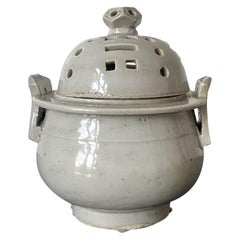
Korean white Porcelain Ritual Incense Burner with Bagua Pattern Joseon Dynasty
Located in Atlanta, GA
An antique Korean ritual incense burner circa 19th century, late Joseon dynasty. It was made in Bunwon Kiln in Gwangju, Gyeonggi Do, near Seoul. The ceramic container has a thickly b...
Category
Antique 19th Century Korean Archaistic Ceramics
Materials
Ceramic
$6,800
H 6.5 in Dm 6.25 in
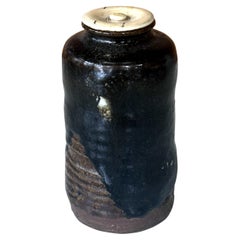
Rare and Fine Antique Japanese Ceramic Ko-Satsuma Chaire Tea Caddy
Located in Atlanta, GA
A ceramic tall chaire (Tea caddies) ko-satsuma type from Edo period Japan circa 18th century. This type of small jar was made of stoneware. Its specific form with raised shoulder and...
Category
Antique 18th Century Japanese Edo Ceramics
Materials
Ceramic
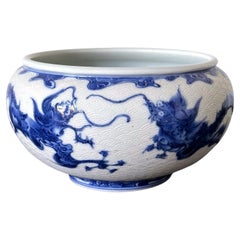
Japanese Glazed and Caved Ceramic Dragon Bowl by Makuzu Kozan
By Makuzu Kozan
Located in Atlanta, GA
A ceramic bowl by Japanese Imperial potter Makuzu Kozan (1842-1916) circa 1891 of late Meiji period. A very fine example of the artist's work that belongs to the middle period of his...
Category
Antique Late 19th Century Japanese Meiji Ceramics
Materials
Ceramic
Japanese Glazed Ceramic and Silver Koro Incense Burner Makuzu Kozan
By Makuzu Kozan
Located in Atlanta, GA
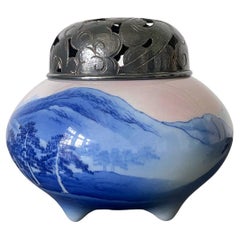
A tri-pod ceramic incense burner (koro) by Japanese Imperial potter Makuzu Kozan (1842-1916) circa late Meiji to the start of Taisho period (1890-1910s). A fine example of the artist's work belonging to the late part of his underglaze paint phase (started around 1887 until his death), the surface of the koro was painted in beautiful shades of blue to depict a continuous landscape not unlike a traditional ink and watercolor hand scroll. The rise and fall mountains recede and fade into the horizon and are dotted with groves of pines. The sky is painted with a beautiful subtle shade of pink, suggesting a time of sunrise or sunset. The koro is fitted with an ensuite reticulated sterling silver hoya (incense cover), pierced with swirling cloud and marked with "pure silver' in Kanji. The base is signed in underglaze blue "Makuzu Kozan Sei" within a double ring. The piece is beautifully potted in form and the decoration was done with expertise using the novel technique developed by Kozan called Fuki-e (the blow painting), in order to achieve the striking landscape known as "Mountain and Water" with sense of dimensions and gradient, the poetic effects normally conveyed only by sumi ink staining on paper. The piece comes with an unsigned tomobako (wood storage box) of a recent age.
Also known as Miyagawa Kozan (1842–1916), Makuzu Kozan was one of the most established and collected ceramist from Meiji Period. Born as Miyagawa Toranosuke, Kozan established his pottery studio in Yokohama around 1870s and later became one of the appointed artists to the Japanese Imperial household. His work was exhibited in many international fairs that the Meiji government participated at the turn of the century and won many grand prizes. Being one of the most creative ceramists, Kozan started experimenting with new chemical colors from the West in the format of his porcelain glaze around 1880s. New colors allowed him to create underglaze designs that appeared bright, smooth and glossy. He even invented his own receipt of cobalt blue to achieve a much brighter yet softer shade, as evident on this vase. To create landscape that is realistic and dimensional, more common in the western paintings, he was inspired by the native Japanese ink painting technique developed around 1900 by Yokoyama...
Category
Antique Early 1900s Japanese Japonisme Ceramics
Materials
Silver
Antique Japanese Ceramic Tanba Chaire with Lid
Located in Atlanta, GA
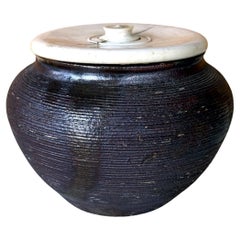
A stoneware ceramic chaires (Tea caddies) of Ko-seto ware type from Edo period Japan circa 18th century. This type of small jar was made of stoneware possibly in Tanba (Tamba) kilns,...
Category
Antique 18th Century Japanese Edo Ceramics
Materials
Ceramic
More From This Seller
View AllFossilised Wood with Blue-Green Highlights
Located in London, GB
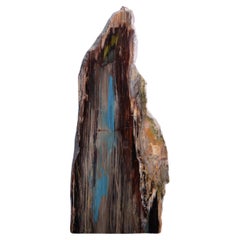
This striking fossilised wood cross-section, dating to the Miocene epoch (23-5 million years ago) and featuring paint-like streaks of greens, blues and browns, is a beautiful natural history specimen and impactful display piece.
This is a magnificent example of the results of permineralisation, a process through which buried wood tissue, permeated by minerals transported in water, can transform into vibrant fossils. This particular example has fossilised over a copper deposit, resulting in the bright inclusions of copper minerals that manifest as impressive streaks of blue, green and red. This distinctive colouration is unique to Colla wood...
Category
Antique 15th Century and Earlier Natural Specimens
Materials
Other
Roman Turquoise-Blue Glass Cup
Located in London, GB
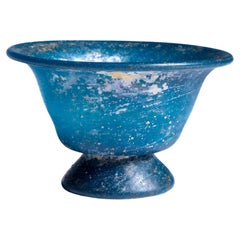
This vibrant, exquisitely well-preserved piece of Roman glassware, with a gently flared lip and cone-shaped foot, was hand blown 2000 years ago. Its maker, evidently an artisan of pa...
Category
Antique 15th Century and Earlier Classical Roman Glass
Materials
Glass
Greyish-White Lunar Meteorite Fragment
Located in London, GB
This beautifully polished lunar meteorite fragment is a precious but powerful display piece, offering both extraterrestrial provenance and striking natural beauty. This specimen is f...
Category
Antique 15th Century and Earlier Natural Specimens
Materials
Stone
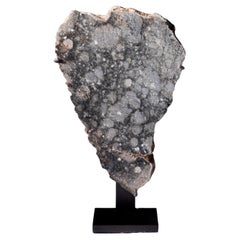
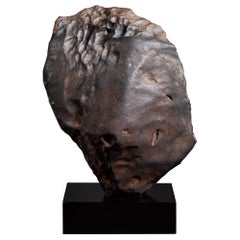
Large and Sculptural Stony Meteorite
Located in London, GB
This strikingly large chondrite meteorite featuring dramatic thumb-print impressions (regmaglypts) and a lustrous surface, is a rare and oriented natural sculpture from outer space....
Category
Antique 15th Century and Earlier Moroccan Minimalist Natural Specimens
Materials
Stone
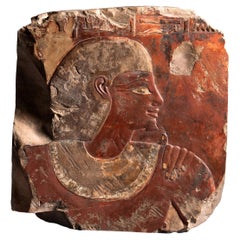
Egyptian Stone Relief of Man and Wife
Located in London, GB
This painted limestone relief is an exquisite example of New Kingdom relief carving from the apogee of Egyptian artistic production. Carved in raised relief - a labour-intensive tech...
Category
Antique 15th Century and Earlier Egyptian Egyptian Busts
Materials
Limestone
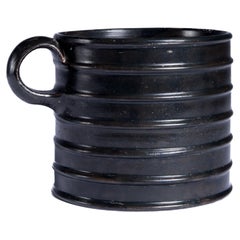
Ancient Greek Black Glaze Mug
Located in London, GB
This strikingly modern ancient Greek mug is a sleek and elegant example of Attic black-glaze pottery at its height. Developing in Athens in the 8th cent...
Category
Antique 15th Century and Earlier Classical Greek Jars
Materials
Pottery
Still Thinking About These?
All Recently ViewedMore Ways To Browse
Floor Vase Blue And White
Sea Dragon
Shipwreck Vase
Scholar Rock
Antique Ink Stone
Chinese Porcelain Scholar
Scholars Desk
Antique Chinese Brush Pots
Chinese Scholar Rock
Stone Display Stand
Antique Calligraphy Brushes
Antique Scholars Desk
Gongshi Stones
Jade Snuff
Jade Snuff Bottle
Red Snuff Bottles
Chinese Brush Washer
Chinese Jade Snuff Bottle