Want more images or videos?
Request additional images or videos from the seller
1 of 21
Antique Signed Meiji Period Japanese Bronze Tiger Sculpture
Price:$1,850
About the Item
- Dimensions:Height: 7.5 in (19.05 cm)Width: 4 in (10.16 cm)Depth: 17.25 in (43.82 cm)
- Style:Meiji (Of the Period)
- Materials and Techniques:
- Place of Origin:
- Period:
- Date of Manufacture:Late 19th or Early 20th Century
- Condition:Wear consistent with age and use. See description for condition details.
- Seller Location:Philadelphia, PA
- Reference Number:Seller: D/I INV1stDibs: LU1610227429992
About the Seller
5.0
Gold Seller
Premium sellers maintaining a 4.3+ rating and 24-hour response times
Established in 1996
1stDibs seller since 2015
611 sales on 1stDibs
Typical response time: 4 hours
Authenticity Guarantee
In the unlikely event there’s an issue with an item’s authenticity, contact us within 1 year for a full refund. DetailsMoney-Back Guarantee
If your item is not as described, is damaged in transit, or does not arrive, contact us within 7 days for a full refund. Details24-Hour Cancellation
You have a 24-hour grace period in which to reconsider your purchase, with no questions asked.Vetted Professional Sellers
Our world-class sellers must adhere to strict standards for service and quality, maintaining the integrity of our listings.Price-Match Guarantee
If you find that a seller listed the same item for a lower price elsewhere, we’ll match it.Trusted Global Delivery
Our best-in-class carrier network provides specialized shipping options worldwide, including custom delivery.You May Also Like
Japanese Miyao Style Gilt Bronze Samurai Archer, Meiji Period, Japan
By Eisuke Miyao 1
Located in Austin, TX
A spectacular Japanese cast, carved, and parcel gilt bronze sculpture, okimono, of a kneeling samurai archer, signed Kiyotsugu (died 1894), Meiji ...
Category
Antique Late 19th Century Japanese Meiji Sculptures and Carvings
Materials
Bronze
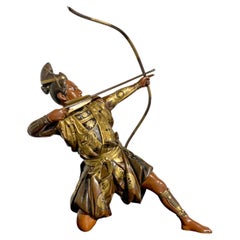
$12,500
H 14.5 in W 11.5 in D 5.5 in
A Massive Japanese Patinated Bronze Sculpture of a Tiger, Meiji Period
Located in Long Island City, NY
A Massive Japanese Patinated Bronze Sculpture of a Tiger, Meiji Period. Signed.
Measuring an impressive 44 inches in length, this extraordinary sculpture is a striking example of t...
Category
Antique 19th Century Japanese Meiji Sculptures and Carvings
Materials
Bronze
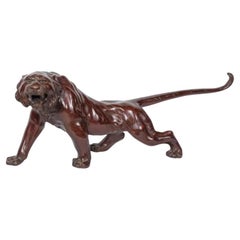
$12,500
H 15 in W 44 in D 18 in
Large Japanese Meiji Bronze Lidded Urn, 19th Century
Located in Bishop
s Stortford, Hertfordshire
A large and stylish antique Japanese Meiji bronze lidded twin handle urn standing on a rounded plinth base with tongue and grotesque head formed legs with dragon handles and a flat c...
Category
Early 20th Century Japanese Meiji Metalwork
Materials
Bronze
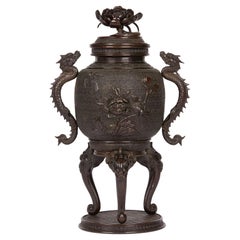
$1,238
Free Shipping
H 17.33 in W 9.85 in D 6.7 in
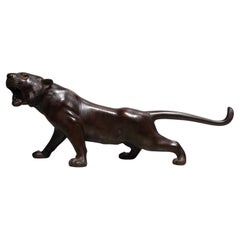
Japanese Meiji Bronze Tiger Sculpture, 1900s.
Located in Asaa, DK
Japanese Meiji Bronze Tiger Sculpture, 1900s.
A japanese patinated solid bronze sculpture of a roaring tiger from the Meiji-period. Complete with o...
Category
Early 20th Century Japanese Meiji Sculptures and Carvings
Materials
Bronze
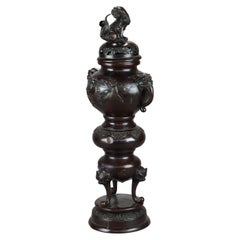
Antique Japanese Bronze Meiji Footed Censer with Figural Foo Dogs
Birds, 1900
Located in Big Flats, NY
An antique Japanese Meiji censer offers cast bronze construction with foo dog lid over bulbous vessel having band with birds and flanking handles with foo ...
Category
Early 20th Century Japanese Metalwork
Materials
Bronze
$960 Sale Price
20% Off
H 22.5 in W 8.75 in D 6.25 in
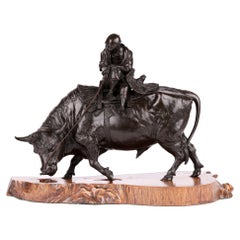
Genryusai Seiya Japanese Meiji Man
Water Buffalo Sculpture on Stand
Located in Bishop
s Stortford, Hertfordshire
An exceptional Japanese Meiji bronze sculpture of a man and water buffalo on a natural polished oak stand by renowned Japanese master craftsman Genryusai Seiya and dating from around 1880/90. The large bronze depicts an elderly man holding a pipe and tobacco pouch...
Category
Antique 1880s Japanese Anglo-Japanese Sculptures and Carvings
Materials
Bronze
$23,192
Free Shipping
H 13.78 in W 17.33 in D 5.52 in
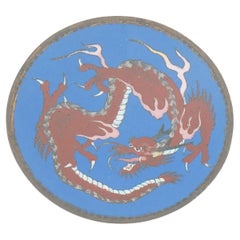
Antique Japanese Meiji period cloisonné enamel bronze dragon plate
Located in Long Island City, NY
An antique Japanese Meiji period cloisonne bronze plate, decorated in enamel depicting a dragon on a blue background. The elegant form and detailed enamel work exemplify the artistry...
Category
Antique Late 19th Century Japanese Meiji Metalwork
Materials
Enamel, Bronze
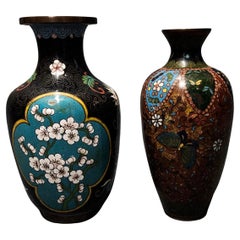
Antique 2 Japanese Cloisonné Meiji Period Vases, Signed
Located in Norton, MA
Quality work, Antique 2 Japanese Cloisonné Meiji Period Vases, Signed opm one vase.
Dimensions;
Larger: 4" Dia x 4.25" H with imperfect shape but no enamel lost
Smaller: 3" Dia x 6" H
Category
Antique 19th Century Chinese Metalwork
Materials
Bronze, Copper
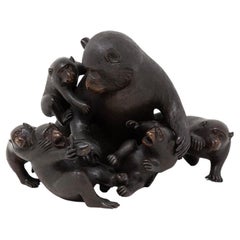
Japanese Meiji Period Bronze Monkey Group Sculpture Okimono Shosai
Located in Newark, England
Featuring Seven Japanese Macaques
Form our Japanese collection, we are delighted to offer this Japanese Bronze Monkey Group by Shosai. The Japanese Bronze Group displaying a male father monkey and his infants playing around and being mischievous with Persimmon fruit. The monkeys modelled as Japanese macaque monkeys (snow monkey). The bronze okimono is beautifully patinated with a highly lifelike and naturalistic casting signed to the underside Shosai 正齊鋳. The Bronze group dates to the Meiji Period (1868-1912) circa 1885.
Japanese macaque (snow monkey) is a terrestrial Old World monkey species that is native to Japan. They are known as snow monkeys because some live in areas where snow covers the ground for long periods each year hence their nickname. No other non-human primate lives further north or in a colder climate than the snow monkey. Individuals have brownish grey fur, pinkish-red faces, and short tails. Two subspecies are known and their conservation Status is of least concern. In Japan, the species is known as Nihonzaru ニホンザル, 日本 (Japan/Nihon) and saru 猿 (monkey) to distinguish it from other primates, but the Japanese macaque is the only species of monkey in Japan.
The Japanese macaque features heavily in the religion, folklore, and art of Japan, as well as in proverbs and idiomatic expressions in the Japanese language. They are often seen in paintings, block prints and represented in all manner of carvings from Okimono to netsuke. Many of these art forms reside in the world’s most famous museums and collections, some of the most prominent pieces by artists such as Mori Sosen and Kawanabe Kyosai. In Shinto belief (Japan’s indigenous religion/nature religion) legendary mythical beasts known as raiju sometimes appeared as monkeys and kept Raijin (the god of lightning/storms) company. In another well known tale the three wise monkeys who warn people to “see no evil, hear no evil and speak no evil” can be seen depicted in relief over the door of the famous Tosho-gu shrine in Nikko.
Meiji Period was an era of Japanese history that spanned from 1868 to 1912. It was the first half of the Empire of Japan, when the Japanese people began to build a paradigm of a modern, industrialised nation state and emergent great power, influenced by Western countries and aesthetics. As a result of radically different ideas, the changes to Japan were profound and it affected the social structure, politics, economy, military, and foreign relations across the board. The period corresponded to the reign of Emperor Meiji and was preceded by the Keio era and was succeeded by the Taisho era.
Cultural Art during the Meiji Period was of particular interest to the government and they overhauled the art export market which in turn promoted Japanese arts via various world’s fairs, beginning in Vienna at the world fair in 1873. The government heavily funded the fairs and took an active role organising how Japan’s culture was presented to the world including creating a semi-public company named Kiritsu Kosho Kaisha (First Industrial Manufacturing Company). The Kiritsu Kosho Kaisha was used to promote and commercialise exports of Japanese art and established the Hakurankai Jimukyoku (Exhibition Bureau) to maintain quality standards. For the 1876 Centennial International Exhibition in Philadelphia, the Japanese government created a Centennial Office and sent a special envoy to secure space for the 30,000 items that would be displayed. The Imperial Household also took an active interest in arts and crafts, commissioning works by select artists to be given as gifts for foreign dignitaries further emphasising the high quality and importance of Japanese art. Just before the end of the 19th century in 1890, the Teishitsu Gigeiin (Artist to the Imperial Household) system was created to recognise distinguished artists. These artists were selected for their exceptionally high quality wares and talent in their own industry. Over a period of 54 years Seventy artists were appointed, amongst these were ceramicist Makuzu Kozan and cloisonné enamel artist...
Category
Antique Late 19th Century Japanese Meiji Sculptures and Carvings
Materials
Bronze
$20,646
Free Shipping
H 5.12 in W 7.09 in D 6.3 in
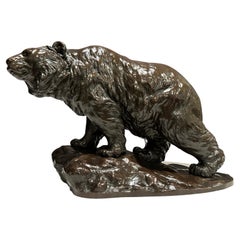
Meiji Period Bronze Bear, Signed
Located in Norwood, NJ
Large and impressive patinated bronze sculpture of a bear. As part of our Japanese works of art collection we are delighted to offer this magnificent high quality Meiji period Okimon...
Category
Antique Early 1900s Japanese Meiji Sculptures and Carvings
Materials
Bronze
More From This Seller
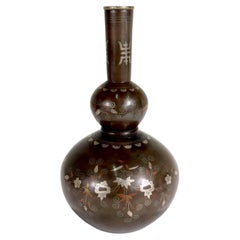
View AllAntique Signed Japanese Meiji Period Mixed Metals Bronze Double Gourd Form Vase
Located in Philadelphia, PA
A fine antique Japanese bronze vase.
From the Meiji Period.
With copper and silver floral and vine and butterfly inlay as well a kanji symbol to the neck (possibly a stylized f...
Category
Early 20th Century Japanese Meiji Vases
Materials
Silver, Bronze, Copper
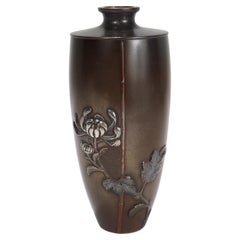
Antique Signed Japanese Bronze Mixed Metals Butterbur Vase by Atsuyoshi / Inoue
Located in Philadelphia, PA
A fine signed antique Japanese Meiji period mixed metals vase.
By Miyabe Atsuyoshi for Inoue of Kyoto.
With a bronze body and d...
Category
Early 20th Century Japanese Meiji Metalwork
Materials
Gold, Silver, Bronze, Copper
Pair of Signed Antique Japanese Cloisonne Enamel Vases by Daikichi
By Ando Shippo Ten, Kumeno Teitaro, Ando Jubei
Located in Philadelphia, PA
A fine pair of Japanese Meiji period cloisonne enamel vases.
By the Ohta Cloisonne workshop of Aichi Prefecture, Japan. T...
Category
20th Century Japanese Meiji Metalwork
Materials
Enamel
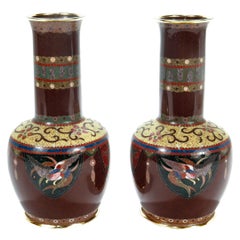
Antique Japanese Cloisonne Enamel Cabinet Vase with Wisteria
Located in Philadelphia, PA
A fine antique Japanese cloisonne enamel cabinet vase.
With polychrome enamel on a brass base.
Decorated with an enameled tree branches with blue & purple wisteria blossoms on a ...
Category
Antique 19th Century Japanese Meiji Metalwork
Materials
Enamel
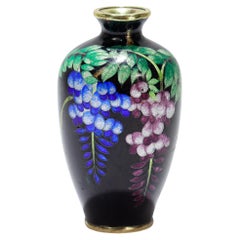
Antique Japanese Kutani Pottery Bodhidharma or Daruma Figurine
Located in Philadelphia, PA
An fine, antique Japanese pottery Daruma figurine.
In the form of a Daruma, a depiction of Bodhidharma the semi-legendary founder of Zen/Chan Buddhism.
The figure's face and protruding toes are an unglazed dark brown and his robe has a dark red glaze.
Simply a charming Japanese figurine...
Category
Early 20th Century Japanese Meiji Sculptures and Carvings
Materials
Pottery
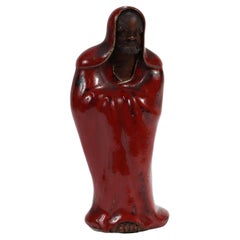
Antique Japanese Mixed Metals Copper
Silver Usubata Ikebana Flower Vase
Located in Philadelphia, PA
A fine antique Japanese flower vase.
In hand-hammered copper (or possibly a thin-bodied bronze) with applied silver bands to rim, footrim, shaped edge, and with a lotus petal border at the joint of neck and body.
Having the usubata form with a wide flared neck and mouth.
The 'usubata' vase is a form favored for large scale floral arrangements by the Ikenobo school, the oldest and largest school of Japanese ikebana founded in the 15th century by Buddhist monk Senno Ikenobo. It is believed that the wide and shallow rim of an usubata vase which displays the surface of the water best imitates natural conditions of growth while also contributing to the longevity of an arrangement with the increased surface area of the water better oxygenating the plants.
The base retains still retains hand-hammered marks.
There is evidence of seams and folds throughout from the construction, and the surface has a cloud-like brown patina throughout.
Simply a wonderful Japanese mixed metal vase...
Category
Antique Late 19th Century Japanese Meiji Vases
Materials
Silver, Copper
Still Thinking About These?
All Recently ViewedMore Ways To Browse
Japanese Bronze Statue
Tiger Carving
Meiji Tiger
Japanese Bronze Tiger
Meiji Bronze Tiger
Chinese Wood Carving
Vintage Japanese Carved
Japanese Wood Carving
Antique Stone Carvings
Japanese Bronze Sculptures
Chinese Jade Sculpture
Unknown Buddha
Buddha Siam
Japanese Temple
Thai Buddhas
Antique Seated Buddha
Carved Wood Buddha
Chinese Statue Statue