1 of 8
Bodhisattva in Gray Schist, Art of Gandhara, 2nd-4th Century J.C
$17,205.08List Price
About the Item
- Dimensions:Height: 16.54 in (42 cm)Width: 6.3 in (16 cm)Depth: 3.55 in (9 cm)
- Materials and Techniques:Schist
- Place of Origin:
- Period:
- Date of Manufacture:Unknown
- Condition:Wear consistent with age and use. Minor losses.
- Seller Location:Saint-Ouen, FR
- Reference Number:1stDibs: LU179524340493
Authenticity Guarantee
In the unlikely event there’s an issue with an item’s authenticity, contact us within 1 year for a full refund. DetailsMoney-Back Guarantee
If your item is not as described, is damaged in transit, or does not arrive, contact us within 7 days for a full refund. Details24-Hour Cancellation
You have a 24-hour grace period in which to reconsider your purchase, with no questions asked.Vetted Professional Sellers
Our world-class sellers must adhere to strict standards for service and quality, maintaining the integrity of our listings.Price-Match Guarantee
If you find that a seller listed the same item for a lower price elsewhere, we’ll match it.Trusted Global Delivery
Our best-in-class carrier network provides specialized shipping options worldwide, including custom delivery.You May Also Like
Gandharan Standing Bodhisattva Maitreya, Carved Black Schist, 2nd-4th Century
Located in Austin, TX
An impressive and well carved Gandharan figure of the Bodhisattva Maitreya, the Buddha of the Future, carved black schist, ancient Kingdom of Gand...
Category
Antique 15th Century and Earlier Pakistani Antiquities
Materials
Schist
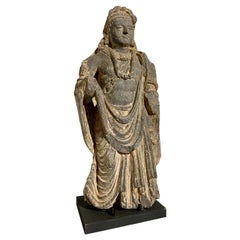
$16,000
H 18.75 in W 8.25 in D 5 in
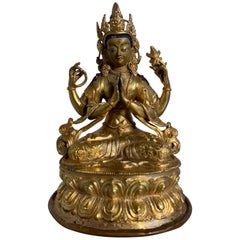
Nepalese Gilt Bronze Figure of Bodhisattva Chenrezig, Mid-20th Century
Located in Austin, TX
A nice vintage early to mid-20th century gilt bronze sculpture of the Buddhist deity Avalokiteshvara in his four armed form, known as Chaturbuhja, or Chenrezig in Tibet.
Chenrezig, a form of Avalokiteshvara, the bodhisattva of compassion (known as Guan Yin or Kwan Yin in Chinese), sits in vajrasana upon a high double lotus pedestal. One pair of hands is clasped in prayer at heart level, the other pair of hands raised upwards at shoulder lever and holding discreet attributes, a mala (prayer beads) in one hand, a lotus blossom in the other.
Chenrezig is dressed in an elaborately patterned floral dhoti that covers his lower half. His torso bare, shoulders covered with a shawl and scarves that billow out around him. He is festooned with jewels, necklaces, bracelets, armlets, earrings, belt and a five pointed crown. The earrings studded with coral. The crown studded with turquoise. His face is cold painted with beautiful details. The hair has been pigmented blue with crushed lapis, indicating his peaceful nature.
The copper base plate is inscribed with a visvajra (double vajra...
Category
Late 20th Century Nepalese Tibetan Sculptures and Carvings
Materials
Coral, Lapis Lazuli, Bronze
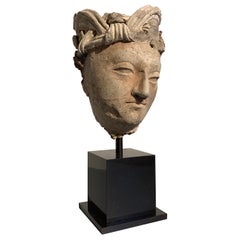
Gandharan Stucco Head of a Bodhisattva, Region of Hadda, 3rd-5th Century
Located in Austin, TX
A striking Gandharan molded stucco head of a male Bodhisattva, tentatively identified as Manjushri, ancient region of Gandhara, probably Hadda or surrounding area, 3rd-5th century.
The Bodhisattva is sculpted of stucco in an idealized manner as a youthful male, with soft and kind features, a benign expression on his face. He wears an elaborate pleated turban wrapped around his head, with two sweeping lobes at the front.
His turban secured on one side by a small image of a roaring lion. The lion may be read as a reference to Manjushri, the Bodhisattva of Wisdom, who is often depicted as riding or subduing a roaring lion, a metaphor for taming the wild thoughts of the mind.
Manjushri gazes outwards in a beatific manner from almond shaped eyes, a gentle smile on his lips. The eyes at different levels when looking at the sculpture head on, indicating the original placement of the head was meant to be viewed at an angle.
Remnants of pigments to the eyes, nose, mouth and ears.
Mounted on a custom black metal stand.
Hadda was an important center of Buddhist learning in the early history of Greco Buddhist Gandhara, and at one time may have housed a bone relic of the historical Buddha, Shakyamuni. The sculpture and architecture of Hadda followed Hellenistic artistic conventions faithfully, leading some scholars to believe the distinct Greco Buddhist style of Gandhara was first developed in Hadda before spreading to the rest of the region.
The kingdom of Gandhara was situated at a crossroads of trade and cultures. Being one of the last remnants of Alexander the Great's Empire, the inhabitants of the Greco-Bactrian Buddhist kingdom preserved Greek culture and heritage for centuries after the decline of the Greek Empire...
Category
Antique 15th Century and Earlier Afghan Hellenistic Sculptures and Carvings
Materials
Stucco
$11,500
H 13.75 in W 6 in D 6.5 in
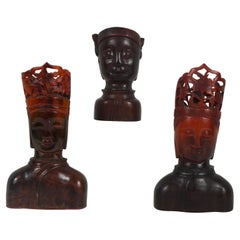
Three Early 20th Century Red Horn Carvings of Buddha and Bodhisattva
Located in Hudson, NY
Three early 20th century red horn carvings of Buddha and Bodhisattvas. These three carvings all from approx. circa 1915 represent the bodhisattvas and or the ...
Category
Early 20th Century Chinese Busts
Materials
Horn, Rosewood
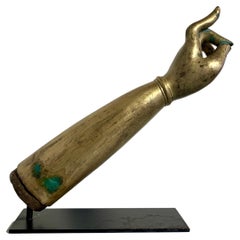
Over Life-Size Tibetan Gilt Bronze Arm of a Bodhisattva, Late 19th Century
Located in Austin, TX
An impressive larger than life-size cast and gilt bronze left hand and arm of a bodhisattva, late 19th century or earlier, Tibet.
The over-sized arm and hand of graceful proportions. The arm tapering down to a slender wrist embellished with a simple bracelet hiding the join between the hand and arm. The hand and arm richly gilt. The join to the elbow visible and exposed.
The hand heavily cast, with nice detail to the fingernails and cuticles. The palm with simple incised lines. The hand, with the pointer and pinky fingers raised, and the middle and ring finger folded down touching the thumb, performs the gesture known as karana mudra, the gesture of dispelling evil. (Here in Texas we refer to this gesture as "Hook'em Horns!")
Karana mudra is often associated with Avalokiteshvara, the bodhisattva of compassion, known in Tibet as Chenrezig, and in China as Guanyin.
The hand and arm would originally have been part of a much larger sculpture. Unfortunately many Tibetan Buddhist sculptures...
Category
Antique Late 19th Century Tibetan Tibetan Sculptures and Carvings
Materials
Bronze
$12,500
H 15.75 in W 15 in D 4 in
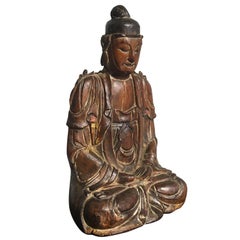
Small Song Dynasty Carved Wood Bodhisattva, 13th Century, China
Located in Austin, TX
A small and very fine Chinese carved sandalwood figure of a bodhisattva, possibly Avalokiteshvara (Guan Yin), Song Dynasty (960 to 1276), circa 13th ...
Category
Antique 15th Century and Earlier Chinese Sculptures and Carvings
Materials
Hardwood
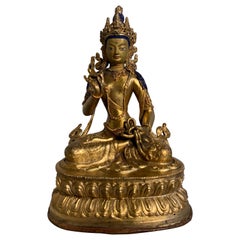
Nepalese Gilt Bronze Bodhisattva
Amoghapasha?
, Early to Mid-20th Century
Located in Austin, TX
A beautiful and unusual gilt bronze figure of a Bodhisattva, possibly Amoghapasha, Nepal, early to mid-20th century, circa 1930s or 1940s.
The regal figure possibly depicting the bodhisattva Amoghapasha, the Unfailing Lasso. The enlightened being is portrayed seated upon a high double lotus pedestal. He is dressed as an Indian prince, wearing a luxurious foliate patterned dhoti around his waist and a billowing scarf around his shoulders. . His torso bare save for the jeweled necklaces and the sacred thread. A five pointed crown with an image of Amitabha Buddha in the central point graces his head.
His princely face cold painted with beautiful detail, his hair colored blue with crushed lapis lazuli, indicating his peaceful nature. Amoghapasha holds a lasso in one hand, an axe in the other. He is considered an emanation of Avalokiteshvara. A bodhisattva of compassion, Amoghapasha is so named because of the lasso he holds in his hand. The lasso represents his vast compassion which is thought to extend to encompass all beings, bringing them into a state of perfection and enlightenment.
The copper base plate, seemingly a later replacement, has been inscribed with a visvajra (double vajra...
Category
Mid-20th Century Nepalese Tibetan Sculptures and Carvings
Materials
Lapis Lazuli, Bronze
$3,500
H 8.5 in W 5.88 in D 4.25 in
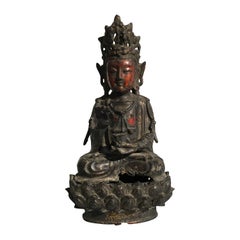
Chinese Ming Dynasty Lacquered and Gilt Bronze Bodhisattva, 17th Century
Located in Austin, TX
Chinese late Ming dynasty bronze figure of the Bodhisattva Avalokiteshvara, also known as Guanyin (Quan Yin, Kwan Yin, Kuan Yin), 17th century, China
The figure well cast in two ...
Category
Antique Mid-17th Century Chinese Ming Sculptures and Carvings
Materials
Bronze
$6,500
H 11.5 in W 6.25 in D 4.25 in
Chinese Carved Wood Bodhisattva Guanyin, Late Ming Dynasty, 17th Century
Located in Austin, TX
An attractive carved wood figure of the Bodhisattva Avalokiteshvara, known as Guanyin in China, late Ming Dynasty, early 17th century, China.
Guanyi...
Category
Antique Early 17th Century Chinese Ming Sculptures and Carvings
Materials
Gesso, Wood
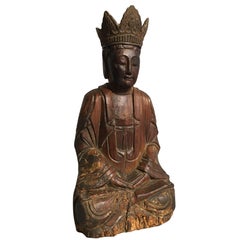
$4,200
H 14 in W 6.75 in D 5 in
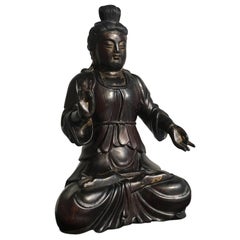
Chinese Carved Zitan Figure of a Bodhisattva, Qing Dynasty
Located in Austin, TX
A finely carved Chinese zitan wood figure of an unidentified bodhisattva, possibly Guanyin, late Qing Dynasty, circa 1900, China.
The androgynous figure has a plump, almost matronly face, with downcast eyes and a gentle smile. The hair in long tresses, gathered and tied in a high chignon.
The enlightened being is portrayed seated in dhyanasana, bare feet resting on crossed legs, both soles pointing up.
Thick robes billow and drape around the full figured body. The hands display...
Category
Early 20th Century Chinese Qing Sculptures and Carvings
Materials
Lapis Lazuli
Still Thinking About These?
All Recently ViewedMore Ways To Browse
J C Gray
Antique Holy Water
Gandhara Sculpture
Japanese Artifact
Japanese Shinto
Mandarin Duck
White Jade Carving
Antique Hanging Bells
Antique Indonesian Wood Carvings
Antique Wooden Heads
Asian Goddess
Bronze Hand Bell
Himalayan Art
Indian Hand Carved Stone Sculpture
Samurai Sculpture
Shinto Shrine
Burmese Monk Wood
Large Burmese Buddha