1 of 10
Bronze Sculpture of Japanese Cranes on a Rocky Shoreline
$1,600List Price
About the Item
- Dimensions:Height: 10 in (25.4 cm)Width: 8.75 in (22.23 cm)Depth: 5 in (12.7 cm)
- Sold As:Set of 3
- Style:Meiji (In the Style Of)
- Materials and Techniques:Bronze,Patinated
- Place of Origin:
- Period:
- Date of Manufacture:circa 1900
- Condition:Wear consistent with age and use. The cranes are both detachable. This sculpture is small and charming.
- Seller Location:Dallas, TX
- Reference Number:Seller: CSMK01108121stDibs: f97021610035614723fs
Authenticity Guarantee
In the unlikely event there’s an issue with an item’s authenticity, contact us within 1 year for a full refund. DetailsMoney-Back Guarantee
If your item is not as described, is damaged in transit, or does not arrive, contact us within 7 days for a full refund. Details24-Hour Cancellation
You have a 24-hour grace period in which to reconsider your purchase, with no questions asked.Vetted Professional Sellers
Our world-class sellers must adhere to strict standards for service and quality, maintaining the integrity of our listings.Price-Match Guarantee
If you find that a seller listed the same item for a lower price elsewhere, we’ll match it.Trusted Global Delivery
Our best-in-class carrier network provides specialized shipping options worldwide, including custom delivery.You May Also Like
A Massive Japanese Patinated Bronze Sculpture of a Tiger, Meiji Period
Located in Long Island City, NY
A Massive Japanese Patinated Bronze Sculpture of a Tiger, Meiji Period. Signed.
Measuring an impressive 44 inches in length, this extraordinary sculpture is a striking example of t...
Category
Antique 19th Century Japanese Meiji Sculptures and Carvings
Materials
Bronze
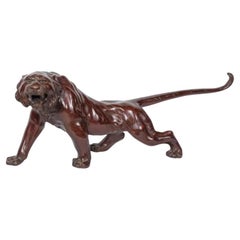
$12,500
H 15 in W 44 in D 18 in
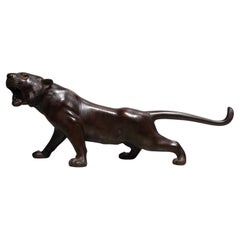
Japanese Meiji Bronze Tiger Sculpture, 1900s.
Located in Asaa, DK
Japanese Meiji Bronze Tiger Sculpture, 1900s.
A japanese patinated solid bronze sculpture of a roaring tiger from the Meiji-period. Complete with o...
Category
Early 20th Century Japanese Meiji Sculptures and Carvings
Materials
Bronze
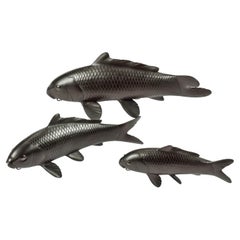
A set of three exquisite nineteenth century Japanese bronze sculptures of carp
Located in Amsterdam, NL
Three exquisite Japanese nineteenth-century bronze sculptures of carp.
The sculptures are in excellent state.
The set contains three different carp: A large one, a medium-sized one ...
Category
Antique Late 19th Century Japanese Meiji Sculptures and Carvings
Materials
Bronze
$21,504
Free Shipping
H 5.91 in W 5.79 in D 15.56 in
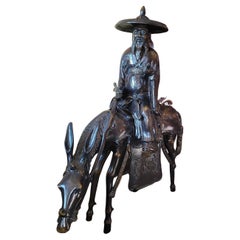
Large Vintage Japanese Bronzed Sculpture of Toba on His Mule
Located in Dallas, TX
Presenting a beautiful large vintage Japanese bronzed sculpture of Toba on his Mule.
Some might say ‘Monumental’ .. being 34 inches tall ...
Category
Mid-20th Century Japanese Japonisme Sculptures and Carvings
Materials
Bronze, Iron
Japanese Bronze Okimono Sculpture by Yamamoto Kozan
Located in Newark, England
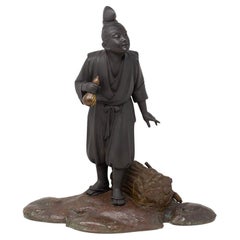
YOUNG MAN WOOD CUTTING
From our Japanese collection, we are pleased to offer this Japanese Bronze Okimono by Yamamoto Kozan. The Japanese Bronze Sculpture cast in Bronze with a natu...
Category
Early 20th Century Japanese Meiji Sculptures and Carvings
Materials
Bronze
$7,506
Free Shipping
H 16.15 in W 14.38 in D 8.08 in
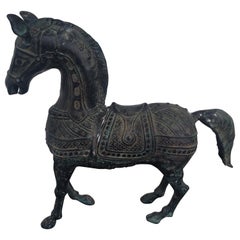
Japanese Bronze Horse sculpture
Located in Pasadena, TX
An excellent example of early 20th century Japanese craftsmanship. This piece captures the energy of the horse as it rears up for battle. The saddle and the battle are emaculately ca...
Category
20th Century Japanese Sculptures and Carvings
Materials
Bronze
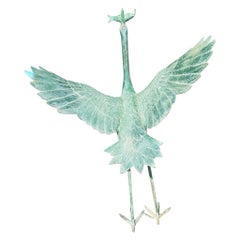
Japanese Big Bronze Crane Garden Fountain With Fine Details
Located in South Burlington, VT
Just received from our last shipment from Japan- the first we've seen
Japan, a fine tall large scale red crested bronze garden crane purposely cr...
Category
Mid-20th Century Japanese Showa Sculptures and Carvings
Materials
Bronze
$1,560 Sale Price
20% Off
H 44 in W 27.5 in D 16 in
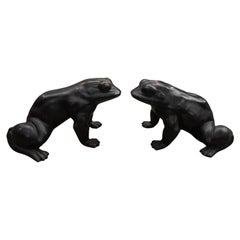
Large Pair Of Japanese Bronze Frog Sculptures
Located in Houston, TX
Large Pair Of Japanese Bronze Frog Sculptures.
Our large Japanese bronze frog statues or sculptures will make a lovely addition to your garden room or atrium or entrance hall.
Frogs,...
Category
Vintage 1940s Japanese Other Sculptures and Carvings
Materials
Bronze
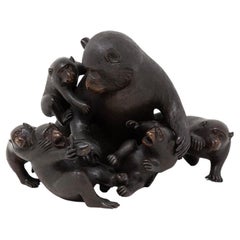
Japanese Meiji Period Bronze Monkey Group Sculpture Okimono Shosai
Located in Newark, England
Featuring Seven Japanese Macaques
Form our Japanese collection, we are delighted to offer this Japanese Bronze Monkey Group by Shosai. The Japanese Bronze Group displaying a male father monkey and his infants playing around and being mischievous with Persimmon fruit. The monkeys modelled as Japanese macaque monkeys (snow monkey). The bronze okimono is beautifully patinated with a highly lifelike and naturalistic casting signed to the underside Shosai 正齊鋳. The Bronze group dates to the Meiji Period (1868-1912) circa 1885.
Japanese macaque (snow monkey) is a terrestrial Old World monkey species that is native to Japan. They are known as snow monkeys because some live in areas where snow covers the ground for long periods each year hence their nickname. No other non-human primate lives further north or in a colder climate than the snow monkey. Individuals have brownish grey fur, pinkish-red faces, and short tails. Two subspecies are known and their conservation Status is of least concern. In Japan, the species is known as Nihonzaru ニホンザル, 日本 (Japan/Nihon) and saru 猿 (monkey) to distinguish it from other primates, but the Japanese macaque is the only species of monkey in Japan.
The Japanese macaque features heavily in the religion, folklore, and art of Japan, as well as in proverbs and idiomatic expressions in the Japanese language. They are often seen in paintings, block prints and represented in all manner of carvings from Okimono to netsuke. Many of these art forms reside in the world’s most famous museums and collections, some of the most prominent pieces by artists such as Mori Sosen and Kawanabe Kyosai. In Shinto belief (Japan’s indigenous religion/nature religion) legendary mythical beasts known as raiju sometimes appeared as monkeys and kept Raijin (the god of lightning/storms) company. In another well known tale the three wise monkeys who warn people to “see no evil, hear no evil and speak no evil” can be seen depicted in relief over the door of the famous Tosho-gu shrine in Nikko.
Meiji Period was an era of Japanese history that spanned from 1868 to 1912. It was the first half of the Empire of Japan, when the Japanese people began to build a paradigm of a modern, industrialised nation state and emergent great power, influenced by Western countries and aesthetics. As a result of radically different ideas, the changes to Japan were profound and it affected the social structure, politics, economy, military, and foreign relations across the board. The period corresponded to the reign of Emperor Meiji and was preceded by the Keio era and was succeeded by the Taisho era.
Cultural Art during the Meiji Period was of particular interest to the government and they overhauled the art export market which in turn promoted Japanese arts via various world’s fairs, beginning in Vienna at the world fair in 1873. The government heavily funded the fairs and took an active role organising how Japan’s culture was presented to the world including creating a semi-public company named Kiritsu Kosho Kaisha (First Industrial Manufacturing Company). The Kiritsu Kosho Kaisha was used to promote and commercialise exports of Japanese art and established the Hakurankai Jimukyoku (Exhibition Bureau) to maintain quality standards. For the 1876 Centennial International Exhibition in Philadelphia, the Japanese government created a Centennial Office and sent a special envoy to secure space for the 30,000 items that would be displayed. The Imperial Household also took an active interest in arts and crafts, commissioning works by select artists to be given as gifts for foreign dignitaries further emphasising the high quality and importance of Japanese art. Just before the end of the 19th century in 1890, the Teishitsu Gigeiin (Artist to the Imperial Household) system was created to recognise distinguished artists. These artists were selected for their exceptionally high quality wares and talent in their own industry. Over a period of 54 years Seventy artists were appointed, amongst these were ceramicist Makuzu Kozan and cloisonné enamel artist...
Category
Antique Late 19th Century Japanese Meiji Sculptures and Carvings
Materials
Bronze
$20,472
Free Shipping
H 5.12 in W 7.09 in D 6.3 in
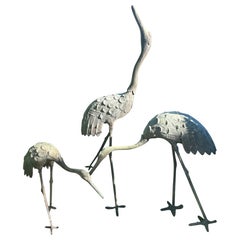
Japanese Set Three Large Antique Bronze Red Crested Cranes, Complete
Located in South Burlington, VT
Just received from our last shipment from Japan, a complete set three (3) 1920s bronze garden red crested cranes
Japan, a fine set of three tall and large scale hand caste bronze fi...
Category
Early 20th Century Japanese Taisho Sculptures and Carvings
Materials
Bronze
$2,850 / set
H 45 in W 25 in D 6.5 in
Still Thinking About These?
All Recently ViewedMore Ways To Browse
Antique Surf
Japanese Bronze Crane And Turtle
Japanese Art Of Cranes
Vintage Chinese Green Jade
Chinese Carving Polychrome
Chinese Polychrome Carved Wood
Indonesian Carved Wood Wall Art
Lapis Lazuli Chinese
Tiger Carving
Burma Lacquerware
Burmese Lacquerware
Chinese Antique Sculpture Soapstone
Old Stone Carving
Qing Dynasty Jade
Small Buddha
15th Century Wood Carving
Antique Soapstone Carvings
Antique Wood Figurines