1 of 17
Chinese boxwood Buddha, c. 1900. Qing Dynasty.
$2,539.94List Price
About the Item
- Dimensions:Height: 4.14 in (10.5 cm)Width: 5.32 in (13.5 cm)Depth: 3 in (7.6 cm)
- Style:Qing (Of the Period)
- Materials and Techniques:
- Place of Origin:
- Period:1900-1909
- Date of Manufacture:1900
- Condition:Wear consistent with age and use.
- Seller Location:Gargrave, GB
- Reference Number:1stDibs: LU4397132846922
Authenticity Guarantee
In the unlikely event there’s an issue with an item’s authenticity, contact us within 1 year for a full refund. DetailsMoney-Back Guarantee
If your item is not as described, is damaged in transit, or does not arrive, contact us within 7 days for a full refund. Details24-Hour Cancellation
You have a 24-hour grace period in which to reconsider your purchase, with no questions asked.Vetted Professional Sellers
Our world-class sellers must adhere to strict standards for service and quality, maintaining the integrity of our listings.Price-Match Guarantee
If you find that a seller listed the same item for a lower price elsewhere, we’ll match it.Trusted Global Delivery
Our best-in-class carrier network provides specialized shipping options worldwide, including custom delivery.You May Also Like
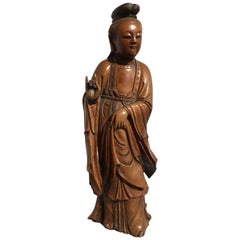
Chinese Carved Boxwood Figure of Guanyin, Mid-Qing Dynasty
Located in Austin, TX
A sublime Chinese carved boxwood figure of the Bodhisattva of Compassion, Avalokiteshvara, called Guanyin in Chinese, mid-Qing dynasty.
The an...
Category
Antique Late 18th Century Chinese Qing Sculptures and Carvings
Materials
Boxwood
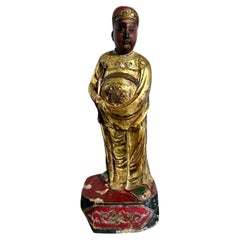
Chinese Taoist Figure of Wenchang, Late Qing Dynasty, c. 1900, China
Located in Austin, TX
A tall and impressive figure of the Taoist deity Wenchang Wang, carved, gessoed, lacquered, gilt and polychromed wood, Late Qing Dynasty, circa 1900, Fujian, China.
Wenchang, the T...
Category
Antique Early 1900s Chinese Qing Sculptures and Carvings
Materials
Wood
$1,950
H 19.25 in W 7 in D 6.75 in
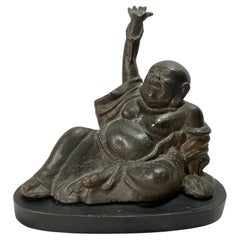
Chinese Qing Dynasty Bronze Statue of Seated Happy Maitreya Buddha
Located in Vero Beach, FL
Chinese Qing Dynasty Bronze Statue of Seated Happy Maitreya Buddha.
A Chinese bronze statue from the late 18th century Qing Dynasty period is ca...
Category
Antique 18th Century Chinese Qing Sculptures and Carvings
Materials
Bronze
$1,280 Sale Price
20% Off
H 6.5 in W 7 in D 3.5 in
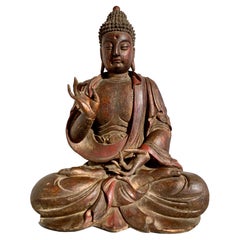
Large Chinese Carved and Lacquered Buddha, Qing Dynasty, 19th Century
Located in Austin, TX
A large and magnificent near life-sized Chinese carved and lacquered wood figure of a Buddha, Qing Dynasty, 19th century or earlier, southern China.
The figure likely represents one of the Five Tathagatas, also known as Dhyani Buddhas or Wisdom Buddhas. More specifically, either Amitabha or Amoghasiddhi. Amitabha is the Buddha of infinite light, and represents the wisdom of observation and recognition. Amoghasiddhi is the Buddha of accomplishment, and represents the wisdom of perfected practices. The size and scale of the Buddha indicates it was made for temple worship.
The large Buddha is portrayed seated in vajrasana, or full lotus position, with the soles of both feet facing up. His elegant hands, with impossibly long and slender fingers, perform shuni mudra, the gesture of bestowing patience. His right arm is bent at the elbow, the right hand raised to heart level. The left arm resting gently in his lap, the left hand at navel level.
The Buddha is dressed in voluminous robes that wrap around his shoulders and body, and tied at the waist. The heavy fabric draping and pooling elegantly all around his robust body. His broad chest and right arm exposed.
The Buddha's face is both solemn and beatific - his expression seeming to change depending on the angle of view. The most notable feature of his face is the large urna to the center of his forehead, set between a pair of painted, high arching brows over heavily lidded almond shaped eyes. A strong nose is set above a small mouth pursed in an ever so slight smile. Long pendulous earlobes touch his shoulders.
The Buddha's hair arranged in the typical fashion, with "spikes" representing tight curls. A prominent ushnisha rises from the crown of his head, covered by more hair, and topped with a rounded protuberance.
The Buddha is constructed from several blocks of wood, joined, carved and lacquered a deep red-brown with gold flecks...
Category
Antique 19th Century Chinese Qing Sculptures and Carvings
Materials
Wood
$24,500
H 32 in W 22.25 in D 16 in
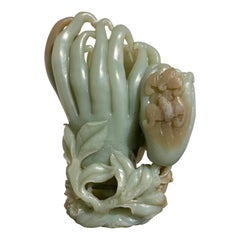
Large Chinese Carved Nephrite Jade Double Buddha
s Hand Vase, Late Qing Dynasty
Located in Austin, TX
A large and graceful carved nephrite jade conjoined double vase in the form of a pair of Buddha's hands fruit (finger citron), late Qing Dynasty, circa 1900, China.
The large and heavy vase carved from a single piece of celadon nephrite jade, with areas of lighter brown "sugar" skin. The vase ingeniously carved as a pair of Buddha's hand fruit, also known as finger citron, rising from a gnarled, leafy branch. The smaller Buddha's hand with a pair of bats. The Buddha's hands fruit with elegant and naturalistic curved "fingers". The "fingers wonderfully shaped and reticulated. The body of the fruit with simple stippling, in imitation of the textured surface of the real fruit. The interior of each fruit well hollowed and able to hold water.
Buddha's hands fruit are auspicious in Chinese culture. Their name in Chinese "Fo Shou" is a homophone for "Happiness and Longevity. They are often placed as offerings on Buddhist altars...
Category
Antique Early 1900s Chinese Qing Sculptures and Carvings
Materials
Jade
$9,800
H 8.75 in W 6.25 in D 3.5 in
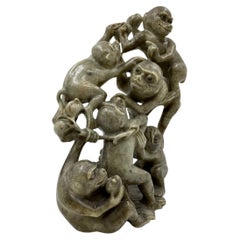
Large Qing Dynasty Chinese Soapstone Monkeys Group Carving
Located in Hoddesdon, GB
A rare large Chinese soapstone monkey group sculpture dating to the early 19th century, featuring seven intricately detailed monkeys scrambling over one another to reach a peach. The...
Category
Antique Early 19th Century Chinese Qing Sculptures and Carvings
Materials
Soapstone
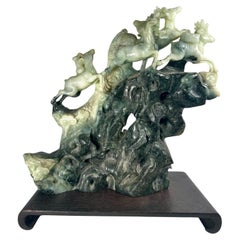
Chinese Natural Large Dushan Jade Carving Qing Dynasty
Located in Vero Beach, FL
Chinese Natural Large Dushan Jade Carving Qing Dynasty
This is a superb piece of large jade carving from the 19th century. A group of deer are clim...
Category
Antique 19th Century Qing Sculptures and Carvings
Materials
Jade
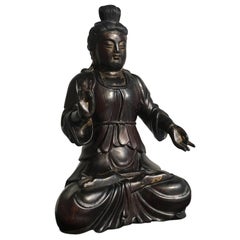
Chinese Carved Zitan Figure of a Bodhisattva, Qing Dynasty
Located in Austin, TX
A finely carved Chinese zitan wood figure of an unidentified bodhisattva, possibly Guanyin, late Qing Dynasty, circa 1900, China.
The androgynous figure has a plump, almost matronly face, with downcast eyes and a gentle smile. The hair in long tresses, gathered and tied in a high chignon.
The enlightened being is portrayed seated in dhyanasana, bare feet resting on crossed legs, both soles pointing up.
Thick robes billow and drape around the full figured body. The hands display...
Category
Early 20th Century Chinese Qing Sculptures and Carvings
Materials
Lapis Lazuli
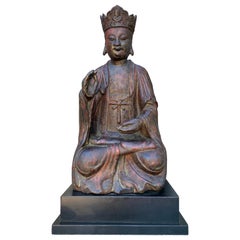
Chinese Qing Dynasty Lacquered Wood Guanyin, 18th Century, Southern China
Located in Austin, TX
A Chinese early Qing Dynasty carved and lacquered wood figure of Guanyin, Southern China, 17th/18th century.
Guanyin, the Bodhisattva of Compassion and Mercy, is portrayed seated in dhyanasana, one hand raised in viktara mudra, the gesture of teaching and discourse.
The great bodhisattva is dressed in heavy, loose robes tied at the chest, with a mantle draped over his shoulders. He looks serenely outwards from heavily lidded eyes. Guanyin's face carved beautifully with somewhat feminine features. A large five pointed crown sits upon his head. The larger leaves of the crown carved with indistinct images of the Buddha.
The statue was originally fully lacquered in the deep red gilt lacquer typical of Southern Chinese Buddhist sculpture...
Category
Antique Early 18th Century Chinese Qing Sculptures and Carvings
Materials
Wood
$4,800
H 15.5 in W 7.5 in D 7 in
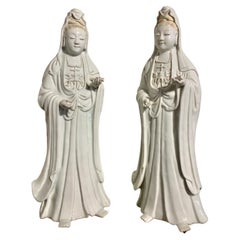
Pair Chinese White Glazed Guanyin, Qing Dynasty, 18th Century, China
Located in Austin, TX
A sublime and rare pair of Chinese white glazed porcelain figures of Guanyin, attributed to Tang Ying (1682 - 1756), Qing Dynasty, Qianlong Period, China.
This ethereal pair of white glazed porcelain figures depict the revered Buddhist Goddess of Mercy, Guanyin. Guanyin is portrayed standing, wearing heavy robes that drape beautifully around her figure. Bare feet peek out from under the hem of the robes. Her hair piled in a high chignon and covered by a cowl. The treatment of the hair, finely textured, unglazed, and with remnants of darker pigment, is typical of works by Tang Yin (1682 - 1756), who was the head of the imperial porcelain works at Jingdezhen.
Guanyin's beatific face is set in a serene smile, with a small, flat nose, and downcast, heavily lidded, almond shaped eyes. A simple beaded necklace graces her chest. Her hands held out, and may have once held attributes.
The hands were originally removable, but have since been permanently attached.
The figures crafted of a fine porcelain and glazed all over in a supple white glaze.
One figure bears a label from the Rafi Mottahedeh collection to the back.
Provenance:
Chinese Porcelain Company...
Category
Antique 18th Century Chinese Qing Ceramics
Materials
Porcelain
$21,000 / set
H 13.25 in W 5 in D 4 in
Still Thinking About These?
All Recently ViewedMore Ways To Browse
Meditation Bell
Carved Mammoth Ivory
Ceremonial Asian Axe
Chinese Terracotta Army Warriors
Female Buddha Statues
Indonesian Wooden Horse
Jade Burners
Jade Geisha
Jade Incense Burner
Japanese Lantern Bells
Japanese Moon Gazing Rabbit
Khmer Goddess
Les Girls Chiparus
Meiji Okimono Ivory
Mongolian Buddha
Rare Duck Decoys
Salvatore Riolo
Samurai Arrows