1 of 12
Fine Chinese Carved Buddha
Hehe Erxian Twins Group, Qing Dynasty
$3,614.72List Price
About the Item
- Similar to:Style House China 1 (Manufacturer)
- Dimensions:Height: 3.35 in (8.5 cm)Width: 2.96 in (7.5 cm)Depth: 5.71 in (14.5 cm)
- Style:Qing (Of the Period)
- Materials and Techniques:
- Place of Origin:
- Period:
- Date of Manufacture:circa 1850
- Condition:Wear consistent with age and use.
- Seller Location:Gargrave, GB
- Reference Number:1stDibs: LU4397121216522
Authenticity Guarantee
In the unlikely event there’s an issue with an item’s authenticity, contact us within 1 year for a full refund. DetailsMoney-Back Guarantee
If your item is not as described, is damaged in transit, or does not arrive, contact us within 7 days for a full refund. Details24-Hour Cancellation
You have a 24-hour grace period in which to reconsider your purchase, with no questions asked.Vetted Professional Sellers
Our world-class sellers must adhere to strict standards for service and quality, maintaining the integrity of our listings.Price-Match Guarantee
If you find that a seller listed the same item for a lower price elsewhere, we’ll match it.Trusted Global Delivery
Our best-in-class carrier network provides specialized shipping options worldwide, including custom delivery.You May Also Like
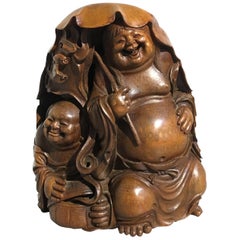
Chinese Qing Dynasty Carved Bamboo HeHe ErXian Group, 19th Century
Located in Austin, TX
A wonderful Chinese bamboo figural carving featuring the Taoist immortal twins of eternal youth, known as the HeHe ErXian, Qing dynasty, 19th century.
F...
Category
Antique 19th Century Chinese Qing Sculptures and Carvings
Materials
Bamboo
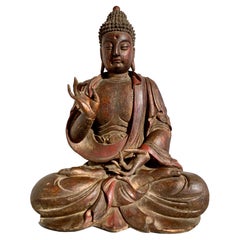
Large Chinese Carved and Lacquered Buddha, Qing Dynasty, 19th Century
Located in Austin, TX
A large and magnificent near life-sized Chinese carved and lacquered wood figure of a Buddha, Qing Dynasty, 19th century or earlier, southern China.
The figure likely represents one of the Five Tathagatas, also known as Dhyani Buddhas or Wisdom Buddhas. More specifically, either Amitabha or Amoghasiddhi. Amitabha is the Buddha of infinite light, and represents the wisdom of observation and recognition. Amoghasiddhi is the Buddha of accomplishment, and represents the wisdom of perfected practices. The size and scale of the Buddha indicates it was made for temple worship.
The large Buddha is portrayed seated in vajrasana, or full lotus position, with the soles of both feet facing up. His elegant hands, with impossibly long and slender fingers, perform shuni mudra, the gesture of bestowing patience. His right arm is bent at the elbow, the right hand raised to heart level. The left arm resting gently in his lap, the left hand at navel level.
The Buddha is dressed in voluminous robes that wrap around his shoulders and body, and tied at the waist. The heavy fabric draping and pooling elegantly all around his robust body. His broad chest and right arm exposed.
The Buddha's face is both solemn and beatific - his expression seeming to change depending on the angle of view. The most notable feature of his face is the large urna to the center of his forehead, set between a pair of painted, high arching brows over heavily lidded almond shaped eyes. A strong nose is set above a small mouth pursed in an ever so slight smile. Long pendulous earlobes touch his shoulders.
The Buddha's hair arranged in the typical fashion, with "spikes" representing tight curls. A prominent ushnisha rises from the crown of his head, covered by more hair, and topped with a rounded protuberance.
The Buddha is constructed from several blocks of wood, joined, carved and lacquered a deep red-brown with gold flecks...
Category
Antique 19th Century Chinese Qing Sculptures and Carvings
Materials
Wood
$24,500
H 32 in W 22.25 in D 16 in
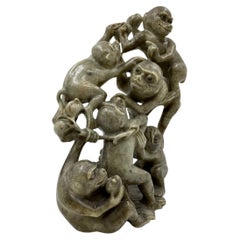
Large Qing Dynasty Chinese Soapstone Monkeys Group Carving
Located in Hoddesdon, GB
A rare large Chinese soapstone monkey group sculpture dating to the early 19th century, featuring seven intricately detailed monkeys scrambling over one another to reach a peach. The...
Category
Antique Early 19th Century Chinese Qing Sculptures and Carvings
Materials
Soapstone
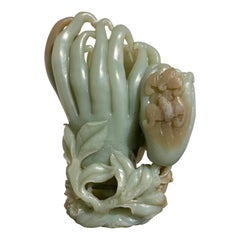
Large Chinese Carved Nephrite Jade Double Buddha
s Hand Vase, Late Qing Dynasty
Located in Austin, TX
A large and graceful carved nephrite jade conjoined double vase in the form of a pair of Buddha's hands fruit (finger citron), late Qing Dynasty, circa 1900, China.
The large and heavy vase carved from a single piece of celadon nephrite jade, with areas of lighter brown "sugar" skin. The vase ingeniously carved as a pair of Buddha's hand fruit, also known as finger citron, rising from a gnarled, leafy branch. The smaller Buddha's hand with a pair of bats. The Buddha's hands fruit with elegant and naturalistic curved "fingers". The "fingers wonderfully shaped and reticulated. The body of the fruit with simple stippling, in imitation of the textured surface of the real fruit. The interior of each fruit well hollowed and able to hold water.
Buddha's hands fruit are auspicious in Chinese culture. Their name in Chinese "Fo Shou" is a homophone for "Happiness and Longevity. They are often placed as offerings on Buddhist altars...
Category
Antique Early 1900s Chinese Qing Sculptures and Carvings
Materials
Jade
$9,800
H 8.75 in W 6.25 in D 3.5 in
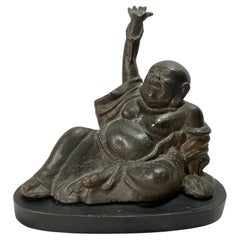
Chinese Qing Dynasty Bronze Statue of Seated Happy Maitreya Buddha
Located in Vero Beach, FL
Chinese Qing Dynasty Bronze Statue of Seated Happy Maitreya Buddha.
A Chinese bronze statue from the late 18th century Qing Dynasty period is ca...
Category
Antique 18th Century Chinese Qing Sculptures and Carvings
Materials
Bronze
$1,280 Sale Price
20% Off
H 6.5 in W 7 in D 3.5 in
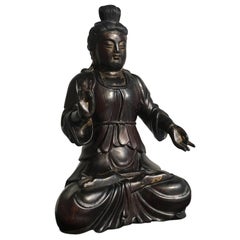
Chinese Carved Zitan Figure of a Bodhisattva, Qing Dynasty
Located in Austin, TX
A finely carved Chinese zitan wood figure of an unidentified bodhisattva, possibly Guanyin, late Qing Dynasty, circa 1900, China.
The androgynous figure has a plump, almost matronly face, with downcast eyes and a gentle smile. The hair in long tresses, gathered and tied in a high chignon.
The enlightened being is portrayed seated in dhyanasana, bare feet resting on crossed legs, both soles pointing up.
Thick robes billow and drape around the full figured body. The hands display...
Category
Early 20th Century Chinese Qing Sculptures and Carvings
Materials
Lapis Lazuli
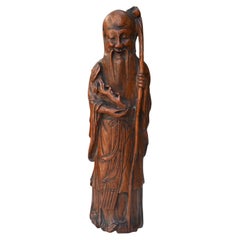
Ancient Chinese Qing Dynasty Carved Bamboo Statue from a Sage
Located in Bilzen, BE
A finely carved Bamboo representing a sage Chinese Qing Dynasty, 19th century
Good condition as shown in the photos Height 25.5 cm
Beautiful aged patina
Category
Antique 19th Century Chinese Qing Sculptures and Carvings
Materials
Bamboo
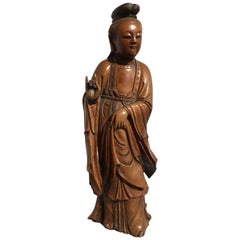
Chinese Carved Boxwood Figure of Guanyin, Mid-Qing Dynasty
Located in Austin, TX
A sublime Chinese carved boxwood figure of the Bodhisattva of Compassion, Avalokiteshvara, called Guanyin in Chinese, mid-Qing dynasty.
The an...
Category
Antique Late 18th Century Chinese Qing Sculptures and Carvings
Materials
Boxwood
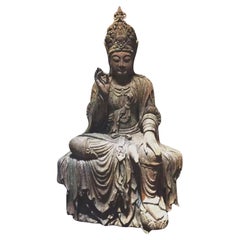
A Large Chinese Carved Wood Figure of Guanyin, Late Qing Dynasty
Located in ARMADALE, VIC
An impressive depiction of Guanyin, the Bodhisattva of compassion, whose name bears the meaning ‘One who hears the cries of the world.’ The rather androgynous figure is adorned with beaded jewellery and the princely regalia of a dhoti, draped across her body and spilling out over to partially obscure what she is resting upon. The goddess’ profile exhibits idealised features of Asian artistic convention; her face is soft and rounded, with full lips and relaxed eyes that provide a serene quality of youthfulness to the figure. Adhering to Chinese iconography of Guanyin, the figure is marked by an urna on her forehead, denoting her own enlightenment, as well as a diadem displaying Buddha Amitabha, the spiritual teacher of Guanyin. Seated in the Lalit asana pose, translated as ‘royal ease’, the figure exudes a fine example of the relaxed majesty typical in the characterisation of Guanyin. Whilst the figure’s left hand is placed restfully upon the left leg pendant, the right is raised in the gesture shuni mudra, the second finger held gently against the thumb. Otherwise known as the seal of patience, this gesture indicates the figure as one intended to bestow this virtue, along with compassion and understanding, upon the beholder.
Notes on the item:
Guanyin is the Chinese interpretation of Avalokiteshvara, the Indian Bodhisattva of compassion. The term “Bodhisattva” is derived from the Sanskrit “Bodhi”, meaning ‘awakening’ or ‘enlightenment’, combined with “Sattva”, meaning ‘spirit’ or ‘being’, referring to one on the path to achieving enlightenment. Bodhisattvas in Mayahana Buddhism are recognised as figures who have effectively achieved enlightenment yet relinquish their accension to nirvana in order to remain amongst mankind in the ultimate act of compassion to aid as spiritual guides. As such, the Bodhisattva inhabit a liminal space between samsara and nirvana; enlightened beings that maintain a relationship with humanity that buddhas cannot, as attaining Buddhahood necessitates the abandonment of all worldly attachments, including mankind. Guanyin’s very name, ‘One who hears the cries of the world’ highlights this role as a compassionate figure who acknowledges the suffering and strife of man. Along with Mahāsthāmaprāpta, a fellow bodhisattva, Guanyin serves as an attendant to Buddha Amitabha, with these three deities recognised as the Three Sages of Western Pure Land Buddhism, a sect of Mayahana Buddhism popular in East Asia.
Avalokiteshvara is commonly posited to have been adopted from Indian Buddhism into China as Guanyin around 200-400 CE, however it was the Tang dynasty (618-907) which saw the popularisation of the deity. By the Ming (1358–1644) and Qing (1644–1911) dynasties, Guanyin held the position as the most popular female deity in China. The unique state of religion in China held no monolithic canon regarding Buddhism and saw the assimilation of several belief systems, primarily Daoism, Buddhism and Confucianism. Consequently, Guanyin became a deity to be revered beyond Buddhism alone, appointed as both an official imperial deity and Daoist deity in the 12th century. Guanyin may also be seen to fulfil the role of idealised femininity as prescribed by Confucianism, with the scarcity of female Chinese deities perhaps accounting for the gradual gender shift Guanyin underwent.
The Indian Avalokiteshvara is unequivocally recognised as male, whilst the supposed gender of Guanyin remains contentious. Although there is a clear shift from the masculine Avalokiteshvara towards a more feminine representation, it is unclear if Guanyin is understood to be entirely feminine, to inhabit qualities of both genders or to be elevated beyond gender entirely, embodying neither. Depictions of Guanyin are highly androgynous, which some believe lends credence towards Guanyin symbolising the unity of dualistic forces as recognised in Daoism, displaying the anthropomorphism of yin and yang.
Comparative Analysis:
Market comparisons of similar Qing Dynasty polychrome figures of Guanyin include lot 767 (no.2) From Christies ‘Important Chinese Ceramics and Works of Art,’ New York, 25 March 2022, with the price realised USD 52,920 (Estimate USD 20,000 – USD 30,000). Christies also auctioned a comparable polychrome Guanyin...
Category
Antique Late 19th Century Chinese Qing Sculptures and Carvings
Materials
Hardwood
$28,500
H 57.09 in W 35.44 in D 25.6 in
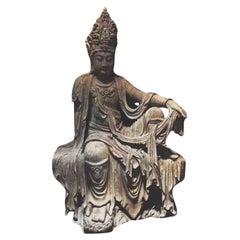
A Large Chinese Carved Wood Figure of Guanyin, Late Qing Dynasty
Located in ARMADALE, VIC
Description:
A fine depiction of Guanyin, possessing the regal tranquillity that the Chinese Bodhisattva of compassion has come to be visually associated with. Marked by an urna signifying her spiritual enlightenment and crowned with a diadem depicting the Buddha Amitabha, the figure is immediately recognisable as Guanyin. Her androgynous figure is gracefully poised in the Lalit asana or “royal ease”, the pose classical in representations of the deity. The figure is asymmetric, with the weight of her supple form falling upon her left hand placed against the base, her right knee raised and left pendant. Her right hand rests upon her raised knee, delicately pinching at her draped attire. At first unassuming, this gesture may be suggestive of the Apana Mudra, the seal of purification. This Mudra is associated with physical wellbeing, fecundity and the cleansing of the body. Though she is adorned in the princely garb of dhoti, she bears features of idealised feminine beauty as prescribed in Asian art. With plump cheeks and near pouted lips, her full face gazes down upon the viewer with an empathetic and half-lidded gaze, upholding her title as ‘One who hears the cries of the world.’
Notes on the item:
Guanyin is the Chinese interpretation of Avalokiteshvara, the Indian Bodhisattva of compassion. The term “Bodhisattva” is derived from the Sanskrit “Bodhi”, meaning ‘awakening’ or ‘enlightenment’, combined with “Sattva”, meaning ‘spirit’ or ‘being’, referring to one on the path to achieving enlightenment. Bodhisattvas in Mayahana Buddhism are recognised as figures who have effectively achieved enlightenment yet relinquish their accension to nirvana in order to remain amongst mankind in the ultimate act of compassion to aid as spiritual guides. As such, the Bodhisattva inhabit a liminal space between samsara and nirvana; enlightened beings that maintain a relationship with humanity that buddhas cannot, as attaining Buddhahood necessitates the abandonment of all worldly attachments, including mankind. Guanyin’s very name, ‘One who hears the cries of the world’ highlights this role as a compassionate figure who acknowledges the suffering and strife of man. Along with Mahāsthāmaprāpta, a fellow bodhisattva, Guanyin serves as an attendant to Buddha Amitabha, with these three deities recognised as the Three Sages of Western Pure Land Buddhism, a sect of Mayahana Buddhism popular in East Asia.
Avalokiteshvara is commonly posited to have been adopted from Indian Buddhism into China as Guanyin around 200-400 CE, however it was the Tang dynasty (618-907) which saw the popularisation of the deity. By the Ming (1358–1644) and Qing (1644–1911) dynasties, Guanyin held the position as the most popular female deity in China. The unique state of religion in China held no monolithic canon regarding Buddhism and saw the assimilation of several belief systems, primarily Daoism, Buddhism and Confucianism. Consequently, Guanyin became a deity to be revered beyond Buddhism alone, appointed as both an official imperial deity and Daoist deity in the 12th century. Guanyin may also be seen to fulfil the role of idealised femininity as prescribed by Confucianism, with the scarcity of female Chinese deities perhaps accounting for the gradual gender shift Guanyin underwent.
The Indian Avalokiteshvara is unequivocally recognised as male, whilst the supposed gender of Guanyin remains contentious. Although there is a clear shift from the masculine Avalokiteshvara towards a more feminine representation, it is unclear if Guanyin is understood to be entirely feminine, to inhabit qualities of both genders or to be elevated beyond gender entirely, embodying neither. Depictions of Guanyin are highly androgynous, which some believe lends credence towards Guanyin symbolising the unity of dualistic forces as recognised in Daoism, displaying the anthropomorphism of yin and yang.
Comparative Analysis:
Market comparisons of similar Qing Dynasty polychrome figures of Guanyin include lot 767 (no.2) From Christies ‘Important Chinese Ceramics and Works of Art,’ New York, 25 March 2022, with the price realised USD 52,920 (Estimate USD 20,000 – USD 30,000). Christies also auctioned a comparable polychrome Guanyin...
Category
Antique Late 19th Century Chinese Qing Sculptures and Carvings
Materials
Hardwood
$28,500
H 57.88 in W 38.59 in D 30.32 in
Still Thinking About These?
All Recently ViewedMore Ways To Browse
Fly Whisk
Qing Dynasty Buddha
Hehe Erxian
Bronze Sculpture Buddha
Burmese Wood Carving
Stone Carving Sculptures
Hand Carved Sculptures Japan
Temple Sculpture
Japanese Iron
Antique Stone China
Brown Jade
Buddha Bronze Antique
Antique Wood Buddha
Japanese Stone
Asian Temple
Stone Carved Asian
Antique Hindu
Schneible Fine Arts Llc