Items Similar to JAPAN 1900 Meiji Signed Okimono Sculpture of Fukurokuju In Polychrome
Gilt
Want more images or videos?
Request additional images or videos from the seller
1 of 10
JAPAN 1900 Meiji Signed Okimono Sculpture of Fukurokuju In Polychrome
Gilt
$978.60
$1,39830% Off
£739.39
£1,056.2730% Off
€847.74
€1,211.0630% Off
CA$1,365.75
CA$1,951.0730% Off
A$1,486.04
A$2,122.9130% Off
CHF 786.84
CHF 1,124.0630% Off
MX$17,878.06
MX$25,540.0830% Off
NOK 9,991.10
NOK 14,27330% Off
SEK 9,141.16
SEK 13,058.8030% Off
DKK 6,333.80
DKK 9,048.2930% Off
About the Item
Meiji period okimono sculpture of Fukurokuju.
This is a beautiful okimono sculpture created in the late 19th century during the imperial Japan in the Meiji era period, back in 1900. The okimono sculpture has been carefully carved with fabulous details and accents in white polychrome and pure gold gildings. The sculpture depicts the figure of Fukurokuju, with a happy smiling face wearing rich clothes. Fukurokuju is the Taoist God whose name means Wealth, Prosperity and Longevity. His high forehead is thought to represent his intellect and long earlobes the acquired knowledge of age. He is also known for his love of children. In this carving a child is carried on the back of the laughing god and a peach, symbol of longevity, is pointed out by the child. Standing in a base with two other child playing around. This okimono is very well executed and retains all the original aged patina of over 100 years old. This piece was recently professionally gently cleaned. This stupendous piece will be a great addition for your desk, your Japanese antiques collection, or your bijouterie cabinet.
Fukurokuju
This is a Japanese deity known as the god of wisdom, longevity, and happiness, and he is one of the Seven Lucky Gods (Shichi Fukujin). His name is a combination of the Japanese words for happiness (福 fuku), wealth (禄 roku), and longevity (寿 ju). He is often depicted as a short, elderly man with a very tall forehead and a long beard, representing his connection to wisdom and a prolonged life.
Okimono
This is a Japanese term meaning for display an ornament; art object; or decorative object, usually displayed in a tokonoma or butsudan "Buddhist altar". It is an ornament or figure, especially one placed in a guest room. An okimono may be a small Japanese carving, similar to but larger than a netsuke. Unlike the netsuke, which had a specific purpose, the okimono is exclusively decorative and was displayed in the tokonoma. During the Meiji period, many okimonos were made for export to the West.
Meiji period
This is an era of Japanese history that extended from October 23, 1868 to July 30, 1912.The Meiji era was the first half of the Empire of Japan, when the Japanese people moved from being an isolated feudal society at risk of colonization by Western powers to the new paradigm of a modern, industrialized nation state and emergent great power, influenced by Western scientific, technological, philosophical, political, legal, and aesthetic ideas. As a result of such wholesale adoption of radically different ideas, the changes to Japan were profound, and affected its social structure, internal politics, economy, military, and foreign relations. The period corresponded to the reign of Emperor Meiji. It was preceded by the Keiō era and was succeeded by the Taishō era, upon the accession of Emperor Taishō.
Year: Meiji, 1900.
Technique: Carved, engraved and accented with polychrome and gold.
Signature: Signed in the bottom on a red lacquer square cartouche with two Japanese characters.
Weight: 89.5 Grams, (0.0895 Kg).
Measurements: 78 mm by 52 mm by 49 mm (3.08 x 2.05 x 1.94 Inches).
Disclosure Note: This is an antique relics piece, with over 100 years old or more and originally carved during the Meiji dynasty (1868-1912) in Japan.
Condition: The overall condition of this Fukurokuju okimono is excellent. Beside the little normal wear, there is no damage and all parts are secured in their settings. This piece was carefully inspected to guarantee the condition and authenticity.
INVENTORY REF: D090725SEMB/.7854
- Dimensions:Height: 3.08 in (7.83 cm)Width: 2.05 in (5.21 cm)Depth: 1.94 in (4.93 cm)
- Style:Meiji (Of the Period)
- Materials and Techniques:
- Place of Origin:
- Period:1900-1909
- Date of Manufacture:1900
- Condition:Wear consistent with age and use. The overall condition of this Fukurokuju okimono is excellent. Beside the little normal wear, there is no damage and all parts are secured in their settings. This piece was carefully inspected to guarantee the condition and authenticity.
- Seller Location:Miami, FL
- Reference Number:Seller: D090725SEMB/.78541stDibs: LU8303246764002
About the Seller
5.0
Gold Seller
Premium sellers maintaining a 4.3+ rating and 24-hour response times
1stDibs seller since 2023
248 sales on 1stDibs
Typical response time: <1 hour
- ShippingRetrieving quote...Shipping from: Miami, FL
- Return Policy
More From This Seller
View AllJAPAN 1890 Meiji Carved Figure of Fortune God Daikoku As a Farmer With Coins
Located in Miami, FL
A Japanese carved sculpture of Daikoku.
Magnificent sculpture of the god of the fortune Daikoku WITH OVER 100 YEARS OLD, created in Japan during the Meiji period, circa 1890. The ca...
Category
Antique 1890s Japanese Meiji Sculptures and Carvings
Materials
Gold
$3,489 Sale Price
30% Off
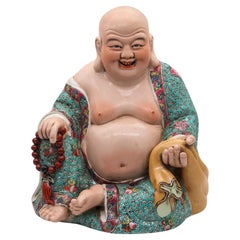
CHINA REPUBLICAN 20th Century Buddha Statue In Porcelain Zeng Long Sheng Mark
Located in Miami, FL
A China republic seated Buddha in porcelain.
This is a beautiful antique devotive figure of a seated happy Buddha created in the China Republic back in the early 20th-century, circa...
Category
Vintage 1920s Chinese Chinese Export Sculptures and Carvings
Materials
Enamel
$698 Sale Price
30% Off
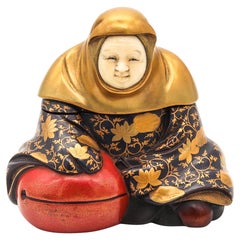
KAZUYOSHI Japan Meiji 1890 Box In Lacquered And Gilt Wood Draped Seated Women
Located in Miami, FL
A Meiji lacquered box in the shape of a seated lady made by Meigetsusai Kazuyoshi.
This is a n extremely rare decorative box made in the shape of a ...
Category
Antique 1890s Japanese Meiji Sculptures and Carvings
Materials
Gold Leaf
$3,489 Sale Price
30% Off
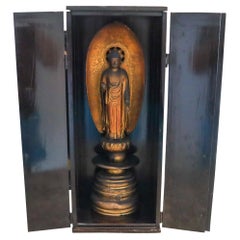
JAPAN 1810 Edo Period Large Butsudan Home Altar With Amida Nyorai In Wood
Located in Miami, FL
Large butsudan home altar with Amida Nyorai figure Edo Period (1600-1868)
This is a beautiful Japanese wooden statue of standing Amida Nyorai Buddha, from the Edo period (1600-1868)...
Category
Antique 1810s Japanese Edo Sculptures and Carvings
Materials
Gold, Brass
$3,489 Sale Price
30% Off
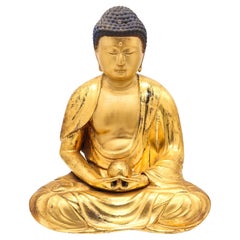
JAPAN Edo Period 1825 Seated Buddha Sculpture In Solid Gilded Carved Wood
Located in Miami, FL
A seated Buddha sculpture in gilt carved wood from the Edo Period.
This is a superbly refined carved wooden figure of a seated Buddha with fabulous pure gold gilt. The sculpture has...
Category
Antique 1820s Japanese Edo Sculptures and Carvings
Materials
Gold
$2,450 Sale Price
30% Off
JAPAN Edo Period 1850 Amida Nyorai Buddha Sculpture In Gilt Carved Wood
Located in Miami, FL
An Amida Nyorai Sculpture In Gilt Carved Wood from the Edo Period.
This is a superbly refined carved wooden figure of Amida Nyorai (Amitabha), the Buddha of Infinite Light, with fab...
Category
Antique Mid-19th Century Japanese Edo Sculptures and Carvings
Materials
Gold, Bronze, Gold Leaf
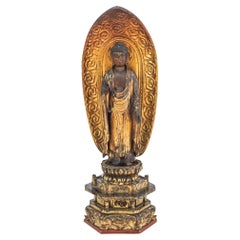
$6,965 Sale Price / set
30% Off
You May Also Like
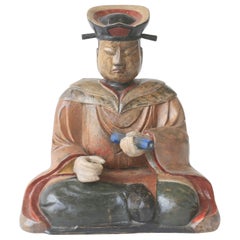
Japanese Meiji Era Wooden Figure with Polychrome Decoration
Located in New York, NY
A charming Japanese Edo Period (1615-1868) seated wooden figure. This figure is likely Buddhist, and would have sat outside a temple. The serene seated figure is wearing a robe and...
Category
Antique Mid-19th Century Japanese Sculptures and Carvings
Materials
Wood, Paint
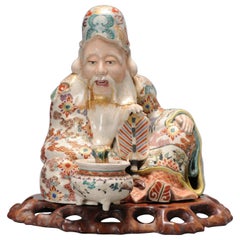
Antique Japanese Sozan of Satsuma Statue Shou Lao Immortal, 19th Century
Located in Amsterdam, Noord Holland
A Japanese Satsuma figure, Large size, Meiji period. There are also turtles on the planter.
Very nice craftmenship.
Additional information:
Material: Porcelain & Pottery
Region of O...
Category
Antique 19th Century Japanese Figurative Sculptures
Materials
Porcelain
$3,072 Sale Price
20% Off
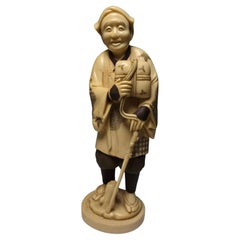
Elegant Japanese Sculpture from Early 1900s
Located in Madrid, ES
Step into the charm of early 20th century Japan with this exquisite sculpture, a true testament to the artistry and craftsmanship of the era. This elegant piece captures the essence ...
Category
Vintage 1910s Figurative Sculptures
Materials
Bone
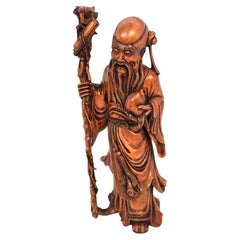
Japanese Okimono of Fukurokuju, the god of wealth and happiness, Meiji period
Located in Central England, GB
This exceptional Japanese Meiji period okimono depicts Fukurokuju, the lucky god of wealth and happiness.
The figure is very finely carved from a single piece of dense tightly graine...
Category
Early 20th Century Japanese Meiji Figurative Sculptures
Materials
Wood
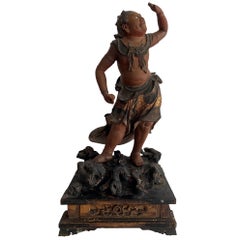
Japanese Lacquered and Gilt Wood Buddhism Statue from Edo Period
Located in Atlanta, GA
An exceptional and wood statue of Buddhism Guardian Seitaka Doji from Japan circa Edo period (1603-1868), likely the earlier part of 17th century. One of two chief attendants of Fudou Myouou (the other being Kongara Doji), the name of Seitaka Doji is a transliteration of Sanskrit "Cetaka", meaning servant, slave, and he is said to personify expedient action. He is most commonly found on the right side of Fudou, together with Kongara Doji on the left, forming the Immovable triad, Fudou Sanzon, the terror of evil doers. Seitaka largely adheres to the iconography of a wrathful youth with fleshy body and face, skin in the color of a red lotus, has his hair tied in five knots, and holds a vajra in his left hand and a vajra-club in his right hand, but the actual artistic representations of him in Japan do...
Category
Antique 17th Century Japanese Japonisme Sculptures and Carvings
Materials
Metal
Japanese Edo Period Saga Ningyo, Ca. 1850
Located in New York, NY
Japanese Edo Period Saga Ningyo, Ca. 1850
DIMENSIONS
Height: 9.5 inches
Width: 6 inches
Depth: 5 inches
Category
Antique 1850s Japanese Japonisme Figurative Sculptures
Materials
Wood