Items Similar to Japanese Bronze Okimono Sculpture by Yamamoto Kozan
Want more images or videos?
Request additional images or videos from the seller
1 of 18
Japanese Bronze Okimono Sculpture by Yamamoto Kozan
$7,570.21
£5,500
€6,434.90
CA$10,346.25
A$11,262.74
CHF 5,978.27
MX$135,515.03
NOK 75,752.79
SEK 69,410.96
DKK 48,055.47
About the Item
YOUNG MAN WOOD CUTTING
From our Japanese collection, we are pleased to offer this Japanese Bronze Okimono by Yamamoto Kozan. The Japanese Bronze Sculpture cast in Bronze with a naturalistic textured base having a central figure stood as he takes a break from wood cutting for a drink of water from his double gourd flask. The bronze figure is cast in exceptional form wearing an eboshi hat and loose robe beside a cut woodpile and a patinated axe. The rear of the figure is signed at the lower leg Kozan saku for Yamamoto Kozan. The Japanese Bronze Okimono by Yamamoto Kozan dates to the early 20th century late Meiji period (1868-1912) to the early tashio period (1912-1926).
YAMAMOTO KOZAN
Yamamoto Kozan was the younger brother of the sculptor Yamamoto Junmin (1888-1962). They both are considered to belong to the group of the most prominent and skilful metal workers in early 20th Century. Kozan was a student of the sculptor Okazaki Sessei (1854-1921) and he was a member of the Chukinka Kyokai (Association of Cast Metal Artists).
BRONZE
is an alloy consisting primarily of copper with approximately 12–12.5% tin and often with the addition of other metals (including aluminium, manganese, nickel, or zinc) and sometimes non-metals, such as phosphorus, or metalloids such as arsenic or silicon depending on the age of the bronze and its origin. The additions of other metals produce a range of alloys that are usually harder than copper alone and carry useful properties such as strength. The earliest known use of bronze dates to the 5th millennium BCE from Iranian plateau, the bronze mix consists of arsenical copper and copper-arsenide. The earliest tin-copper-alloy recovered is dated to circa 4650 BCE and was found in Plocnik, Serbia. It is believed to have been smelted from a natural tin-copper ore.
TASHIO PERIOD 大正時代
was a period in the history of Japan dating from 1912-1926 coinciding with the reign of Emperor Taishio. The new emperor was a sickly man, which prompted the shift in political power from the old oligarchic group of genro (elder statesmen) to the Imperial Diet of Japan and the democratic parties. The era is considered the time of the liberal movement known as Taisho Democracy. Preceded by the Meiji Period and succeeded by the Showa period.
MEIJI PERIOD
was an era of Japanese history that spanned from 1868 to 1912. It was the first half of the Empire of Japan, when the Japanese people began to build a paradigm of a modern, industrialised nation state and emergent great power, influenced by Western countries and aesthetics. As a result of radically different ideas, the changes to Japan were profound and it affected the social structure, politics, economy, military, and foreign relations across the board. The period corresponded to the reign of Emperor Meiji and was preceded by the Keio era and was succeeded by the Taisho era.
Cultural Art during the Meiji Period was of particular interest to the government and they overhauled the art export market which in turn promoted Japanese arts via various world’s fairs, beginning in Vienna at the world fair in 1873. The government heavily funded the fairs and took an active role organising how Japan’s culture was presented to the world including creating a semi-public company named Kiritsu Kosho Kaisha (First Industrial Manufacturing Company). The Kiritsu Kosho Kaisha was used to promote and commercialise exports of Japanese art and established the Hakurankai Jimukyoku (Exhibition Bureau) to maintain quality standards. For the 1876 Centennial International Exhibition in Philadelphia, the Japanese government created a Centennial Office and sent a special envoy to secure space for the 30,000 items that would be displayed. The Imperial Household also took an active interest in arts and crafts, commissioning works by select artists to be given as gifts for foreign dignitaries further emphasising the high quality and importance of Japanese art. Just before the end of the 19th century in 1890, the Teishitsu Gigeiin (Artist to the Imperial Household) system was created to recognise distinguished artists. These artists were selected for their exceptionally high quality wares and talent in their own industry. Over a period of 54 years Seventy artists were appointed, amongst these were ceramicist Makuzu Kozan and cloisonné enamel artist Namikawa Yasuyuki.
- Dimensions:Height: 16.15 in (41 cm)Width: 14.38 in (36.5 cm)Depth: 8.08 in (20.5 cm)
- Style:Meiji (Of the Period)
- Materials and Techniques:Bronze,Cast
- Place of Origin:
- Period:
- Date of Manufacture:Circa 1912
- Condition:Wear consistent with age and use.
- Seller Location:Newark, GB
- Reference Number:Seller: HBBDHD1stDibs: LU6971243759172
About the Seller
5.0
Vetted Professional Seller
Every seller passes strict standards for authenticity and reliability
Established in 2019
1stDibs seller since 2022
40 sales on 1stDibs
Typical response time: 3 hours
- ShippingRetrieving quote...Shipping from: Newark, United Kingdom
- Return Policy
More From This Seller
View AllJapanese Bronze Figure by Miyao Eisuke, Meiji Period
By Eisuke Miyao 1
Located in Newark, England
FREE WORLDWIDE SHIPPING
A FINELY DETAILED JAPANESE BRONZE FIGURE BY MIYAO EISUKE, MEIJI PERIOD, CIRCA 1890.
From our Japanese collection, we are delighted to offer this outstanding...
Category
Antique Late 19th Century Japanese Meiji Sculptures and Carvings
Materials
Bronze
Japanese Meiji Period Bronze Monkey Group Sculpture Okimono Shosai
Located in Newark, England
Featuring Seven Japanese Macaques
Form our Japanese collection, we are delighted to offer this Japanese Bronze Monkey Group by Shosai. The Japanese Bronze Group displaying a male father monkey and his infants playing around and being mischievous with Persimmon fruit. The monkeys modelled as Japanese macaque monkeys (snow monkey). The bronze okimono is beautifully patinated with a highly lifelike and naturalistic casting signed to the underside Shosai 正齊鋳. The Bronze group dates to the Meiji Period (1868-1912) circa 1885.
Japanese macaque (snow monkey) is a terrestrial Old World monkey species that is native to Japan. They are known as snow monkeys because some live in areas where snow covers the ground for long periods each year hence their nickname. No other non-human primate lives further north or in a colder climate than the snow monkey. Individuals have brownish grey fur, pinkish-red faces, and short tails. Two subspecies are known and their conservation Status is of least concern. In Japan, the species is known as Nihonzaru ニホンザル, 日本 (Japan/Nihon) and saru 猿 (monkey) to distinguish it from other primates, but the Japanese macaque is the only species of monkey in Japan.
The Japanese macaque features heavily in the religion, folklore, and art of Japan, as well as in proverbs and idiomatic expressions in the Japanese language. They are often seen in paintings, block prints and represented in all manner of carvings from Okimono to netsuke. Many of these art forms reside in the world’s most famous museums and collections, some of the most prominent pieces by artists such as Mori Sosen and Kawanabe Kyosai. In Shinto belief (Japan’s indigenous religion/nature religion) legendary mythical beasts known as raiju sometimes appeared as monkeys and kept Raijin (the god of lightning/storms) company. In another well known tale the three wise monkeys who warn people to “see no evil, hear no evil and speak no evil” can be seen depicted in relief over the door of the famous Tosho-gu shrine in Nikko.
Meiji Period was an era of Japanese history that spanned from 1868 to 1912. It was the first half of the Empire of Japan, when the Japanese people began to build a paradigm of a modern, industrialised nation state and emergent great power, influenced by Western countries and aesthetics. As a result of radically different ideas, the changes to Japan were profound and it affected the social structure, politics, economy, military, and foreign relations across the board. The period corresponded to the reign of Emperor Meiji and was preceded by the Keio era and was succeeded by the Taisho era.
Cultural Art during the Meiji Period was of particular interest to the government and they overhauled the art export market which in turn promoted Japanese arts via various world’s fairs, beginning in Vienna at the world fair in 1873. The government heavily funded the fairs and took an active role organising how Japan’s culture was presented to the world including creating a semi-public company named Kiritsu Kosho Kaisha (First Industrial Manufacturing Company). The Kiritsu Kosho Kaisha was used to promote and commercialise exports of Japanese art and established the Hakurankai Jimukyoku (Exhibition Bureau) to maintain quality standards. For the 1876 Centennial International Exhibition in Philadelphia, the Japanese government created a Centennial Office and sent a special envoy to secure space for the 30,000 items that would be displayed. The Imperial Household also took an active interest in arts and crafts, commissioning works by select artists to be given as gifts for foreign dignitaries further emphasising the high quality and importance of Japanese art. Just before the end of the 19th century in 1890, the Teishitsu Gigeiin (Artist to the Imperial Household) system was created to recognise distinguished artists. These artists were selected for their exceptionally high quality wares and talent in their own industry. Over a period of 54 years Seventy artists were appointed, amongst these were ceramicist Makuzu Kozan and cloisonné enamel artist...
Category
Antique Late 19th Century Japanese Meiji Sculptures and Carvings
Materials
Bronze
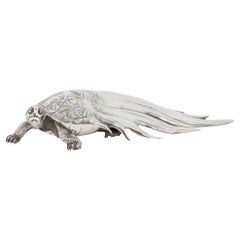
Japanese Antique Silvered Bronze Minogame by Ryūbundō Meiji Period
Located in Newark, England
FREE WORLDWIDE SHIPPING
LEGENDARY JAPANESE MINOGAME
From our Japanese collection, we’re pleased to offer this Meiji period silvered bronze minogame Okimono by Ryūbundō.
Cast in si...
Category
Antique Early 1900s Japanese Meiji Sculptures and Carvings
Materials
Silver, Bronze
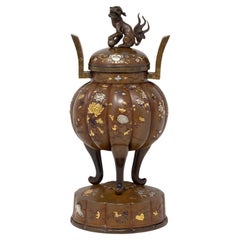
Japanese Bronze and Mixed Metals Koro by Kumagai, Meiji Period
Located in Newark, England
FREE WORLDWIDE SHIPPING
From our Japanese collection, we are pleased to present this Japanese Bronze and Mixed Metals Koro by Kumagai, dating to the Meiji Period (1868–1912).
The ...
Category
Antique Late 19th Century Japanese Meiji Metalwork
Materials
Gold, Silver, Bronze
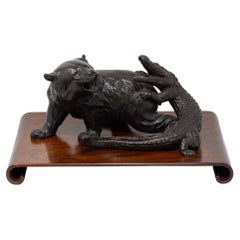
Japanese Meiji Bronze Okimono by Yoshimitsu Depicting a Bear and Alligator
By Saeki Yoshimitsu
Located in Newark, England
FREE WORLDWIDE SHIPPING
A DYNAMIC MEIJI PERIOD BRONZE OKIMONO BY YOSHIMITSU FEATURING A BEAR AND ALLIGATOR IN COMBAT.
From our Japanese collection, we are pleased to present this ...
Category
Antique Late 19th Century Japanese Meiji Animal Sculptures
Materials
Bronze
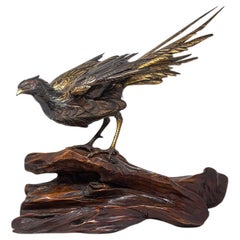
Japanese Bronze Pheasant Okimono Genryusai Seiya
Located in Newark, England
Unusual Casting of a Pheasant in Flight
From our Japanese collection, we are delighted to offer this Japanese bronze okimono of a Pheasant upon a naturalistic root wood base. The Ph...
Category
Antique Late 19th Century Japanese Meiji Sculptures and Carvings
Materials
Bronze
You May Also Like
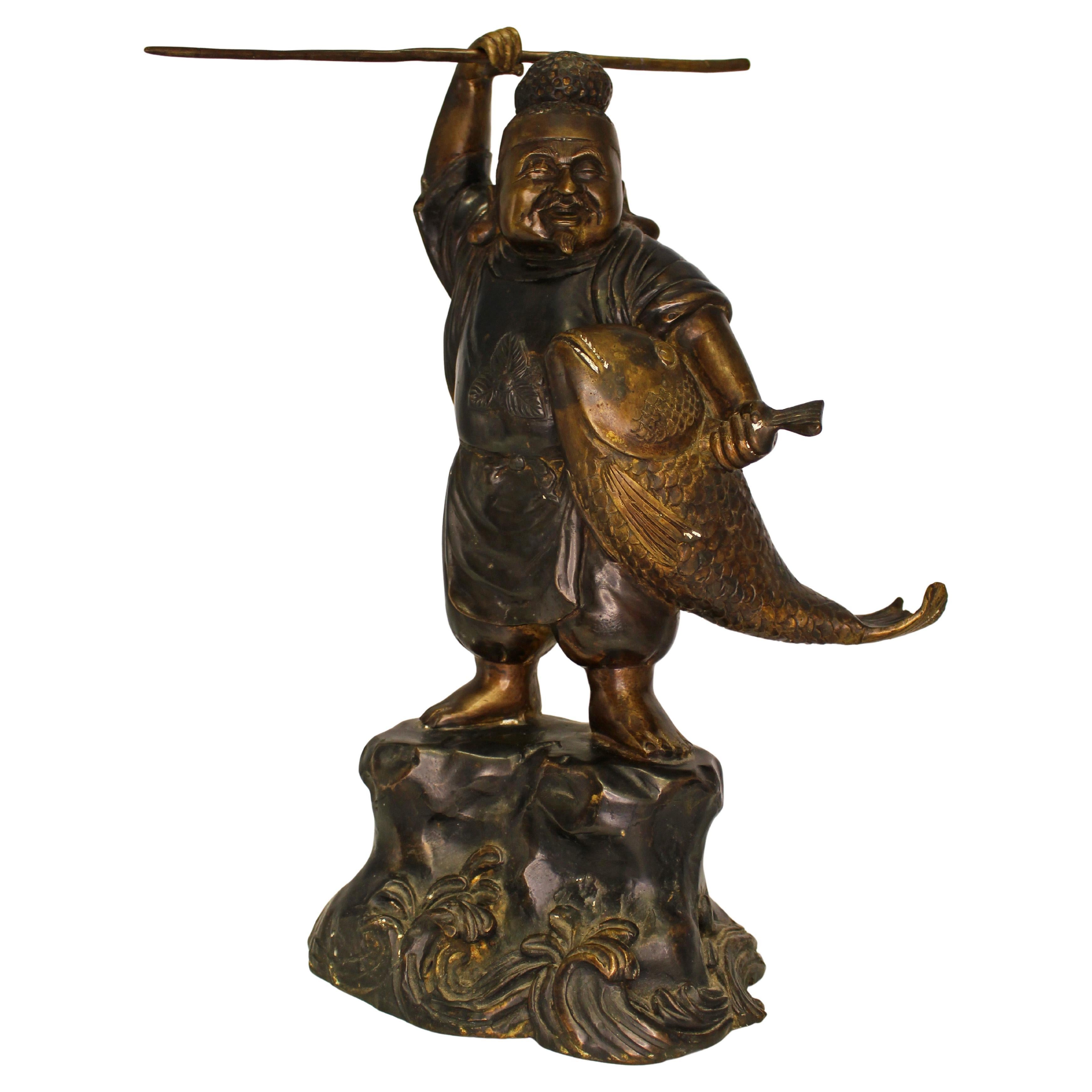
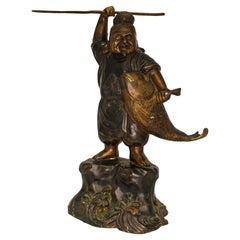
c. 1912-26 Japanese Bronze of Ebisu, God of Luck and Fishermen
Located in Chapel Hill, NC
Japanese bronze of Ebisu, the god of luck, fishermen, and propriety, circa 1912-26. Antique, likely Taisho era. He holds a red sea bream (which symbolizes good fortune and abundance)...
Category
Early 20th Century Japanese Taisho Figurative Sculptures
Materials
Bronze
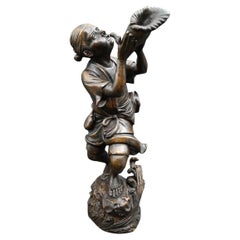
Japanese bronze Okimono , Edo period
Located in Bilzen, BE
Japanese bronze okimono from the Edo period in its old patina and good condition,
Beautiful quality and expression
Height 30 cm, not signed
Category
Antique 18th Century Japanese Edo Sculptures and Carvings
Materials
Bronze
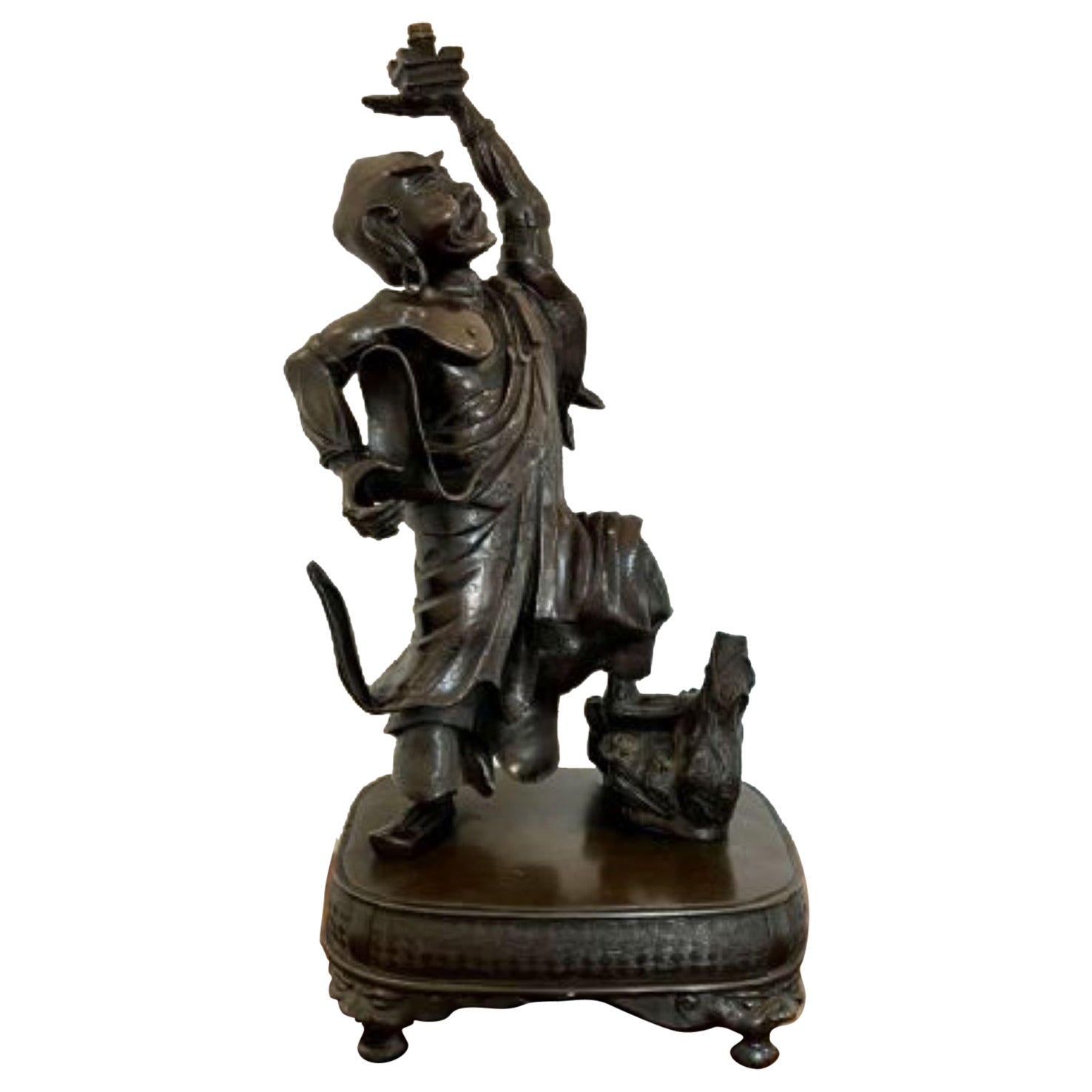
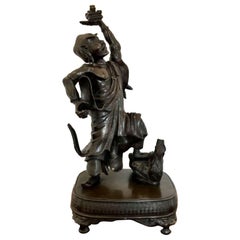
Quality large antique Japanese bronze figure
Located in Ipswich, GB
Quality large antique Japanese bronze figure having a quality large antique Japanese bronze figure of a man holding his left arm aloft standing ...
Category
Antique Early 19th Century Victorian Sculptures and Carvings
Materials
Bronze
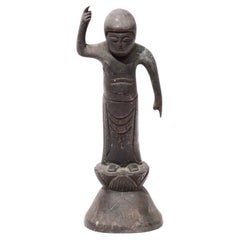
Japanese bronze image of Tanjo no Shaka
Located in Point Richmond, CA
Japanese bronze image of Tanjo no Shaka, the infant Buddha (Shakyamuni), a standing figure with the right hand pointing towards heaven and the left hand pointing toward earth, costum...
Category
Antique 1850s Japanese Edo Metalwork
Materials
Bronze
19th Century Japanese Silver Inlayed Bronze Representing Daikoku
Located in Hudson, NY
From the Estate of Paul & Clara Kellner. This large bronze of Daikoku or the God of Prosperity closely associated with farmers, agriculture and rice staples of Japanese life and stability. His attributes are a co-mingling of Indian Buddhist forms of Shiva and the Shinto God...
Category
Antique Late 19th Century Japanese Sculptures and Carvings
Materials
Silver, Bronze
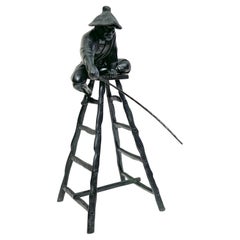
Meiji Bronze Fisherman Okimono, Sealed Masatsune Saku
Located in West Palm Beach, FL
Meiji Bronze Fisherman Okimono, Sealed Masatsune saku
Japan, Meiji period (1868–1912)
A fine and rare Meiji period bronze Okimono of a fisherman by Masatsune Saku, originating from Japan and crafted during the Meiji period (1868–1922). This exquisite piece is a notable example of the Tokyo School's artistry, dating to the late 19th century.
The Okimono depicts a fisherman seated on a four-rung ladder, holding a bamboo fishing rod...
Category
Antique Late 19th Century Japanese Meiji Sculptures and Carvings
Materials
Bronze
$2,360 Sale Price
27% Off